 HIPAA Compliant
 ISO 27001 Certified
Clinical Trial Data Governance: What Advocacy Groups Should Verify Before Endorsing a Study
Patient information now travels further than most study participants expect. A study that closes after twelve months can keep generating information about the people who joined it for years afterward, because the records gathered during the study can be matched against insurance claims, hospital records, pharmacy data, and public death records long after the final visit. That matching is usually accomplished through tokenization, a technical process that converts a person's name and date of birth into a scrambled code. For an advocacy organization asked to promote a study, co-sign a registry partnership, or seat a representative on a community advisory board, the useful question is not whether tokenization is safe in principle. The useful question is whether this sponsor has built the governance around it that makes it safe in practice, which is a separate matter from where study data goes after a trial closes.
What Clinical Trial Data Governance Actually Covers
Data governance is the set of rules, contracts, and oversight structures that determine who can hold participant information, what they are permitted to do with it, how long they may keep it, and who checks that the rules are being followed. Governance sits above the technology. A well-built technical safeguard inside a weak governance structure still exposes participants, and that is the part advocacy organizations are best positioned to interrogate.
Three terms get used interchangeably in sponsor materials, and they do not mean the same thing. De-identification means the direct identifiers have been stripped or obscured so the information no longer counts as protected health information under U.S. privacy rules. Pseudonymization means the identifiers have been swapped for a stand-in code while a key that reverses the swap still exists somewhere. Anonymization means the information has been transformed so that nobody, including the organization holding it, can trace it back to a person. Tokenization is closer to the first two than the third, and readers who want the mechanics in full will find how tokenization actually works covered separately.
A workable way to explain a token to a community audience is a jersey number. The number lets anyone following the game recognize that the same player appeared in three different matches, without the legal name ever being printed on the shirt. It also captures the honest limitation, because a spectator who knows the roster can still work out who wears number nine. Tokens behave the same way. They reliably identify the same person across separate databases while carrying no readable personal detail, and that persistence is exactly what makes them useful and what makes governance necessary.
Why Sponsors Link Trial Data to Outside Records
Sponsors are rarely linking data for its own sake. Several legitimate pressures push study designs in this direction, and advocacy groups negotiate better when they can name them.
Long-term safety follow-up is the most common driver. For certain one-time interventions, particularly gene-based study products, regulators may expect observation stretching over many years and in some cases more than a decade. Keeping study sites open and asking participants to return for visits across that span places a heavy burden on everyone involved. Matching records to routine care data lets that follow-up happen passively, which reduces visits for participants while still meeting the regulatory obligation.
Linked data also supports comparison groups drawn from existing records, which can reduce the number of participants who must be assigned to a placebo group. Sponsors use the same capability to detect duplicate enrollment across sites, to test whether a planned study is feasible in a given region before committing to it, and to meet post-approval safety commitments. Each of those uses can genuinely benefit the communities advocacy groups represent, and each of them widens the number of parties who touch participant information.
Where the Privacy Risk Actually Sits
Research on re-identification has been consistent for decades, and the finding matters more than the technology debate. Stripping names is not a durable safeguard on its own. Landmark work in this field showed that a small combination of ordinary facts, such as a postal code, a date of birth, and a sex marker, can single out a large share of a national population when matched against a publicly available list. Later studies extended the same result to viewing histories, mobility traces, payment records, and genomic data.
The practical risk, then, is rarely that a properly built token gets mathematically reversed. Published evidence for that happening in clinical research is thin. The risk is linkage, sometimes called the mosaic effect: enough attributes travel alongside the token that someone holding a matching outside dataset can narrow a record down to one person. Governance controls, not cryptography, are what hold that risk down.
Two situations deserve extra scrutiny. Small populations are the first. In a rare disease cohort, or any narrow subgroup, so few people share a given combination of characteristics that ordinary de-identification stops working, which is a live concern wherever registry-to-trial pathways are involved. Genetic information is the second. U.S. law restricts genetic discrimination in health insurance and employment, but that protection does not extend to life insurance, disability insurance, or long-term care insurance, and genomic data can also expose relatives who never agreed to anything.
The Questions That Reveal How a Sponsor Handles Data
Most sponsors will answer a general question about privacy with a general reassurance. Specific questions produce specific answers, and the answers are what an advocacy group can actually evaluate. The following questions are grouped by what they test.
Who Holds the Key
- Which organization performs the tokenization, and is it contractually independent from the parties holding the health data?
- Does any single party hold both the identity information and the linked health records?
- Where is the key or crosswalk that could re-link tokens to identities stored, and who can reach it?
- Which de-identification method is being relied on, and will the sponsor share the certification behind it?
Downstream Use and Onward Transfer
- Is re-identification contractually prohibited for every recipient, including recipients who receive the data second-hand?
- Can the linked data be sold, licensed, or transferred to a commercial third party, and under what limits?
- Can the data be used for purposes beyond this study, such as other product programs or commercial analytics?
Retention, Deletion, and Withdrawal
- How long are the tokens and the linked records retained, and is there a firm deletion date?
- If a participant withdraws, does that stop future data collection only, or does it also remove records already merged into other datasets?
- Will the sponsor state plainly, in writing, what withdrawal cannot undo?
Accountability and Community Voice
- What breach notification commitments apply, including for recipients who fall outside federal health privacy rules?
- Are there audit rights allowing an independent party to verify that no re-identification has occurred?
- Does a data governance committee exist, and does it include patient or community representatives with real standing?
- For small or rare disease populations, what specific techniques are applied to prevent identification through very small subgroups?
The withdrawal question is the one most often misunderstood, and it is worth pressing hardest. Once a record has been tokenized and merged into a larger dataset, withdrawal is frequently partial and sometimes not technically possible. A sponsor who says so directly is being straight with the community. A sponsor who implies full reversal is either mistaken or overselling, and the difference shows up in what a consent form should disclose.
How DecenTrialz Approaches Participant Information
DecenTrialz operates at the front end of the participant journey. The platform uses AI-assisted participant matching to identify studies that may fit a person's situation, followed by pre-screening led by registered nurses who talk through what a study would involve before anyone is referred anywhere.
Final eligibility determination, informed consent, the study walk-through, and enrollment always belong to the research site team. That boundary is worth stating explicitly to any community an advocacy group serves, because it clarifies who is accountable for which decision. A recruitment platform can help someone find a study and understand it. A research site, working under its own ethics oversight, decides whether that person can join and obtains their consent.
Advocacy organizations evaluating any recruitment partner can apply the same governance questions listed above. Groups that want to review how the model works before recommending it to their community can start at decentrialz.com.
Frequently Asked Questions
Is tokenized data the same as anonymous data?
These are different things. Tokenized data carries no readable personal detail, which is a real protection, but the token still reliably points to the same individual across datasets. Genuine anonymization removes that ability entirely. Sponsor materials sometimes blur the two, and the distinction is worth correcting whenever an advocacy group encounters it.
Can a token be turned back into a participant's name?
A properly built token is produced through one-way mathematics and is not practically reversible on its own. The realistic concern is different. Someone holding a matching outside dataset may be able to narrow a tokenized record down to one person by combining enough surrounding details, which is why contractual bans on re-identification and audit rights matter as much as the mathematics.
Do participants have to be told their data will be linked to other records?
Consent expectations depend on whether the information is considered identifiable and on the oversight framework governing the study. When identifiable information is involved, consent and ethics review generally apply, and consent documents may need to disclose future research use, commercial possibilities, and genomic sequencing. Advocacy groups should read the consent language directly rather than accepting a summary of it.
Why do sponsors want data linkage in the first place?
The most common reason is long-term safety follow-up that would otherwise require years of in-person visits. Other reasons include building comparison groups so fewer participants receive a placebo, detecting duplicate enrollment, and meeting post-approval safety commitments. These purposes are legitimate, which is precisely why the governance around them needs to be verified rather than assumed.
What should an advocacy group do if a sponsor will not answer these questions?
Silence is information. An organization that cannot say who holds the key, whether the data can be sold, or what withdrawal actually accomplishes is not ready to be endorsed to a patient community. Withholding endorsement until the answers arrive is a legitimate and constructive position, and it tends to produce better documentation for every group that asks afterward.
Turning Questions Into Conditions
Advocacy organizations carry a specific kind of leverage in clinical research. Sponsors want community trust and community reach, and that gives advocacy groups standing to set conditions rather than simply receive assurances. The questions in this article are most effective when they are treated as prerequisites for endorsement, documented in writing, and revisited when a study design changes.
The goal is not to slow research down. Communities benefit when studies run well and when the information they contribute continues to produce knowledge. That benefit holds only when participants understand where their information goes and when someone independent is empowered to check. Advocacy groups that want to see how a recruitment platform documents its own scope and handoffs can review the process at decentrialz.com.
Was this article helpful?

Similar Blogs
Decentralized Clinical Trials: an advocacy checklist for digital inclusion
Decentralized clinical trials are being promoted as a way to bring research to the partici...
 Vamshi Kantoju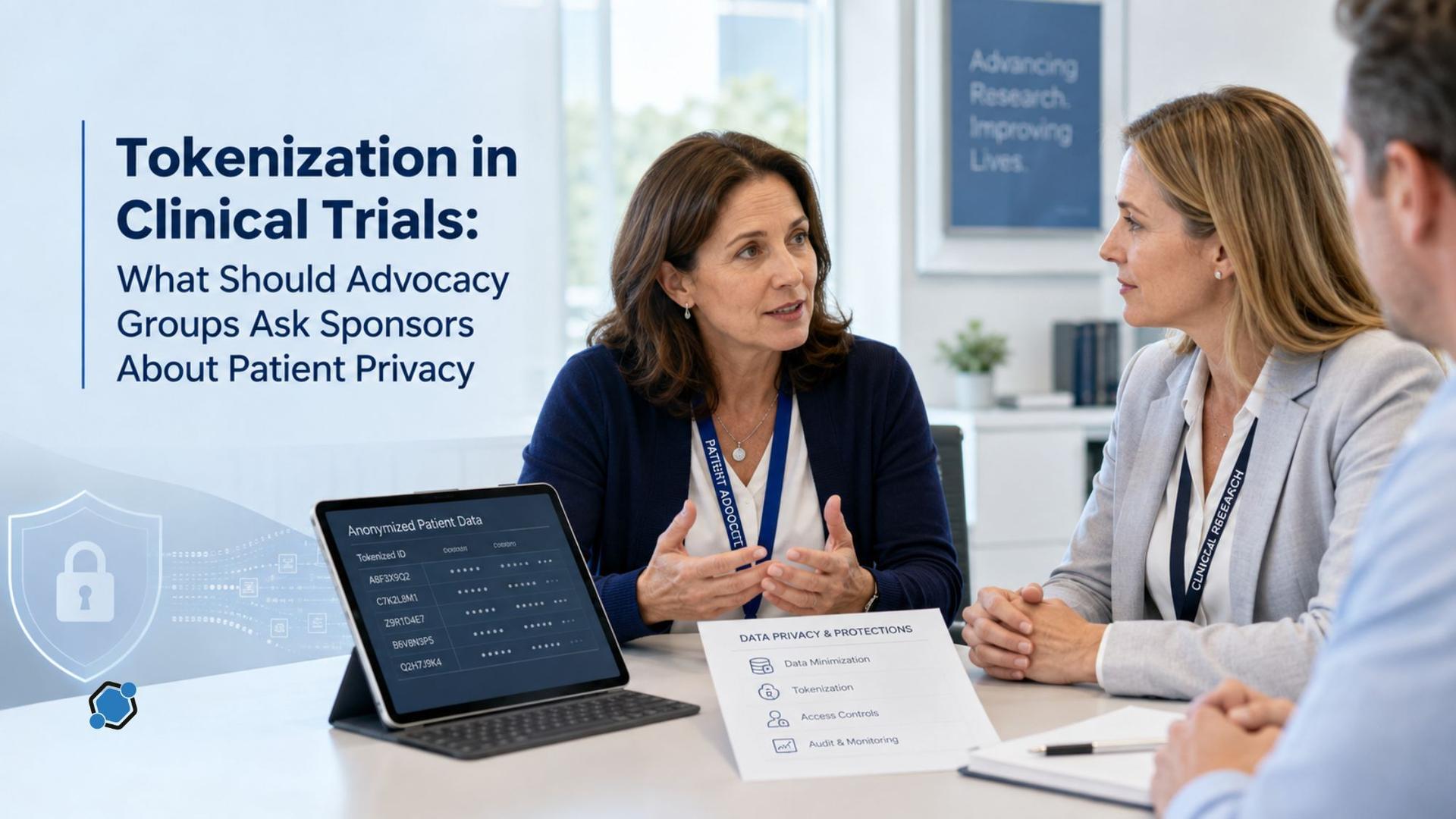
Tokenization in Clinical Trials: What Should Advocacy Groups Ask Sponsors About Patient Privacy
Tokenization has become one of the most widely adopted data techniques in modern clinical ...
Mahesh Upadrista
How advocacy groups turn patient registries into clinical trials
For most rare and chronic disease communities, the biggest obstacle to research is not sci...
Deeksha GittaStay Informed. Stay Connected.
Get updates on verified clinical trials, emerging treatments, and research breakthroughs directly in your inbox. No spam, just science that matters.
