 HIPAA Compliant
 ISO 27001 Certified
How advocacy groups turn patient registries into clinical trials
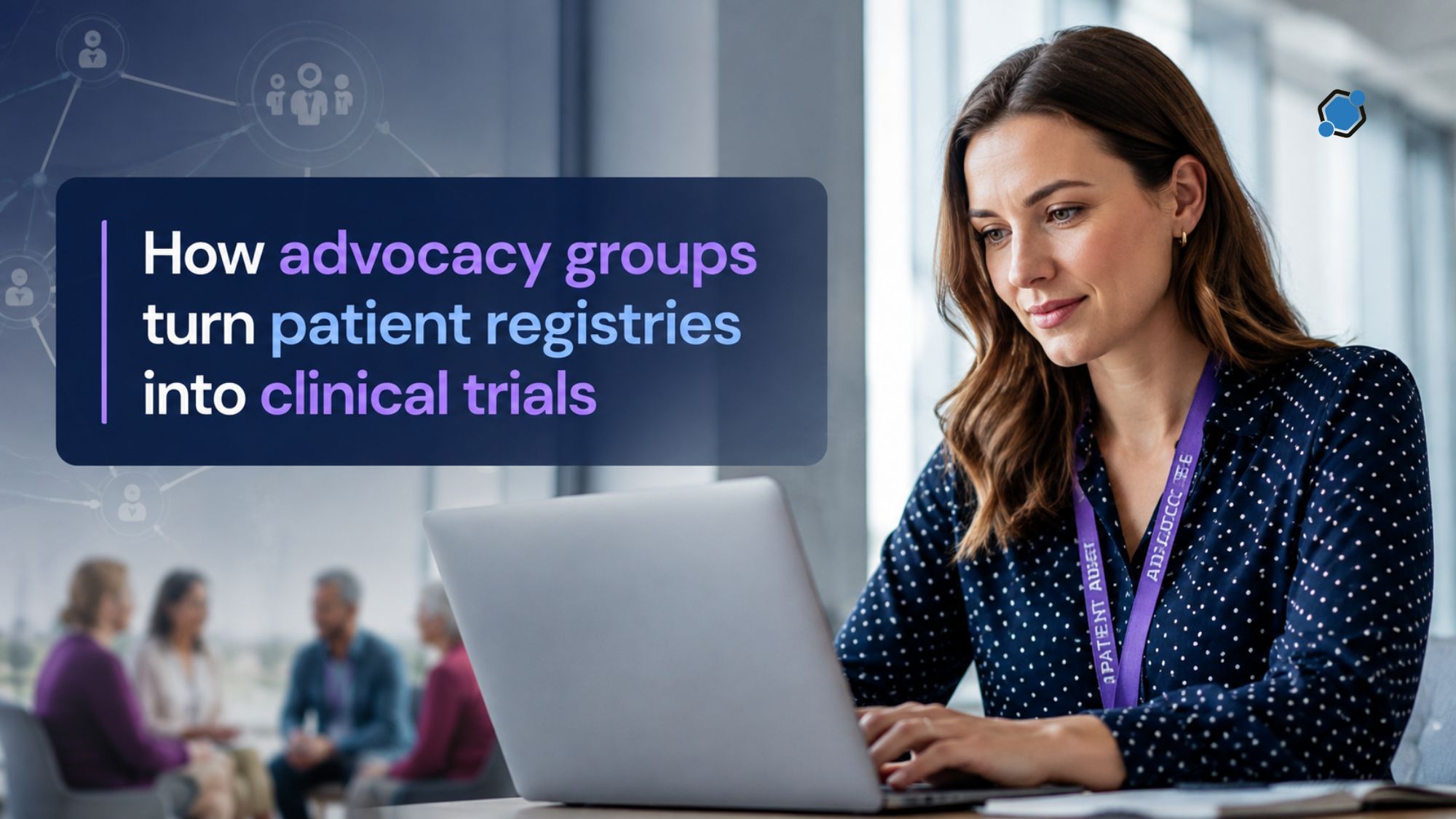
For most rare and chronic disease communities, the biggest obstacle to research is not scientific. It is finding enough patients, quickly, with the right clinical profile, at the right moment. Advocacy groups sit closer to those patients than any sponsor, contract research organization, or research site. That proximity gives advocacy groups a rare kind of power in clinical research, but only if the community's data is organized in a way that studies can actually use. That is where a patient registry becomes something more.
What a patient registry actually is
A patient registry is an organized system for collecting standardized information about people who share a diagnosis, a genetic variant, or an exposure. Regulators define it as a structured way to collect uniform data over time for a defined population. In practice, a registry can range from a simple contact list of people who want to hear about research to a highly detailed longitudinal record of symptoms, laboratory results, and outcomes.
An advocacy-led registry usually starts small. A group opens a signup form and asks community members to share their diagnosis, demographics, and contact preferences. Over time, that same registry may add periodic questionnaires, connect to biospecimens, or link to a natural history study. A natural history study is closely related: it uses registry-style data to characterize how a disease progresses when no study intervention is involved. Both serve as foundational research infrastructure, and both are frequently built by advocacy groups because no other stakeholder has the community reach to do it well.
The gap between a mailing list and a research-ready cohort
Not every registry can support a clinical trial. The distance between a list of names and a research-ready cohort is significant, and understanding that distance matters for any advocacy group planning to invest in registry infrastructure.
A mailing list can share news and event invitations. A research-ready cohort can do more. It uses standardized data fields so information about one person can be compared to another. It follows registrants over time rather than capturing a single snapshot. It uses validated instruments to measure symptoms and quality of life. It captures consent that permits future research contact and, where appropriate, secondary use of data. Some also include genetic testing results or link to stored biospecimens.
When those elements are in place, the registry can identify patients who match the eligibility criteria of a specific study, characterize the underlying disease course to inform trial design, and support faster referrals into enrolling sites. Advocacy groups that already run a registry-to-referral workflow know how much closer that structured data brings the community to real research participation.
Why advocacy groups are positioned to build these cohorts
Sponsors and research sites have neither the community trust nor the sustained relationships to build a research-ready cohort at scale. Advocacy groups do. Community members often engage with an advocacy organization long before they consider joining a study. That relationship, built over years, is exactly what makes a longitudinal registry possible.
For rare diseases, the case is even stronger. When prevalence is measured in the hundreds or low thousands, no single research site can enroll a study alone. An advocacy-led registry can pull scattered patients into one organized cohort that a sponsor or contract research organization can actually work with. This is one reason advocacy partnerships have become central to rare disease recruitment strategy: the advocacy group is often the only stakeholder with a defensible line into the community.
Beyond rare disease, advocacy groups also bring an equity advantage. Community-facing organizations can reach populations that research has historically missed, which improves both the scientific quality of a study and its relevance to the people who need the answers.
Consent that lets a registry support future research
Consent is often the single most important design decision in a registry. A registrant who agreed only to receive newsletters cannot be contacted about a specific clinical trial without going back for fresh permission. A registrant who consented to broad future research contact can be matched to studies as they emerge.
Advocacy groups planning a research-ready cohort should design consent from day one to cover future research contact, secondary use of de-identified data for scientific analysis, and clear participant rights around withdrawal and data deletion. Institutional review board approval is essential for any registry that intends to support research use.
The consent process itself should be plain-language, participant-friendly, and revisitable. Consent is not a one-time transaction. As registry uses expand, or as regulations change, re-consent may be required to keep the registry aligned with current expectations. Groups that build this into their operating rhythm avoid painful workarounds later.
Data standards that make registry information usable
A registry with beautifully collected data that no one else can read is a wasted asset. To become genuinely useful across studies, sponsors, and academic collaborators, registry data needs to follow recognized standards.
Common data elements are the starting point. These are pre-defined, controlled data fields that let one registry speak the same language as another. Health authorities and rare disease research networks have published lists of common data elements that advocacy groups can adopt directly rather than inventing their own. Interoperability standards, which govern how data moves between clinical systems, matter too. When registry data can flow into and out of electronic health records and study platforms, the registry becomes far more valuable to sponsors and far easier to sustain.
Data quality control is the other half of the picture. Audit trails, validation rules, and periodic review protect the registry's credibility. Groups that invest in standards and quality early have the best chance of seeing their data accepted as evidence and used to match community members to relevant clinical trials.
Choosing a registry platform without losing ownership
Registry platforms range from cooperative advocacy-focused systems, to academic software licensed to nonprofits, to fully custom builds. Each option carries cost, control, and sustainability tradeoffs, and none is universally right for every community.
The single question that should sit above every other consideration is data ownership. Who owns the raw data if the platform vendor is acquired, changes pricing, or shuts down? Who can share the data with sponsors or researchers, and on what terms? Some advocacy groups have discovered too late that the platform housing their community data holds more rights over it than they do. That answer belongs in a signed agreement, not on a marketing page.
Adjacent questions matter almost as much: how the platform handles patient privacy, whether the consent framework is flexible, whether the platform can support the standards adopted for interoperability, and whether the group can export its full dataset at any time. The same evaluation logic applies to any external partner brought in to help match registrants to trials. Groups that apply the same discipline used when choosing a patient recruitment platform tend to avoid the most common pitfalls in registry-to-trial partnerships.
How DecenTrialz works with advocacy-led registries
DecenTrialz supports advocacy groups that want to turn a research-ready registry into real clinical trial referrals without losing control of the community data behind it. The platform matches potential participants to relevant studies using AI-assisted matching against current trial eligibility criteria, and a registered nurse pre-screens interested community members to confirm fit before referral.
The registered nurse pre-screens only. Final eligibility determination, informed consent, study walk-through, and enrollment always belong to the research site team.
For an advocacy group, this means the community keeps its trusted relationship with the organization while gaining a structured pathway into research. The registry stays under the group's stewardship. The clinical judgment stays with qualified nursing staff. And the final study decisions stay with the research site, where they belong.
Turn your registry into a research engine
A patient registry is one of the most valuable assets an advocacy group can build. Structured, standardized, and consent-ready, it can move a community from waiting for research to actively driving it. The right partners can extend that reach further, matching registrants to trials at the moment a fit exists rather than months later.
Advocacy groups exploring how to translate registry infrastructure into real trial referrals can learn more about the DecenTrialz platform at decentrialz.com.
Was this article helpful?

Similar Blogs

Clinical Trial Data Governance: What Advocacy Groups Should Verify Before Endorsing a Study
Patient information now travels further than most study participants expect. A study that ...
 Swaroop ESD
Tokenization in Clinical Trials: What Should Advocacy Groups Ask Sponsors About Patient Privacy
Tokenization has become one of the most widely adopted data techniques in modern clinical ...
Mahesh Upadrista
The Diversity Action Plan debate, explained for advocacy groups
A federal rule that was supposed to make clinical trials more representative of the people...
Swaroop ESDStay Informed. Stay Connected.
Get updates on verified clinical trials, emerging treatments, and research breakthroughs directly in your inbox. No spam, just science that matters.
