 HIPAA Compliant
 ISO 27001 Certified
Tokenization in Clinical Trials: What Should Advocacy Groups Ask Sponsors About Patient Privacy
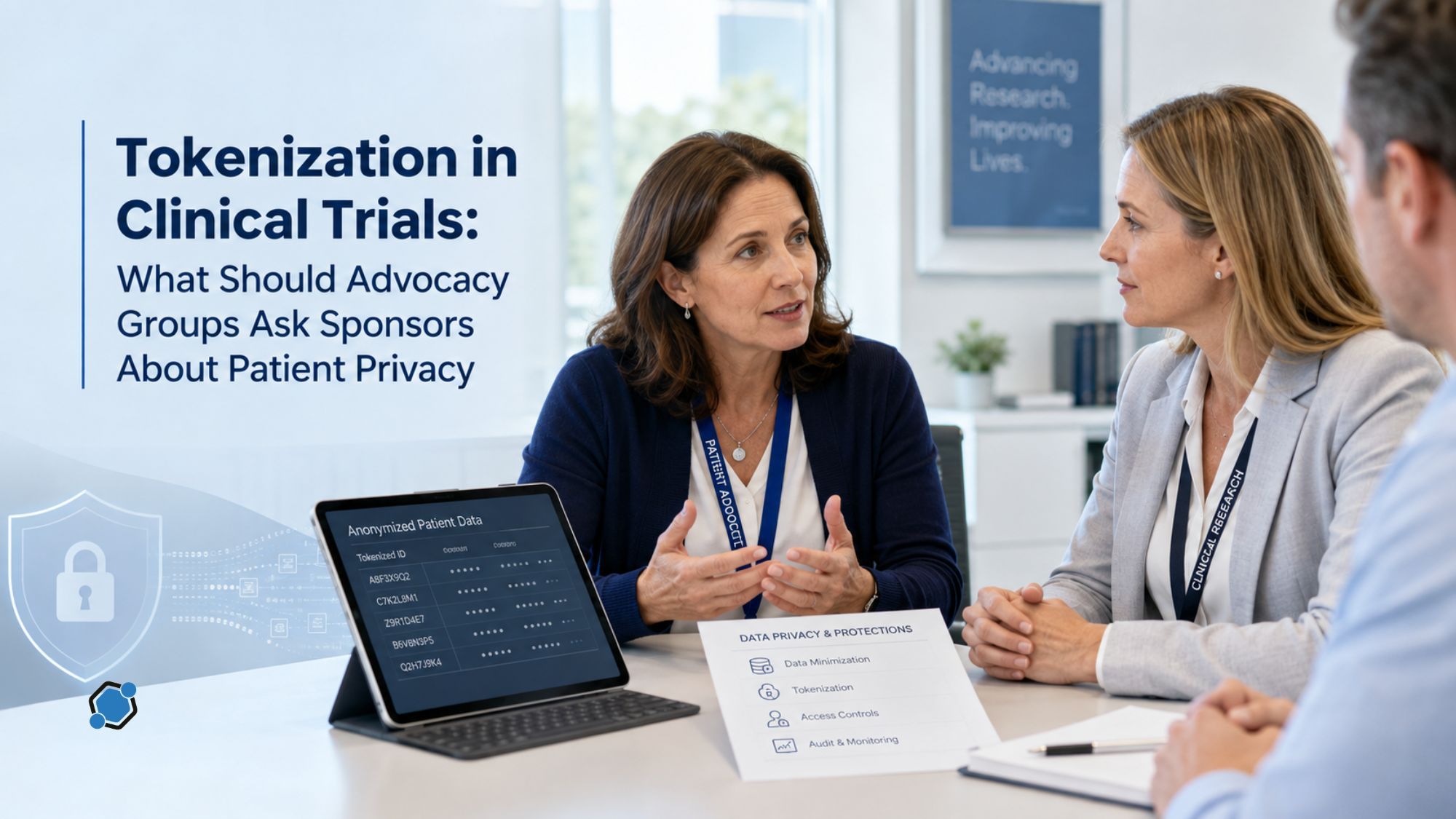
Tokenization has become one of the most widely adopted data techniques in modern clinical research, and one of the least understood outside of technical teams. Sponsors use it to connect trial data to a participant's outside health records without directly sharing that person's name. For advocacy groups asked to endorse studies, recruit through registries, or advise communities on participation, the technique raises a set of specific and answerable questions.
This article explains what tokenization actually is in the clinical trial context, why sponsors are relying on it more heavily, where the real privacy risks sit, and the concrete questions advocacy leaders should put to sponsors before lending their name or their community to a study.
What tokenization actually is in a clinical trial
Tokenization is a form of privacy-preserving record linkage. In practice, a participant's direct identifiers, typically first name, last name, date of birth, gender, and ZIP code, are converted through a one-way cryptographic process into a coded string called a token. Because the process is one-way, the token cannot be mathematically reversed back into the original identifiers. The same person's records receive the same token across different databases, which lets a sponsor connect trial data to that participant's electronic health records, pharmacy history, insurance claims, and even mortality files, without the sponsor ever seeing the person's name.
This is where the language often confuses non-technical audiences. Tokenization is a form of pseudonymization, meaning the underlying identity can, in principle, be re-linked under controlled conditions. It is not the same as de-identification, which is a legal standard under the Health Insurance Portability and Accountability Act, known as HIPAA. Under HIPAA, health data is de-identified only when it meets one of two standards: Safe Harbor, which requires the removal of eighteen specific identifiers, or Expert Determination, in which a qualified statistician certifies that the risk of re-identification is very small. Tokenization is usually a step in that process, not a substitute for it. Anonymization goes further still and means that re-identification is effectively impossible, a bar that is rarely truly achieved in real datasets.
Why sponsors are relying on tokenization more than ever
Sponsors have practical reasons to adopt tokenization, and some of them genuinely benefit participants. Linking a trial record to a person's real-world data allows sponsors to enrich baseline information, follow safety outcomes after the trial ends without repeated in-person visits, and support post-market surveillance once a therapy is approved. This is often called passive long-term follow-up, and it can meaningfully reduce the burden on participants who would otherwise return to a research site for years after their active participation ends.
The regulatory backdrop is shifting in favor of these uses. The Food and Drug Administration, or FDA, has been steadily expanding the role of real-world data and real-world evidence in regulatory submissions, following the mandate set by the 21st Century Cures Act. In December 2025, the agency announced that it will accept real-world evidence for certain medical device submissions without always requiring identifiable individual patient-level data, which further opens the door to large linked databases. The broader trajectory is covered in the role of real-world data in decentralized clinical trials, and it helps explain why sponsors are increasingly building tokenization into study designs from the start rather than treating it as an add-on.
The privacy risks advocacy groups should take seriously
The single most important point for advocacy leaders to internalize is this: tokenization by itself does not make data anonymous. A 2025 peer-reviewed study in the Journal of the American Medical Informatics Association quantified the residual risk and found that commonly used tokenization schemes carry a re-identification rate that rises from under one percent for datasets of under one million individuals to roughly ten to twenty percent for datasets of 250 million individuals. Risk increases with dataset size, with the number of tokens attached to each patient, and with the amount of demographic information shared alongside the tokens. The same authors also showed that these risks are largely avoidable when a sponsor uses well-designed tokens and routes the matching through an independent third party that never sees the underlying demographics.
Beyond re-identification, three concerns deserve direct attention. The first is secondary use. Once trial data is tokenized and linked to commercial datasets, it can flow into analytic uses that were not clearly explained in the original consent form. The second is the data broker ecosystem. The Federal Trade Commission has taken enforcement actions against several data brokers for handling sensitive location information that could track people to medical clinics, and much of that ecosystem sits outside HIPAA's reach entirely. The third is retention. Tokenized links to a participant's real-world data can, in principle, persist indefinitely, long after the trial itself has closed. For a fuller treatment of the broader data-protection landscape, see patient privacy in the digital age: safeguarding data in research.
The questions every advocacy group should put to sponsors
Advocacy groups occupy a position that neither individual participants nor regulators can fully replicate. They are trusted community intermediaries, they have standing to ask uncomfortable questions, and they often shape whether underrepresented populations engage with a study at all. The following questions are specific, answerable, and appropriate to raise with any sponsor whose study involves tokenization.
- What data fields build the token, and which downstream datasets will the tokenized trial record be linked to?
- Who holds the token key, and is matching performed by an independent third party that does not see participant demographics?
- Is tokenization described in the informed consent form in plain language, with specific and potential future uses named?
- Can a participant decline tokenization and still enroll in and remain in the trial without penalty to their care or participation?
- Which third parties, including commercial data vendors, will have access to the tokenized data, and for what purposes?
- How long will tokenized and linked data be retained, and is there a defined deletion pathway if a participant withdraws?
- What safeguards against re-identification are in place, including an Expert Determination on the linked dataset and demographic minimization?
- How are data breaches handled, and does the sponsor treat tokenized data with the same safeguards it applies to protected health information?
- Has the sponsor built patient or community advisory input into decisions about tokenization design and consent language?
A separable, plain-language opt-in, independent third-party matching, an Expert Determination on the linked dataset, and defined retention limits together represent a supportable design. Bundled or mandatory tokenization, undisclosed third parties, indefinite retention, or linkage to sensitive categories such as reproductive health, behavioral health, immigration status, or genetic data without additional safeguards are signals to withhold endorsement pending changes. The broader case for structured advocacy involvement in study review is developed in why patient advocacy groups matter in decentralized clinical research.
Trust, transparency, and the community role
Underrepresented communities have historically grounded reasons for caution around medical research, and those reasons interact directly with how tokenization is implemented. Handled transparently, tokenization can reduce participant burden and support inclusion in the long-term evidence base. Handled opaquely, it can deepen existing distrust and discourage the very participation that would make research more representative. Research on record linkage has also shown that matching accuracy can vary by ethnicity and naming conventions, which raises fairness questions about who ends up well-represented in linked datasets and who does not. The broader case for open information practices is set out in transparency in clinical research: why trial information access matters.
Where DecenTrialz fits
DecenTrialz is a U.S.-based clinical trial recruitment and pre-screening platform that uses AI-assisted matching and registered nurse-led pre-screening to help potential participants find studies that may fit their situation. The platform operates in the early stages of the participant journey, before enrollment. Final eligibility determination, informed consent, study walk-through, and enrollment are owned by the authorized research site and study team, which is also where tokenization consent decisions are actually executed.
For advocacy groups working with communities considering trial participation, DecenTrialz provides a starting point for identifying relevant studies while leaving the substantive medical and consent conversations with the research site. Advocates can direct community members to explore study options at DecenTrialz and encourage them to bring the tokenization questions in this article to the site team during the consent discussion.
Frequently asked questions
Does tokenization mean the sponsor cannot identify a participant?
Not exactly. The sponsor typically does not see the participant's name, but tokenized data remains pseudonymized rather than anonymous. An authorized party, or one with the right additional data, could potentially re-link it. Tokenization is safer than sharing raw identifiers, but it is not invisibility.
Can a participant join a trial without agreeing to tokenization?
In well-designed studies, yes. Tokenization should be an optional add-on, and declining it should not affect enrollment or care. Advocates should confirm this is true for any specific study before recommending participation.
What happens if a participant changes their mind after the trial begins?
A participant can usually withdraw consent for future linkage, but data already linked before withdrawal generally remains linked. The specifics vary by study, so participants should ask the site team exactly how withdrawal works in practice.
Could tokenized trial data end up with data brokers?
Tokenized data is designed to be linked to commercial datasets such as claims and pharmacy data. Whether it can be shared further depends on the consent language and the sponsor's contracts, which is precisely why advocacy groups should ask about third-party access and secondary use.
Is tokenization actually regulated?
Partially. HIPAA governs the standards for de-identification of protected health information, and FDA guidance governs how real-world evidence is used in regulatory submissions. Once data is properly de-identified, however, it can move beyond HIPAA protection, and much of the data broker ecosystem operates outside HIPAA entirely, which is why the Federal Trade Commission has been the primary enforcer in that space.
A path forward for advocacy leaders
Tokenization is not going away, and it should not have to. Used well, it can reduce participant burden, support long-term safety evidence, and expand what the research community learns from every trial. Used poorly or opaquely, it can quietly erode the trust that makes participation possible in the first place. Advocacy groups do not need to become cryptographers to hold sponsors accountable. They need to ask specific questions, expect specific answers, and be willing to withhold endorsement when the answers do not add up. That is the advocacy role that tokenization now requires.
Was this article helpful?

Similar Blogs
Decentralized Clinical Trials: an advocacy checklist for digital inclusion
Decentralized clinical trials are being promoted as a way to bring research to the partici...
 Vamshi Kantoju
Clinical Trial Data Governance: What Advocacy Groups Should Verify Before Endorsing a Study
Patient information now travels further than most study participants expect. A study that ...
Swaroop ESD
How advocacy groups turn patient registries into clinical trials
For most rare and chronic disease communities, the biggest obstacle to research is not sci...
Deeksha GittaStay Informed. Stay Connected.
Get updates on verified clinical trials, emerging treatments, and research breakthroughs directly in your inbox. No spam, just science that matters.
