 HIPAA Compliant
 ISO 27001 Certified
Synthetic control arms and placebos: what advocacy groups can teach their communities
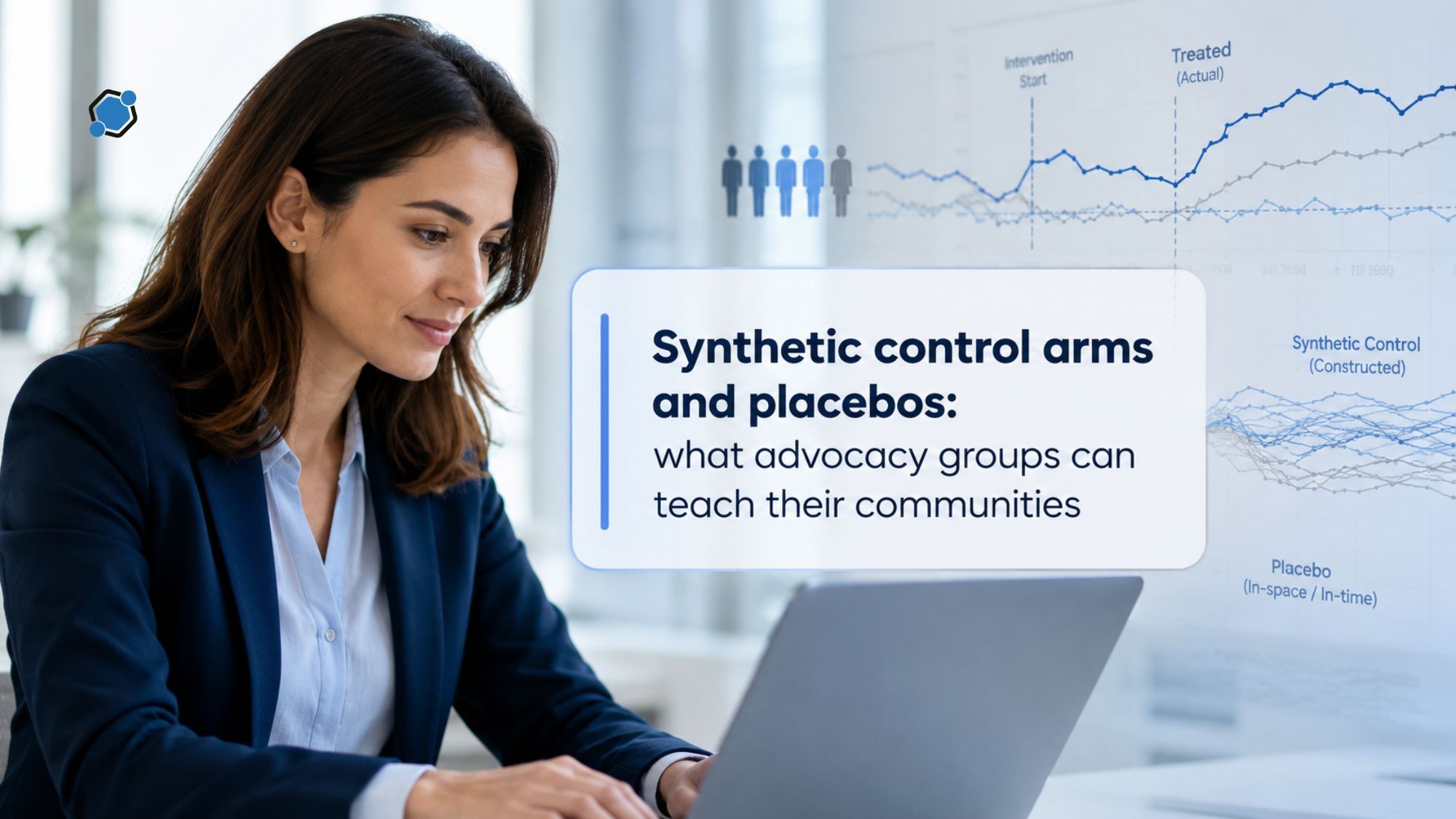
Placebo fear is one of the most common reasons people turn down a clinical trial. Community members hear the word and picture a sugar pill instead of care, or worry that joining a study means becoming a test subject with nothing in return. That fear rests on a mix of real ethical history and modern misunderstanding, and it sits directly in the space where advocacy groups can help. A newer trial design, the synthetic control arm, is also changing what a comparison group can look like, which shifts the placebo conversation in some studies. This piece walks through what these terms actually mean, why the ethics matter, and how advocacy groups can turn plain-language education into stronger trust with the communities they serve.
What a synthetic control arm actually is
A synthetic control arm, more formally called an external control arm, is a comparison group built from patient data that already exists rather than from participants enrolled at the same time as the people receiving the study drug. The data can come from earlier clinical trials, disease registries, electronic health records (the digital charts kept during routine care), insurance claims, and natural history studies (research that tracks how a condition progresses over time without a new intervention). Analysts clean and standardize these records and then match them, person by person, to the participants receiving the investigational product, so the two groups look as similar as possible.
The core difference from a traditional randomized control arm is randomization. In a randomized trial, a computer randomly assigns each participant either to the study drug or to a control group receiving a placebo, standard care, or no intervention, which balances both known and unknown differences. A synthetic control skips shared randomization, so statistical matching has to do the work randomization normally does. That approach opens new possibilities, and it also introduces bias risk when the two groups do not truly match.
For a deeper look at where the underlying data comes from, see what is a natural history study, and how researchers learn about a disease before treating it.
Why placebos are still used, and where the ethics draw the line
A placebo is an inactive substance or procedure designed to look like the study drug but containing no active ingredient. Researchers use placebos for three reasons: to support blinding (keeping participants, and often the research team, unaware of who is receiving what, so expectations do not skew the results), to control for the placebo effect and the natural rise and fall of a condition, and to establish whether the study drug actually works.
The placebo effect is real and measurable, not imaginary. Documented responses appear in conditions ranging from pain to depression to Parkinson's disease, and neuroimaging shows genuine biological activity behind them. Without a placebo comparison, the true effect of a study drug cannot be separated from those responses or from the natural course of the condition.
Ethics frameworks, including the Declaration of Helsinki and international guidance adopted by the U.S. government, restrict placebo use when an effective option that prevents death or serious harm already exists. In those settings, an active-controlled design (comparing the study drug against an existing effective option) or an add-on design (where everyone continues standard care and the study drug or placebo is layered on top) is preferred. Rescue therapy provisions let the site step in if a participant worsens. The idea that a placebo-controlled trial means going without any care is, in most modern serious-illness settings, no longer accurate.
For a plain-language walkthrough of how blinding shapes the participant experience, see open-label vs blinded clinical trials: what the difference means for participants.
Where the sugar pill and guinea pig fears come from
Two fears show up again and again in community conversations: the sugar pill fear (that participants will be assigned to placebo and left without care) and the guinea pig fear (that trial participation means being experimented on with no benefit). Both fears have real historical roots. Research abuses, uneven access, and periods of poor communication with communities gave these worries a place to live. Modern research ethics were built in direct response to that history, and yet the fears have outlasted the changes.
The system, not the community, is responsible for closing that gap. Consent forms remain long and difficult to read, plain-language education about randomization and blinding is inconsistent, and community outreach often arrives after a study is designed rather than during the design phase. Advocacy groups sit in a position no sponsor or research site occupies. They already carry community trust, they already speak the community's language, and they can translate research vocabulary into terms that meet people where they are.
Building on that trusted position is the practical work of advocacy, described in more depth in how patient advocacy groups guide their community to clinical trials.
How synthetic control arms change the placebo conversation
Because a synthetic control arm draws its comparison from existing data, some trials can offer every enrolled participant the investigational product while still producing a rigorous comparison. That does not eliminate placebos across research, and it does not fit every study. It does mean that in certain designs, especially where randomizing people to placebo would be impractical or ethically troubling, the comparison group can now come from data rather than from newly enrolled participants.
The clearest use cases are in rare disease research, pediatric research, and some oncology settings. In a rare condition affecting only a few thousand people worldwide, assembling a placebo group can be nearly impossible, and in a serious, progressive illness, assigning participants to no active option can be ethically unacceptable. Synthetic controls drawn from natural history data or prior studies have supported approvals in exactly those settings. In pediatric research, families often decline studies that would randomize children to placebo for a serious condition, and external controls open the door to trial designs that would otherwise stall. In oncology, active-controlled and add-on designs already limit placebo exposure, and external controls extend that logic further.
The rare disease example is a useful anchor here, and hope in research: how clinical trials are transforming rare disease treatment explains why these designs matter to families with limited options.
What informed consent should tell participants about control arms
Informed consent is the process, led by the research site team, in which a person learns what a study involves before deciding to join. For any trial with a control arm, the consent conversation and the consent form should state clearly whether the study is randomized, what the odds of assignment are, whether a placebo is involved, whether standard care continues, and what happens if the participant's condition worsens. When a synthetic control arm is used, the consent conversation should also explain that the comparison is coming from existing data rather than from another group of participants in the same study.
A short list of questions helps community members turn a vague worry into an informed decision. Is the study randomized, and what are the odds of receiving the study drug versus a control? Is a placebo used, and if so, will standard care continue? Is there rescue therapy if the condition worsens? Can current medications continue? What data source is the comparison group built from, and how were participants matched? The site team should be able to answer each of these clearly, and if a community member cannot get clear answers, that itself is useful information.
A practical companion for community members walking into consent is how to read your informed consent form before joining a clinical trial.
Diverse data, diverse controls: the equity question underneath
A quieter concern sits underneath synthetic control arms. If the real-world datasets used to build them underrepresent certain communities, the comparison may not reflect the people most affected by the disease being studied. Electronic health records and claims databases carry forward the same access gaps that shape care in the first place. A synthetic control built from a dataset that missed a community will, in effect, keep missing that community.
This is direct advocacy territory. Pushing sponsors and research sites to explain what data source their external control is built from, whether the community is represented in that source, and what steps are being taken to close any gap, moves the conversation from acceptance to accountability. Supporting registries that reflect the community, and encouraging community members to contribute data through consented channels, feeds a stronger pipeline for future studies.
Diversity in the comparison group is a subset of a broader pipeline question, and how sponsors build a diverse enrollment pipeline without slowing the study lays out where those decisions get made.
How DecenTrialz supports advocacy groups and their communities
DecenTrialz is a clinical trial participant recruitment platform based in the United States. The platform uses AI-assisted matching to connect community members with studies whose eligibility criteria fit their situation, and a registered nurse completes an initial pre-screening review before any referral is sent forward. Final eligibility determination, informed consent, the study walk-through, and enrollment decisions always belong to the research site team.
For advocacy groups, that division of work removes a common friction point. Community members can share information through a channel that has already done the first pass, which means the referral that reaches the site is more likely to fit the study. Advocacy groups keep their trusted role as the educator and the connector, and the technical and clinical filtering happens before anyone is asked to travel for a screening visit. Community members who want to explore a study can start by sharing information at decentrialz.com.
Bringing clearer trial education to the communities you serve
The vocabulary of clinical research, synthetic control arms, placebos, randomization, blinding, rescue therapy, is not going to shrink. Advocacy groups that turn those words into plain-language explanations, pair them with the right questions to ask the site team, and press for representative data in the comparison groups behind studies are doing work that no sponsor or site can replicate. That work builds trust, and trust is what turns awareness into informed participation.
Community members ready to explore whether a current study fits their situation can share information at decentrialz.com, receive a registered nurse pre-screening review, and be referred forward to a research site if a match is found.
Was this article helpful?

Similar Blogs

Clinical Trial Data Governance: What Advocacy Groups Should Verify Before Endorsing a Study
Patient information now travels further than most study participants expect. A study that ...
 Swaroop ESD
Tokenization in Clinical Trials: What Should Advocacy Groups Ask Sponsors About Patient Privacy
Tokenization has become one of the most widely adopted data techniques in modern clinical ...
Mahesh Upadrista
How advocacy groups turn patient registries into clinical trials
For most rare and chronic disease communities, the biggest obstacle to research is not sci...
Deeksha GittaStay Informed. Stay Connected.
Get updates on verified clinical trials, emerging treatments, and research breakthroughs directly in your inbox. No spam, just science that matters.
