 HIPAA Compliant
 ISO 27001 Certified
Health Unit Coordinator Day: the behind-the-scenes team that helps clinical trials run
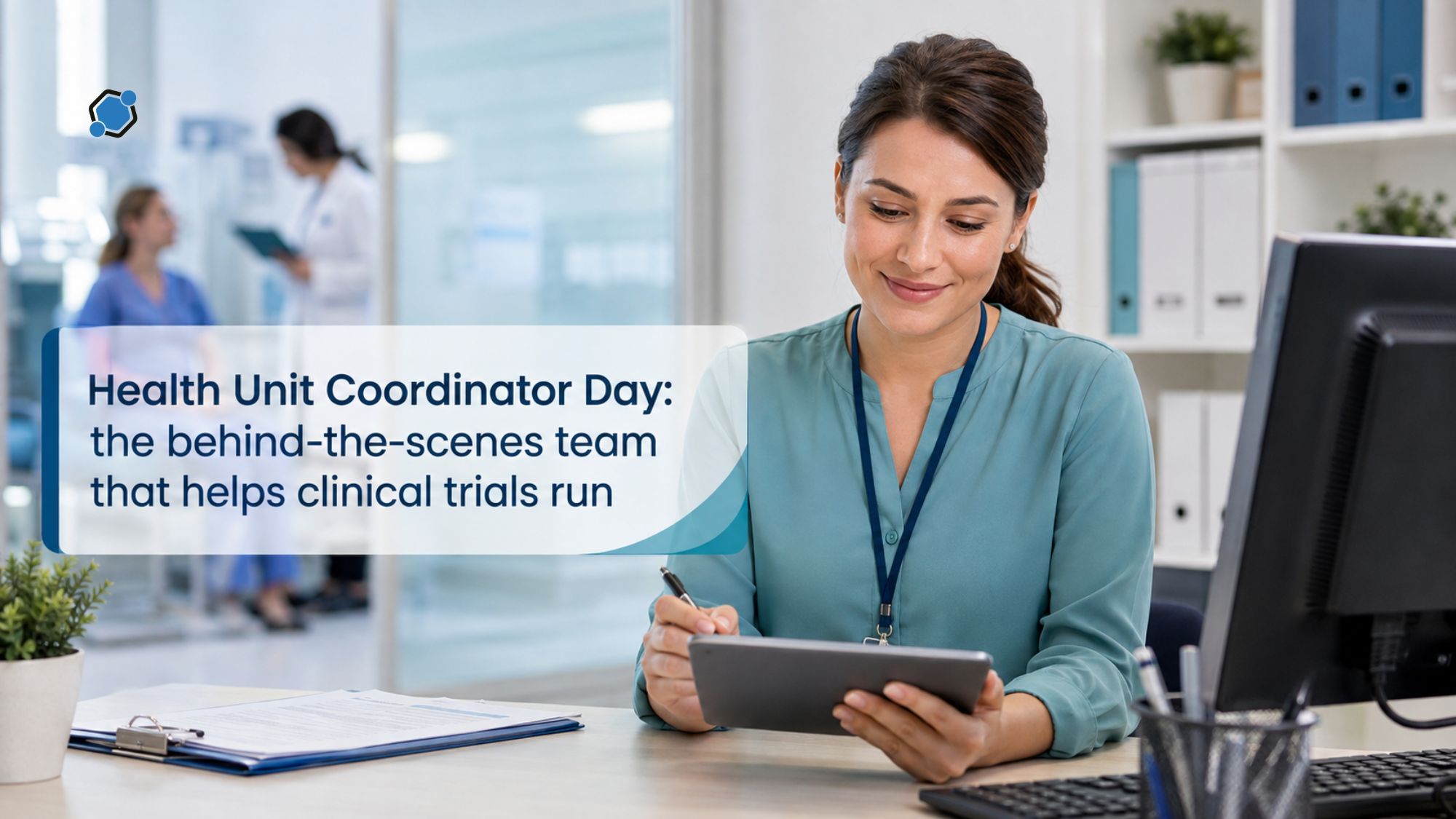
Every August 23, the United States recognizes Health Unit Coordinator Day. The date honors the professionals who sit at the busiest desk on a hospital floor, coordinating the flow of information among physicians, nurses, patients, families, and every department the unit depends on. Most people have interacted with a health unit coordinator without knowing the job title. For people considering a clinical trial at a hospital-based research site, this role is one of many that shape the experience of a study visit, even though the coordinator never delivers medical care directly.
What Health Unit Coordinator Day is and why August 23 matters
Health Unit Coordinator Day traces back to August 23, 1980, when a small group of hospital unit clerks convened in Phoenix, Arizona to form what became the National Association of Health Unit Coordinators, or NAHUC. The organization went on to hold its first national convention in 1982 and administered its first certification exam in 1983. Since 2017, NAHUC has expanded recognition from a single day into a full week, observed August 23 through August 29. Cities and states across the country continue to issue proclamations each year.
The observance exists because the role itself is easy to overlook. Health unit coordinators are non-clinical staff, which means they are not nurses, technicians, or medical assistants. They do not administer medications, take vital signs, or provide hands-on patient care. What they do is coordinate the paperwork, communication, and logistics that allow the clinical team to focus on caring for patients. Recognizing the role once a year is a way of naming work that would otherwise stay invisible. The history of clinical trials shows a similar pattern across the wider research field, where progress often depends on operational staff whose contributions rarely appear in headlines.
What a health unit coordinator actually does on a hospital unit
The job description varies by hospital, but the core functions are consistent. A health unit coordinator sits at the central desk of a nursing unit and manages the flow of information in and out of that unit. That includes answering the phone, greeting visitors, entering and verifying physician orders in the electronic health record, assembling and maintaining patient charts, and coordinating admissions, discharges, and transfers.
The coordinator also acts as a scheduling hub. When a patient on the unit needs a lab draw, an imaging study, a consultation with a specialist, or transport to another department, the health unit coordinator often makes it happen. Supplies, equipment requests, and communication with pharmacy typically route through the same desk. On a busy shift, a single coordinator may handle hundreds of small transactions that keep the unit functioning.
The role has evolved with technology. Older versions of the job involved transcribing handwritten physician orders by hand. As electronic health records became standard, physicians began entering many orders themselves, and the coordinator role shifted toward verification, communication, and cross-department coordination. Some hospitals still call the position Health Unit Coordinator. Others use titles like Unit Secretary, Unit Clerk, or Patient Care Coordinator. The underlying function is the same. Voluntary national certification is available through NAHUC for coordinators who choose to pursue it, and the credential is called Certified Health Unit Coordinator, or CHUC. Many people considering trial participation ask what to expect at a first study visit, and part of the answer is that a coordinator like this is often the first person they encounter at the desk.
How health unit coordinators support clinical trial visits
At hospitals that host clinical research, health unit coordinators support trial participants through the same coordination work they do for any other patient on the unit. When a study visit is scheduled on an inpatient floor or in a hospital-affiliated research unit, the coordinator helps ensure that the room is ready, the chart is set up, the required lab and imaging orders are placed, and the different teams involved know a research participant is expected.
This matters more than it sounds. Clinical trial visits often involve strict timing requirements, multiple departments, and procedures that must happen in a specific sequence. A blood sample may need to be drawn at an exact hour. An imaging scan may need to be completed before a study drug is given. A consultation may need to happen the same day as an admission. The coordinator sitting at the desk is often the person routing these requests to the right places and confirming that each step is on track.
Health unit coordinators also help with the communication that surrounds a study visit. Families call to ask when a loved one will be discharged. Referring physicians call to check in. The research team on the unit needs to know when a participant arrives. Ancillary departments need to know a chart is flagged for research. All of that traffic tends to flow through the coordinator's desk. Participants who want to understand how technology is changing clinical trials sometimes forget that the human coordination layer is still what holds a study visit together, even in a hospital that uses the most advanced electronic systems.
How health unit coordinators differ from clinical research coordinators
The two titles sound similar, and confusion is common. The roles are different in important ways.
A clinical research coordinator, often abbreviated as CRC, is the person who owns the execution of a clinical trial at a research site. The CRC reviews eligibility criteria with candidates, walks participants through the informed consent process, conducts study visits according to the protocol, collects the data, reports any adverse events, and ensures the study is run in compliance with regulatory requirements. The clinical research coordinator works directly for the research site or the principal investigator running the trial.
A health unit coordinator is a hospital unit employee. The coordinator is not responsible for the study protocol, does not perform study procedures, and does not consent participants. What the coordinator provides is the operational infrastructure of the unit itself: the scheduling, the chart work, the communication routing, and the coordination with every other department. On an inpatient study, the two roles work in parallel. The clinical research coordinator manages the study. The health unit coordinator helps manage the unit where the study visit takes place. Both roles matter, and both are part of the team a participant meets when a clinical trial happens inside a hospital.
Why this role shapes the participant experience in clinical trials
Research on participant experience consistently identifies scheduling problems, long wait times, and communication gaps as major frustrations for people enrolled in clinical trials. Hospital-based studies are particularly vulnerable to these issues because a single visit may involve multiple departments, several different staff members, and precise timing.
Health unit coordinators reduce those frustrations by keeping the coordination layer running smoothly. When a participant arrives for a study visit and the room is ready, the chart is prepared, the labs are ordered, and the right team members know to expect them, the visit tends to go better. When those elements fall apart, the visit becomes longer, more stressful, and more likely to produce errors. The coordinator is rarely the person a participant remembers by name. That does not mean the role is invisible in its effects.
The participant also often encounters the coordinator as a human presence at the desk. A warm greeting, a clear direction to the right room, an answer to a family member's question, or a phone call returned promptly can shape how a person feels about the entire experience. For anyone navigating clinical trials for the first time, small human touches at the front desk can matter as much as the clinical care that follows.
How DecenTrialz connects participants with research sites
DecenTrialz is a clinical trial recruitment and pre-screening platform based in the United States. The platform uses AI-assisted matching to identify studies that may fit a person's health background and location, and a registered nurse then walks through a structured pre-screening call to talk through the person's interest, answer questions, and confirm whether a referral to a research site makes sense.
The registered nurse pre-screens only. Final eligibility, informed consent, the study walk-through, and enrollment always belong to the research site team.
That distinction matters because the research site is where the clinical work happens. The health unit coordinator, the clinical research coordinator, the study nurses, the investigator, and the rest of the team at the site are the people who care for a participant during the trial. DecenTrialz helps people find studies and start the conversation. The site team takes it from there.
Find clinical trials that may fit you on DecenTrialz.
Take the first step toward a clinical trial that fits you
Health Unit Coordinator Day is a reminder that a clinical trial is never the work of one person. It takes an investigator, a research coordinator, study nurses, a hospital unit staff that includes the health unit coordinator at the desk, and every ancillary department that supports the unit. For anyone considering participation, knowing that a whole team is involved can make the experience feel less unfamiliar.
Anyone curious about active clinical trials in the United States can start with a matching platform. It costs nothing to explore what studies are enrolling, ask questions, and decide whether joining a trial is the right step.
Was this article helpful?

Similar Blogs

Remote eConsent for research sites: what compliance requires beyond the electronic signature
Electronic informed consent, often shortened to eConsent, is now standard at many research...
 Swaroop ESD
Eczema Awareness Month 2026: Signs, triggers, and why research matters
October is Eczema Awareness Month in the United States, led by the National Eczema Associa...
Paramraj
Liver Awareness Month 2026: Liver Disease, Liver Cancer, and the Research Changing Outcomes
Every October, two overlapping observances turn attention to an organ most people rarely t...
Vamshi KantojuStay Informed. Stay Connected.
Get updates on verified clinical trials, emerging treatments, and research breakthroughs directly in your inbox. No spam, just science that matters.
