 HIPAA Compliant
 ISO 27001 Certified
How do clinical trial matching services work, and what should you look for in 2026?
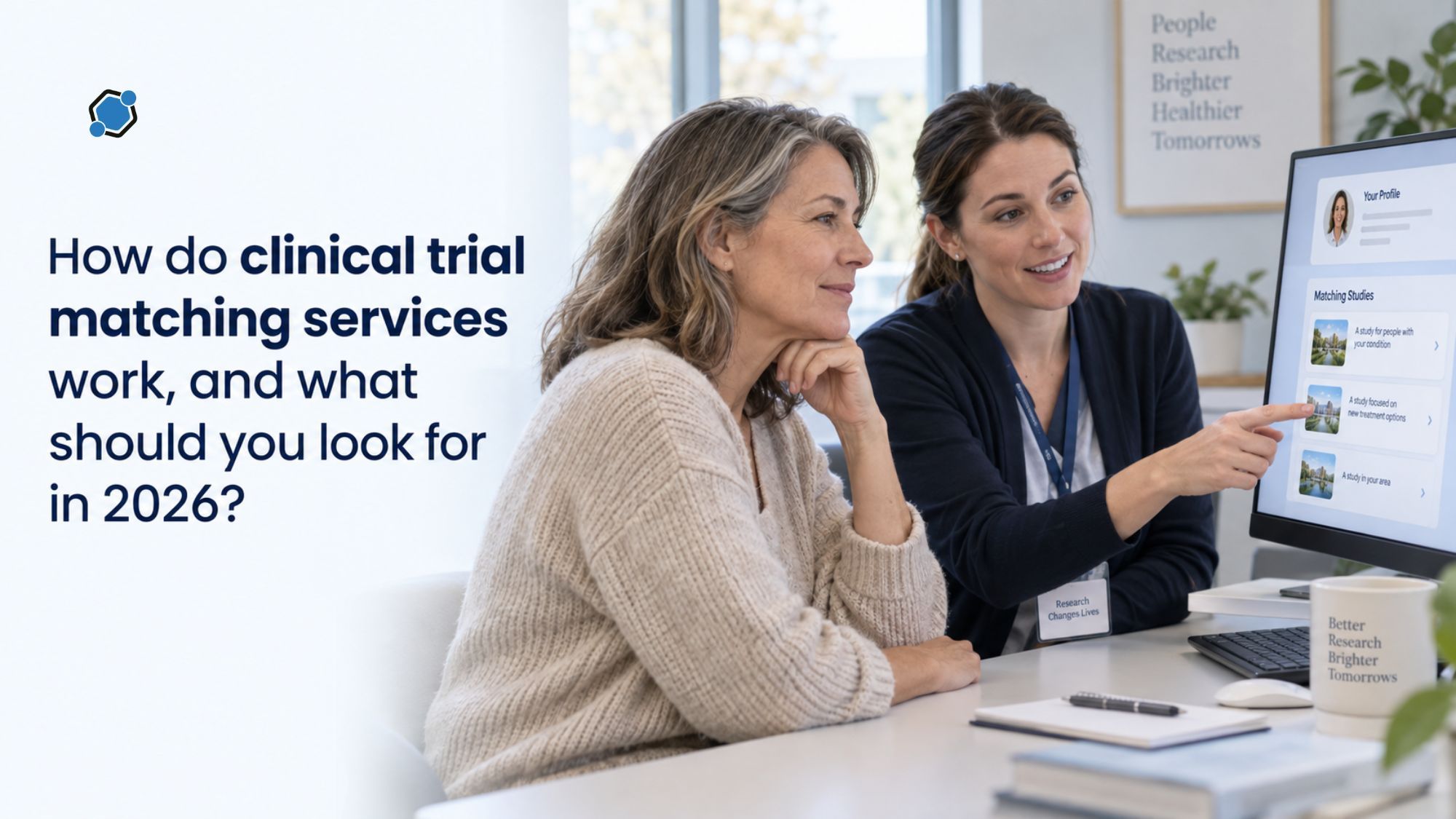
Clinical trial matching services have moved from a small corner of the research world into everyday health conversations. More people now search online for studies related to their condition, and more platforms compete to connect them with research teams. That growth is useful, but it has also created confusion. The tools available today range from public government databases to advertising-driven lead lists to concierge programs staffed by nurses, and each works very differently once a person submits their information.
This guide explains, in plain language, what clinical trial matching services actually do, how the main types differ, and what patients should evaluate before choosing one. It also shows where DecenTrialz fits in the current landscape.
What a clinical trial matching service actually does
A clinical trial matching service is any tool or program that helps a person find a research study they might qualify to join. In principle, the service takes some information about the person, compares it against the eligibility criteria of active studies, and returns a set of options. In practice, services vary widely in how much of that work they do for the patient and how much the patient must do alone.
Some services simply display a searchable list of studies and leave everything else to the reader. Others collect detailed health information, apply an algorithm, and return a curated list. A smaller number include a human review step, where a trained clinician looks at the results before any referral is made. The words used to describe these services sound similar, but the experience they deliver is not.
Eligibility criteria matter here. Every clinical study defines who can and cannot join, using medical, demographic, and lifestyle rules. These criteria are written for research professionals, not for the general public, and they can be difficult to interpret without training. A good matching service helps bridge that gap. A weaker one hands the reader a long list and expects them to work it out on their own.
The main kinds of clinical trial matching services
Most services fall into one of several categories, and knowing the category is the fastest way to set expectations.
The federal public trial registry is the largest free source of study information in the United States. It is authoritative and comprehensive, but it is a database rather than a matching service. A patient searches, reads the eligibility criteria, and contacts each study site directly. There is no personalized filtering and no human intermediary.
Nonprofit and academic matching services, often created by universities or research consortia, allow people to submit health information and be connected with studies. Some use a mix of automation and human review. Many of these services are free, privacy-conscious, and trusted, though several still leave the patient to make first contact with the site.
For-profit patient recruitment platforms are usually funded by study sponsors. They collect information through online questionnaires and route qualified leads to research sites. These services are typically free to the patient, but the underlying business model is worth understanding, especially where digital advertising is involved.
Disease-specific and advocacy-run matchers are curated by patient organizations focused on a single condition. They tend to be trusted within their community and offer depth in that condition, though narrow by design.
AI-first matching platforms use natural language processing to compare patient information with study criteria at scale. This category has grown quickly, and its strengths and limits are covered in more detail in Digital Pathways: How AI and Virtual Tools Are Changing Clinical Trial Enrollment.
Concierge and nurse-navigator services pair a patient with a trained clinician who reviews the situation, filters options, and helps the patient through referral. These programs deliver the most personal experience but have historically been limited in scale or restricted to specific diseases.
The difference between a listing and a matching service
One of the most common misunderstandings in this space is the difference between a listing and a matching service. A listing service shows the reader a directory of studies that can be searched by condition, location, or study phase. The reader still has to interpret each entry, contact the site, and confirm eligibility on their own. A matching service takes information from the reader, applies filters against active study criteria, and returns a shorter set of options. In some cases it also passes that information along to the research team.
Confusing these two categories can lead to wasted time. A patient who believes they have been matched to a study, when they have only been shown a list, may not realize how much work still lies ahead. A clear walk-through of one such matching process is available in DecenTrialz Explained: How to Search, Read, and Apply for Clinical Trials.
Why human review changes the experience
Human review is the point where clinical trial matching services diverge most sharply. Algorithms are efficient at surfacing candidate studies, but eligibility criteria often contain nuance that a computer cannot fully evaluate. A person taking a specific medication, recovering from a recent procedure, or living with more than one condition may look eligible on paper and yet fail a formal screening once contacted by the site. The result is frustration for the patient and lost time for everyone involved.
Pre-screening review by a registered nurse addresses that gap. A nurse is trained to interpret clinical language, ask follow-up questions, and identify factors that a form or algorithm alone might miss. Pre-screening also gives the patient a person to speak with. Many surveys of patient experience report the same theme: people want someone knowledgeable to answer their questions before they commit to an in-person study visit.
Human pre-screening does not replace the research site. It is an added step before the referral, designed to reduce mismatches and improve the quality of the eventual introduction. The broader case for this approach is discussed in RN-led pre-screening in clinical trials: what does nurse review add that AI matching cannot?.
How DecenTrialz fits into the landscape
DecenTrialz is a United States-based clinical trial matching platform that combines AI-supported matching with a human pre-screening step. The patient-facing workflow is straightforward. A person shares information about their condition and history, the platform surfaces candidate studies through AI-assisted matching, a registered nurse completes an initial pre-screening review, and, if the fit looks appropriate, the platform refers the person to the research site team.
The research site team always owns final eligibility determination, informed consent, the study walk-through, and enrollment.
That boundary is important. DecenTrialz is not a hospital, a sponsor, or a medical authority. It supports the earliest stages of the participation journey and hands the person off to the research team once the pre-screening step is complete. This design places DecenTrialz in the emerging category of services that combine algorithmic filtering with human clinical judgment, rather than relying on one or the other alone.
Because different platforms present themselves in similar language, patients often benefit from a side-by-side view of how a full-service model differs from a self-service search. DecenTrialz vs traditional recruitment platforms: how does full-service matching differ from self-service trial search? walks through the distinction in detail.
What patients should look for when choosing a matching service
A few practical questions help separate strong matching services from weaker ones. These questions apply regardless of the specific platform under consideration.
- Transparency: Does the service explain how matches are generated, whether an algorithm is involved, and whether a person reviews the result? A service that will not answer these questions is a caution sign.
- Human review: Is there a clinician, ideally a registered nurse, who reviews the pre-screening before any referral is made? This step reduces mismatches and improves the patient experience.
- Data privacy: Is it clear what information is collected, where it goes, and how the person can withdraw it? Clear, plain-language privacy practices should be easy to find.
- Cost: The service should be free to the patient. If a fee is mentioned, ask why.
- Hand-off: Does the service refer the patient into the research team, or provide contact details and leave the outreach to the patient? Both models exist, and both are valid, but the difference in effort is significant.
- Coverage: Is the service broad across many conditions, or focused on a single one? For complex or rare conditions, a disease-specific service may add depth. For most patients, a broad service is a good starting point.
Frequently asked questions
Are clinical trial matching services free?
Most services aimed at patients are free to use. Funding usually comes from study sponsors, research grants, or nonprofit budgets. Patients should still ask how a service is funded and what happens to the information they submit.
Does using a matching service guarantee a spot in a study?
No. A matching service can identify candidate studies and, in some cases, complete an initial pre-screening review. Final eligibility, informed consent, and enrollment are always decided by the research site team after a formal screening visit. No platform can promise a spot in a study.
Is it safe to share medical information with a matching service?
Reputable services follow clear privacy practices and describe them in plain language. Before submitting sensitive information, the person should be able to see what data is collected, how it is used, and how it can be removed. If those answers are not available, that is a reason to step back.
What is the difference between AI matching and nurse pre-screening?
AI matching uses software to compare information against study criteria at scale. Nurse pre-screening is a review by a trained clinician who can interpret complex criteria, ask clarifying questions, and confirm that a referral is appropriate. Some platforms use only AI, some use only human review, and a growing number combine both.
Taking the next step
Choosing a clinical trial matching service does not have to be complicated. The main goal is to find a service that is honest about how it works, offers real human review where it matters, protects the information shared, and reduces the effort required to reach a research team. For readers who are new to clinical research and want a grounding before starting a search, the Clinical Trial Volunteers Guide: Your First Step Into Clinical Trials is a useful place to begin.
Clinical trial matching services will keep evolving as artificial intelligence, data privacy standards, and patient expectations change. The categories described in this guide should hold up over time, and the questions to ask when choosing a service will stay much the same. Patients who understand the landscape are better placed to find studies that fit their situation and to reach research teams with less friction along the way.
Was this article helpful?

Similar Blogs

What is HbA1c and What Does It Really Tell You About Your Blood Sugar?
The HbA1c test is one of the most common blood tests ordered in the United States, yet it ...
 Vamshi Kantoju
Silent Stroke Symptoms and Long-Term Effects: Signs Adults Miss and Why They Matter
A silent stroke is a real injury to the brain caused by an interrupted blood supply, yet i...
Mahesh Upadrista
Finding a Clinical Trial: What ClinicalTrials.gov Shows and What DecenTrialz Adds
Clinical trial participation begins with a search. For adults in the United States who wan...
Deeksha GittaStay Informed. Stay Connected.
Get updates on verified clinical trials, emerging treatments, and research breakthroughs directly in your inbox. No spam, just science that matters.
