 HIPAA Compliant
 ISO 27001 Certified
Digital Endpoints in Clinical Trials: What Wearable Data Measures and What It Does Not
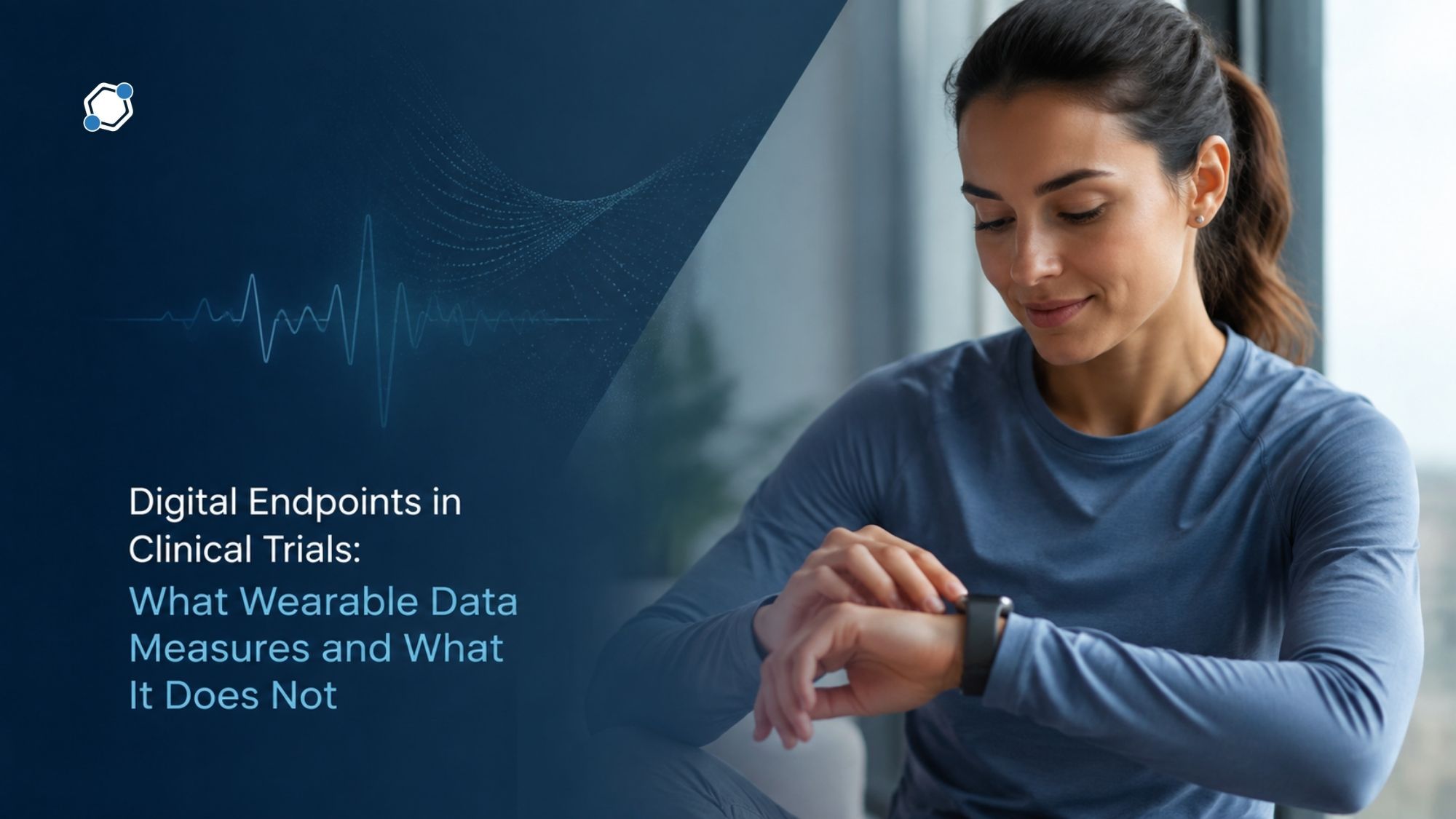
Digital endpoints in clinical trials have changed both what a study measures and where the measurement happens. A patient who once demonstrated walking ability during a timed test in a clinic hallway may now wear a small motion sensor at home for several weeks, producing a continuous record of how far and how fast that person actually moves during ordinary life.
For physicians who refer patients into research, or who continue managing those patients while a study runs, this shift raises a practical question. What does that sensor data actually mean, and how much weight should it carry in routine clinical care? The answer begins with a distinction that is easy to miss. A number produced by a wearable device is a research measurement, not a clinical finding.
What Are Digital Endpoints in Clinical Trials?
A digital endpoint is a prespecified study outcome captured by a sensor or connected device rather than by a clinician during a scheduled visit. The device itself is usually called a digital health technology, which means any hardware or software used to record health data outside a traditional clinical assessment. Common examples include wrist-worn and ankle-worn motion sensors, adhesive cardiac patches, continuous glucose monitors, and smartphone applications that record voice, typing, or movement.
Three terms appear repeatedly in this area and are often used interchangeably, although they describe different things. A digital measure is any quantity a device records, such as minutes of movement. A digital biomarker is an objective, quantifiable characteristic derived from that recording, such as walking speed or resting heart rate. A digital endpoint is the version of that biomarker written into the study protocol in advance and used to judge whether a study intervention produced an effect.
Position within the protocol matters as much as the measurement itself. A primary endpoint is the outcome a study is designed and statistically powered to detect, and regulatory decisions rest largely on it. Secondary endpoints support and extend the primary finding. Exploratory endpoints generate hypotheses and carry no confirmatory weight. Most digital endpoints in use today sit in the secondary or exploratory positions, which is worth knowing before assigning significance to anything a device recorded.
Sensor-based measurement also explains why more studies now split activity between the clinic and the patient's home. Research sites make deliberate decisions about what stays on-site and what moves remote, and endpoint type is one of the main factors shaping that decision.
How a Sensor Measurement Becomes a Regulated Trial Outcome
Before a wearable measurement can serve as an endpoint, it must clear several layers of evidence. Verification asks whether the sensor captures and stores raw signal accurately when tested against a known physical reference. Analytical validation asks whether the algorithms that convert raw signal into a usable metric perform accurately in the specific population being studied. Clinical validation asks whether the resulting metric genuinely reflects the clinical or functional state it claims to represent. A fourth layer, usability, asks whether real patients can operate the device correctly over weeks or months.
A measurement can pass one layer and fail another. A step counter may be verified as mechanically accurate and still be clinically meaningless in a condition where walking volume has little relationship to disease activity.
United States regulators set out expectations for this work in final guidance issued in December 2023 covering digital health technologies used for remote data acquisition in clinical investigations. That guidance addresses how sponsors select a device fit for a specific purpose, document verification and validation, handle software updates during a study, and manage data loss. Revised international good clinical practice guidance, ICH E6(R3), adds detailed expectations for data governance across the full data lifecycle, including computerized systems, audit trails, and traceability. Both frameworks endorse a process rather than any particular product.
Formal qualification of a specific digital endpoint remains uncommon. European regulators qualified a stride speed measure, derived from an ankle-worn motion sensor, as a primary endpoint in a rare neuromuscular disease, and that decision is still treated as the international reference case. In the United States, continuous glucose monitoring measures are the most widely accepted sensor-derived outcomes, while digital measures in most other areas remain supportive rather than decisive. Research sites absorb much of the resulting documentation burden, which is one reason the data governance expectations sites now work under have become a recurring operational topic.
Why Wearable Measurements Can Mislead
Consumer devices and research-grade devices are not interchangeable, and the difference has less to do with headline accuracy than with control. Consumer products typically rely on proprietary algorithms that are not disclosed, can change through a firmware update in the middle of a study, and may reduce sampling frequency to preserve battery life. Raw signal is often unavailable, which prevents a sponsor from reprocessing data or auditing how a number was produced. Research-grade devices preserve raw data and hold the algorithm fixed for the duration of the study.
Accuracy also degrades in the populations that clinical research most needs to measure. Step detection performs well at ordinary walking speeds and considerably worse at slow speeds. Wrist placement performs worse than placement at the hip or ankle, and it performs worse still in patients using a walker or cane, because restricted arm swing deprives a wrist sensor of the movement signal it depends on. Optical heart rate sensing, which estimates pulse by shining light through the skin, loses reliability during irregular motion, and skin pigmentation influences how much light is absorbed. Consumer sleep tracking separates sleep from wakefulness reasonably well while remaining substantially less reliable at classifying individual sleep stages.
Missing data introduces a subtler problem. Activity studies generally require a minimum number of wear hours per day, across a minimum number of days, before a period counts as valid. Non-wear, however, can carry information of its own. A patient who feels worse may charge the device less often, remove it more frequently, or stop using it entirely, so discarding invalid days can quietly remove the sickest observations from an analysis.
Context confounds interpretation further. A drop in recorded activity may reflect a snowstorm, a work trip, a hospital admission, a dead battery, or genuine functional decline, and a single day of data cannot distinguish among them. Study teams therefore aggregate across defined windows rather than reading day-to-day fluctuation, and study procedures that move into the patient's home require documented handling rules before the first participant enrolls.
Statistical movement in a sensor metric also does not establish clinical benefit. Regulators focus on meaningful within-patient change, meaning a threshold anchored to what an individual patient would actually notice, rather than a group average difference that happens to reach statistical significance.
What Clinicians See, and What That Data Should Not Decide
Referring and co-managing physicians usually receive little or no real-time access to trial sensor data, and that restriction is deliberate. Continuous endpoint data can reveal how a participant appears to be responding, which risks unblinding study arm assignment and altering both clinician and patient behavior. Sensor streams generally flow to the sponsor or coordinating center, often after de-identification, with sensitive elements such as location data restricted even from site staff.
Trial wearable data should not drive clinical decisions outside the study. These measurements are investigational, validated only for the narrow research purpose described in the protocol, and not cleared for diagnostic use. A sensor-derived walking speed is evidence about a study question rather than a substitute for clinical assessment.
Incidental findings require a defined pathway. Devices may surface irregular rhythm notifications, low oxygen saturation alerts, or other signals with potential clinical relevance. Well-designed protocols specify who monitors these alerts, how participants are contacted, and when confirmatory testing is triggered. Consumer-grade notifications in particular carry meaningful false-positive rates, and an unconfirmed alert can generate anxiety along with a cascade of unnecessary testing.
Referral infrastructure rarely gives the treating clinician a defined channel for these signals. The system tends to route device data toward the study team while leaving the physician who knows the patient's history outside the loop, which is why clarifying the referring physician's role during and after a study at the point of referral is more practical than reconstructing it once a study is underway.
What to Ask the Study Team About a Digital Endpoint
A short set of questions establishes how much interpretive weight a digital endpoint deserves.
- What exactly is being measured, and from what raw signal?
- Is the device validated in this specific population, accounting for age, mobility level, assistive device use, and skin pigmentation?
- Is the endpoint primary, secondary, or exploratory?
- What is the minimum wear time, and how is missing data handled in the analysis?
- Who monitors device alerts, and what is the escalation pathway when a clinically concerning signal appears?
- What happens to the sensor data once the study closes?
Participant burden deserves equal attention during the referral conversation. Wearing a device across a study means charging it, syncing it, maintaining connectivity, and troubleshooting failures, and these requirements land unevenly. Older patients, rural patients with limited broadband access, and patients without a suitable personal smartphone face higher practical barriers, and study designs that rely on participants supplying their own devices can narrow the enrolled population without intending to.
Privacy questions also differ from those in conventional studies. Continuous movement and location data are unusually re-identifiable, because patterns of daily activity can identify a person even after names are removed. Data handled inside a research framework carries research and health privacy protections, while data held by a consumer device manufacturer may sit under commercial terms of service instead. Patients ask about this, and a useful answer depends on understanding where trial data goes once a study closes.
Common Questions About Digital Endpoints and Wearable Data
Are consumer smartwatch and fitness tracker data used in clinical trials?
Sometimes, particularly in very large or pragmatic studies where scale absorbs measurement noise. Studies intended to support regulatory decisions generally favor research-grade devices that provide raw data access and version-controlled algorithms.
Can a wearable measurement serve as a primary endpoint?
Yes in principle. European regulators have qualified a sensor-derived stride speed measure as a primary endpoint in a rare neuromuscular disease. The practice remains uncommon, and most sensor-derived outcomes still function as secondary or exploratory endpoints.
What is the difference between a digital biomarker and a digital endpoint?
The biomarker is the measurement itself. The endpoint is the validated, prespecified version of that measurement written into the protocol and used to evaluate the study intervention.
Should a physician act on a wearable alert from a patient in a trial?
Any clinically concerning signal warrants standard clinical evaluation through normal channels rather than action based on the device reading alone. The protocol should define who monitors alerts and how escalation works, and that pathway is worth confirming at the point of referral.
Referring Patients Into Technology-Enabled Trials
Digital endpoints expand what clinical research can measure, and they add a layer of technical judgment that most referral conversations were never built to carry. The questions above establish whether a sensor measurement is trustworthy, and those answers belong to the study team rather than to the device.
DecenTrialz is a clinical trial recruitment and pre-screening platform that connects potential participants with research sites conducting relevant studies. The platform uses AI-assisted matching to identify studies that fit a patient's condition and circumstances, followed by pre-screening conducted by registered nurses who confirm basic criteria and document what participation would involve, including device and technology requirements. The research site retains full responsibility for final eligibility determination, informed consent, the study walk-through, and enrollment. Physicians who want a clearer referral path for patients who may be candidates for technology-enabled studies can review how the process works.
Was this article helpful?

Similar Blogs
How Tokenization Helps Physicians Track Patients After a Clinical Trial Ends
Tokenization is changing how sponsors keep track of clinical trial participants long after...
 Swaroop ESD
Digital Endpoints in Clinical Trials: How HCPs Interpret Wearable Data From Their Patients
Wearable devices now generate a substantial share of the data collected during modern clin...
Deeksha Gitta
Point-of-care clinical trials: how research fits inside routine practice
Clinical research and clinical care have long operated as parallel systems. Patients recei...
 Anish Teepireddy
Stay Informed. Stay Connected.
Get updates on verified clinical trials, emerging treatments, and research breakthroughs directly in your inbox. No spam, just science that matters.
