 HIPAA Compliant
 ISO 27001 Certified
How patient advocacy groups turn registries into clinical trial referrals
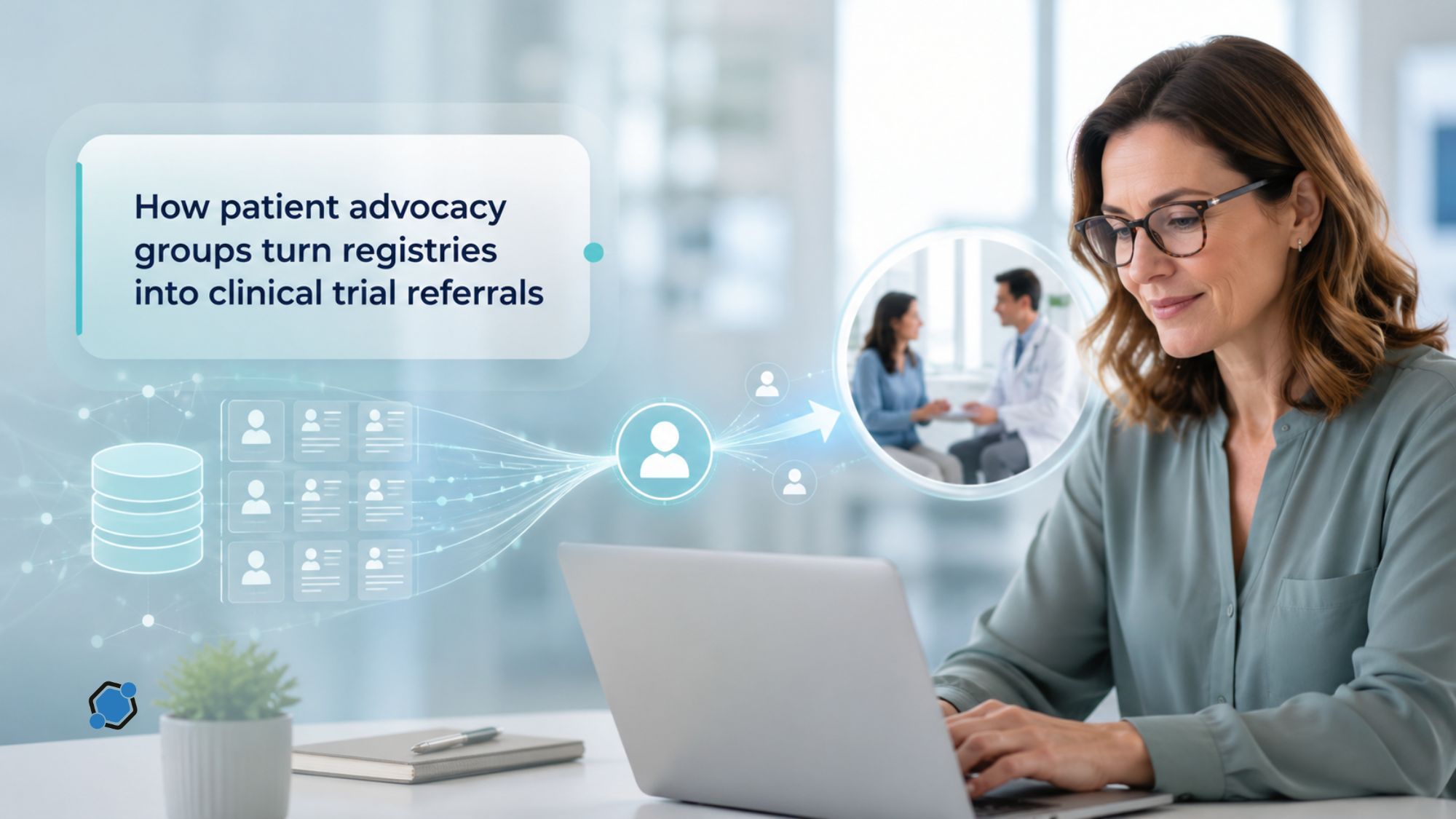
A patient registry is one of the most valuable assets an advocacy group holds. It represents years of trust, community-building, and quiet consent to be part of research when the right study appears. But a registry, on its own, rarely produces enrollments. The reason is structural. A list of names, even a well-organized one, is not the same as a pipeline that connects those members to actively recruiting studies. Closing that distance is where an advocacy group's mission and the research system's needs meet.
This article walks through what a research-ready registry pipeline looks like, why so many stall between sign-up and study, and where the responsibilities of advocacy groups end and the responsibilities of research sites begin.
What a patient advocacy registry actually is
A patient advocacy registry, sometimes called a disease registry or a contact registry, is an organized database of people who share a condition and have agreed to be part of a community effort around it. Registries typically hold contact information, a confirmed or self-reported diagnosis, sometimes genetic or genotype data, self-reported outcomes over time, and permission metadata indicating whether the member has agreed to hear about research opportunities.
A patient advocacy registry is not the same as a clinical trial registry such as ClinicalTrials.gov. A clinical trial registry is a public database of studies. A patient advocacy registry is a database of people. The distinction matters because it shapes what the registry can and cannot do. A well-maintained advocacy registry is a trusted channel to reach members with relevant information. It is not, on its own, a matching engine or a recruitment system.
Advocacy groups that treat the registry as a research resource, rather than a mailing list, tend to protect it more carefully and use it more sparingly. That posture is the foundation of every step that follows. For context on the broader role advocacy organizations play in research participation, see Why Patient Advocacy Groups Matter in Decentralized Clinical Research.
Why a registry alone rarely produces trial enrollments
The willingness of patients to participate in research is high. In one meta-analysis of cancer patients offered a clinical trial, more than half chose to participate. In broader patient surveys, most people who have never been asked say they would consider joining a study if the option were presented clearly. The bottleneck is not appetite. It is infrastructure.
Several structural gaps sit between a registry sign-up and an enrolled participant. Contact data ages quickly, and members who moved, changed phone numbers, or switched email accounts become progressively unreachable. Outreach that is not matched to a specific study leads to irrelevant messages, which train members to stop opening them. Interest expressed by a member often has nowhere to go, because there is no defined route from the advocacy group to a research site. And consent given at sign-up may not clearly cover study-specific recontact, which creates uncertainty about what outreach is even permitted.
Each of these gaps is fixable, but only when the registry is treated as one part of a larger workflow. A closer look at how the wider recruitment system produces avoidable friction is available in The Ongoing Challenge of Clinical Trial Recruitment.
What a qualified clinical trial referral means
The output of a working registry pipeline is not a name on a list. It is a qualified referral. A qualified referral is a registry member who has been matched against the eligibility criteria of a specific recruiting study, given accurate plain-language information about that study, indicated willingness to be pre-screened, and passed an initial pre-screening review. That referral is then handed off to the research site team, which handles site-side eligibility confirmation, informed consent, study walk-through, and enrollment.
The definition matters because it draws a clear line. Everything before the handoff is where an advocacy group can add unique value, because it involves community trust, accurate information, and permission-based outreach. Everything after the handoff belongs to the research site, because it involves clinical judgment, regulatory obligations, and the formal consent process. Blurring that line is one of the most common ways registry-to-referral programs run into trouble.
For members who are new to research participation, the language around eligibility, pre-screening, and consent can be unfamiliar. A plain-language overview of the participant journey is available in How to Find and Enroll in a Clinical Trial: A Step-by-Step Guide.
How structured matching connects registry members to studies
Matching is the step that turns a registry from a list into a pipeline. Structured matching compares what is known about a member, such as diagnosis, subtype, prior care history, age, and geography, against the inclusion and exclusion criteria of a specific recruiting study. The result is a short list of members who plausibly fit, rather than the entire registry.
This is increasingly done with the help of AI-assisted matching. Recent tools use natural language processing to convert free-text eligibility criteria into structured logic, then score member records against those criteria. Common data standards such as OMOP, a shared model for organizing health data, and FHIR, a standard for exchanging health information, make that matching more reliable across systems. AI-assisted matching does not replace human judgment. It narrows a large pool to a plausible one, which is then reviewed before any member is contacted.
The alternative to structured matching is broadcast outreach, which produces low relevance and high fatigue among members. A wider view of how AI is changing patient-facing recruitment channels is available in Patient Advocacy and AI: Connecting Communities to Trials.
Where pre-screening fits in the pipeline
Pre-screening is the step between a matched member and a referred participant. It is a short structured conversation, often conducted by a registered nurse or trained coordinator, that confirms basic eligibility factors the member can answer themselves and verifies that the member is genuinely interested in learning more from the research site. Pre-screening is not eligibility determination. Eligibility is confirmed at the site through clinical review, source documents, and any required tests.
Many advocacy groups do not have the internal capacity to conduct pre-screening at scale, particularly across multiple recruiting studies at once. A practical alternative is to work with a patient recruitment platform that provides nurse-led pre-screening as a defined service. That capacity sits between matching and site handoff, and its purpose is to make sure the members who reach a research site are the ones most likely to convert into enrolled participants.
For an accessible explanation of why eligibility criteria are strict and how pre-screening reduces avoidable screen failures, see Eligibility Explained: Why Not Everyone Qualifies for a Trial.
How the handoff to research sites should work
The handoff is where most registry-to-referral programs succeed or fail. A structured handoff means the research site receives only the information it needs to contact the member, with the member's permission, and confirms that the referral was received and acted on. The member should know what to expect next, including who will contact them, when, and what the next step involves.
A weak handoff looks different in every direction. Members express interest and then hear nothing for weeks. Sites receive referrals without context and are unsure whether the person has been informed about the study. Advocacy groups have no visibility into whether their members reached the site at all. The fix is a documented workflow with a named owner at each step, and a closed loop that confirms the referral was received. Nothing about this workflow requires an advocacy group to take on clinical responsibility. The role stays consistent throughout. The advocacy group informs, matches, pre-screens, and transfers. The research site handles eligibility, consent, and enrollment.
For a companion perspective on the awareness and information work that supports strong handoffs, see How Advocacy Groups Can Support Informed Trial Awareness.
Privacy, consent, and IRB guardrails advocacy groups need to respect
Registry data is sensitive, and the pipeline that uses it operates inside a clear set of guardrails. HIPAA sets expectations for how identifiable health information is handled, including the principle that only the minimum necessary information should be shared for a given purpose. Registry members should give explicit permission to be contacted about research, ideally layered so that a member can consent to the registry, to research use of their information, and to study-specific recontact as distinct choices.
Any communication tied to a specific recruiting study is a recruitment material, and it must be reviewed and approved by the study's Institutional Review Board before it is used. Recruitment materials cannot overstate benefits, imply a certainty of favorable outcome, or use coercive framing. Informed consent for the trial itself is obtained by the research site under IRB oversight, not by the advocacy group. Advocacy groups are strongest and safest when they stay firmly on the education, matching, and informed-choice side of that line.
A broader view of how research data is protected across the participant journey is available in Patient Privacy in the Digital Age: Safeguarding Data in Research.
How DecenTrialz supports advocacy-group registry-to-referral workflows
DecenTrialz is a United States clinical trial recruitment platform built around AI-assisted participant matching and registered nurse-led pre-screening. For advocacy groups, that combination is designed to sit exactly where the gap usually opens. AI-assisted matching compares member information, with permission, against the eligibility criteria of specific recruiting studies. Nurse-led pre-screening then confirms basic fit and willingness before the referral is handed to the research site.
Final eligibility determination, informed consent, study walk-through, and enrollment are always handled by the research site team. The nurse pre-screens only. The role of the platform is to protect the trust an advocacy group has built with its members by ensuring that outreach is relevant, that willingness is confirmed, and that the handoff to the research site is clean. Advocacy groups interested in exploring this model can start at decentrialz.com.
Building a research-ready registry pipeline
A registry becomes a research asset when it is embedded in a workflow with clear roles, honest communication, and a defined handoff. The advocacy group brings community trust, mission alignment, and the relationships that make members willing to be part of research in the first place. The matching, pre-screening, and site infrastructure make that willingness actionable. Neither side works without the other.
Advocacy groups considering how to move from a well-intentioned registry to a structured registry-to-referral pipeline can learn more about DecenTrialz's approach at decentrialz.com.
Was this article helpful?

Similar Blogs
Clinical Trial Data Governance: What Advocacy Groups Should Verify Before Endorsing a Study
Patient information now travels further than most study participants expect. A study that ...
 Swaroop ESD
Tokenization in Clinical Trials: What Should Advocacy Groups Ask Sponsors About Patient Privacy
Tokenization has become one of the most widely adopted data techniques in modern clinical ...
Mahesh Upadrista
How advocacy groups turn patient registries into clinical trials
For most rare and chronic disease communities, the biggest obstacle to research is not sci...
Deeksha GittaStay Informed. Stay Connected.
Get updates on verified clinical trials, emerging treatments, and research breakthroughs directly in your inbox. No spam, just science that matters.
