 HIPAA Compliant
 ISO 27001 Certified
What Advocacy Groups Should Look For in a Patient Recruitment Platform
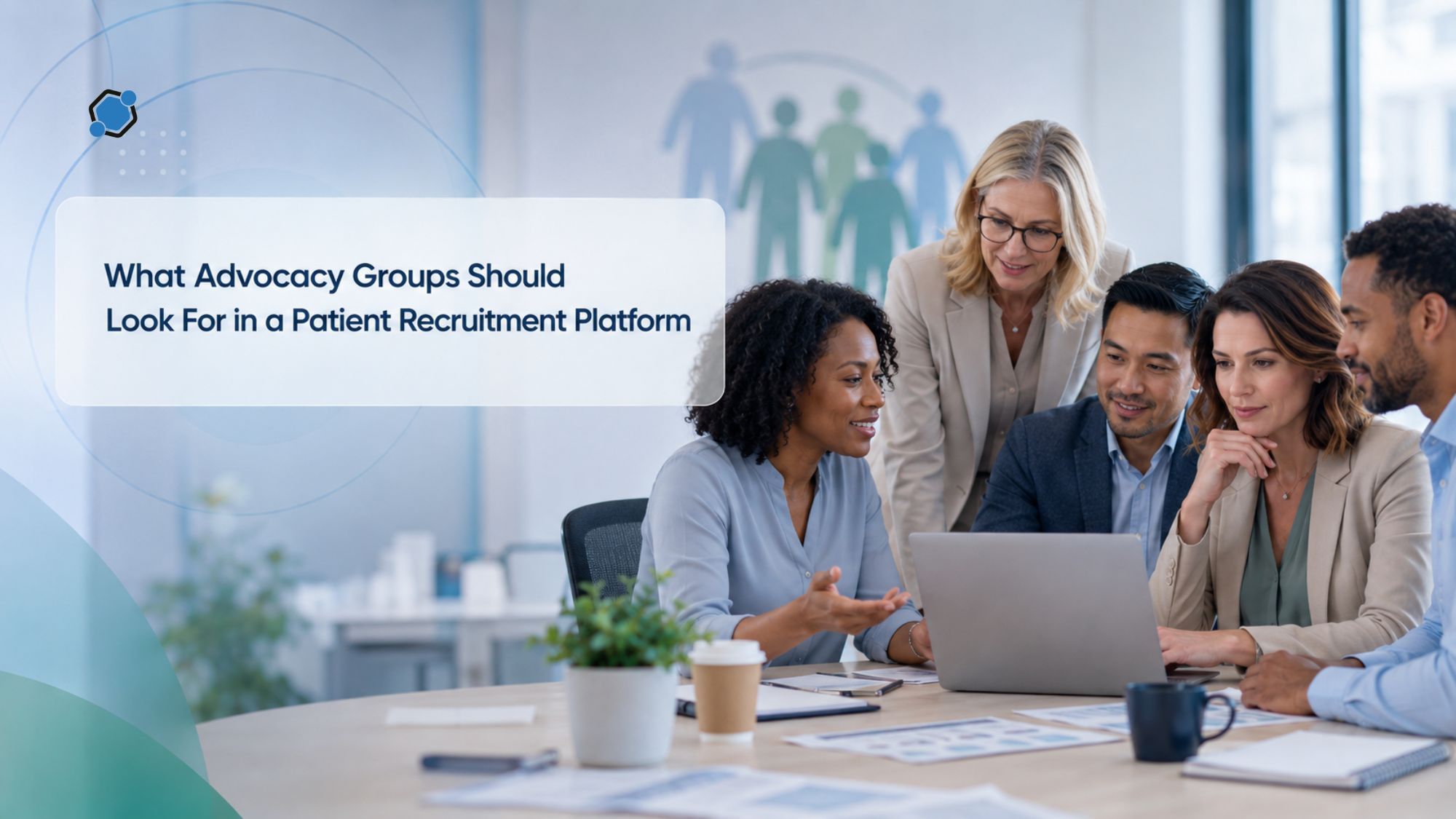
Advocacy organizations occupy a rare seat at the table. Community members turn to disease foundations, rare disease networks, and patient advocacy groups for guidance they can't get anywhere else, including guidance on clinical research. When an advocacy group signals that a patient recruitment platform is worth engaging with, that signal carries weight. It also carries risk. A single bad experience can quietly erode years of trust that took a lifetime of community work to build.
This article lays out what a patient recruitment agency should be able to demonstrate before an advocacy group is comfortable pointing community members toward it. DecenTrialz is a U.S.-based patient recruitment agency, and the standards below reflect how the platform is built and what advocacy partners are entitled to expect from any recruitment agency they consider.
Advocacy groups carry the trust, and the risk
Community members listen to advocacy organizations differently than they listen to sponsors, sites, or search engines. A recommendation from a disease foundation feels personal because it usually is. It comes from people who share the diagnosis, who have sat through the same appointments, who understand what the next step actually costs in time and energy.
That trust is finite. When a recruitment experience goes sideways, if someone waits weeks for a callback that never comes, if they're told they qualify and then aren't, if their information ends up somewhere they didn't expect, the disappointment doesn't stop at the platform. It reaches back to the advocacy group that made the introduction. Vetting a recruitment partner well before recommending them isn't a bureaucratic exercise. It's how an advocacy organization protects the relationship that makes everything else possible. For more on the trust dynamics that shape research participation, see Why Patient Advocacy Groups Matter in Decentralized Clinical Research.
Where a patient recruitment agency fits in your community's trial journey
Community members often don't know the difference between a public trial registry, a study sponsor's own outreach, a research site's local recruitment, and a patient recruitment agency. That's fair. The field is crowded, and the labels overlap.
A patient recruitment agency sits between the person exploring a trial and the research site that would enroll them. The agency's job is to help people learn about relevant studies, understand what participation might involve, and go through an early conversation to see whether they might fit before the research site invests time in a formal visit. The agency doesn't determine eligibility, doesn't obtain informed consent, and doesn't enroll anyone. Those responsibilities belong to the authorized research site and study team, always. To see how this positioning works in practice, see Where DecenTrialz Fits in the U.S. Clinical Trial Ecosystem.
When the agency is doing its job well, the community member arrives at the site already informed, already pre-screened for the basics, and clear that the site team, not the agency, is the medical authority.
What a trustworthy recruitment partner should be able to answer
Before an advocacy group recommends a platform, the platform should be able to answer a handful of plain questions without hedging. Advocacy leaders don't need a technical briefing. They need clarity on the things that shape a community member's actual experience.
The questions worth asking include:
- Who reviews a candidate's information before that person is contacted, and what are their qualifications?
- What exactly happens between the moment someone shows interest and the moment they meet the research site team?
- What data is collected, why, and who receives it?
- How is consent explained, and how is it made clear that this is research, not guaranteed care?
- What happens to someone who turns out not to be eligible?
- How does the platform handle communities that have historically been underrepresented in research?
- Who pays the platform, and is that disclosed to the community member?
- How does the platform measure whether its work actually helped people, not just whether it generated leads?
A recruitment partner that answers these questions clearly, in writing, is a partner an advocacy group can evaluate. A partner that dodges them isn't one worth recommending. For more on evaluating recruitment partnerships broadly, see How Advocacy Groups Can Support Informed Trial Awareness.
Why a nurse in the loop is non-negotiable
Algorithmic matching is useful. It scans large volumes of information quickly and surfaces studies that fit a person's basic profile on paper. What it doesn't do well, on its own, is judge the parts of a person's situation that don't fit neatly into fields on a form. Comorbidities, medication history, recent hospitalizations, the difference between what a chart says and what a person is actually experiencing, all of that needs a human read.
That's why a registered nurse pre-screening step matters. When a licensed clinician reviews matches before anyone is contacted, community members are far less likely to be reached about studies they were never really suited for. They're also more likely to feel treated with respect, because the first substantive conversation happens with someone trained to listen. To understand how clinical review reduces friction earlier in the process, see Pre-Screening Smarter: How Technology Reduces Screen Failures at Sites.
Advocacy groups should be direct on this point. If a platform can't name the clinician or the clinical role responsible for reviewing candidates before outreach, that's a gap worth flagging.
How consent and data privacy should be handled
Community members share sensitive information with recruitment platforms. That information deserves the same care it would receive at any medical office, and the same legal protections under U.S. health privacy law.
A trustworthy platform is transparent about what it collects and why. Consent language is written for people, not for lawyers. It explains what happens next, names who will receive the information, and makes clear that the person can stop at any time without losing anything. It doesn't bury data sharing inside a wall of legal text, and it doesn't treat the person's contact information as a commercial asset to resell. For a broader look at how research handles participant data, see Patient Privacy in the Digital Age: Safeguarding Data in Research.
Advocacy groups can ask to see the consent language a platform uses. If it takes a law degree to understand it, that's a signal. If it clearly states what data flows where, and gives the person meaningful control, that's a different signal, and a better one.
What the handoff to the research site should look like
The moment between pre-screening and the first site visit is where a lot of recruitment platforms quietly lose people. A community member says yes, then hears nothing for weeks. Or gets a call from a site team member who has none of the information the person already provided, and has to start over. Or shows up expecting one conversation and is met with a different one.
A good handoff looks nothing like that. The site team receives the pre-screening information promptly and in a usable form. Someone follows up with the community member within a defined window, not an open-ended one. If the person turns out not to be eligible after the site's own review, they're told, kindly and clearly, and given a sense of what other options might exist. Nobody vanishes.
Advocacy groups should ask a candid question: what does the platform do to make sure the site team actually picks up the thread? A platform that can describe its handoff process concretely is one that has thought about the community member's experience past the point where its own metrics stop counting. For a deeper look at how the referral-to-site relationship should work, see How DecenTrialz Works: From Trial Matching to Transparent Dashboards.
Red flags that should end the conversation
Some patterns should stop the vetting process altogether. If any of the following show up in how a platform describes itself or its work, an advocacy group is right to walk away:
- Language that promises a cure, guarantees improvement, or implies a certain medical outcome.
- Calling an investigational product a new drug or new treatment without clearly saying it's still being studied.
- Any suggestion that a community member is guaranteed to qualify before an actual screening has happened.
- Heavy emphasis on payment, framed to draw the eye rather than to inform.
- Vague or missing information about who's paying the platform, and why the platform is running the outreach at all.
- No clinician anywhere in the review process, only automated matching.
- Consent language that reads as if it were designed to be skimmed and forgotten.
- Recruitment materials that don't appear to have been reviewed by an ethics board.
- A pattern of community members reporting that they were contacted for studies that clearly didn't match their situation.
None of these are minor. Each one reflects a choice the platform made about what to prioritize. Advocacy groups are entitled to prioritize differently. For a related look at how misleading messaging in this space plays out, see Educating Patients About Decentralized Trials Without Overselling.
How DecenTrialz is built for advocacy partnership
The standards above aren't a wish list. They're the specification DecenTrialz was built around.
DecenTrialz is a patient recruitment agency that combines AI-assisted matching with registered nurse-led pre-screening. The AI does what it's good at, scanning study criteria at scale and surfacing candidates whose profile fits on paper. The nurse does what only a clinician can do, reviewing those matches with the judgment that keeps people from being contacted about studies that were never really right for them. The nurse pre-screens only. The research site team handles walk-through, eligibility determination, informed consent, and enrollment. That boundary is deliberate, and DecenTrialz doesn't blur it.
For advocacy groups, the practical benefits show up in the details that shape a community member's experience. The information a person shares is collected with clear purpose and handled with care. The conversation they have during pre-screening is with a nurse, not a chatbot and not a marketing rep. The handoff to the research site is tracked, not hoped for. People who turn out not to fit are treated with the same respect as people who do. To learn more about how the agency approaches community engagement, see Patient Advocacy & AI: Connecting Communities to Trials.
Advocacy leaders are welcome to test all of this directly. Visit https://decentrialz.com to see how DecenTrialz describes its work to the communities it serves, and reach out to talk through what an advocacy partnership could look like for your organization.
Partner with DecenTrialz to support your community
Advocacy groups don't need a perfect platform. They need a partner that can answer honest questions honestly, that puts a clinician between an algorithm and a community member, that treats consent and data with the seriousness they deserve, and that hands people off to research sites in a way that respects the trust the advocacy group extended in the first place.
DecenTrialz is built to be that partner. To explore an advocacy collaboration, visit https://decentrialz.com and start the conversation. Your community's trust is the most valuable thing any recruitment agency will ever be asked to protect. DecenTrialz is ready to protect it alongside you.
Was this article helpful?

Similar Blogs
Clinical Trial Data Governance: What Advocacy Groups Should Verify Before Endorsing a Study
Patient information now travels further than most study participants expect. A study that ...
 Swaroop ESD
Tokenization in Clinical Trials: What Should Advocacy Groups Ask Sponsors About Patient Privacy
Tokenization has become one of the most widely adopted data techniques in modern clinical ...
Mahesh Upadrista
How advocacy groups turn patient registries into clinical trials
For most rare and chronic disease communities, the biggest obstacle to research is not sci...
Deeksha GittaStay Informed. Stay Connected.
Get updates on verified clinical trials, emerging treatments, and research breakthroughs directly in your inbox. No spam, just science that matters.
