 HIPAA Compliant
 ISO 27001 Certified
Home healthcare in clinical trials: what HCPs should know
What home healthcare in clinical trials means
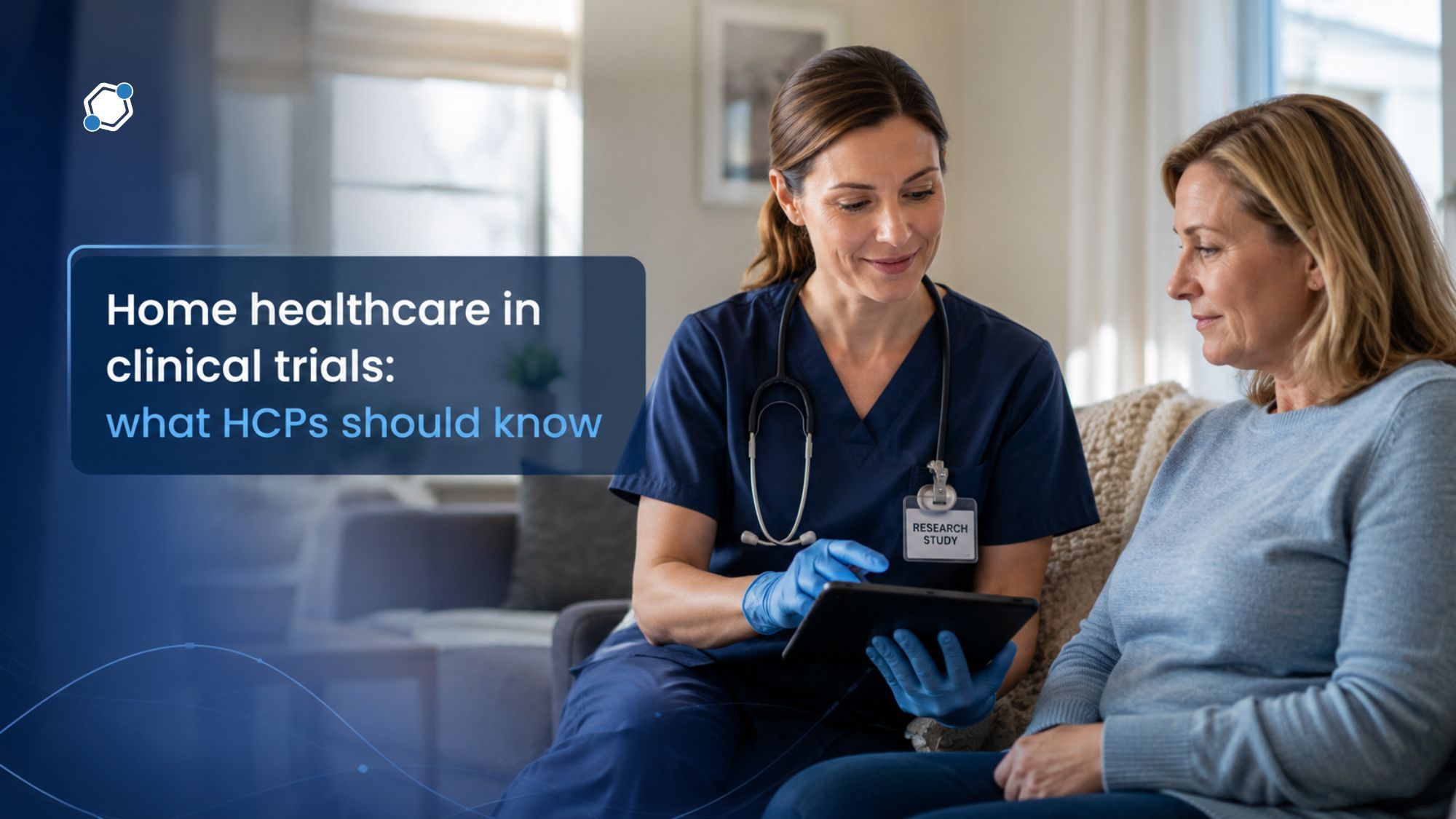
Home healthcare in clinical trials refers to the model where trained clinical professionals travel to a participant's home, workplace, or other convenient location to perform study visits that would traditionally happen at the research site. The Food and Drug Administration's September 2024 final guidance on clinical trials with decentralized elements describes these as in-home visits with either remote trial personnel or local healthcare providers. The activities performed can include vital signs measurement, blood draws for laboratory analysis, administration of the study drug, adverse event queries, and completion of participant-reported assessments.
This model sits inside a broader shift toward decentralized clinical trials, sometimes shortened to DCTs, which are studies that move some or all activities away from the traditional research site. Home healthcare is one decentralized element among several, alongside telehealth visits, digital health devices, and community-based visits at a participant's regular clinic. The nurse or clinician performing the home visit is typically a research-trained professional, sometimes a mobile research nurse contracted through a vendor, sometimes a member of the site's own extended team, and sometimes a local HCP who already sees the participant for routine care.
Home healthcare in this context is distinct from the U.S. Medicare home health benefit, which covers post-acute skilled nursing and therapy services under a physician's plan of care. Trial-focused home visits are governed by the study protocol and by internationally recognized clinical research standards, not by Medicare coverage rules. The nurses and clinicians who conduct them may come from research-nursing vendors, from a site's own research staff, or from health-system home care programs that have been separately trained to research standards.
Community physicians and generalist HCPs who see participants in their day-to-day practice often become the first point of contact for questions about home-based trial participation. That gatekeeper role is discussed in more depth in How Community Physicians Can Expand Clinical Trial Participant Pools.
Who decides on build, buy, or partner
The strategic choice of how to deliver home healthcare in a clinical trial usually belongs to the sponsor and the contract research organization, sometimes shortened to CRO. It rarely belongs to individual HCPs or research sites. Three options dominate the decision.
Build means an organization stands up its own in-house capability, training research nurses on staff and dispatching them to participants' homes. This model gives maximum control over quality, credentialing, and standardization, but it carries high fixed costs and is generally viable only at sustained trial volume.
Buy means acquiring a home nursing vendor to bring the capability inside the organization. Large CROs have used this route to internalize a service line, absorb the margin, and integrate home visits with their broader trial operations. It requires substantial upfront capital and carries integration risk.
Partner means contracting with an existing home nursing vendor or research-nursing agency on a study-by-study basis. This is the most common path today. It offers variable cost, faster start-up, and broad geographic reach, and it lets sponsors match the vendor's therapeutic experience to the study's needs. It also means the trial's home-visit quality depends on the partner's training, standard operating procedures, and oversight practices.
For HCPs, the practical question is not which of these three options to choose. It is how to engage productively with whichever model the sponsor has selected. Whether the HCP works with a mobile nurse contracted by the sponsor, a local clinician the sponsor has separately engaged, or a research nurse who is part of the site's own extended team, the underlying HCP-research relationship follows familiar principles, as discussed in When Doctors Partner With Research: Benefits for Practice and Patients.
What HCPs remain responsible for
The Food and Drug Administration's final decentralized elements guidance is clear on one point: the investigator remains responsible for the overall conduct of the trial, including the supervision of anyone to whom activities are delegated. Home visits do not shift this accountability. If a mobile nurse or a local HCP performs a study assessment at a participant's home, the principal investigator still owns the quality of that data, the safety of the participant, and compliance with the protocol.
Certain trial activities cannot be delegated to a local HCP under the current framework. Informed consent is the most important example. The consent process must be conducted by the investigator or a qualified delegate on the study team, not by a general-practice HCP who happens to see the participant in the community. Consent forms should specify which visits will be at the site, which will be at the participant's home, and who will be performing which activities.
For HCPs newer to clinical research, the practical consequence is that the delegation-of-duties log matters. Every person performing trial-related activities on behalf of the site, including a mobile research nurse traveling to participants' homes, should be identified by name, qualified for the tasks assigned, and trained on the protocol. The Food and Drug Administration no longer requires a separate task log for local HCPs performing routine clinical care, but the investigator must still ensure that any person acting as trial personnel is appropriately qualified and supervised.
The referring physician's role does not end at the referral. Communication with the trial team continues throughout the study, particularly around adverse events, medication changes, and interim clinical findings, as discussed in Referring patients to clinical trials: the physician's role during and after.
Delegation and safety escalation
Safety escalation is where the home healthcare model earns or loses HCP confidence. When a nurse conducts a home visit and observes a concerning symptom, an adverse event (an unwanted medical occurrence during a study), or a serious adverse event (one that is life-threatening, requires hospitalization, or results in significant disability), the protocol must define exactly how and how quickly that information reaches the investigator. Same-day escalation to the principal investigator is a common standard in real trial protocols, and for good reason. The investigator is the clinician who will decide whether the participant continues in the study, requires unblinding, or needs urgent clinical attention.
The safety monitoring plan should describe the communication path in advance. Trial personnel should know how to reach the investigator, how to document findings, and how to hand off to the participant's regular medical team if needed. Home-visit reports typically summarize what was done at the visit, what was observed, and any events that require follow-up. Those reports feed back into the site's source records and, ultimately, into the trial's safety database.
For HCPs, the practical takeaway is to confirm the escalation pathway at the start of any study that includes home visits. Where does the nurse's report go? Who reviews it, and how quickly? What happens if an event occurs outside business hours? These questions have straightforward answers in well-run trials and unclear answers in poorly designed ones. The presence of a clear, protocol-defined safety plan is a reasonable proxy for how seriously the sponsor and CRO take home-visit oversight.
Larger studies also have an independent safety layer beyond the site team and the sponsor, which is discussed in What Is a Data Safety Monitoring Board (DSMB)? Who Watches Over Clinical Trial Participants and How.
Where home healthcare helps HCPs and their patients
Home healthcare removes friction from participation. For participants with limited mobility, chronic illness, caregiving obligations, or long distances to the nearest research site, the ability to complete a visit at home can be the difference between enrolling and declining. This is particularly meaningful in rare disease studies, pediatric trials, and oncology protocols where visits are frequent and physically demanding.
For HCPs, the model expands the practical universe of participants they can refer. A community physician whose patient lives two hours from the nearest research site can reasonably refer that patient to a trial that includes home-visit options, whereas the same referral to a fully site-based study would likely fail on logistics alone. Studies with home healthcare components tend to enroll faster and retain participants better, which is why sponsors increasingly design them in from the start.
Continuity of care benefits, too. A participant who sees the same mobile nurse for multiple visits builds a rapport that supports protocol adherence and honest symptom reporting. The nurse is not a substitute for the referring HCP or the principal investigator. But the added continuity often surfaces issues that a distant, infrequent site visit would miss.
Better structural pathways between HCP practices and research teams also reduce the friction that keeps many willing patients from ever finding a suitable study, as discussed in How easier referral pathways help HCPs connect patients to clinical trials.
How DecenTrialz supports HCPs in home healthcare workflows
DecenTrialz is a United States clinical trial participant recruitment platform designed to reduce the friction on the HCP side of trial participation. Interested patients share information about their condition and preferences. An AI-assisted matching layer narrows the field to relevant studies. A registered nurse then completes an initial pre-screening review of the shared information.
The registered nurse pre-screening on the DecenTrialz platform is limited to an initial review of participant-shared information and is not a clinical assessment or eligibility determination.
The research site team owns the study walk-through, informed consent, final eligibility determination, and enrollment decisions. For HCPs referring patients into studies that include home-visit elements, this workflow removes the administrative burden of parsing complex eligibility criteria before the referral reaches the site. Learn more at decentrialz.com.
Was this article helpful?

Similar Blogs

Digital Endpoints in Clinical Trials: What Wearable Data Measures and What It Does Not
Digital endpoints in clinical trials have changed both what a study measures and where the...
 Mahesh Upadrista
Digital Endpoints in Clinical Trials: How HCPs Interpret Wearable Data From Their Patients
Wearable devices now generate a substantial share of the data collected during modern clin...
Deeksha Gitta
Point-of-care clinical trials: how research fits inside routine practice
Clinical research and clinical care have long operated as parallel systems. Patients recei...
 Anish Teepireddy
Stay Informed. Stay Connected.
Get updates on verified clinical trials, emerging treatments, and research breakthroughs directly in your inbox. No spam, just science that matters.
