 HIPAA Compliant
 ISO 27001 Certified

Informed consent in clinical trials: what should advocacy groups check?
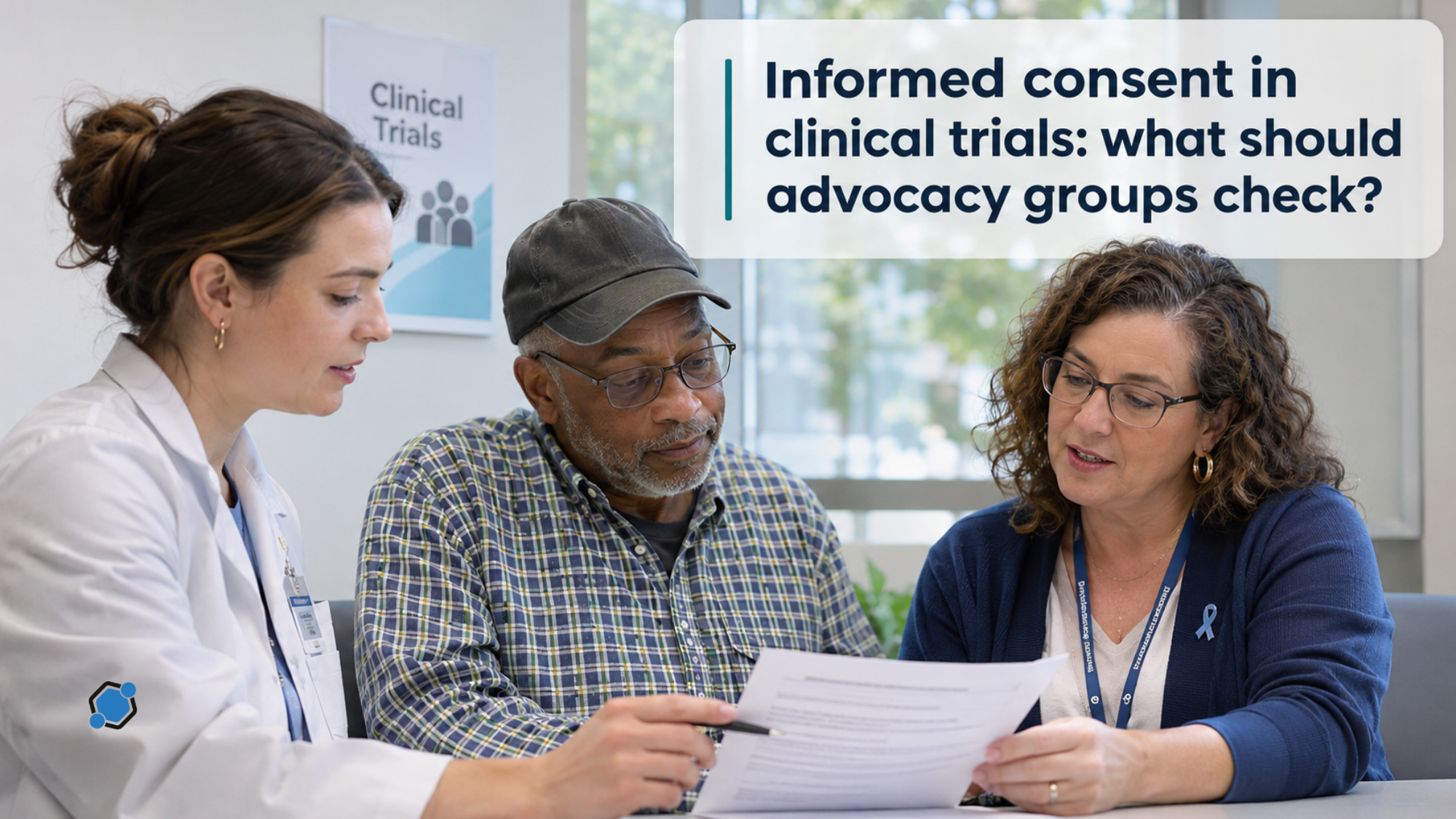
Informed consent in clinical trials is the process through which a person learns about a research study and decides, voluntarily, whether to take part. Federal rules require that information to be presented in language the person can understand, yet many consent forms are long, technical, and written well above the reading level of most adults.
Patient advocacy groups are well placed to close that gap because they know how their communities read, speak, and make health decisions. This article explains what understandable consent looks like and sets out a practical checklist advocacy groups can use when reviewing studies and preparing community members.
What informed consent in clinical trials involves
Informed consent is an ongoing exchange of information between a participant and the research team. It begins before enrollment and continues until the study ends. The signed form documents the decision, but the signature is not the consent itself.
The FDA describes the process as giving people adequate information, helping them understand it, allowing time to ask questions and consider, and continuing to share information as the study progresses. Two sets of federal rules define what must be covered: the Common Rule, which governs most federally funded research, and FDA regulations, which govern studies of drugs, biological products, and medical devices. Both require the research team to explain:
- That the study is research, what it aims to learn, how long participation lasts, and what procedures are involved
- Reasonably foreseeable risks or discomforts
- Possible benefits to the participant or to others
- Other treatments or procedures that may be available
- How personal records will be kept confidential
- For studies involving more than minimal risk, whether compensation or medical treatment is available if an injury occurs
- Whom to contact with questions about the study or participant rights
- That participation is voluntary and that declining or leaving carries no penalty or loss of benefits
Before a study begins, an Institutional Review Board (IRB) reviews and approves the consent form and process. An IRB is an independent committee that oversees research involving people to protect their rights and welfare. Community members preparing for a study can also learn how to read a consent form before signing.
Why consent forms are often hard to understand
Health literacy is the ability to find, understand, and use health information to make decisions. The most recent national assessment of adult health literacy, conducted in 2003, found that only about 1 in 8 U.S. adults had proficient health literacy, while more than a third had basic or below-basic skills.
Many health literacy guides recommend writing patient materials at a 6th- to 8th-grade reading level. A 2024 analysis of consent forms from nearly 800 federally funded trials found they averaged about a 12th-grade level. A separate 2024 review of more than 5,000 consent forms found that roughly 9 in 10 were written above the 8th-grade level, and the average form ran to about 14 pages.
The analysis of federally funded trials also found that harder-to-read forms were associated with higher dropout. That link does not prove reading level caused people to leave, but it suggests consent quality matters beyond the day of signing.
Gaps in understanding follow a consistent pattern. A 2015 review of more than 100 studies found that about three in four participants understood that taking part was voluntary and that they could leave at any time. Only about half understood randomization, which means being assigned to a study group by chance, or placebo, which is an inactive substance used for comparison. A similar share could name even one risk of their study.
Randomization and placebo deserve particular attention because misunderstanding either one can leave a participant feeling misled later. Advocacy groups can draw on resources about explaining placebos to their communities before a consent conversation takes place.
What understandable consent looks like
Recent rules and guidance share three principles: lead with what matters most, use plain language, and check understanding rather than assume it. Since 2019, the revised Common Rule has required consent for most federally funded research to open with a concise, focused summary of the key information most likely to help a person decide whether to join.
FDA proposed the same requirement for the studies it regulates in 2022, but that rule had not been finalized as of November 2026. In 2024, FDA and the HHS Office for Human Research Protections (OHRP) issued joint draft guidance on presenting key information and helping participants understand it. The guidance is not final, but its recommendations offer a useful benchmark:
- A key information section that is relatively short, generally no more than a few pages
- The most important risks placed on the first page where possible
- Benefits described realistically, with a clear statement when no direct benefit is expected
- A clear explanation that taking part in research is different from receiving regular medical care
- Illustrations, visual layouts, and video to support understanding
- Early input from patient advocacy groups or prospective participants on which information matters most
International good clinical practice guidance points the same way. ICH E6(R3), which FDA issued as final guidance in September 2025, says participants should be informed in a way that supports their understanding, and it allows electronic consent, also called eConsent, and remote consent where appropriate. eConsent can combine text with audio, video, and interactive questions, provided every required element is still covered. Research sites carry the operational side of this work, including what a compliant remote eConsent process requires.
Method matters as much as the document. The teach-back method asks a person to explain the study in their own words so staff can correct misunderstandings on the spot. In reviews of consent research, approaches built on this kind of back-and-forth discussion have shown some of the most consistent improvements in understanding.
Document design also makes a measurable difference. A 2026 randomized study found that a redesigned form written at a much lower reading level produced noticeably higher comprehension scores than the original long industry form. The shortest version tested did not perform best, which suggests that plain wording and clear organization matter more than page count alone. Participants in that study were responding to a hypothetical study rather than enrolling in a real one.
An informed consent checklist for advocacy groups
Advocacy groups bring knowledge that research teams often lack: how a community reads, speaks, and weighs risk. The checklist below turns that knowledge into specific contributions. Each item supports the IRB-approved process led by the research site and does not replace it.
Reviewing consent materials
- Check whether the form opens with a short key information section that a reader can absorb in one sitting
- Run the text through a standard readability tool and compare the result with the 6th- to 8th-grade target
- Flag terms used without explanation, such as “randomization,” “placebo,” “adverse event,” and “investigational”
- Confirm that the form states plainly whether direct benefit is expected
- Offer to test drafts with community members and share their questions with the study team
Language, culture, and access
- Ask whether fully translated consent forms will be available in the languages the community speaks
- Ask whether a qualified medical interpreter will join every consent conversation, not only the first
- Discourage relying on family members, especially children, to interpret
- Request accessible formats, including large print, audio or video versions, screen-reader-compatible eConsent, and sign language interpretation
- Review examples and images for cultural fit and respectful language
Language access is a legal requirement, not an optional extra. Consent information must be in language the participant understands. When no translated form exists, an IRB may approve a short form process, in which an interpreter presents the full information orally with a witness present and the participant signs a brief document in their own language.
Separately, the 2024 nondiscrimination rule under Section 1557 of the Affordable Care Act requires covered health programs to use qualified interpreters and to have a qualified human translator review machine-translated content that is critical or technical. Groups focused on technology access can pair this review with an advocacy checklist for digital inclusion.
Preparing people for the consent conversation
- Share a short list of questions to bring, such as what the study is testing, how it differs from usual care, and what happens if the person leaves
- Encourage people to take an unsigned copy home and read it with family or a caregiver
- Explain the teach-back method so people expect to describe the study in their own words
- Make clear that “no” and “not yet” are always acceptable answers
How consent continues after enrollment
Consent does not end with a signature. Federal rules require the consent process to include a commitment to share significant new findings that may affect a participant’s willingness to continue. When a study changes in a meaningful way, participants may be asked to review and sign an updated form, a step known as re-consent.
Advocacy groups can reinforce several points after enrollment:
- Participants may withdraw at any time without penalty or loss of benefits they are otherwise entitled to
- Participants should keep contact details for both the study team and the IRB
- New information about risks or procedures should be explained in the same plain language as the original consent
Advocacy groups can also gather feedback on the consent experience and share it with sponsors and sites. Repeated confusion about the same procedure, for example, gives study teams concrete evidence for revising future materials.
Frequently asked questions about informed consent
Is signing a consent form the same as giving informed consent?
The signature documents the decision, but informed consent is the full process of receiving information, asking questions, and deciding voluntarily. That process continues for as long as the person takes part in the study.
Can a participant leave a clinical trial after signing the consent form?
Yes. Participation is voluntary, and a participant may withdraw at any time without penalty or loss of benefits they are otherwise entitled to. The study team may discuss follow-up steps for safety, but the decision to leave belongs to the participant.
Can advocacy groups review a consent form before a study starts?
Advocacy groups can offer to review draft materials or serve on community advisory boards, which are groups of community members who advise researchers on study design and participant materials. The FDA and OHRP draft guidance encourages consulting advocacy groups about which information is key. The IRB still approves the final form.
What happens if a person does not speak English?
Consent information must be presented in a language the person understands, ideally through a fully translated form and a qualified interpreter. When no translation exists, an IRB-approved short form process with an interpreter and a witness may be used.
Where advocacy groups and recruitment platforms fit in the consent process
The authorized research site and study team conduct informed consent under IRB oversight. They explain the study, answer questions, confirm understanding, and make final eligibility and enrollment decisions. Advocacy groups strengthen that process by improving materials, protecting language access, and preparing community members to ask informed questions.
DecenTrialz is a clinical trial recruitment, pre-screening, and participant management platform. People share information about their health, AI-assisted matching identifies studies that may fit, a registered nurse reviews preliminary fit through pre-screening, and a referral goes to the research site team. Advocacy group partners also have access to a dashboard.
DecenTrialz does not obtain informed consent, determine eligibility, or guarantee enrollment, trial access, or outcomes. Those steps belong to the research site and study team.
Advocacy groups that want to connect their communities with relevant research opportunities can learn more at decentrialz.com.
Was this article helpful?

Similar Blogs

How advocacy groups can push for clinical trial reimbursement
Clinical trial reimbursement determines whether many people can afford to take part in res...
 Paramraj

What do community health workers do in clinical trials?
Community health workers in clinical trials serve as trusted guides between a community an...
 Anish Teepireddy
Decentralized Clinical Trials: an advocacy checklist for digital inclusion
Decentralized clinical trials are being promoted as a way to bring research to the partici...
Vamshi KantojuStay Informed. Stay Connected.
Get updates on verified clinical trials, emerging treatments, and research breakthroughs directly in your inbox. No spam, just science that matters.
