 HIPAA Compliant
 ISO 27001 Certified
Decentralized Clinical Trials: an advocacy checklist for digital inclusion
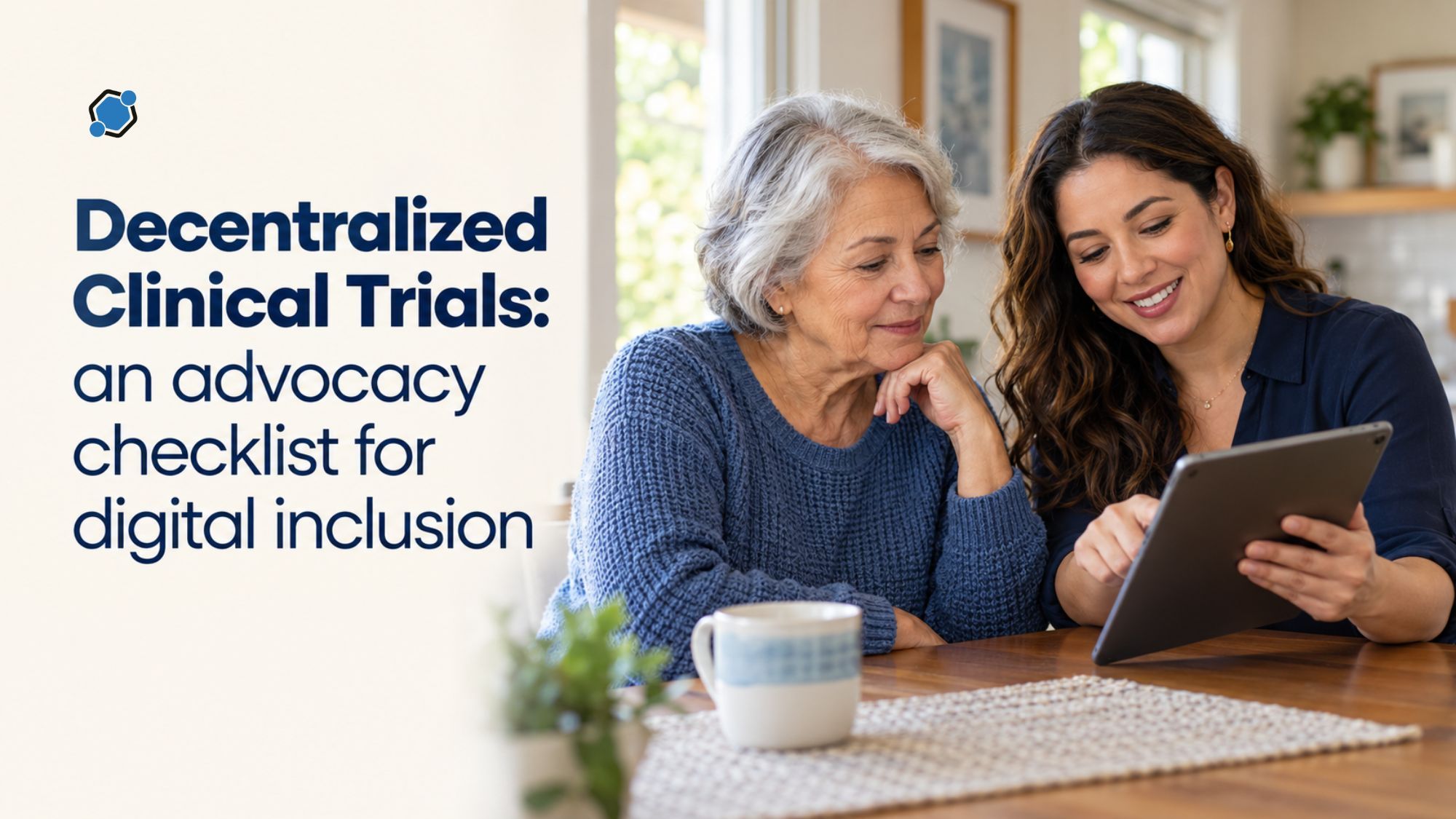
Decentralized clinical trials are being promoted as a way to bring research to the participant instead of forcing the participant to travel to research. The promise is real. Home nursing visits, telehealth check-ins, mobile phlebotomy, direct-to-participant medication shipment, and electronic consent can remove barriers that have kept underrepresented communities out of clinical research for decades.
The risk is equally real. A trial that moves everything online can quietly exclude the same populations it was designed to include. Rural households, older adults, low-income families, Tribal communities, non-English speakers, and people with disabilities are least likely to have reliable broadband or the digital literacy most study apps assume. For advocacy groups evaluating a decentralized trial, the central question is not whether the study uses digital tools, but whether it offers a working alternative for participants who cannot.
What decentralized clinical trials actually change
A decentralized clinical trial, sometimes called a DCT, moves some or all study activities out of the traditional research clinic. Visits may happen at home, at a local clinic, at a nearby lab, or by video call. Fully decentralized trials, where every activity happens remotely, remain uncommon. Most sponsors adopt a hybrid model, mixing a smaller number of in-person visits with remote check-ins, wearable devices, and home services.
The advantages for participants are clear. Fewer long drives, less time off work, less dependence on caregivers, and more flexibility for people with mobility limitations. For rural communities and Tribal lands where the nearest academic medical center may be hundreds of miles away, the ability to complete visits from home is often the difference between joining a study and declining.
How that mix is drawn matters. The decisions about which visits stay on-site, which move to a home nurse, and which convert to a video call are made during protocol design, long before any participant hears about the study. Research site teams weigh clinical safety, data quality, and participant burden when setting that mix, and the choices they make on what stays in the clinic and what goes remote directly shape who can realistically join.
The equity case, and its limits
Historical clinical trial participation in the United States has been sharply skewed toward White, urban, working-age, English-speaking participants. Black, Hispanic, Indigenous, and Asian populations have all been underrepresented in pivotal trials. Older adults with multiple health conditions have been excluded by eligibility rules that assume a single primary diagnosis, and rural residents have been geographically shut out.
Decentralized elements address the geographic and logistical layers of that exclusion. An academic program studying decentralized services, published in a major medical journal in 2026, reported meaningful increases in the share of participants living far from the site and in the share from racial and ethnic groups historically underrepresented in research. The authors noted the design was observational, so the gains cannot be attributed to decentralization alone. The direction is consistent with what community researchers have argued for years: when the burden of participation drops, previously excluded populations show up.
Federal policy has moved in the same direction, though the pace has been uneven. The federal drug regulator finalized guidance on trials with decentralized elements in September 2024, and a related final guidance on enhancing participation in clinical trials was issued in late 2025. A separate framework requiring sponsors to submit diversity enrollment plans has moved more slowly, and its status has shifted several times. The current state of that federal diversity policy is worth understanding before advocacy groups build campaigns around it, because voluntary sponsor commitments and community pressure currently carry more weight than any enforceable mandate.
The digital divide inside the U.S. patient population
The paradox of decentralized trials is that participants who stand to gain most from remote participation are often the same participants least equipped to use it. National survey data from the Pew Research Center, updated in early 2026, shows home broadband adoption drops sharply with income and age, that Hispanic households have seen broadband access decline in recent years, and that a substantial share of lower-income adults rely on a smartphone as their only internet connection. Smartphone dependence sounds workable, but it fails quickly when a study app requires long form entry, large file uploads, or frequent video calls on a capped data plan.
Infrastructure gaps compound the affordability problem. Federal broadband data indicate that roughly one in four rural residents and a comparable share of people on Tribal lands still lack access to service at current benchmark speeds, and the federal subsidy program that had helped over twenty million households afford home internet ended in mid-2024 without a direct replacement. Language is a further barrier: tens of millions of U.S. residents speak English less than well, and most study apps and consent platforms are available only in English or in a handful of high-resource languages.
Accessibility is the layer most often missed. Trial apps, wearables companion apps, and electronic consent platforms must work for people who use screen readers, who have low vision, limited dexterity, cognitive disabilities, or who are Deaf or hard of hearing. Federal accessibility rules covering public and federally funded health entities have been strengthened, though compliance deadlines have been extended into 2027 and 2028. Advocacy groups working on inclusion can find useful background in this overview of how disability access rules apply to clinical research, which frames the reasonable-accommodation obligations that continue regardless of deadline extensions.
How advocacy groups can pressure-test a decentralized trial design
A useful way for advocacy groups to evaluate whether a decentralized trial genuinely serves an underrepresented community is to run it through five plain questions. Each question corresponds to a layer of exclusion that a digital-only design can create.
- Access. Can someone with no home broadband and no smartphone participate fully in this study, and if so, exactly how?
- Ability. Have the study app, the wearable companion app, and the electronic consent platform been tested for compatibility with screen readers, for keyboard navigation, for color contrast, and for cognitive load?
- Language and literacy. Are consent documents, app interfaces, and live participant support available in the languages this community actually speaks, at a reading level a general adult audience can follow?
- Support. Is a real human being available by phone, in the participant's language, to walk through setup, first use, and any problems that arise?
- Accountability. Will the sponsor track and report who enrolled, who stayed, and who dropped out, broken down by participation mode, age, rurality, and language, so exclusion becomes visible rather than hidden?
The same lens applies to the recruitment and matching layer that sits in front of a trial. Some AI-assisted matching platforms surface studies to community members through advocacy partnerships and offer phone-based support alongside online forms; others are online-only. Advocacy groups can request the same access, ability, language, support, and accountability information from any matching platform they consider working with, using the questions in this framework for evaluating AI-assisted matching partners as a starting point.
Practical pathways to close the divide
Design changes that meaningfully close the digital divide are not exotic. They are documented in the research literature and increasingly reflected in regulatory guidance. What they require is deliberate protocol planning and adequate budget, both of which advocacy groups can influence when brought in early.
The most consistent recommendation is to make every digital element optional and every remote element supported. That means phone-based surveys alongside app-based ones, paper diaries alongside electronic ones, and in-person consent locations alongside electronic consent. It means budgeting for study-provided devices, hotspots or paid data plans, and technical support in the participant's language. It means apps that work offline, sync when a connection is available, and do not assume unlimited data.
Community infrastructure closes many of the remaining gaps. Libraries, senior centers, faith organizations, Tribal health programs, and community health workers can serve as trusted local support points for participants completing remote study tasks. Reimbursement for travel, mileage, childcare, and lost wages removes a category of financial barrier that has historically kept lower-income participants out of research even when studies are geographically close.
Advocacy groups themselves can play a direct operational role, not only an advisory one. Community-led awareness sessions, in-language explanations of what a trial involves, and warm phone-based conversations with prospective participants often surface fit or non-fit far more accurately than online forms alone. Guidance on how to structure that work sits in this walkthrough of community-led pre-screening in advocacy settings, which covers the practical mechanics of scoping, staffing, and handoff to a research site team.
Where DecenTrialz fits
DecenTrialz is a clinical trial recruitment and pre-screening platform that pairs AI-assisted participant matching with registered nurse-led pre-screening. Prospective participants share information about their health and interests, the platform surfaces studies for which they may be a fit, and a registered nurse conducts a structured pre-screening conversation before any referral is made.
The scope boundary is important for advocacy groups to understand. Final eligibility determination, informed consent, the study walk-through, and enrollment are handled by the research site team, not by DecenTrialz. That separation matters for trust and for accuracy, because it keeps clinical decisions with the clinicians authorized to make them.
For advocacy groups that want to route community members toward relevant studies without asking every member to navigate a fragmented digital landscape alone, a platform that combines algorithmic matching with a human pre-screening step can reduce the digital-literacy burden on participants and improve the fit of referrals reaching research sites.
Frequently asked questions
Are decentralized clinical trials safe and regulated?
Yes. The federal drug regulator has confirmed that the same regulatory requirements apply to trials with decentralized elements as to fully on-site trials, including informed consent, safety reporting, and good clinical practice standards. Decentralization changes where activities happen, not the underlying oversight framework.
Can someone join a decentralized trial without home internet or a smartphone?
In well-designed hybrid trials, yes. Participants may complete visits by phone, at home with a visiting nurse, at a local lab, or at the research site itself. Some studies also provide devices and data plans. Prospective participants should ask the research site team directly what non-digital options are available before assuming a study requires internet access.
Do decentralized trials actually improve diversity?
They can, but the effect depends heavily on design. Studies that offer only digital pathways tend to select for younger, healthier, better-connected participants. Studies that pair remote options with phone, mail, and in-person alternatives, and that provide devices and support, have shown expanded rural and underrepresented enrollment in early published evaluations.
What can advocacy groups do if a sponsor refuses to add non-digital options?
Advocacy groups can decline to endorse or promote the study to their communities, can raise the design gap publicly, and can request that the sponsor report enrollment demographics by participation mode. Voluntary transparency commitments have historically responded to organized advocacy pressure even in the absence of a regulatory mandate.
How can advocacy groups get involved before a trial is designed?
Community advisory boards, patient advisory councils, and formal protocol review roles are becoming more common. Advocacy groups that want influence over digital-inclusion decisions should ask sponsors and contract research organizations about these structures early, ideally during feasibility discussions rather than after the protocol is locked.
The design decision that matters most
Decentralized clinical trials are neither an automatic equity tool nor an automatic digital-divide trap. What they are is a set of design choices, and the choices that determine whether a study genuinely widens access are made early, quietly, and often without community input. Advocacy groups that engage during protocol design, that press for non-digital alternatives as a baseline rather than an exception, and that hold sponsors to reporting on who actually enrolled, are the mechanism by which the equity case for decentralization becomes an equity outcome.
The technology is available. The regulatory framework supports it. What remains is whether every study calling itself decentralized treats digital inclusion as a design requirement rather than a hope.
Was this article helpful?

Similar Blogs

Clinical Trial Data Governance: What Advocacy Groups Should Verify Before Endorsing a Study
Patient information now travels further than most study participants expect. A study that ...
 Swaroop ESD
Tokenization in Clinical Trials: What Should Advocacy Groups Ask Sponsors About Patient Privacy
Tokenization has become one of the most widely adopted data techniques in modern clinical ...
Mahesh Upadrista
How advocacy groups turn patient registries into clinical trials
For most rare and chronic disease communities, the biggest obstacle to research is not sci...
Deeksha GittaStay Informed. Stay Connected.
Get updates on verified clinical trials, emerging treatments, and research breakthroughs directly in your inbox. No spam, just science that matters.
