 HIPAA Compliant
 ISO 27001 Certified
International Clinical Trials Day 2026: Origins, Impact, and the Future of Clinical Research
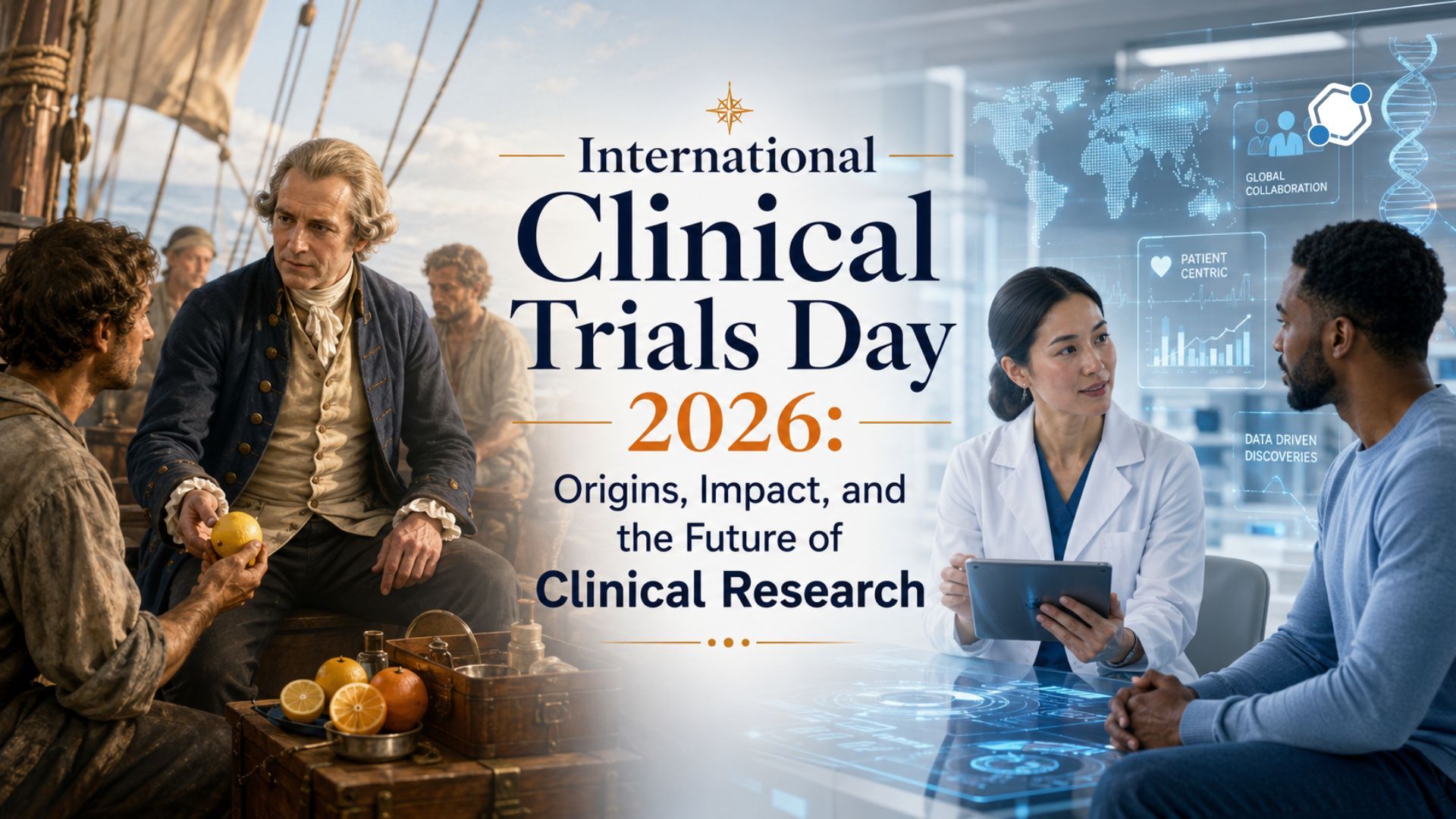
Every year on May 20, the clinical research field marks International Clinical Trials Day. The date traces back to 1747, when British naval physician James Lind ran what is widely considered the first controlled clinical trial: a twelve-sailor study aboard HMS Salisbury that identified citrus fruit as the remedy for scurvy. Nearly three centuries later, May 20 has become the annual moment for sponsors, contract research organizations, research sites, healthcare professionals, advocacy bodies, and participants to recognize the work that turns a scientific question into a documented, regulated answer.
International Clinical Trials Day, often shortened to ICTD, is a global observance launched in 2005 by the Association of Clinical Research Professionals (ACRP) and supported across regions by research networks including the European Clinical Research Infrastructure Network (ECRIN). It is not a single campaign with a fixed theme; it is a coordinated set of events, panels, and recognition activities held by research organizations, sites, sponsors, advocacy groups, and academic centers around May 20 each year.
This article covers the three things the day asks the field to revisit: the origins of clinical research as a method, the impact clinical trials continue to have on modern medicine, and the future shape of the research enterprise as it adapts to decentralization, artificial intelligence, and participant-centric models.
The Origins of International Clinical Trials Day
James Lind's 1747 experiment is the historical anchor of the day. Lind divided twelve sailors with scurvy into six pairs, each pair receiving a different candidate remedy: cider, sulfuric acid, vinegar, seawater, a paste of garlic and mustard, or two oranges and a lemon. The pair receiving citrus recovered within days; the others did not. Lind documented the experiment in his Treatise of the Scurvy, published in 1753.
What makes the trial historically important is the method. Lind tested several candidate interventions in parallel, held the underlying diet constant across all participants, and compared results. That basic structure (defined participants, controlled conditions, parallel intervention groups, recorded outcomes) is the lineage today's randomized controlled trials sit. Modern protocols add randomization, blinding, statistical power calculations, regulatory oversight, ethics committee review, informed consent, and adverse event reporting (an adverse event is a documented medical issue that occurs during the trial, whether or not it turns out to be related to the study). The principle is the same; the apparatus has expanded considerably.
The path from Lind's twelve-sailor study to today's multi-site, multi-country, sponsor-CRO-site partnerships is a roughly 280-year history of methodological refinement and regulatory development. Major waypoints include Sir Austin Bradford Hill's 1948 streptomycin trial (often cited as the first modern randomized controlled trial), the Nuremberg Code in 1947 and the Declaration of Helsinki in 1964, and the rise of contract research organizations as operational partners running studies on behalf of sponsors. CROs now sit at the operational center of the field, powering every phase of a trial on behalf of the sponsors that finance and own the research.
May 20 was chosen as the observance date to honor Lind's experiment, which began on that day in 1747. ACRP formalized the observance in 2005, and it has since been adopted by clinical research bodies in Europe, Asia, and the Americas as a shared annual recognition of the field.
What International Clinical Trials Day Represents in 2026
ICTD is not a single theme or single event. It is a coordinated annual recognition of three things: the participants who make clinical research possible by volunteering for studies, the clinical research professionals who design and run those studies, and the ongoing need for more participation across more diverse populations.
Different organizations approach the day differently. ACRP, which launched the observance, runs recognition campaigns and member events through May. ECRIN and partner research infrastructures across Europe host coordinated events focused on the academic and non-commercial research sector. National research bodies, academic medical centers, and clinical research training organizations hold panels, social media campaigns, and site-based recognition activities. Many sponsors and CROs use the day for internal recognition of clinical teams, including study coordinators, research nurses, clinical research associates, data managers, and principal investigators (the licensed physicians responsible for each study at a given site).
The day also sits inside a clustered set of May observances that recognize different parts of the research and care ecosystem. International Nurses Day on May 12, for example, recognizes the nurses who staff clinical sites, run pre-screening, and serve as participants' primary contact across long studies. National Cancer Research Month, Mental Health Awareness Month, Asthma and Allergy Awareness Month, and Women's Health Month all run through May, each pointing to a different segment of the research the day is recognizing.
For sponsors, CROs, and sites, ICTD is a practical moment to do three things internally: recognize the cross-functional teams that ran the year's studies, acknowledge participants without whom no data exists, and review where the field's recruitment and retention pressures are concentrating. For HCPs and academic researchers, it is a public-facing moment to discuss what trials are running in their therapeutic area, who they are looking for, and why the gap between people who would benefit from research access and people who actually enroll remains as wide as it does.
The Impact of Clinical Trials on Modern Medicine
Every therapy on a pharmacy shelf, every vaccine in a clinic refrigerator, every device used in surgery, and every diagnostic test in a lab arrived there because clinical trial data established that the product was reasonably safe and worked as intended for its indication. There is no parallel pathway: the trial data is the entry permission, and that data is what allows clinical research to advance medicine and change lives across every disease area where new options reach patients.
The impact shows in long-term outcome trends across major disease areas. Cancer mortality in the United States declined by roughly a third between the early 1990s and the early 2020s, driven in part by trial-validated screening, surgical, radiotherapy, and systemic therapy advances. Cardiovascular mortality has fallen significantly over the same period as statins, antihypertensives, antiplatelet therapy, and acute care protocols accumulated trial evidence. HIV moved from a uniformly fatal diagnosis to a manageable chronic condition over three decades of antiretroviral trials. Rare disease therapy, historically the most under-served area, has expanded substantially under regulatory frameworks that incentivize sponsors to run trials for small populations.
Vaccine programs offer a more compressed example. The mRNA (messenger ribonucleic acid) platform, in development for years, moved from a research-stage technology to billions of doses administered through trial pipelines that compressed timelines without removing the safety and efficacy gates. The same platform is now being studied in oncology, infectious disease, and rare disease applications, because the underlying trial infrastructure already existed at scale.
What is sometimes lost in the impact framing is that none of the data exists without participants. Each approval rests on people who volunteered for studies that did not yet have a confirmed outcome, who took on the uncertainty of an investigational product, and who agreed to the scheduled visits, data collection, and follow-up that the protocol (the document that defines how a study is run) required. ICTD is, in part, an annual recognition of that contribution.
Where Clinical Research Stands in 2026
Based on a search of public clinical trial registries in May 2026, approximately 47,400 actively recruiting interventional trials are running globally, with around 18,000 of those in the United States. These counts shift continuously as trials open, close, and update status, so the exact numbers will look different a few months from now. The order of magnitude reflects a field that is still expanding in absolute scale even as individual studies grow in complexity.
Recruitment remains the dominant operational pressure point. Industry analyses across the past decade have consistently shown that the majority of trials fail to meet enrollment timelines, that protocol amendments driven by recruitment difficulty are common and costly, and that screen-failure rates (the share of pre-screened candidates who do not meet eligibility criteria at the site) absorb significant site resources. The ongoing challenge of clinical trial recruitment is the structural problem sponsors are most actively trying to solve, because delayed enrollment delays approval, which delays patient access to therapies under study.
The field's response in 2026 is concentrated in four interconnected shifts. Decentralized and hybrid trial models have moved from pilot status into routine use, with telehealth visits, remote consent, in-home study procedures, and wearable-based data collection now treated as standard tools rather than experimental adjustments. AI-assisted matching is increasingly used to surface trial-eligible candidates from electronic health records, patient registries, and direct-to-participant outreach, with the goal of reducing the gap between people who could qualify and people who actually reach a screening visit. Diversity and inclusion initiatives, prompted in part by FDA guidance on representative enrollment, are reshaping site selection, community partnerships, and recruitment communications. And nurse-led pre-screening models are being used to reduce screen-failure rates at sites by routing only well-qualified candidates through the formal eligibility verification process.
For sponsors and CROs, the practical implication is that recruitment is no longer a downstream operational task that begins after protocol finalization. It is increasingly treated as part of protocol design, with participant burden, geographic accessibility, eligibility breadth, and source diversity considered before the protocol locks. For sites, the tools used to screen and refer participants are now part of competitive positioning when sites bid for studies.
The Future of Clinical Research and How to Mark ICTD 2026
The trends concentrating in 2026 are not separate experiments. They are converging into a default model for how trials will be designed, recruited, and run over the next decade. Decentralization, AI-assisted matching, nurse-led pre-screening, and platform-based participant flow are increasingly delivered through integrated systems rather than as standalone interventions, with sponsor dashboards providing real-time visibility into recruitment, screening, and enrollment at the trial, site, and source-attribution level. That convergence is the practical reason what sponsors look for in a recruitment platform has shifted from one-off vendor evaluations to long-term partnership decisions.
DecenTrialz operates at the intersection of those shifts. It is a participant recruitment and pre-screening platform serving sponsors, CROs, and research sites in the United States. The platform uses AI-assisted matching to identify candidates whose profile fits a study, and a registered nurse completes an initial pre-screening review before referral to the site research team. Trial-level dashboards provide sponsor, CRO, and site visibility into pipeline progress, screening conversion, and source-attributed enrollment. Final eligibility verification, informed consent, and enrollment are always handled by the study team responsible for the trial. You can start a search at decentrialz.com.
For sponsors and CROs, ICTD 2026 is a practical moment to take stock of the year's recruitment performance: which studies hit their enrollment timelines, where the bottlenecks concentrated, how much of the gap was protocol-driven and how much was pipeline-driven, and what the year's data says about whether decentralized elements actually improved access or just shifted participant burden. For sites, the day is a moment to recognize the coordinators, nurses, and investigators who ran the year's studies, and to review the screen-failure data and source-attribution data that show where the site's recruitment is over- and under-performing.
For HCPs, the day is a moment to revisit which trials are running in the conditions their patients live with, what the trials are looking for, and how to make the referral pathway visible without overpromising. For advocacy groups and patient communities, it is a moment to recognize the people who participated and reinforce that participation remains the limiting factor in how fast the next generation of therapies arrives.
International Clinical Trials Day exists because every study, every approval, and every therapy traces back to a question someone asked, a method someone designed, and a group of participants who agreed to volunteer. May 20 is a single day on the calendar, but the work it recognizes is continuous, and the gap between what the field could deliver and what it actually delivers remains determined by how well sponsors, CROs, sites, HCPs, and platforms recruit and retain the participants the science depends on. You can begin a search at decentrialz.com.
Was this article helpful?

Similar Blogs
Why is my blood pressure still high on medication? Resistant hypertension explained
Blood pressure that stays high after treatment has already started is more common than mos...
 Vamshi Kantoju
What is insulin resistance and how does it affect blood sugar?
Insulin resistance is a condition in which muscle, liver, and fat cells respond weakly to ...
Swaroop ESD
Mini-stroke symptoms: how to recognize a transient ischemic attack before a full stroke
A transient ischemic attack, often called a mini-stroke, is a short episode of stroke symp...
Deeksha GittaStay Informed. Stay Connected.
Get updates on verified clinical trials, emerging treatments, and research breakthroughs directly in your inbox. No spam, just science that matters.
