 HIPAA Compliant
 ISO 27001 Certified
Juvenile Arthritis Awareness Month 2026: Symptoms, Subtypes, and Pediatric Research
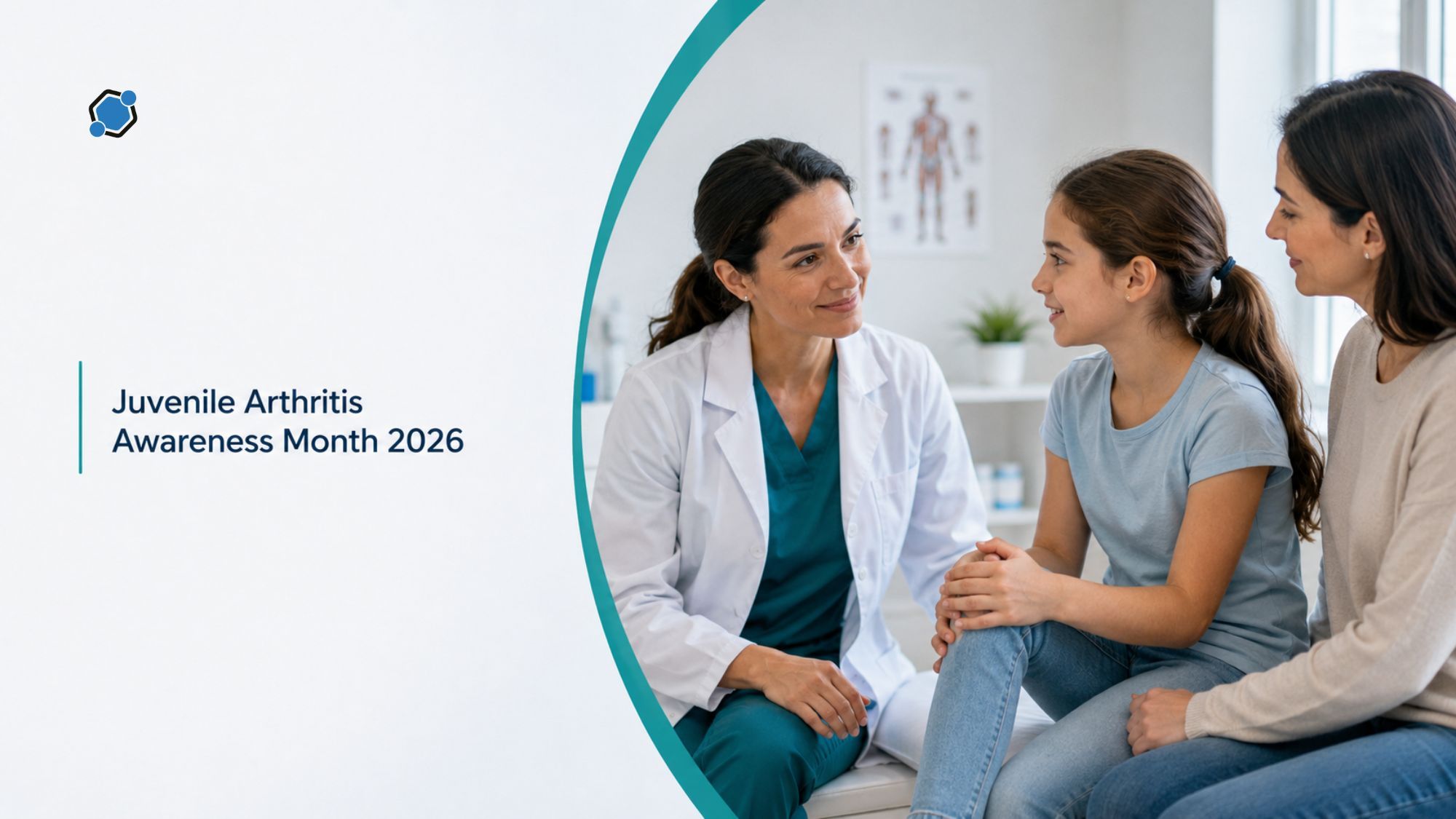
Roughly 300,000 children and teens in the United States live with some form of arthritis, according to the Arthritis Foundation. The number sits at odds with what most people picture when they hear the word: a knee that aches with age, or a hand that stiffens after a lifetime of work. Childhood arthritis is something different. It is most often an autoimmune condition, meaning the body's defense system mistakenly attacks its own joints and tissues. It can begin in infants as young as a few months old and can persist for years.
July is Juvenile Arthritis Awareness Month in the United States. The month, led by the Arthritis Foundation, is built around the campaign phrase "Kids Get Arthritis Too," and is intended to address a real public misconception with measurable consequences for diagnosis, care, and access to specialists. The article below covers the symptoms families and clinicians look for, the main subtypes that fall under the juvenile arthritis umbrella, why the awareness month exists, where pediatric arthritis research currently stands in 2026, and what families living with a diagnosis quietly carry.
What childhood arthritis actually is
Juvenile arthritis, often shortened to JA, is an umbrella term for a group of inflammatory and autoimmune conditions that begin before the age of 18. Unlike osteoarthritis, the wear-and-tear condition most older adults associate with the word arthritis, juvenile arthritis is not caused by aging joints or repetitive use. In most cases, the immune system, which is built to defend the body against infections, instead targets the lining of the joints and surrounding tissues, and sometimes other organs. The result is inflammation that can produce pain, swelling, stiffness, fatigue, fever, and in some children rashes or eye inflammation.
The most common form of juvenile arthritis is juvenile idiopathic arthritis (JIA), where "idiopathic" simply means a condition whose exact cause is not fully understood. JIA is the most frequent chronic rheumatic disease in childhood. Other conditions captured under the broader JA umbrella include juvenile myositis (inflammation of the muscles), juvenile lupus (an autoimmune disease that can affect joints, skin, and internal organs), juvenile scleroderma (which causes the skin and connective tissue to harden), Kawasaki disease (a form of childhood blood vessel inflammation), and fibromyalgia.
Research is steadily changing what is known about how these conditions begin, how they progress, and how they respond to current therapies. Clinical trials are the route through which most of that knowledge is built, and that route is the same one being used to study many other chronic and rare conditions. How Clinical Trials Advance Medicine and Change Lives offers a broader view of how research moves from question to answer.
The main forms of juvenile idiopathic arthritis
Juvenile idiopathic arthritis is divided into several subtypes. The classification used most often in clinical practice comes from the International League of Associations for Rheumatology (ILAR), which groups JIA into seven subtypes based on how many joints are affected in the first six months of disease, whether systemic symptoms appear, and what blood markers are present.
The three most frequently diagnosed subtypes are oligoarticular JIA (four or fewer joints affected, often involving a knee or ankle, and the most common form in the United States), polyarticular JIA (five or more joints affected, often including small joints in the hands and feet), and systemic JIA (where fever, rash, and lymph node enlargement appear in addition to joint involvement). Less commonly diagnosed forms include enthesitis-related arthritis (where the inflammation centers on the points where tendons attach to bone), juvenile psoriatic arthritis (linked to psoriasis), and undifferentiated arthritis (cases that do not fit neatly into a single category).
Diagnosis is rarely as simple as a single test. Pediatric rheumatologists rely on the pattern of joint involvement, blood markers such as rheumatoid factor and antinuclear antibody, and imaging methods to classify a child's specific subtype. Recent research is also exploring whether molecular and blood-based signatures, sometimes called biomarkers, can help distinguish subtypes earlier and predict which children will respond best to which therapies. What Is a Biomarker? Your Body's Hidden Health Signals explains the broader role biomarkers now play across clinical research.
Why Juvenile Arthritis Awareness Month exists
Public awareness of childhood arthritis lags behind awareness of many other pediatric conditions. The Arthritis Foundation officially designated July as Juvenile Arthritis Awareness Month in 2006, and the month is anchored by the campaign phrase "Kids Get Arthritis Too." The phrase exists because the assumption that arthritis is a disease of older adults is still widespread, and that assumption has practical consequences. Families have reported delays in diagnosis, dismissed concerns at general pediatric visits, and difficulty finding specialists.
Access to pediatric rheumatology care is one of the most concrete concerns the month raises. The Arthritis Foundation has reported that there are roughly 420 board-certified pediatric rheumatologists practicing in the United States, with eight states having no pediatric rheumatologist at all and six states having only one. Approximately one in four children with arthritis is currently able to see a pediatric rheumatologist, and a child seeking that care travels an average of 57 miles, more than double the average distance for other pediatric subspecialties.
Beyond clinical access, the awareness month also focuses on the social and educational realities of growing up with a chronic condition. School absences, modifications to physical education, the timing of medications during the school day, and the emotional weight of explaining a chronic illness to peers are all part of the picture. Advocacy work during July is partly aimed at policymakers, health insurers, and schools, and partly at the broader public whose donations, fundraising walks, and grassroots support fund research and family services. How Clinical Trials Contribute to Public Health describes how that funded research connects back to community-level outcomes.
Where pediatric arthritis research stands in 2026
Clinical research in juvenile arthritis has shifted considerably over the past two decades. Older approaches to disease management relied heavily on broad immune suppression. Current research, and increasingly current clinical care, focuses on more targeted approaches that aim to interrupt specific parts of the immune signaling that drives joint inflammation. Several classes of medicines, including biologic medicines that block specific immune messengers and a newer class of small-molecule medicines that target intracellular signaling, have changed the long-term outlook for many children with moderate-to-severe disease.
Based on a search of public clinical trial registries in mid-2026, roughly 65 trials are actively recruiting worldwide for juvenile arthritis or juvenile idiopathic arthritis, with around 17 of those recruiting in the United States. These counts shift as trials open and close, so the precise numbers will look different a few months from now. The studies cover a wide range of questions, from comparing how well newer medicines work across different JIA subtypes, to tracking how children's growth and development are affected over time, to observational studies that follow the long arc of disease beyond the initial years of treatment.
Research is also expanding beyond medicines. Studies are examining how imaging methods such as musculoskeletal ultrasound can detect joint inflammation earlier, how diet and physical activity influence disease course, and how a child's emotional well-being interacts with physical disease activity. The questions being asked today reflect a broader recognition that juvenile arthritis is not just a joint disease but a whole-child condition. For readers unfamiliar with how studies work, Clinical Trials Explained: Simple Guide for Beginners offers a plain-language starting point.
The part of the diagnosis families carry quietly
A diagnosis of juvenile arthritis reshapes more than a child's physical routine. Research conducted by the Arthritis Foundation has found that about 65 percent of children with arthritis report moderate to severe depressive symptoms. The reasons are layered. Chronic pain interferes with sleep and concentration. Visible swelling or assistive devices can draw unwanted attention at school. Frequent appointments, blood draws, and infusions interrupt friendships, activities, and academic continuity. Parents and siblings absorb their own version of the load, which often goes unspoken.
The financial picture adds another layer. Direct costs include specialist visits, imaging, laboratory tests, and medications, several of which remain expensive even with insurance. Indirect costs include parental work hours lost to caregiving, the cost of school accommodations or tutoring, and in some cases relocation closer to a pediatric rheumatology center. These costs land on families whose children look, from the outside, like every other child their age.
Research increasingly reflects these realities. Pediatric trials are paying more attention to participant-reported outcomes such as fatigue, school participation, and quality of life, alongside the traditional clinical measures of joint counts and laboratory markers. Study teams that include a clinical research coordinator, a research nurse, and at some centers a child-life specialist are designed around the recognition that children and families need both medical and human support throughout a study. What Is a Clinical Research Coordinator? The Role of the CRC in Your Clinical Trial gives a closer view of that role within a trial team.
How families can engage during Juvenile Arthritis Awareness Month
Juvenile Arthritis Awareness Month is a yearly reminder that pediatric arthritis is real, common, and underacknowledged, and that research is one of the main ways the outlook continues to improve. Families curious about whether their child might be eligible for a clinical study can speak with their pediatric rheumatologist, who knows the family's history and can identify trials that align with the child's specific subtype and treatment course.
For families exploring options independently, online platforms can help with the first step of identifying studies that may be relevant. DecenTrialz helps people in the United States find clinical trials that may be relevant to their condition, location, and basic eligibility details. After a person shares their information, the platform may identify trial options that appear to fit their profile. A registered nurse may then complete an initial pre-screening review before the person is referred to the research site or study team. Final eligibility, enrollment, and informed consent are always handled by the study team responsible for the trial. You can start a search at decentrialz.com.
July passes quickly. The realities of juvenile arthritis, the children who live with it, and the research questions still open do not.
Was this article helpful?

Similar Blogs
World Arthritis Day 2026: Early Signs, Types, and Why Timing Matters
World Arthritis Day is observed on October 12 every year, and in 2026 it falls on a Monday...
 Mahesh Upadrista
OCD Awareness Week 2026: symptoms, myths, and the research gap
OCD Awareness Week 2026 runs October 11 through October 17 and marks the second full week ...
Mahesh Upadrista
Ischemic vs hemorrhagic stroke: what causes each and how they differ
A stroke happens when blood flow to part of the brain is disrupted. There are two main kin...
Deeksha GittaStay Informed. Stay Connected.
Get updates on verified clinical trials, emerging treatments, and research breakthroughs directly in your inbox. No spam, just science that matters.
