 HIPAA Compliant
 ISO 27001 Certified
How advocacy partnerships strengthen rare disease clinical trial recruitment
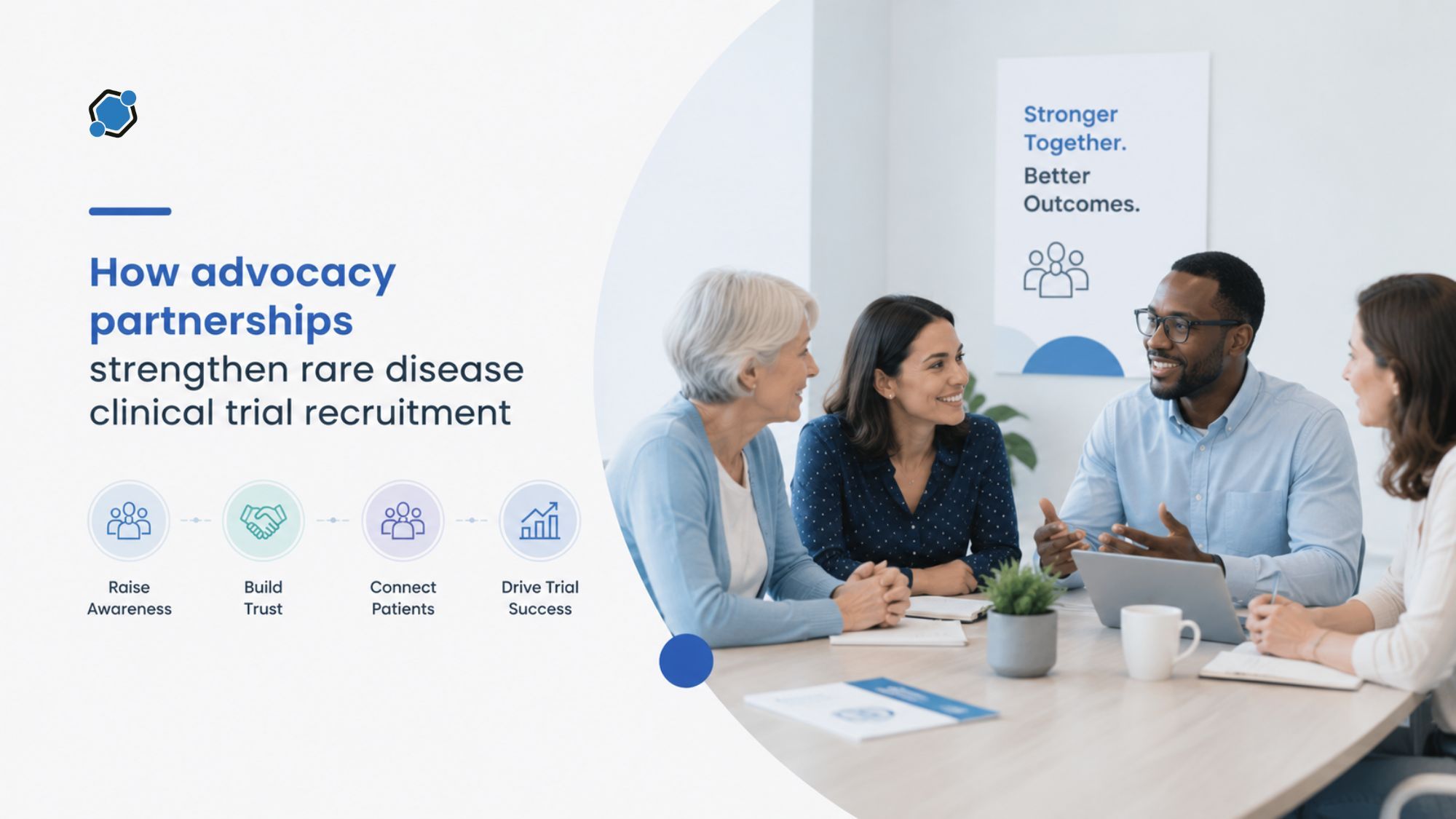
Rare disease clinical trial recruitment is the part of the trial lifecycle most likely to break. The math is unforgiving. The entire eligible patient population for a single rare condition might number in the low thousands across an entire country, and the subset that meets a specific protocol's eligibility criteria might number in the dozens. Finding those participants, confirming they qualify, and getting them through the research site door inside a sponsor's timeline is the work where most rare disease studies lose months or years.
Advocacy groups already do critical work on the patient side of that equation. The unmet need sits in the connective layer between the community and the trial system, which is where a recruitment platform partner can extend what an advocacy group's existing infrastructure reaches. This article walks through where rare disease clinical trial recruitment stalls today, what advocacy groups already contribute, and what a platform partnership adds when the two sides align.
Why rare disease clinical trial recruitment is so hard
Rare disease clinical trial recruitment inherits a system designed for common conditions, where eligible patient populations are large enough to recruit through a few sites in a few cities. That model breaks for rare diseases. A condition affecting only a small fraction of the population produces patient communities scattered across an entire country, and often across borders. Site-by-site recruitment cannot reach them efficiently because no single site sits near enough of them.
Diagnostic delay compounds the problem. People with rare conditions often spend years moving through specialists before receiving an accurate diagnosis, which means the pool of identified, diagnosed patients available to enroll in a study at any given moment is far smaller than the underlying disease population. Awareness gaps cut further into that pool. Many diagnosed patients are not aware that clinical research exists for their condition, and many physicians caring for rare disease patients do not have a routine way to learn what trials are recruiting.
These are system conditions, not individual failures. The Ongoing Challenge of Clinical Trial Recruitment: What Sponsors Must Change frames why recruitment friction has persisted across the broader trial system, and the same forces hit rare disease studies harder because the underlying numbers are smaller.
What advocacy groups bring to rare disease recruitment
Advocacy groups are the closest thing rare disease research has to a community infrastructure. Many have spent a decade or more building relationships with the families they serve, running educational events, supporting newly diagnosed patients, and maintaining the only sustained communication channel that reaches the full diagnosed population for a given condition.
That work produces assets no recruitment platform can replicate on its own:
- Trust earned over years of consistent presence, which determines whether a community member opens an email about a new trial or deletes it.
- Patient registries, formal or informal, that capture diagnosis details, current standard care, and contact preferences.
- Translational fluency, meaning the ability to take complex protocol language and explain what participation actually involves in terms a family can act on.
- Visibility into where patients cluster, including which centers serve the most patients, which physicians make most of the diagnoses, and which subgroups of the disease population are easier or harder to reach.
- Direct knowledge of the lived experience, which lets advocacy staff anticipate which study designs will work for participants and which will create barriers.
These assets are exactly what rare disease recruitment needs. How patient advocacy groups guide their community to clinical trials covers the broader contribution advocacy groups make across the trial information lifecycle, from awareness through post-study follow-up.
The gap is not on the advocacy side. The gap sits in how those assets connect to active trials. Most advocacy groups do not have a real-time view of which trials are recruiting, which trial designs match their patient subpopulation, or which site teams are running the protocols closest to their community. That visibility lives inside the recruitment system, not inside the community.
What recruitment platforms add to that work
A recruitment platform sits where most advocacy groups cannot easily reach: inside the active trial layer. A platform tracks which studies are open, which are enrolling, what their eligibility criteria look like in machine-readable form, and how those criteria map to a potential participant's profile. Done well, that mapping work is the difference between an advocacy group sharing a generic trial link with five hundred community members and connecting twelve specific community members to two specific studies they actually qualify for.
A few capabilities matter most for rare disease recruitment:
- AI-assisted matching that compares a potential participant's profile against active trial eligibility criteria across many studies at once, surfacing trials the participant may qualify for rather than asking the participant to evaluate each study individually.
- Pre-screening conducted by a registered nurse, which catches eligibility issues that protocol language alone cannot reveal and gives the participant a chance to ask questions before any site contact.
- A structured referral pathway that hands qualified, pre-screened participants to the research site team with the relevant clinical information already organized.
- Real-time recruitment visibility for sponsors and sites, which tells the partnership which protocols are filling, which are struggling, and where additional community outreach would be useful.
- A platform layer that scales without losing the human steps, so a rare disease community of two thousand families and a community of two hundred thousand get the same care in the referral process.
Partnering for Success: What Sponsors Should Look for in a Recruitment Platform outlines the broader criteria for evaluating recruitment platforms. For rare disease applications, the criteria that matter most are matching depth across small-population eligibility criteria, the quality of the pre-screening layer, and how cleanly the platform integrates with the existing community infrastructure an advocacy group already runs.
How advocacy groups and recruitment platforms work together
When an advocacy group and a recruitment platform partner align, the rare disease pipeline gains coverage that neither side can produce alone. The advocacy group continues running its community work and adds the platform as a structured pathway from community awareness to trial referral. The platform continues running its matching and pre-screening layers and gains a trusted channel into the patient population that protocol-based outreach cannot reach.
Several handoffs make the model work in practice:
- Joint education and awareness, where advocacy materials reference the platform as a way to find trials a community member may qualify for, and the platform's communications respect the framing and language the advocacy group has developed for its community.
- Registry coordination, where consenting members of an advocacy registry can opt into the platform's matching layer, allowing trials to be surfaced to them as they open rather than requiring the registry holder to push individual studies manually.
- Pre-screening handoff, where community members who indicate interest in a trial are pre-screened by the platform's registered nurse rather than by advocacy staff, freeing advocacy capacity for the work no one else can do.
- Site coordination, where the platform's referral pathway routes qualified participants directly to the research site team, reducing the advocacy group's role to community-facing support rather than trial-management coordination.
- Feedback loops, where data on which trials are filling, which subpopulations are reaching pre-screening, and which protocols are creating friction flows back to the advocacy group so its outreach can adjust.
How advocacy groups can partner with AI-assisted clinical trial matching platforms goes deeper into the operational layer of the partnership and how an advocacy group can evaluate whether a specific platform is a fit.
Where DecenTrialz fits in the partnership
DecenTrialz is a recruitment platform built around three pieces. An AI-assisted matching layer compares a potential participant's profile against the eligibility criteria of active trials and surfaces the studies they may qualify for. A registered nurse conducts an initial pre-screening review before any referral, giving the potential participant a chance to ask questions and giving the site a cleaner intake. A structured referral pathway routes qualified participants to the research site team, which handles all final eligibility, enrollment, and informed consent decisions.
For rare disease pipelines, that structure is built to handle the conditions that make rare disease recruitment hard:
- The matching layer reads eligibility criteria across many active trials at once, including small studies that would be invisible in a manual search.
- The pre-screening layer catches eligibility issues early, which matters more for rare disease trials because each potential participant represents a larger share of the available pool.
- The referral pathway is structured to work for sponsors and sites that need every qualified referral to count.
- Real-time recruitment visibility lets advocacy partners see which protocols are open and which are filling, which informs community outreach without requiring the advocacy group to chase sponsors for updates.
Hope in Research: How Clinical Trials Are Transforming Rare Disease Treatment covers the broader rare disease research landscape DecenTrialz is built to support.
Advocacy groups exploring the partnership model can start a conversation about how a platform layer fits alongside the community work the group already does. The platform layer extends what an advocacy group's existing infrastructure can reach. It does not replace it. You can start a conversation at DecenTrialz.
Next steps for advocacy groups
Building a working rare disease trial pipeline starts with the recognition that no single organization solves rare disease recruitment alone. The community work an advocacy group has built over years sits at the front of the pipeline. The matching, pre-screening, and referral layers a platform partner brings sit at the back. The partnership is the connective tissue, and it is what turns a scattered patient population into a real recruitment pathway.
Advocacy groups interested in this model can begin a conversation with the DecenTrialz team at decentrialz.com.
Was this article helpful?

Similar Blogs
Liver Awareness Month 2026: Liver Disease, Liver Cancer, and the Research Changing Outcomes
Every October, two overlapping observances turn attention to an organ most people rarely t...
 Vamshi Kantoju
Down Syndrome Awareness Month 2026: what it is and why research matters
Every October, the United States recognizes Down Syndrome Awareness Month. The month exist...
Mahesh Upadrista
Mental Illness Awareness Week 2026: facts, stigma, and the science changing mental health care
Mental Illness Awareness Week runs from October 4 to October 10, 2026. Established by Cong...
Deeksha GittaStay Informed. Stay Connected.
Get updates on verified clinical trials, emerging treatments, and research breakthroughs directly in your inbox. No spam, just science that matters.
