 HIPAA Compliant
 ISO 27001 Certified
What Is a Clinical Research Coordinator? The Role of the CRC in Your Clinical Trial
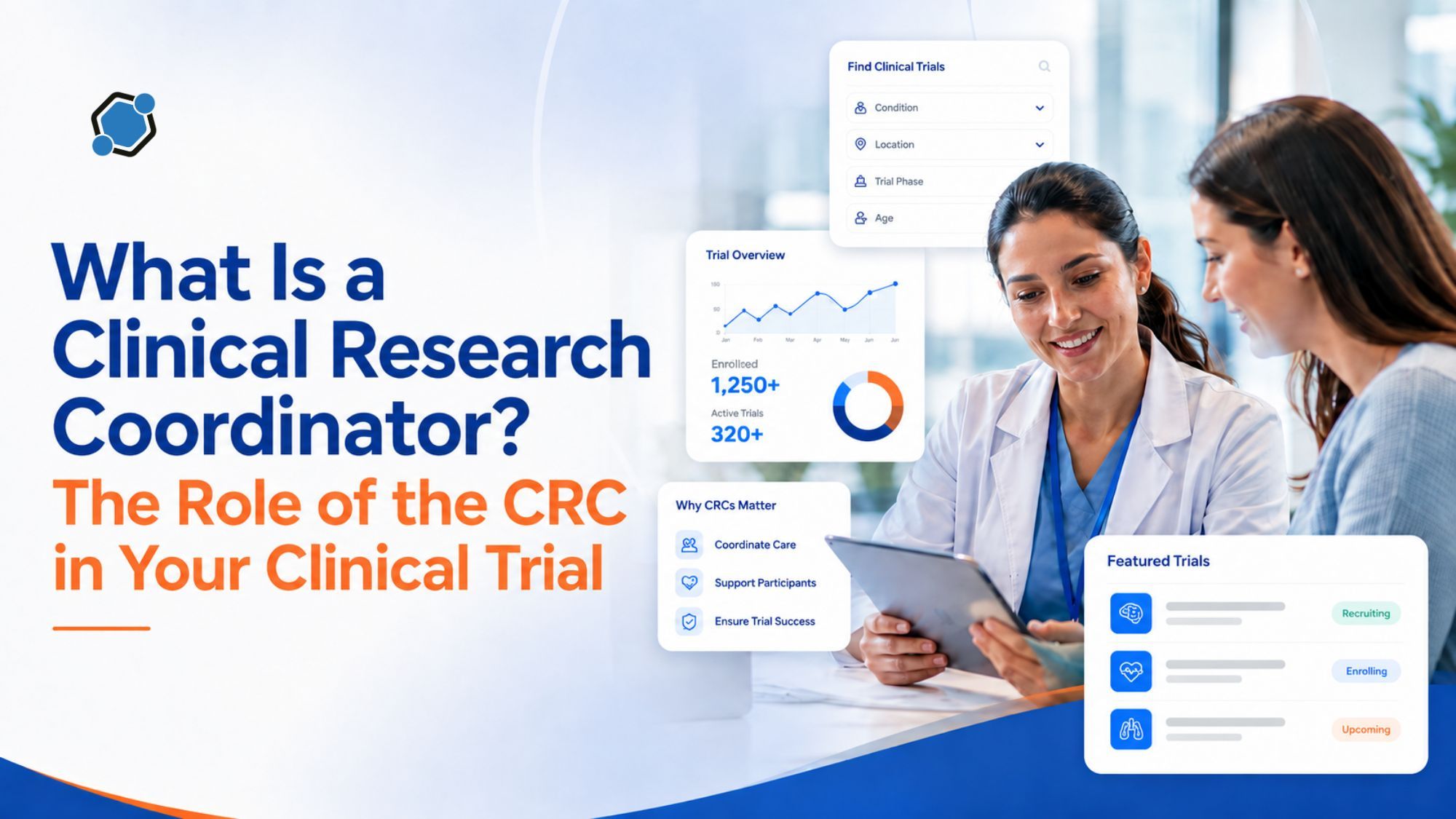
At most research sites, the day-to-day work of running a clinical trial falls to a Clinical Research Coordinator. The CRC is the research professional who handles trial operations at the site, and for most participants, they are the team member they interact with most often. Visit scheduling, screening procedures, the informed consent walkthrough, study-day labs and assessments, and the check-in calls between appointments all usually go through the CRC, not the doctor whose name appears on the consent form.
This guide covers what the CRC's role looks like in practice: who they are, what they handle at each stage of your trial, where the limits of their role sit, and the questions worth bringing to them along the way.
Who Is the Clinical Research Coordinator?
The CRC reports to the principal investigator (PI), the physician with overall medical and legal responsibility for the study at that site. They are sometimes called study coordinators, research coordinators, or research nurses, but the formal job title across most U.S. research sites is Clinical Research Coordinator.
Many CRCs are registered nurses, which is why the term "research nurse" is common in patient-facing contexts. They are not the only path into the role, though. Some CRCs come from allied health fields like medical assisting, respiratory therapy, or paramedicine. Others come from laboratory science, public health, or research administration. The broader role of nurses in clinical research is covered in more depth in International Nurses Day 2026: Nurses in Clinical Trials. What unites CRCs across these backgrounds is training in Good Clinical Practice (GCP), the international framework that governs how clinical trials are conducted ethically and reliably.
The CRC does not make medical decisions. They execute the study protocol, document what happens, escalate concerns to the PI, and keep the trial running on schedule.
When You Will Meet Your CRC and What They Do at Each Stage
The CRC's role with you typically begins before your first in-person visit. If your information was forwarded to the site by a recruitment platform, a referring doctor, or a community outreach effort, a CRC is often the first person from the study team to contact you. They will introduce the trial, confirm a few basic details, and schedule what is usually called a screening visit. A step-by-step walkthrough of that visit is available in Your First Clinical Trial Screening Visit: What to Expect Step by Step.
At the screening visit, the CRC walks you through the informed consent form (ICF). The ICF is a document that explains the study's purpose, what participation involves, what risks and benefits are known, and what your rights are. The CRC's job is to make sure you actually understand it before you sign, which means answering your questions, giving you time to read it (including taking it home if you want to), and explaining anything that is unclear in plain language.
Once you are enrolled, the CRC is the team member who runs most of your visit-day procedures: vital signs, blood draws, electrocardiograms (ECGs), questionnaires, and any study-specific assessments the protocol calls for. If the trial involves a study drug or device, the CRC may dispense it under the PI's direction and walk you through how to use it.
Between visits, the CRC handles the logistics that keep your participation on track. They send reminders, follow up on missed appointments, coordinate with your regular doctor if the study requires it, and call to check in if there has been a change in your health you reported. If the protocol changes during the trial, the CRC walks you through a re-consent process so you can decide whether to continue under the new terms.
At the end of the study, the CRC handles your final visit, any required follow-up assessments, and the transition back to your regular care.
How CRCs Help Protect Your Safety, Rights, and Comfort
The CRC sits at the center of most of the safeguards that protect you during a trial.
If you experience anything new or unexpected during the study, a side effect, a change in how you feel, or an issue that may or may not be related to the study, the CRC is the person who documents it, asks the right follow-up questions, and notifies the PI. Adverse events that meet certain criteria are reported to the sponsor and to the Institutional Review Board (IRB), the independent committee responsible for protecting research participants. The CRC manages that documentation and submission process so that nothing is missed.
The CRC is also the person responsible for making the informed consent process genuinely informed. Good practice means giving you time, answering your questions clearly without making you feel rushed, and confirming that you understand the study before you sign. If anything in the protocol or the consent form changes during the trial, they bring you a revised consent form and walk you through what is different. A closer look at the form itself, what it contains, and what to focus on while reading it, is available in How to Read Your Informed Consent Form Before Joining a Clinical Trial.
Most studies provide a 24-hour contact number on the consent form. That number usually reaches the CRC or a designated backup. If something happens at night or on the weekend, you can call. You are not expected to wait until the next business day to flag something that feels off.
The line between the CRC's role and the PI's role matters here. The CRC does not decide whether a symptom is serious or whether to change your participation. They document, escalate, and follow the PI's instructions. The PI makes the medical calls.
Questions You Can Ask Your Clinical Research Coordinator
The CRC is the right person to bring almost any practical question to. Some that are useful to have ready before your screening visit:
- How does eligibility get decided after my screening labs come back?
- What happens if I have a question between visits, and who should I call?
- What is the best way to reach you, and who covers if you are not available?
- How long are visits expected to take, and how flexible are scheduling windows?
- What happens if I decide to withdraw from the trial after I have started?
- Will any of the study procedures interact with the medications I already take?
- How will my regular doctor be kept informed, if I want them to be?
You can ask the CRC about almost anything operational and most things practical. For questions about medical decisions, the CRC will route you to the PI. A broader list of questions worth bringing to any clinical trial conversation is available in Top Questions to Ask Before Joining a Clinical Study.
How DecenTrialz Fits In Before You Meet a CRC
The CRC's work with you starts when you arrive at the study site. Before that, there is a separate stage: figuring out which trials you may be a fit for, and a first review of whether your basic profile aligns with a study's requirements.
DecenTrialz is a platform that connects people to clinical trials they may be eligible for. Matching is AI-assisted, a nurse pre-screens each potential participant before referral to a study site, and the research team running the study makes all final eligibility and enrollment decisions, since they are the ones responsible for the participant's care during the trial.
The handoff is straightforward. If DecenTrialz identifies a trial that may suit your situation and the initial nurse-led pre-screening looks like a fit, your information is referred to the research site. From there, the site's CRC takes over. They schedule the screening visit, walk you through the informed consent process, and become your primary contact for the rest of the trial. If you are new to clinical trials and want a broader orientation before that point, Clinical Trial Volunteers Guide: Your First Step Into Clinical Trials covers the basics.
Next Steps
If you have already been matched to a clinical trial and have a screening visit coming up, the CRC is the person to lean on. Bring questions. Ask them to slow down if anything moves too fast. Use the 24-hour contact number if you need to.
If you are still exploring whether a trial is a fit, you can start by browsing decentrialz.com to see what is recruiting in your area and your condition. The platform handles the matching and the first pre-screening review. The site's CRC takes it from there.
Was this article helpful?

Similar Blogs
Blood Pressure Numbers: What Do Systolic and Diastolic Actually Mean?
A blood pressure result contains two numbers, and most people are never told what either o...
 Paramraj
National HIV/AIDS and Aging Awareness Day 2026: What Aging With HIV Looks Like Today
The population of people living with HIV in the United States has aged in a way few would ...
Mahesh Upadrista
Prediabetes symptoms: what the early signs are and how prediabetes is reversed
Prediabetes means blood sugar is higher than normal, but not yet high enough to be called ...
Deeksha GittaStay Informed. Stay Connected.
Get updates on verified clinical trials, emerging treatments, and research breakthroughs directly in your inbox. No spam, just science that matters.
