 HIPAA Compliant
 ISO 27001 Certified
National HIV Testing Day 2026: Testing, Treatment, and Research
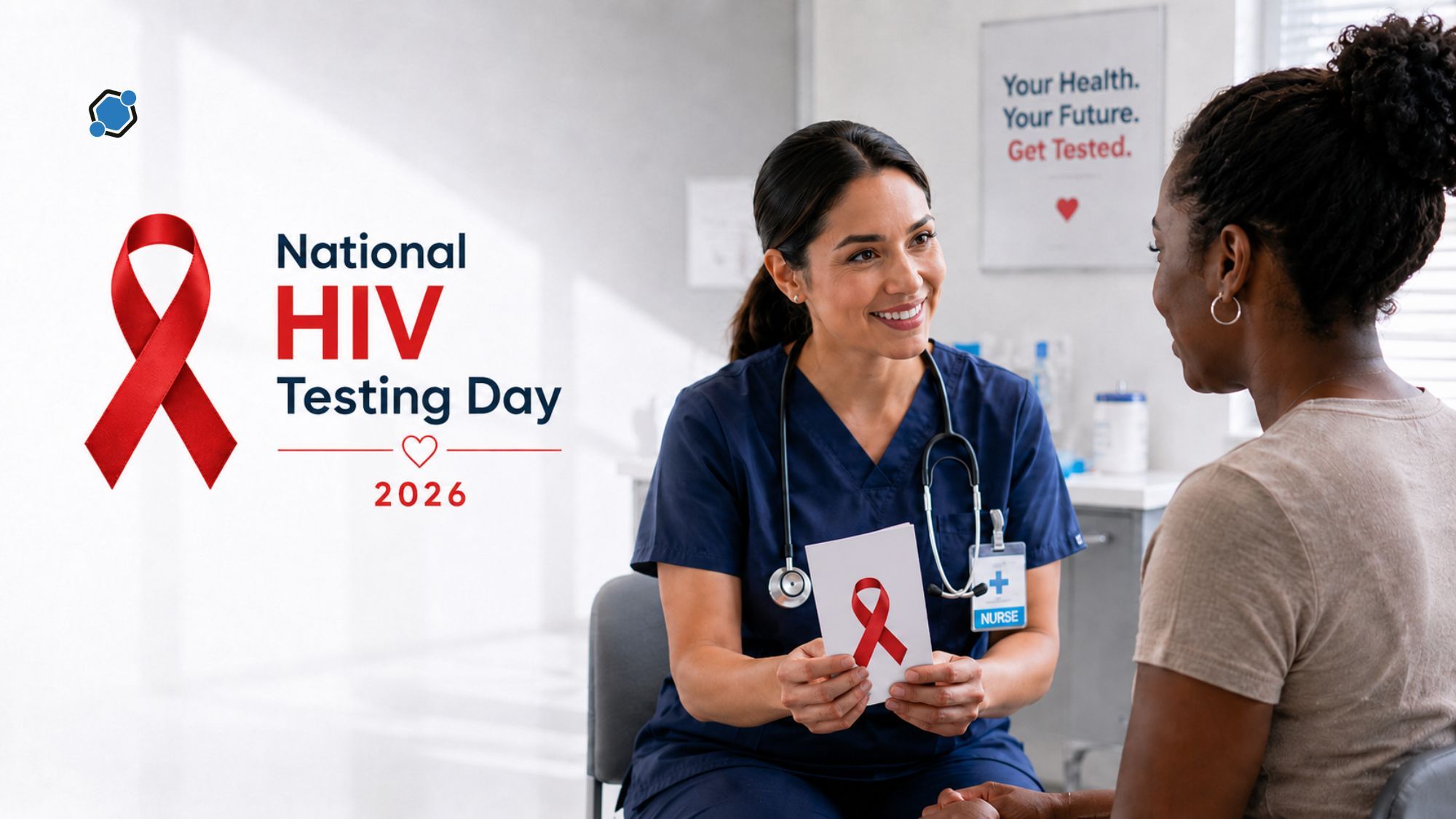
Many people living with HIV in the United States have not yet been diagnosed. The distance between carrying the virus and knowing it is the gap that National HIV Testing Day exists to close. Observed every year on June 27, the day points people toward an HIV test, the medical step that opens the door to care for those who need it and to prevention options for those who do not.
What National HIV Testing Day is, and what it is trying to fix
National HIV Testing Day was first observed on June 27, 1995. It was founded by the National Association of People with AIDS, a community organization that wanted a public moment to push back on stigma and to make HIV testing feel ordinary rather than exceptional. The reasoning was straightforward. A person who does not know they have HIV cannot start medical care, and a person who does not know their negative status cannot make fully informed choices about prevention.
That logic has held up over three decades. HIV is no longer the immediate medical crisis it was in the 1990s, thanks in large part to widely available antiretroviral therapy and prevention tools. The diagnosis gap, however, persists. The federal Centers for Disease Control and Prevention (CDC) reports that a notable share of people living with HIV in the United States are unaware of their status, and that group is the population the day is built around.
The case for routine HIV testing rests on decades of public health evidence, the same kind of evidence summarized in How Clinical Trials Contribute to Public Health.
Who the CDC recommends should get tested
The CDC recommends that everyone between the ages of 13 and 64 get an HIV test at least once as part of routine medical care. The point of a routine recommendation is that testing should not be reserved for people who think they are at risk. Many people with HIV do not have obvious risk factors, and routine testing catches infections that would otherwise be missed for years.
Some people are advised to test more frequently. The CDC recommends at least annual testing for sexually active gay and bisexual men, for people whose sexual partners have HIV, for people who share needles or syringes, for people being treated for another sexually transmitted infection, and for people whose sexual partners have one of those factors. Pregnant people are recommended to test as part of standard prenatal care, since early diagnosis sharply reduces the chance of passing the virus to a baby.
Routine recommendations like these emerge from long observation and structured research. The discipline of clinical research is explained in plain terms in Clinical Trials Explained: Simple Guide for Beginners, which covers what trials are, how they are run, and why their findings shape everyday medical guidance.
What HIV testing looks like today
HIV testing today is faster, simpler, and more private than it was even a decade ago. Three broad categories cover most of what is available.
Laboratory testing is the first. A healthcare provider draws blood or collects an oral fluid sample and sends it for analysis. Results typically come back within a few days. Laboratory tests are the most sensitive, particularly for catching very recent infections.
Rapid testing is the second, available at many clinics, community health centers, and pharmacies. These tests use a finger-stick blood sample or an oral fluid swab and give a preliminary result in about twenty to thirty minutes. A reactive rapid test is confirmed with a follow-up laboratory test.
HIV self-testing is the third option. It lets a person collect a sample and read the result at home. Self-test kits can be purchased over the counter, and federal programs distribute them free of charge by mail to eligible United States residents who request them. Self-testing has been particularly important for people who do not have easy access to a clinic or who prefer to test privately.
Whichever option a person chooses, the visit follows a familiar pattern: a brief intake, the sample collection, a short wait, and a result delivered with information about next steps. Anyone who wants a sense of what a structured health screening visit feels like before committing to one can preview the rhythm in Your First Clinical Trial Screening Visit: What to Expect Step by Step.
What a test result opens up
The point of an HIV test is not the result itself. It is what becomes possible after the result is known.
A positive test result connects a person to antiretroviral therapy, often shortened to ART. ART is a daily medication regimen that suppresses the virus to levels too low to detect on standard tests. Reaching and maintaining this undetectable level produces two outcomes that have changed the medical picture of HIV. People living with HIV who maintain viral suppression have substantially longer life expectancies than people who do not, and they have effectively no risk of sexually transmitting HIV to a partner. That second finding has been summarized in the public health phrase Undetectable equals Untransmittable, often shortened to U equals U.
A negative test result opens different doors. People who test negative and want to stay that way can ask a clinician about pre-exposure prophylaxis, often shortened to PrEP, a daily pill or scheduled injection that lowers the risk of acquiring HIV. People who have had a possible recent exposure can ask about post-exposure prophylaxis, or PEP, a short course of medication that must be started within seventy-two hours of the exposure to be effective.
Both pathways, care after diagnosis and prevention without diagnosis, are areas where eligibility and clinical criteria matter. The broader idea that eligibility shapes who can access which option, including in the research that produces these medications, is covered in Eligibility Explained: Why Not Everyone Qualifies for a Trial.
Where HIV research is heading
Research is reshaping what is medically possible against HIV faster than at any point in the past decade. Three directions are particularly active.
Long-acting prevention is shifting PrEP from a daily pill to scheduled injections given every few months, and studies are testing prevention products that could last six months or longer per dose. The appeal is straightforward: a long-interval injection is easier to keep up with than a daily pill, and adherence has historically been the limiting factor in HIV prevention.
HIV vaccine research has entered a phase that combines decades of immunology with newer mRNA platforms. Recent early-phase studies are testing whether the immune system can be coached, step by step, into producing the rare and powerful antibodies that can neutralize many strains of the virus. A licensed HIV vaccine is not yet available, but the candidates in the pipeline are scientifically more sophisticated than earlier generations.
Cure research, once treated cautiously by the field, is now a recognized direction. Documented cases of long-term HIV remission after specialized medical procedures have given researchers a starting point, and studies are exploring whether the immune system can be safely retrained to suppress the virus without lifelong medication.
People who want to follow these research directions, or who are open to considering participation in a study related to a condition they live with, can search and read about active clinical trials on DecenTrialz. A walkthrough of how that search works is covered in DecenTrialz Explained: How to Search, Read, and Apply for Clinical Trials.
Marking the day this June 27
National HIV Testing Day is one of the simpler awareness days to act on. The recommended action is the same as the topic.
A person who has never been tested, or who has not been tested in the past year, can use the day as the reason to do it. Free testing events are organized in many United States communities around June 27, and federal programs distribute free self-test kits by mail. A person who tests negative can ask a clinician about prevention options. A person who tests positive can begin antiretroviral therapy, the medical step that turns HIV from a progressive infection into a managed chronic condition.
The day also has a role for people who are not the ones being tested. Sharing accurate information helps reduce stigma, and the lower the stigma around HIV, the more likely it is that someone who has been avoiding testing will go.
For people interested in the research side of HIV, DecenTrialz connects people who may want to join clinical studies with the research teams running those studies, through AI-assisted matching and registered nurse-led pre-screening. Final eligibility, informed consent, and enrollment are handled by the authorized research site.
Was this article helpful?

Similar Blogs
Why is my blood pressure still high on medication? Resistant hypertension explained
Blood pressure that stays high after treatment has already started is more common than mos...
 Vamshi Kantoju
What is insulin resistance and how does it affect blood sugar?
Insulin resistance is a condition in which muscle, liver, and fat cells respond weakly to ...
Swaroop ESD
Mini-stroke symptoms: how to recognize a transient ischemic attack before a full stroke
A transient ischemic attack, often called a mini-stroke, is a short episode of stroke symp...
Deeksha GittaStay Informed. Stay Connected.
Get updates on verified clinical trials, emerging treatments, and research breakthroughs directly in your inbox. No spam, just science that matters.
