 HIPAA Compliant
 ISO 27001 Certified
Neurosurgery Awareness Month 2026: clinical trials, precision care, and how participation works
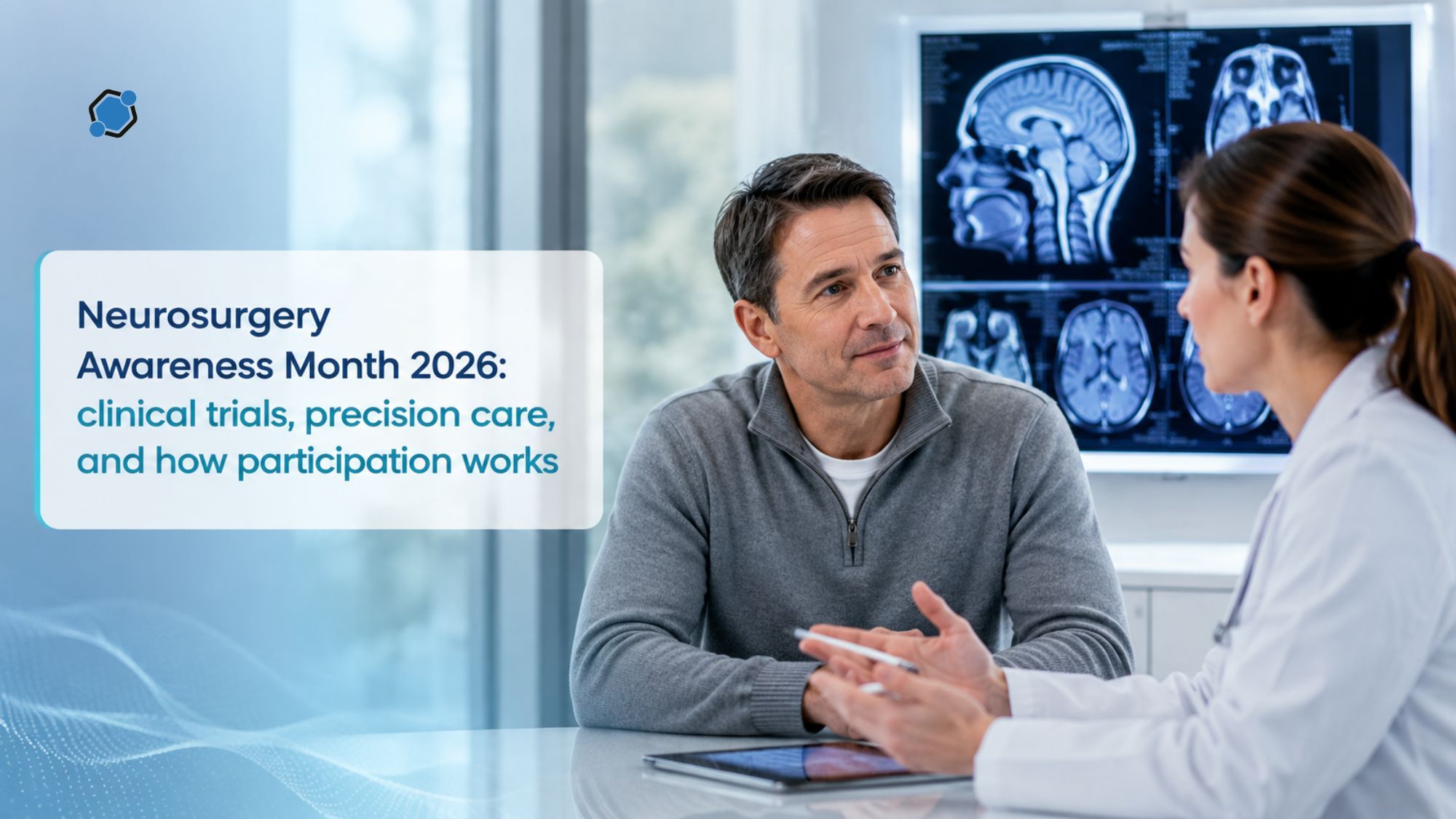
Neurosurgery is one of the most technically demanding fields in modern medicine, and it is also one of the most active areas of clinical research in the United States. Every August, the American Association of Neurological Surgeons (AANS), a professional organization that represents more than twelve thousand neurosurgical professionals worldwide, leads a national observance dedicated to public education about the specialty. The 2026 observance carries the theme “Precision That Changes Lives,” and it is a useful entry point for anyone curious about how brain, spine, and nerve research reaches the people who might benefit from it.
Clinical trials are a central part of that story. Neurosurgery has moved rapidly toward less invasive procedures and image-guided targeting, and public participation in research is what allows these advances to be tested carefully. This article explains what the observance covers, what neurosurgery treats, how it differs from neurology, and what joining a neurosurgery-related clinical trial can involve for an interested member of the public.
What Neurosurgery Awareness Month is
Neurosurgery Awareness Month is a public education initiative that the AANS has led each August for more than a decade. The stated purpose is to help the public understand what neurosurgeons do, the conditions they treat, and the research that shapes the future of the field. The campaign is directed at patients, caregivers, policymakers, media, and industry partners.
The 2026 theme, “Precision That Changes Lives,” is organized around six areas: the patient journey, the scope of neurosurgery, innovation and technology, the people behind the profession, the future of the specialty, and advocacy. The theme reflects a broader shift in the field toward highly targeted procedures that minimize disruption to healthy tissue and shorten recovery time.
Awareness months matter for research access for a straightforward reason. Studies of clinical trial participation consistently find that lack of information, not lack of interest, is one of the most common reasons people do not consider joining a trial. A month dedicated to plain-language public education helps close that gap. Readers who want a broader introduction to how research works may find Clinical Trials Explained: Simple Guide for Beginners a helpful next step.
What neurosurgery actually covers
Neurosurgery is the medical specialty concerned with the diagnosis, surgical care, and rehabilitation of disorders that affect the nervous system. That includes the brain, the spinal cord, the spinal column, and the peripheral nerves, which are the nerves that branch out from the spine to the rest of the body. Neurosurgical training is among the longest in medicine, and residency programs typically last around seven years after medical school.
The specialty covers several distinct areas. Cranial surgery addresses conditions inside the skull, such as brain tumors, aneurysms, which are bulges in a brain blood vessel, and traumatic brain injuries. Spine surgery addresses herniated discs, spinal stenosis, which is a narrowing of the spinal canal, fractures, and structural deformities. Peripheral nerve surgery addresses nerves outside the brain and spine, including procedures such as carpal tunnel release. Pediatric neurosurgery focuses on congenital conditions, meaning conditions present from birth, such as hydrocephalus, which is a buildup of fluid in the brain.
The conditions addressed span a wide clinical range. They include brain tumors, epilepsy, movement disorders such as Parkinson’s disease and essential tremor, stroke, chronic pain, and structural spine problems. Clinical research plays a role in nearly every one of these areas, and the observance is a reminder that today’s standard procedures were tested through decades of careful study. Readers interested in that longer arc may find How Clinical Trials Advance Medicine and Change Lives a useful companion read.
How neurosurgery differs from neurology
Neurology and neurosurgery both deal with the nervous system, but the two specialties take different primary approaches. Neurologists diagnose and manage conditions of the brain, spine, and nerves largely with medications, procedures that do not require an operation, and rehabilitation. Neurosurgeons are trained to perform surgery when the situation calls for it, and they often also provide non-surgical care first.
The two specialties frequently share the same care team. A person with epilepsy may work with a neurologist for medication management for many years and see a neurosurgeon only if surgical evaluation becomes appropriate. A person with a herniated disc may see a neurosurgeon who first recommends physical therapy and anti-inflammatory medication before any consideration of surgery. The line between the two fields is less rigid in practice than the names suggest.
This distinction matters for clinical trial understanding. Trials in neurosurgery often study procedures, devices, or a combination of a device and long-term follow-up. Trials in neurology often study medications or diagnostic approaches. Both types of trials serve people with nervous system conditions, and both are important.
Where clinical trials fit in neurosurgery today
Clinical research in neurosurgery has expanded significantly in the last decade, and much of the growth has focused on less invasive approaches. Several categories are worth understanding.
Device trials study implanted technologies that deliver electrical stimulation to specific parts of the nervous system. Deep brain stimulation involves placing thin wires into targeted areas of the brain connected to a small battery under the skin, and it is used for movement disorders and under active study for other conditions. Spinal cord stimulation delivers electrical pulses to the spine to manage chronic pain that has not responded to other options.
Focused ultrasound is an incisionless approach that uses sound waves guided by magnetic resonance imaging to create a small area of change in brain tissue without opening the skull. It is approved for essential tremor and certain features of Parkinson’s disease, and it is under study for a broader range of conditions.
Laser interstitial thermal therapy, sometimes called LITT, uses a thin laser probe passed through a small opening in the skull to address targeted tissue with heat under real-time imaging. It is used as a less invasive alternative to open surgery for some cases of epilepsy and hard-to-reach brain tumors.
Other active areas include gene therapy delivery, which uses neurosurgical techniques to introduce therapies directly into brain tissue, and the use of artificial intelligence, augmented reality, and robotics to improve surgical planning and precision. Technology in clinical trials also extends well beyond the operating room, and Wearables, Sensors and ePROs: Technology in Clinical Trials offers helpful context on how digital tools are changing the participant experience.
What joining a neurosurgery trial can involve
Participation in a neurosurgery-related clinical trial varies significantly by study, but several common elements appear across most trial designs. Understanding these elements helps interested individuals prepare for conversations with a research site team.
The process usually begins with a screening phase. This phase includes a review of medical history, imaging studies such as magnetic resonance imaging or computed tomography, and an evaluation of whether the individual meets the eligibility criteria for the study. Eligibility criteria are the specific requirements that describe who a trial is designed to include. They exist for participant safety and for scientific reasons, and they are set by the study protocol before enrollment begins.
Some device studies include a temporary evaluation period. Spinal cord stimulation studies, for example, often use an external stimulator for a short evaluation window before any permanent implant is considered. This structure allows participants and the study team to gather information about whether the approach is likely to be helpful for that individual.
The study procedure or intervention itself is followed by structured follow-up visits, which for device trials can extend for a year or longer. Some trials use blinding, meaning that during a defined study period neither the participant nor certain members of the study team know whether a device is active. Blinding is a standard research method that reduces bias in how outcomes are measured.
Informed consent is a central part of every clinical trial. It is a documented process, not a single form, in which the study team explains the purpose of the research, the procedures involved, the known risks, the possible benefits, and the alternatives to participation. Neurosurgical trials require particular care around a concept called therapeutic misconception, which is the tendency to view research as personalized clinical care when the primary purpose of a trial is to answer a scientific question that applies to a broader group.
DecenTrialz pre-screens interested individuals to identify potentially matching studies. The research site team owns final eligibility determination, informed consent, study walk-through, and enrollment. Preparing questions in advance helps make the site conversation more productive, and Top Questions to Ask Before Joining a Clinical Study is a practical reference for that step.
What questions should someone ask before joining a neurosurgery trial?
Useful questions to bring to a site conversation include the following. What is the specific purpose of this study, and what question is it designed to answer? What does participation involve, including all visits, procedures, and expected follow-up time? What are the known risks, and how are unexpected events monitored? Who will be responsible for medical care during and after the study? What happens if a participant decides to stop taking part? How is participant information protected? Any research site team should welcome these questions and answer them fully before consent is finalized.
Why access to neurosurgery trials is uneven
Access to neurosurgical care and research is not evenly distributed across the United States. The neurosurgical workforce is concentrated in metropolitan areas, and a large number of counties have no neurosurgeon at all. Clinical trials tend to cluster at academic medical centers, which are also disproportionately located in urban areas. For a person living far from such a center, participation may involve significant travel, time away from work, and out-of-pocket costs even when the study itself is provided at no cost.
These barriers are structural, not individual. Research on trial participation consistently shows that willingness to join a study is comparable across communities when logistical and informational barriers are removed. The barriers most often cited by participants include difficulty reaching a research center, time constraints, and the affordability of time away from daily responsibilities.
Decentralized and hybrid trial designs, which use technology to conduct parts of a study remotely, are one response to these access gaps. Not every neurosurgical study can be decentralized, since the procedure itself must be performed at a qualified site. Follow-up visits, questionnaires, and certain monitoring activities, however, can often be conducted closer to home or virtually. Readers who want to understand this shift more fully may find How Decentralized Trials May Improve Research Access a useful reference.
How DecenTrialz supports people exploring neurosurgery trials
DecenTrialz is a clinical trial participant recruitment platform that uses artificial-intelligence-assisted matching and registered-nurse-led pre-screening to help interested individuals identify studies that may be relevant to their situation. Individuals share information about their health background through structured conversations, and the platform surfaces potentially matching studies for further evaluation.
The research site team owns final eligibility determination, informed consent, study walk-through, and enrollment. DecenTrialz does not diagnose conditions, does not determine whether a person qualifies for a trial, and does not enroll anyone in research. That boundary exists to protect participants and to keep clinical decisions with the qualified investigators and site staff who are responsible for the study.
People interested in learning about neurosurgery-related studies can start a pre-screening conversation with DecenTrialz today.
Take the next step in your clinical trial journey
Neurosurgery Awareness Month is a reminder that research participation is a personal decision, and that clear information supports better decisions. Anyone considering a neurosurgery-related clinical trial should take time to understand the study, ask questions of the research site team, and involve trusted family or advisors in the conversation.
To explore whether a current study may match your situation, connect with DecenTrialz to begin a pre-screening conversation.
Was this article helpful?

Similar Blogs

Autoinflammatory Awareness Month: what participants should know about a hidden group of rare diseases
Recurring fevers that appear without infection, rashes that come and go on their own, and ...
 Swaroop ESD
National Wellness Month: eight everyday habits that support trial participants
What National Wellness Month is Every August in the United States is National Wellness Mon...
Paramraj
National Minority Donor Awareness Month: why diverse donors and research participants matter
The U.S. organ transplant waiting list reflects a persistent imbalance. People from multic...
Vamshi KantojuStay Informed. Stay Connected.
Get updates on verified clinical trials, emerging treatments, and research breakthroughs directly in your inbox. No spam, just science that matters.
