 HIPAA Compliant
 ISO 27001 Certified
Predictive feasibility in clinical trials: what sponsors should check before committing to enrollment targets
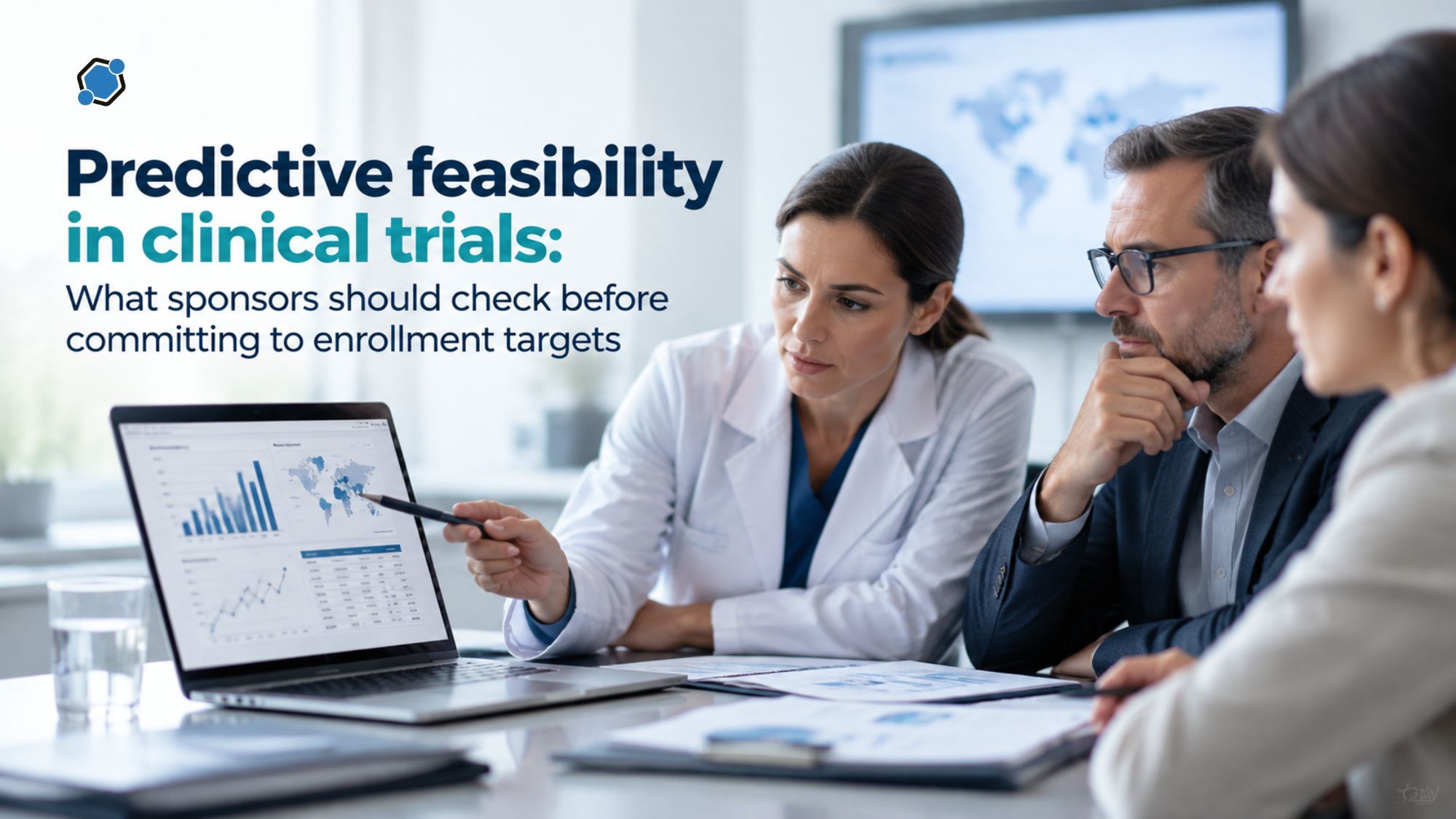
Feasibility assessments decide who runs a study, where it runs, and how quickly it can enroll. When the assessment is wrong, the trial still moves forward. It just moves late, costs more, and puts research sites in the position of missing enrollment numbers that no one could realistically have hit. The problem is not that sponsors ignore feasibility. The problem is that most feasibility processes are built to collect commitments, not to test them. Predictive feasibility flips that order. It treats every projection as a hypothesis and looks for evidence before the first patient is ever screened.
Why traditional feasibility questionnaires miss the mark
Feasibility questionnaires often go out before the protocol is finalized. Sites respond to a synopsis, estimate a patient pool from memory, and return numbers shaped by two forces working against accuracy. The first is incentive. Sites that project ambitiously win more studies, and sponsors who assume every projection is inflated discount them by rule of thumb. Over time, both sides adjust to each other, and neither ends up with a number tied to observable evidence.
The second force is data quality on the site side. When a coordinator estimates how many patients meet the inclusion and exclusion criteria (the clinical rules that define who can join a trial), the estimate usually rests on chart recall and general impression, not a criterion-by-criterion query against the site's electronic health records. That gap between "patients with this diagnosis" and "patients who actually match every rule" is where most feasibility optimism lives. It is often the root cause of enrollment shortfalls that sponsors only recognize months after startup. Diagnosing the real cause of slow enrollment is easier when the feasibility inputs are traceable to real data rather than free-text answers.
Protocol complexity compounds the problem. Modern trials collect far more data points per participant than they did a decade ago, and every added procedure or narrower criterion lowers the true eligible pool. Feasibility questionnaires rarely re-ask their questions when a protocol picks up a genetic biomarker requirement, a wearable device schedule, or a new washout window, so the answers on file quietly go out of date.
What separates a predictive feasibility model from a performative one
A performative feasibility process produces a document that satisfies internal governance. A predictive one produces a forecast that holds up when enrollment starts. The differences are practical. Predictive feasibility works from the full or near-final protocol, not a synopsis. It draws patient counts from real-world data queries and historical site performance, not free-text answers. It expresses enrollment as a range with best-case, likely, and worst-case scenarios rather than a single point estimate. It ranks candidate sites using observed enrollment against target from prior comparable studies, rather than reputation or existing relationships. And it re-forecasts continuously as screening data arrives, rather than freezing the projection at startup.
Feeding aspirational site commitments into even the most sophisticated statistical model will not fix the underlying data quality problem. Statistical rigor amplifies whatever assumptions go in, which is why predictive feasibility depends on the quality of inputs at least as much as the sophistication of the model. Approaches that combine site-history data with real-world evidence have consistently outperformed traditional heuristics in published research. Predictive feasibility modeling for site selection shows what this looks like in operational practice for CRO teams supporting sponsor programs.
Site-level evidence that actually predicts performance
The single most reliable predictor of how a site will perform is how it has performed before, in trials that resemble the current one. Not enrollment history in general, but enrollment against target in studies with comparable eligibility, therapeutic area, and visit burden. Activation speed matters just as much. Sites that consistently take longer than average to open compress the effective enrollment window, even when their per-month enrollment rate looks strong on paper.
Three site-level signals deserve more weight than most feasibility scorecards give them. The first is screen-failure history and, more importantly, the reasons behind it. A site with a high screen-fail rate driven by biomarker exclusions in a previous oncology study may perform well in a study without that criterion. The second is coordinator bandwidth and competing studies, which are rarely captured in questionnaires but often decide whether a site prioritizes a new protocol. The third is principal investigator engagement in the feasibility process itself, which correlates with more accurate downstream performance. Using historical data to predict site performance explores how these signals combine into a defensible site ranking.
Pre-screening as the first live test of your assumptions
Every feasibility model rests on assumptions: how many people will be identified, how many will pass eligibility screens, how many will consent, and how many will randomize. Those assumptions stay theoretical until real candidates start flowing through the funnel. Pre-screening is the first place where the model meets reality.
When pre-screening is run as a structured, criterion-by-criterion process rather than a general interest form, it produces evidence that directly validates or corrects the feasibility model within the first weeks of active outreach. Sponsors can see which inclusion or exclusion criteria are driving the most disqualifications, which geographies are producing candidates in the expected demographic mix, and which sites are converting interest into qualified referrals versus which are stalling. When the observed pass-through rate is materially lower than the modeled rate, sponsors have time to reallocate outreach, adjust criteria where the science permits, or add sites before timelines slip. Pre-screening funnel metrics walks through the specific stages and rates that sponsors should be tracking in that first live window.
DecenTrialz is a U.S.-based clinical trial recruitment platform that combines AI-assisted patient matching with registered nurse-led pre-screening. That combination produces criterion-level funnel data early enough to inform feasibility corrections, and it delivers pre-screened candidates to research sites rather than unfiltered leads. Final eligibility determination, informed consent, the study walk-through, and enrollment remain with the authorized research site and study team.
How quality by design reframes feasibility under ICH E6(R3)
The revised ICH E6(R3) Good Clinical Practice guideline formalizes an idea sponsors have been moving toward for years: build quality into the trial at the design stage, rather than inspect for it later. The guideline asks sponsors to identify the elements of a trial that are critical to participant safety and reliable results, then design proportionate controls around them. Eligibility assumptions, enrollment feasibility, and site capability all fall inside that scope.
A feasibility process that documents its reasoning, tests its assumptions with independent data, and updates its forecast when new evidence arrives is a quality-by-design artifact in the sense E6(R3) intends. A process that collects unverified commitments and files them away is not. What ICH E6(R3) means for sponsors explains how the quality-by-design language connects to operational decisions like feasibility and site selection.
Frequently asked questions
What is a feasibility assessment in a clinical trial?
A feasibility assessment is a structured evaluation of whether a proposed clinical trial can realistically deliver the required number of qualified participants within the planned timeline and budget. It typically operates at three levels: the overall protocol (can the study design be run at all), the country (can the regulatory and clinical environment support it), and the site (can a specific research center deliver its share of enrollment).
Why do so many trials miss their enrollment timelines?
Most trials eventually reach their enrollment targets, but many require significant extensions to do so. The reasons usually trace back to feasibility inputs that were never tested against real data: overly optimistic site projections, patient pool estimates based on diagnosis counts rather than full eligibility, and protocols whose complexity makes the effective eligible population smaller than expected at the planning stage.
What is the difference between feasibility and pre-screening?
Feasibility is a planning activity done before startup to estimate whether a trial can enroll. Pre-screening is an operational activity done during recruitment to check whether individual candidates likely meet the eligibility criteria before they are sent for formal screening at a research site. Pre-screening data is one of the fastest ways to check whether the feasibility model's assumptions are holding up in the real world.
Can real-world data replace site feasibility questionnaires?
No. Real-world data can improve the accuracy of patient pool estimates and site ranking, but it cannot replace what a site tells you about its own capacity, staff bandwidth, competing studies, and referral patterns. The strongest predictive feasibility processes triangulate real-world data, historical site performance, and site-provided operational context, and then validate the combined estimate with pre-screening data once outreach begins.
Turning feasibility into a live process
Predictive feasibility is not a document produced once at startup. It is a discipline of stating assumptions clearly, checking them against independent evidence, and updating the forecast as real recruitment data arrives. Sponsors who treat feasibility this way spend less time explaining slipped timelines and more time acting on early signals. DecenTrialz partners with sponsors and their CRO teams to embed structured pre-screening evidence into that loop, so feasibility models are corrected while there is still time to change the outcome. Speak with the DecenTrialz team to see how pre-screening data can support the feasibility work already underway.
Was this article helpful?

Similar Blogs
Clinical Trial Patient Matching: Why Do Sponsors Need More Than a Public Registry Listing?
Every applicable clinical trial conducted in the United States must be registered in the f...
 Swaroop ESD
DecenTrialz vs traditional recruitment platforms: how does full-service matching differ from self-service trial search?
Comparisons between DecenTrialz and traditional recruitment platforms usually come down to...
Vamshi Kantoju
RN-led pre-screening in clinical trials: what does nurse review add that AI matching cannot?
Artificial intelligence has changed how quickly clinical trial candidates can be identifie...
Deeksha GittaStay Informed. Stay Connected.
Get updates on verified clinical trials, emerging treatments, and research breakthroughs directly in your inbox. No spam, just science that matters.
