 HIPAA Compliant
 ISO 27001 Certified

Rater training in clinical trials: how do research sites keep COA scores consistent?
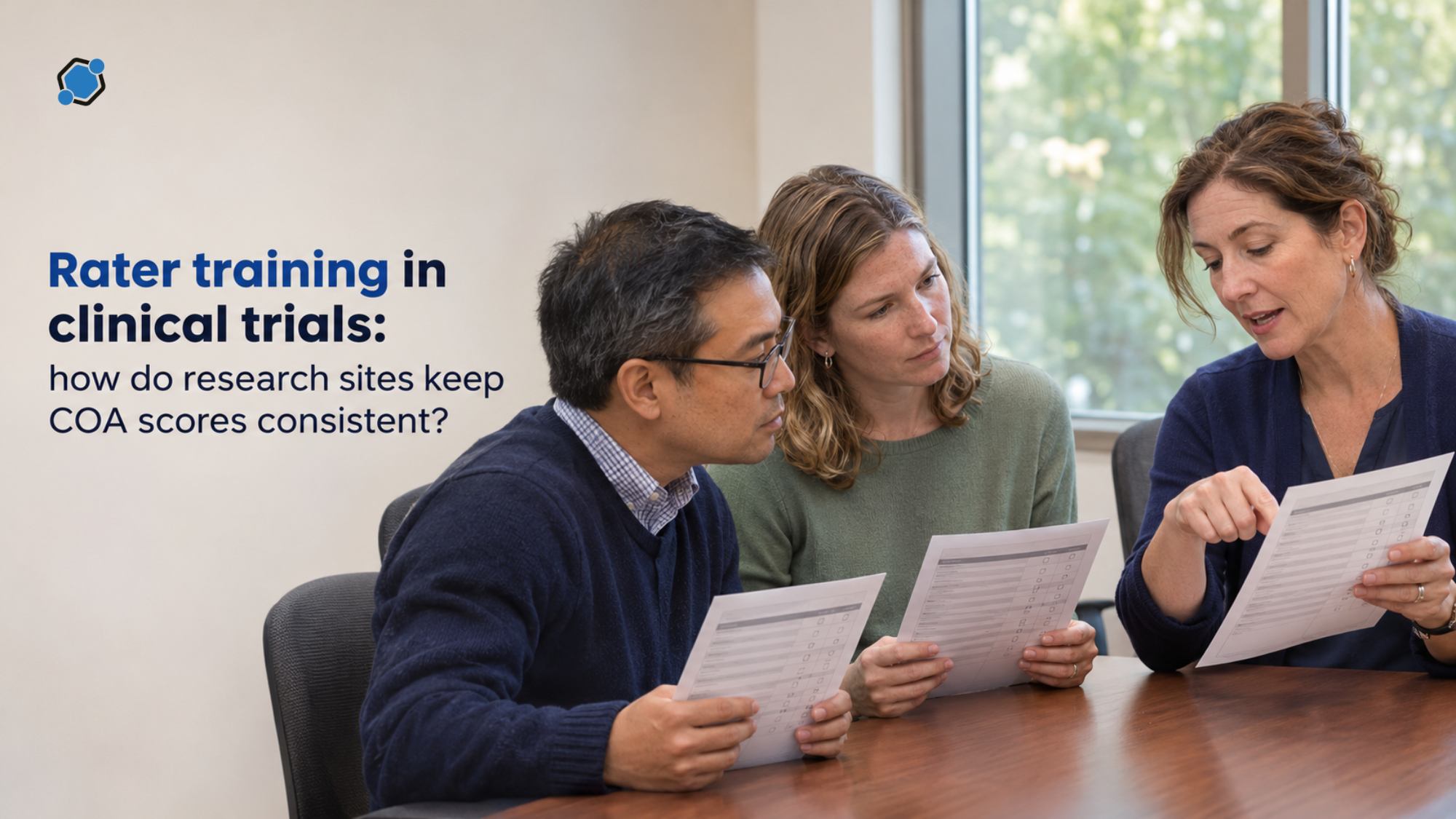
Rater training in clinical trials determines whether a score recorded at one research site means the same thing as a score recorded at another. Many studies measure benefit through clinical outcome assessments, or COAs: structured interviews, rating scales, and performance tests that turn a participant's symptoms or abilities into numbers. When a trained person administers and scores those measures, that person's consistency becomes part of the data.
Small differences in how questions are asked or answers are scored can blur a real treatment effect and admit participants who do not meet eligibility thresholds. This article explains why rater consistency matters, what regulators expect, and how research sites can keep COA data clean.
What is a clinical outcome assessment, and where do site raters fit?
A clinical outcome assessment is a measure that describes or reflects how a person feels, functions, or survives. The Food and Drug Administration (FDA) recognizes four types, and each one depends on site staff in a different way.
- Patient-reported outcomes (PROs) come directly from the participant, such as a symptom diary or a pain score from 0 to 10. Site staff explain instructions and support devices but do not interpret or coach answers.
- Clinician-reported outcomes (ClinROs) rely on a trained health professional's observation and judgment, such as a structured depression interview or a skin severity score. The rater's technique directly shapes the result.
- Observer-reported outcomes (ObsROs) come from a parent, caregiver, or other observer who reports what they see without applying medical judgment. Site staff train and instruct the observer.
- Performance outcomes (PerfOs) measure how well a participant completes a standardized task, such as a timed walk or a memory test. How instructions are given, timed, and scored affects the number recorded.
In trial language, a rater is the trained, protocol-approved person who administers and scores a COA. Depending on the scale, that may be a physician, psychologist, nurse, or study coordinator. Raters matter most for ClinROs and PerfOs, where a person produces the score.
Not every outcome depends on a human rater. Some studies collect activity or sleep data from devices, and digital endpoints built on wearable data raise different validation questions.
Why rater consistency matters for COA data
Three terms describe the consistency problem. Inter-rater reliability is whether two raters give the same score to the same participant at the same moment. Intra-rater reliability is whether one rater scores the same information the same way twice. Rater drift is the gradual slide away from the scoring rules a rater was trained on, often through habit, fatigue, or personal shortcuts.
Inconsistent ratings add noise, and noise hides signal. Published modeling of measurement error shows that less reliable ratings force a study to enroll considerably more participants to detect the same treatment effect. That means longer timelines, higher costs, and more people exposed to study procedures.
Rating quality also shapes who enters a study. Many trials, especially in psychiatry and neurology, use a minimum COA score as an eligibility threshold. In one published depression trial, roughly one in three participants whom site raters scored as eligible would not have qualified based on the scores of independent central raters. The same study found placebo response roughly double under site ratings. Scores that run high at screening and settle later can make a placebo group appear to improve, which shrinks the measured difference between treatment and placebo.
Errors are not limited to inexperienced staff. In a published study of raters described as experienced, about four in five made at least one error scoring a standard cognitive test used in dementia research. Each error is small, but across hundreds of assessments the pattern can add up to meaningful bias.
Rating accuracy at screening is also a screen failure issue. An inflated score can move an ineligible person forward, while an accurate score that rules someone out early protects both the participant and the study. Sites already working through practical ways to reduce screen failures can treat COA rating quality as part of the same effort.
What regulators expect from research site raters
No single regulation sets out a rater training curriculum, but current guidance is clear about direction. ICH E6(R3), the latest revision of the international Good Clinical Practice guideline, was adopted by the International Council for Harmonisation on January 6, 2025, and published by FDA as final guidance in September 2025. FDA guidance is not legally binding, and no separate U.S. compliance date has been set.
The guideline expects everyone involved in a trial to be qualified by education, training, and experience, with trial-specific training that matches the activities each person is delegated. For raters, that expectation translates into three practical requirements:
- Each rater completes documented, study-specific training before rating any participant.
- The delegation log lists the rater for that assessment, with dates that align with the training records.
- Source records meet the data integrity principles often summarized as ALCOA+: attributable, legible, contemporaneous, original, and accurate, plus complete, consistent, enduring, and available.
A rating recorded by someone not yet trained or delegated is a protocol deviation, and the data point may be excluded from analysis. E6(R3) also emphasizes risk-based quality management, which concentrates oversight on the data most critical to a study's results. Primary endpoint COA scores usually sit at the top of that list. Sites can review what ICH E6(R3) changes for research sites for the wider picture.
FDA's patient-focused drug development guidance series addresses COAs directly. Guidance 3, on selecting and developing fit-for-purpose COAs (measures supported by enough evidence for the specific way they are used), was finalized in October 2025 and defines the four COA types. Guidance 4, on turning COAs into trial endpoints, remains a draft issued in April 2023 as of October 2026. Its draft text notes that assessment criteria should be consistent across sites.
How research sites build a rater training program that holds up
Before the first participant
A dependable program starts with a rater roster: each rater, the scales they are certified on, certification dates, and recertification dates, reconciled against the delegation log. Sponsors usually verify each rater's credentials and scale experience before training begins. Certification from a previous study rarely carries over automatically, because scoring conventions differ between protocols.
Training typically combines two parts. Didactic training explains each item on the scale, the timeframe it covers, and the scoring anchors, which are the written descriptions that define each score level. Applied training puts that knowledge to work through recorded interviews, role-play, and practice cases compared against an expert reference score. Research on video-based training for a widely used depression scale found that a small number of standardized sessions brought new raters to satisfactory agreement.
Calibration within the site is equally useful. When all site raters score the same recorded interview and discuss where they differ, disagreements surface before they reach participant data. Items that rely heavily on judgment, such as mood or inner tension, tend to produce the most disagreement.
During the study
- Use the structured interview guide every time. Standard question wording and follow-up prompts reduce variation between raters and between visits.
- Keep the same rater with each participant. Assign a primary rater and one certified backup, and schedule visits around their availability where possible. An analysis of pooled dementia trial data presented in 2024 found that changing raters between visits added variability to scores in several of the studies examined.
- Separate efficacy and safety roles where the protocol requires it. Raters who see side effects or laboratory results can be influenced without realizing it.
- Recalibrate periodically. Drift occurs even in well-trained raters, so refresher sessions at study milestones or after a flagged issue keep scoring aligned.
- Plan for turnover. New raters complete the same training and certification before they rate anyone.
Documentation ties the program together. Training certificates, calibration results, recertifications, and delegation entries belong in the investigator site file, and their dates should show that every rater was qualified on the day of every assessment. Sites that maintain continuous inspection readiness can produce this evidence quickly when a monitor or inspector asks.
How sponsors monitor rating consistency, and how sites can respond
Sponsors and their partners increasingly review COA data while a study is running rather than after it closes. Methods vary by study, but most fall into four categories:
- Central raters, who sit outside the site and are often unaware of visit number or treatment, interview participants by video or phone.
- Audio and video review, in which experts assess recorded interviews, with participant consent, and give feedback on technique and scoring.
- Blinded data analytics, in which analysts who cannot see treatment assignments look for patterns such as identical scores across visits, implausibly large jumps, or one rater scoring very differently from peers.
- Electronic COA (eCOA) tools, which calculate totals, block out-of-range entries, and timestamp every entry, reducing the scoring and transcription errors common on paper.
These checks often sit within broader centralized statistical monitoring, which compares data across sites to identify outliers that need follow-up.
Central rating is not automatically more accurate than site rating. Published comparisons show that central raters can be more stringent without being more correct, and different rating models have produced different patterns. Adherence to the study's scoring conventions matters more than which model a study uses.
For sites, the most productive response to a data query or reviewer feedback is to treat it as coaching. Discuss disagreements with the sponsor's scale expert, document the resolution, apply it consistently, and retrain promptly when a pattern appears. Stable, certified rater teams, low deviation rates, and clean endpoint data are signals sponsors notice, and they often carry weight when future studies are placed.
Rater training questions research sites often ask
Who is allowed to serve as a COA rater?
The person the protocol and sponsor specify, typically based on credentials and scale experience, who has completed study-specific training and appears on the delegation log for that assessment.
Is rater certification from a previous study valid for a new one?
Usually not automatically. Scoring conventions vary between studies, so most sponsors require study-specific training even for experienced raters.
What happens if the assigned rater is unavailable on a visit day?
The pre-designated certified backup performs the assessment, and the reason for the change is documented. An uncertified staff member should not step in.
Do recorded assessments mean the sponsor distrusts the site?
That is a common misconception. Recording is a quality tool that documents proper technique and can support the site when a score is questioned.
Clean COA data starts before the first rating
Rater training works as a system rather than a certificate: qualified raters, study-specific training, calibration, structured interviews, rater continuity, ongoing review, and documentation that proves each step. Sites that run it well protect both participants and the studies that depend on accurate endpoints.
Accurate rating also depends on who arrives at the screening visit. DecenTrialz is a clinical trial recruitment and pre-screening platform that connects people interested in research with relevant studies through AI-assisted matching, registered nurse-led pre-screening, and structured referral workflows. Pre-screening reviews basic criteria such as diagnosis history, current medications, and logistics before a referral reaches the site, so formal COA ratings are spent on better-matched candidates.
The protocol-required COA rating remains the research site's responsibility, along with final eligibility determination, informed consent, the study walk-through, and enrollment. Pre-screening supports accurate site ratings and does not replace them or guarantee eligibility.
Was this article helpful?

Similar Blogs

What makes community-based recruitment work for research sites
Clinical trial recruitment has moved beyond the walls of the research site. Many of the pe...
 Paramraj

What research sites need to know about central IRBs, local IRBs, and reliance agreements
A multisite clinical trial used to mean one protocol and many separate ethics reviews. Eac...
 Anish Teepireddy

Remote eConsent for research sites: what compliance requires beyond the electronic signature
Electronic informed consent, often shortened to eConsent, is now standard at many research...
Swaroop ESDStay Informed. Stay Connected.
Get updates on verified clinical trials, emerging treatments, and research breakthroughs directly in your inbox. No spam, just science that matters.
