 HIPAA Compliant
 ISO 27001 Certified
What Is a Natural History Study? How Researchers Learn About a Disease Before Treating It
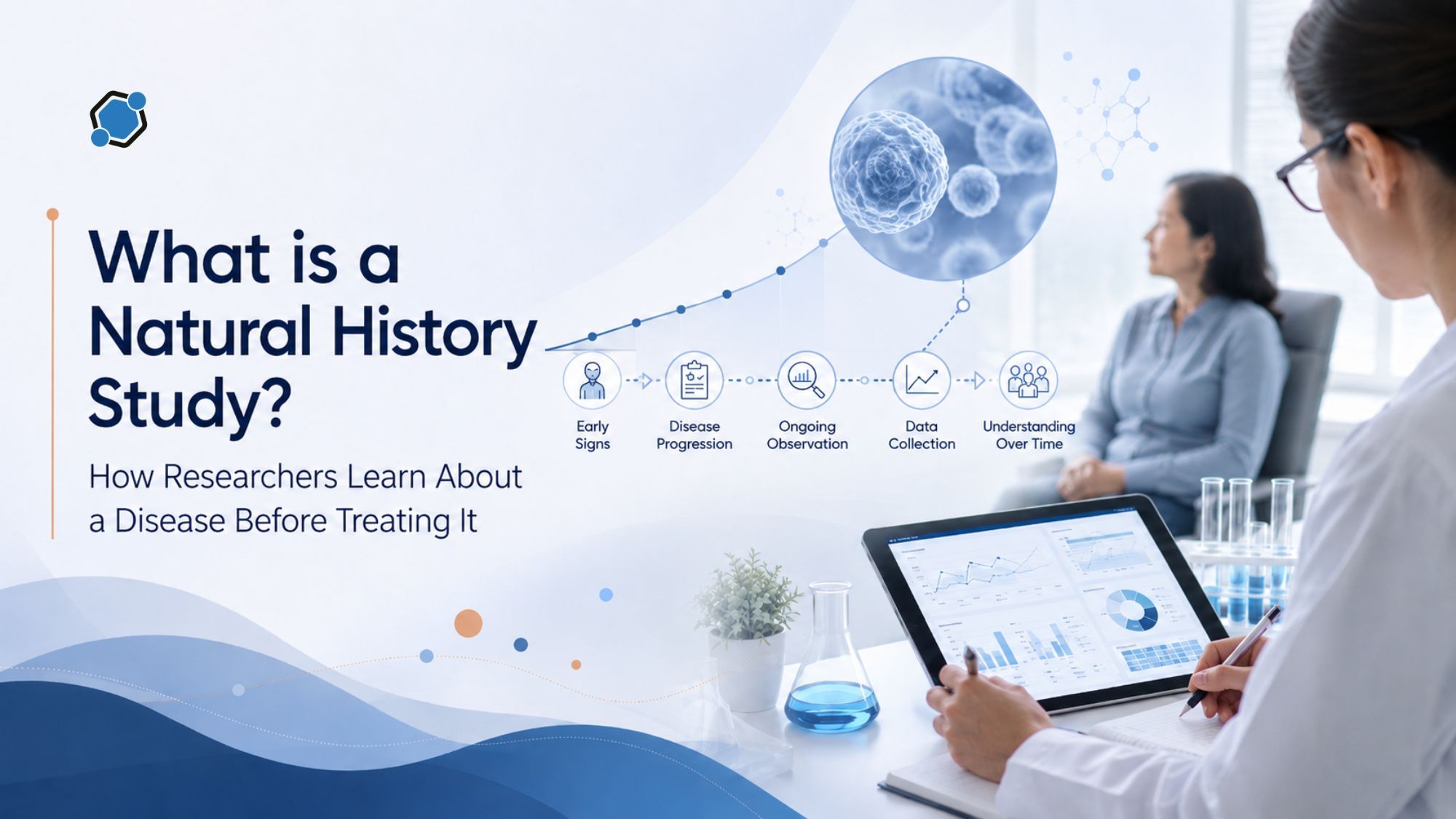
Most people picture medical research as a race to invent a new drug. In practice, the work usually starts much earlier than that, and it looks nothing like a laboratory breakthrough. Long before anyone is testing a treatment, researchers will spend years simply watching a disease. They keep careful notes on what it does to different people, how fast it changes them, which symptoms appear first, and which patients seem to fare better or worse than others. That careful watching has a name in medical research. It is called a natural history study.
For families dealing with a serious illness, especially a rare one, a natural history study can sound underwhelming at first. No one is trying out a new medicine. No one is promising results. But this kind of research is often the single most important step in the entire journey toward better care, and understanding why it matters changes how you read everything else that follows in clinical research.
What is a Natural History Study, in Plain Terms?
A natural history study is a type of observational research. The word “observational” is doing the heavy lifting in that label. Researchers watch and record, but they do not try to change anything. No one in the study is given an experimental drug. No one is asked to undergo a new procedure. Whatever standard care a participant is already receiving from their own doctor continues exactly as it was. The study just adds a layer of careful note-taking on top of real life.
What researchers are trying to capture is how a disease actually behaves when nothing new is interfering with it. They follow participants over weeks, months, or years, and they keep building a picture of how the condition plays out across many different people. Some natural history studies wrap up in a year or two. Others continue for decades, with new participants joining as the work goes on.
The result is something like a slow-motion film of a disease, pieced together from real patients living real lives. It rarely makes headlines, but it is the foundation newer research ends up being built on.
If you are still piecing together how medical research works as a whole, our guide Clinical Trials Explained: Simple Guide for Beginners walks through the basics of how studies are designed and run.
How Is a Natural History Study Different from a Clinical Trial?
The clearest way to understand a natural history study is to put it next to its better-known cousin: the clinical trial.
A clinical trial is built around a question. Does this new drug work? Is this surgical technique safer than the older one? Does this medicine actually relieve symptoms in people who do not yet have a good treatment option? To answer questions like those, researchers give participants something. A drug, a device, a procedure. They watch what happens, usually by comparing the people who got the treatment to people who did not.
A natural history study has no such intervention. Nothing experimental is given. No one is randomly assigned to anything. The researchers are not trying to prove a treatment works because they are not testing a treatment. They are trying to capture what a disease does when nobody is actively trying to fight it.
That distinction matters in everyday terms. A person who joins a clinical trial is, in some sense, on a treatment journey, even if they end up in the group that does not receive the investigational drug. A person who joins a natural history study is contributing data while continuing their normal life and their normal medical care. Their day-to-day experience does not change in any major way.
Both kinds of research are tightly regulated. Both require informed consent from every participant before anything begins. Both follow detailed plans that have been reviewed by independent ethics committees. The difference is in what the researchers actually do once you are part of the study.
Even within trial-based research, the questions and methods can look surprisingly different from one study to the next. Our piece on What Is the Difference Between Pragmatic and Explanatory Clinical Trials? walks through how those design choices shape the kind of answers a study can produce.
What Information Do Researchers Collect?
The data that goes into a natural history study can feel surprisingly personal. The whole point is to capture as much of the disease’s signature as possible, and that means looking at it from many angles at once.
A study might ask participants about their family history, where they live, the kind of work they do, and what their daily symptoms feel like. Researchers may collect blood samples, imaging scans, or tissue samples. They often record genetic information, sometimes by sequencing a participant’s entire genome. They may track quality of life through regular questionnaires. In some studies, participants record their own voices over the phone every month, so researchers can listen for tiny changes in speech that might not be obvious in conversation. Others wear small motion sensors on their wrists, which pick up subtle shifts in how they move long before a doctor would notice anything in the clinic.
How participants contribute all of this varies from study to study. Some studies are designed to run almost entirely from home. A visiting nurse may stop by once a month for a blood draw. A short questionnaire may arrive in an app every Friday. A few studies require periodic visits to a research site for tests that cannot be done remotely, such as a specialized MRI. Many studies blend both approaches, asking for a few in-person visits a year and remote check-ins in between.
What makes natural history data different from most other medical research is its scale and its patience. The same kinds of measurements are collected from the same people, over and over, for years. Anything interesting about the disease, including patterns that would be nearly impossible to spot in a single doctor’s visit, has a chance to emerge over time.
Why Are Natural History Studies Especially Important for Rare Diseases?
For rare disease communities, natural history studies are not a curiosity. They are often the most consequential research being done in the entire field.
A rare disease, by U.S. definition, is one that affects fewer than 200,000 people nationwide. Many rare diseases are far less common than that. Some affect only a few thousand people in the world, or even a few hundred. When the patient population is that small, two problems emerge at the same time.
The first problem is that basic information about the disease is often missing. There may be no clear answer to questions like: How fast does this condition progress? Is the version that hits at age twenty the same as the version that appears at age sixty? Does it ever stabilize on its own, or does it always get worse? Without answers to questions like these, no one can design a meaningful treatment, because there is no agreement on what treatment success would even look like.
The second problem is that conventional clinical trials, which usually need enough participants to compare different groups, may not be possible at all. A trial that needs three hundred people in each group simply cannot run if there are only two hundred patients in the world.
Natural history studies do not solve both problems instantly, but they make both problems smaller. By gathering as much detail as possible from the patients who do exist, they build the missing picture of the disease. They reveal which symptoms predict severity, which subtypes behave differently from one another, and which measurements are worth tracking when a treatment eventually becomes possible. And the data they collect can later serve as a comparison point: if researchers already know how a disease typically unfolds without intervention, they can evaluate a new drug’s effects without needing to assign anyone to a no-treatment group within a trial.
For many families with a rare diagnosis, the natural history study being run for their condition is not just useful background. It is the first concrete sign that the medical world is paying close attention to the disease they are living with.
For a closer look at how the rare disease research landscape is shifting, see Hope in Research: How Clinical Trials Are Transforming Rare Disease Treatment.
Who Can Participate, and What Joining Looks Like?
Eligibility for a natural history study tends to be broader than eligibility for a clinical trial. Because no experimental treatment is being tested, the safety concerns that narrow trial eligibility do not apply in the same way. A natural history study can include people across a wider range of ages, symptom severities, and overall health, and it often does.
Some studies focus only on people who already have a confirmed diagnosis. Others also enroll people at known risk of developing the condition, including family members who carry a genetic marker but have no symptoms yet. A few enroll healthy participants who do not have the condition at all, to provide a baseline that researchers can compare against.
That said, eligibility still matters. Each study has a protocol that defines who can join, and not every interested person will be a fit. Our explainer Eligibility Explained: Why Not Everyone Qualifies for a Trial walks through how eligibility decisions work in clinical research and why specific criteria exist.
Joining typically begins with informed consent, where a member of the research team walks you through what the study involves and answers your questions before you sign anything. After that, you would expect an initial round of assessments, which might mean a medical history review, baseline blood work or imaging, and a set of questionnaires. From there, the day-to-day rhythm of the study takes over: occasional surveys, periodic samples, and check-ins that happen at home, over the phone, or at a research site, depending on how the study has been designed.
Time commitment varies a great deal between studies. A short, focused study might only ask for a handful of contacts spread across a year. A long-running study might continue for five or ten years, with monthly check-ins throughout. Compensation also varies, but many studies cover practical participant costs like travel, accommodation, and meals, and the study assessments themselves are typically provided at no charge to the participant.
How to Learn More About Research Studies
If a natural history study or clinical trial sounds like something you would like to explore, there are a few practical ways to begin.
DecenTrialz is a U.S.-based clinical study matching platform that helps connect people with research studies they may be eligible for. The process is straightforward. You share some basic information about yourself and the conditions you are interested in, you get matched with studies that may fit your situation, and a nurse pre-screens you to walk through what each study involves before you decide whether to take the next step.
The research team running each study makes all final eligibility and enrollment decisions, since they are the ones responsible for participants’ care during the study. You can start a search at decentrialz.com.
For a closer look at how the platform works in practice, our walkthrough DecenTrialz Explained: How to Search, Read, and Apply for Clinical Trials covers what to expect step by step.
Your own doctor is also a useful starting point. If you are managing a condition or watching one in a family member, your care team may already know about research studies recruiting in your area, and they can help you think through whether participation makes sense for your situation.
The more researchers learn about a disease, the better the treatments that eventually follow it. Natural history studies make that learning possible, and the participants who contribute their data are the reason any of it happens at all. To explore studies that may match your conditions and your goals, start at decentrialz.com.
Was this article helpful?

Similar Blogs
International Week of Deaf People 2026: how can clinical research become accessible to Deaf participants?
More than seventy million people around the world belong to signing Deaf communities, and ...
 Deeksha Gitta
DecenTrialz vs. EMR-based clinical trial recruitment tools: what actually delivers qualified participants for sponsors and CROs?
Clinical trial recruitment technology now divides into two broad philosophies. One prizes ...
Vamshi Kantoju
Visceral Fat Health Risks: What Makes Belly Fat Different From Other Body Fat?
Body fat is usually discussed as a single quantity, weighed on a scale and summarized in o...
 Anish Teepireddy
Stay Informed. Stay Connected.
Get updates on verified clinical trials, emerging treatments, and research breakthroughs directly in your inbox. No spam, just science that matters.
