 HIPAA Compliant
 ISO 27001 Certified
What Is an Umbrella Trial? How Researchers Test Different Drugs for the Same Disease in Parallel
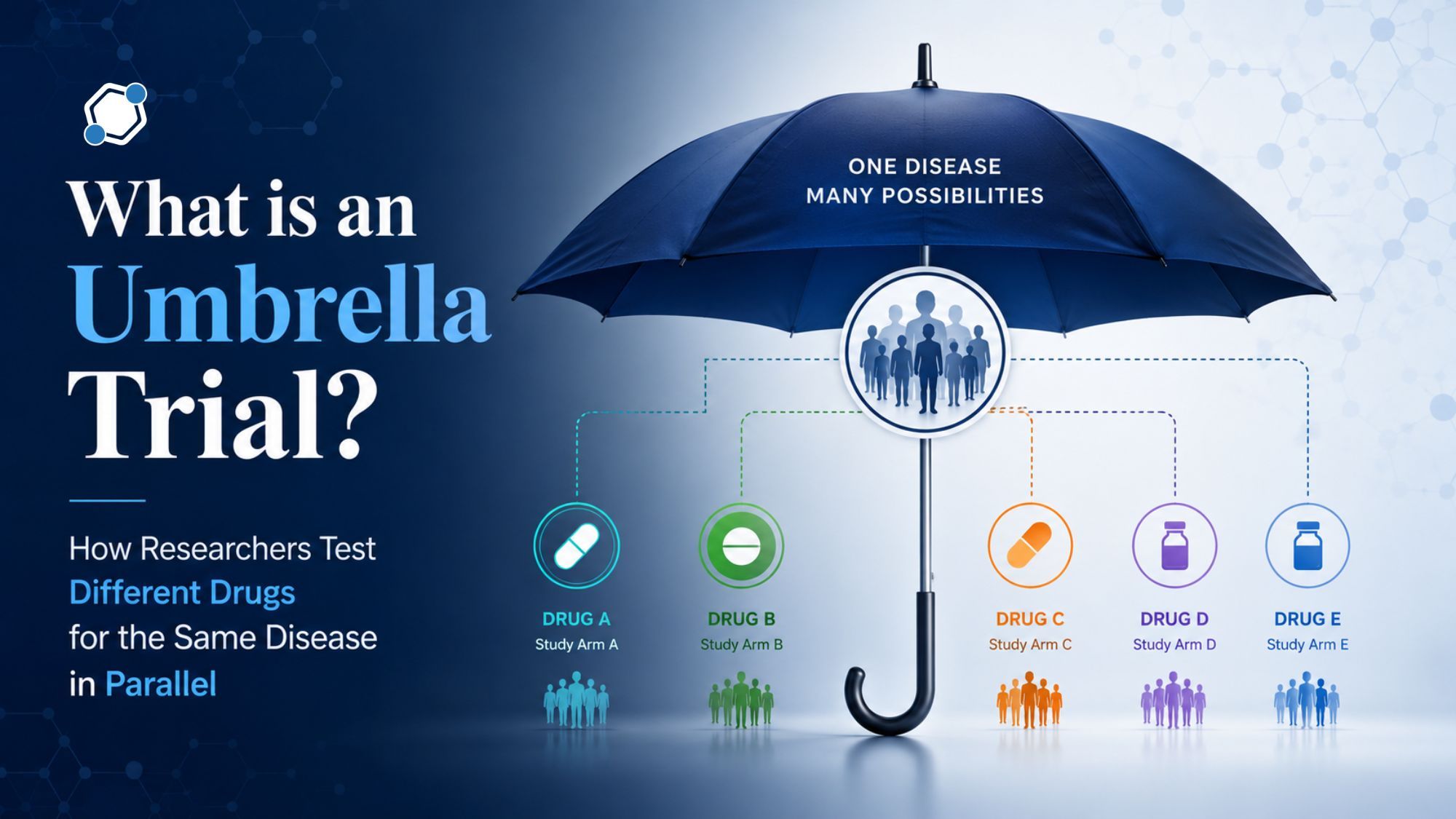
Two people can receive the same diagnosis and still have two different versions of the disease. Doctors used to assume that a diagnosis like lung cancer or breast cancer pointed to one condition with one set of treatments. Modern research has shown that this is often not true. Inside the cells, the same disease can come in several different forms, and each form may respond to a different drug.
An umbrella trial is a clinical trial built for this reality. Everyone in the trial has the same disease. But before any treatment begins, each person is tested to find out which version of the disease they have. Each person is then placed into a smaller study group, and each group tests a different drug matched to one specific version. The “umbrella” is the shared disease, and underneath it are the smaller studies, each one testing a different drug in a different group of people.
What Is an Umbrella Trial?
An umbrella trial is a clinical trial that tests several different drugs against the same disease at the same time. Every participant has the disease. But each participant is sorted into a smaller study group based on a specific signal found in their own body. Each smaller group tests a different drug.
The whole structure is held together by one shared set of rules, sometimes called a master protocol. The master protocol is the single rulebook that covers every smaller study underneath the umbrella. Each smaller study is called an arm. Each arm tests one drug in a defined group of participants, and the participants in that arm all share one specific signal in the body.
That signal is called a biomarker. A biomarker is any measurable feature that doctors can use to sort people with the same disease into different groups. It might be a small change in a gene. It might be the level of a particular protein in the blood. Whatever it is, it tells the research team which version of the disease a person has, and which drug is most likely to help that version.
This is different from a design that puts the same person through more than one treatment. In a crossover trial, one person receives one drug for a while, then switches to a different drug, and the same person is compared to themselves. An umbrella trial does the opposite. Different people are sorted by biomarker into different arms, and the arms run in parallel. Crossover Clinical Trials: When the Same Participant Receives More Than One Treatment explains that compare-to-yourself design in detail.
Why Umbrella Trials Exist
For most of the history of clinical research, doctors treated each disease as one single condition. One diagnosis meant one drug, tested against everyone with that diagnosis in one trial. Modern biology has shown that this view is often too simple. A diagnosis like lung cancer or breast cancer can include several different forms, each driven by a different change inside the cells.
This shift in understanding has led to an approach often called precision medicine. The goal of precision medicine is to match each person to a drug that fits the exact version of the disease they have, rather than treating everyone with the same diagnosis in the same way. Many of the newest drugs are designed to act on one very specific change inside the body, and those drugs usually work only for people who have that specific change.
Umbrella trials are a way to test many of these targeted drugs at the same time, in the same disease, without setting up a separate full trial for each drug. One round of testing identifies the version each person has, and each person is sent to the smaller study testing the drug for that version. The same logic now drives a wider set of trials that test treatments tied to very specific features in a person’s biology, including the gene-editing approaches described in Gene Editing Has Reached Real Patients. Here’s What CRISPR Clinical Trials Look Like Now.
How an Umbrella Trial Works in Practice
An umbrella trial usually moves through four steps.
First, every person who wants to join is checked against the basic rules of the whole trial. These rules are the things every smaller study has to share, such as the type and stage of the disease, the age range, and the person’s general health.
Second, the people who pass that first check go through testing for the biomarker. This usually means a sample of blood, tissue, or both, sent to a laboratory for analysis. The result shows which version of the disease the person has.
Third, each person is matched to the smaller study that tests the drug for their version. If they carry version A, they enter the group testing Drug A. If they carry version B, they enter the group testing Drug B. Many umbrella trials also include a backup group for people whose biomarker does not match any of the targeted drugs. That backup group usually tests an alternative therapy or the current standard of care.
Fourth, treatment begins inside the matched study, and the research team tracks safety and progress over time.
Real examples of umbrella trials are well documented in cancer research. Lung-MAP is a large U.S. lung cancer study run with the National Cancer Institute that tests several different drugs against different versions of lung cancer. ALCHEMIST is another lung cancer study that tests people for specific changes in their genes after surgery and matches them to different treatments. HUDSON tests combinations of drugs in advanced lung cancer, sorting people by the features of their disease. I-SPY 2 uses the same approach in breast cancer.
Because the biomarker test is what decides which group a person joins, not everyone who agrees to be screened will end up in an active treatment group. Some people will not be a match for any of the arms and will not enroll. Why People Get Screened for Clinical Trials and Still Don’t Get In explains how that experience plays out for people and why it is not a sign that anything is wrong.
Umbrella Trials vs. Basket Trials: The Mirror Designs
Umbrella trials are often discussed alongside basket trials, because the two designs are mirror images of each other. The difference is which side stays the same.
A basket trial keeps the drug the same and tests it against several different diseases that share the same biological feature. One drug, many diseases.
An umbrella trial keeps the disease the same and tests several different drugs in smaller groups inside that disease, with each group defined by a biomarker. Many drugs, one disease.
Both designs belong to a wider family of trials run under one shared rulebook. A third design in that family is called a platform trial. A platform trial tests several drugs against one disease but is built to add new drugs and drop old ones over time as new evidence comes in. Some umbrella and platform trials are also designed to change parts of the plan partway through, based on what the data show.
Comparisons like this matter for the people who join. The choice of design shapes what the trial can answer and who is allowed to enroll. What Is the Difference Between Pragmatic and Explanatory Clinical Trials? walks through a different comparison along similar lines.
Where Umbrella Trials Are Headed
Umbrella trials began in cancer research, and most published examples are still in that field. The design is now spreading into other areas where doctors are starting to recognize that one diagnosis often hides several different versions of the same disease. A 2024 review in a major gastroenterology journal explored how the umbrella trial design could be used in inflammatory bowel disease, which is the broad name for conditions that cause long-term inflammation in the digestive tract, including Crohn’s disease and ulcerative colitis. Similar interest is growing in joint diseases and brain disorders, where more targeted drugs are being developed every year.
Two changes are likely to keep shaping these trials. The first is the ability to add, pause, or drop smaller studies inside the umbrella without restarting the whole trial. The second is the use of blood-based biomarker testing, sometimes called liquid biopsy, which identifies the biomarker from a blood sample instead of a tissue sample. Both changes make the trial more flexible and less demanding for the people who take part.
For the people who join these trials, the practical result is that more clinical trials will be matched to the specific features of each person’s disease, rather than only to the broad name of the diagnosis. The family of specialized trial designs these belong to also includes other less familiar study types, such as Phase 0 Clinical Trials: What They Are and Why They Exist.
Clinical research is moving away from trials that treat every person with the same diagnosis in the same way. Umbrella trials are one of the clearest examples of that shift. As more drugs are designed to act on narrower features of a person’s biology, finding the right trial for one specific person becomes more specialized, and harder to navigate alone.
DecenTrialz helps people in the United States find clinical trials that may fit their condition, location, and basic eligibility details. After a person shares basic information, the platform may identify trial options that match their profile. A registered nurse may then complete an initial pre-screening review before the person is referred to the research team running a study. Final eligibility, enrollment, and informed consent are always handled by the study team responsible for the trial. A search can start at decentrialz.com.
Was this article helpful?

Similar Blogs

Master protocols explained: basket, umbrella, and platform trials in clinical research
Most clinical trials answer one question at a time. One study drug is tested against one c...
 Mahesh Upadrista
World Hepatitis Day 2026: Testing, vaccines, and the research shaping what comes next
World Hepatitis Day falls on July 28 every year. The 2026 theme, set by the World Health O...
Swaroop ESD
World Head and Neck Cancer Day 2026: Signs, risk factors, and current research
Every year on July 27, health organizations around the world observe World Head and Neck C...
Mahesh UpadristaStay Informed. Stay Connected.
Get updates on verified clinical trials, emerging treatments, and research breakthroughs directly in your inbox. No spam, just science that matters.
