 HIPAA Compliant
 ISO 27001 Certified
What is pharmacogenomics, and why does it matter for clinical trials?
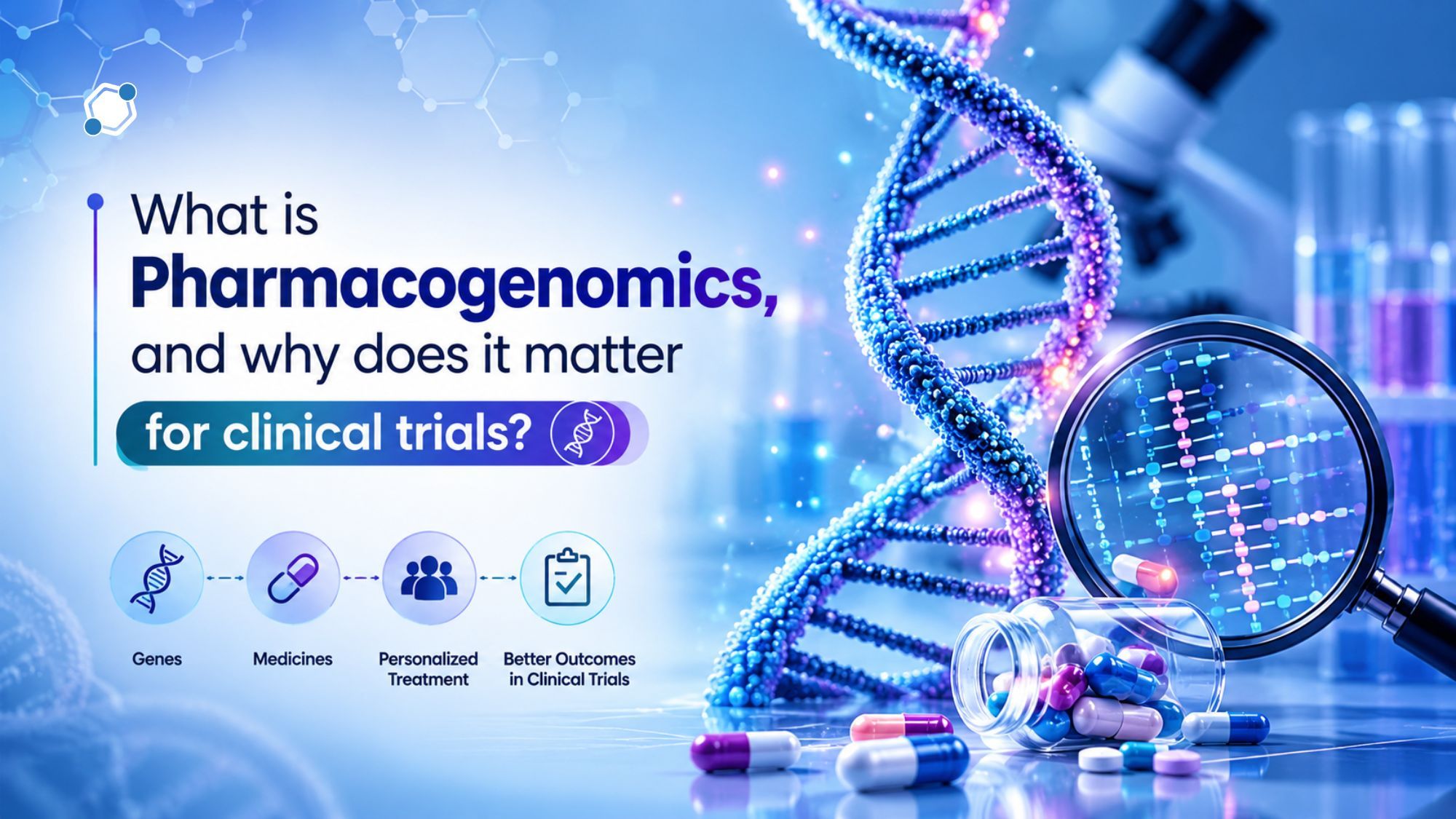
Doctors have known for decades that the same drug does not always work the same way for everyone. Some patients improve quickly. Others see no benefit. Some have serious reactions. For a long time, much of this was put down to individual variation. Pharmacogenomics is the field that traced a large part of the explanation back to genetics.
This matters for everyday prescribing, and it is changing how clinical trials are designed, who gets enrolled in them, and how researchers decide whether a drug actually works.
What pharmacogenomics is and how it works
Pharmacogenomics combines two fields. Pharmacology is the science of how drugs interact with the body. Genomics is the study of genes and how they function. Pharmacogenomics asks why one person processes a medication efficiently while another struggles with it, and traces the answer back to small differences in DNA.
Genes are instructions the body uses to build proteins. Many of those proteins are enzymes, which act as tiny chemical processors. A family of liver enzymes called cytochrome P450, often shortened to CYP, breaks down more than 30 different classes of medications. If a person's CYP enzyme works faster than average, the body clears a drug before it has time to do its job. If the enzyme works slower than average, the drug builds up and can cause serious side effects. If a key enzyme is missing entirely, the dose that helps most people can cause a dangerous reaction.
These differences are usually caused by tiny variations called single nucleotide polymorphisms, often shortened to SNPs. A SNP is a one-letter change in the genetic code, like swapping a single letter in a long sentence. Most SNPs are harmless, but some sit inside genes that control how the body handles medicines, and those are the ones pharmacogenomics focuses on.
These genetic signals are a type of biomarker, which is any measurable biological feature that gives doctors and researchers usable information. Pharmacogenomic biomarkers are specifically about how the body interacts with drugs, but they share the same purpose as other biomarkers: turning invisible biology into information that can guide care.
Where pharmacogenomics shows up in medicine right now
Pharmacogenomics is not a future technology. It is already used to guide prescribing decisions for a growing list of medications, and the FDA tracks which drug labels carry genetic information that doctors should consider before prescribing.
Some of the clearest examples involve serious safety risks. The HIV medication abacavir can cause a severe, sometimes fatal hypersensitivity reaction in people who carry a variant called HLA-B*57:01, so guidelines now require testing before the drug is started. The chemotherapy drug 5-fluorouracil can be deadly at standard doses in people whose bodies lack enough of an enzyme called DPD. The blood thinner warfarin needs lower starting doses in people with certain variants of two genes, CYP2C9 and VKORC1, to reduce the risk of internal bleeding. The heart medication clopidogrel may not work well in people whose CYP2C19 enzyme has reduced activity, which means a medication intended to prevent a stroke may not actually do so.
Pharmacogenomics also underpins some of the most important advances in cancer treatment. Trastuzumab, sold as Herceptin, only helps breast cancer patients whose tumors carry a marker called HER2. Imatinib only works in chronic myeloid leukemia patients whose cancer cells carry a specific genetic change called the BCR-ABL fusion. In each case, a genetic test does more than personalize the dose. It determines whether the drug should be used at all.
Other areas where pharmacogenomic testing is becoming more common include certain antidepressants, statins for cholesterol, immunosuppressants for transplant patients, and pain medications metabolized through the CYP2D6 enzyme. Just as individual measurements like body mass index can change how a drug behaves in the body, genetic differences can shift the right dose and the likelihood of side effects, sometimes more dramatically than weight or age.
Why pharmacogenomics is changing clinical trial design
For most of the last century, clinical trials worked the same way. Find as many people as possible with a given condition. Give half the new drug and half a placebo or a standard treatment. Compare results. The patient population was treated as a single group, with the underlying assumption that the average response would apply broadly.
That assumption is changing. Modern trials increasingly enroll only the people whose genetic profile suggests they are likely to benefit, a design known as biomarker-enriched recruitment. In cancer research, where pharmacogenomic testing is most established, this is now common practice. An analysis of cancer drugs approved by the FDA that required pharmacogenomic testing found that for the majority of approvals, every supporting clinical trial enrolled only patients who tested positive for the relevant biomarker.
This shift has produced new trial designs that did not exist a decade ago. A basket trial, for example, tests a single drug across patients who have different diseases but share the same underlying genetic mutation. A drug that targets a specific gene change can be evaluated in lung cancer, colon cancer, and melanoma in the same study, because the molecular cause of the cancer matters more than which organ it appears in.
The shift is also reshaping how trials measure success. Researchers no longer have to ask only whether a drug worked on average across a varied population. They can ask whether it worked in the subset of patients whose biology made them most likely to respond.
For research sites, this changes the enrollment funnel. Eligibility criteria often now include genetic markers that have to be confirmed by laboratory testing before a participant can be enrolled. Recruitment moves slower in raw numbers because the eligible pool is smaller, but enrollment is more efficient because the people who do qualify are more likely to respond to the treatment being studied.
What pharmacogenomic testing looks like in a trial
For a participant, pharmacogenomic testing in a clinical trial usually involves a cheek swab or a small blood sample, often collected during the screening visit before enrollment is confirmed. The sample goes to a laboratory, which checks specific genes for variants that affect either eligibility or drug dosing. Depending on the study, results may take a few days to a few weeks to return.
A few things are worth knowing before signing up. The informed consent form for any trial involving genetic testing should clearly explain what will be tested, how the sample will be stored, and whether results will be shared back with the participant or their doctor. Some trials offer participants the option to receive their results. Others store samples for future research without identifying information. The consent form should make this clear before anyone signs.
Pharmacogenomic testing is also different from broader genetic testing for disease risk. A pharmacogenomic test for a trial looks only at the specific genes that affect how a person processes the drug being studied. It does not provide information about ancestry, cancer risk, or unrelated health traits unless the consent form specifically says it will.
For research sites, pharmacogenomic testing adds operational steps. Sample collection, chain-of-custody documentation, laboratory turnaround, and integration of results into eligibility decisions all require workflows that not every site has in place. The sites that adapt earliest gain a competitive position with sponsors, who increasingly prefer to work with sites that can handle biomarker-driven recruitment without delaying enrollment. Central laboratories handle the genetic analysis itself; site coordinators and nurses own the collection and handoff.
If you are exploring whether a clinical trial might be a fit, DecenTrialz is a platform that connects people to studies they may be eligible for. Matching is AI-assisted, a nurse pre-screens each potential participant before referral, and the research team running the study handles all final eligibility and enrollment decisions. You can start a search at decentrialz.com.
The limits of what pharmacogenomics can do
Genes are powerful predictors, but they are not the whole story. Other medications a person takes can change how an enzyme functions. Diet, kidney function, liver function, age, and body composition all shift how a drug behaves once it enters the body. A person with the same gene variant as someone else can still respond to the same drug differently because of these other factors.
There are practical limits as well. Pharmacogenomic testing is well-established for a few dozen drugs. For most medications, the genetic picture is still being mapped out. Even where a test exists, insurance coverage and access vary widely. A participant living near a large research hospital may have easier access to studies using pharmacogenomic data than someone in a rural area with fewer trial sites nearby.
Pharmacogenomics also cannot guarantee a good outcome. A patient who tests positive for the right biomarker has a better chance of responding to a targeted therapy, but a better chance is not a certainty. Some people with the right genetic profile do not respond as expected. Clinical trials are how the field keeps getting better at predicting response, but the science is still developing.
Genetic data also raises privacy questions. DNA is uniquely identifying. Reputable trials handle it carefully and protect participant identities, but it is reasonable to ask before signing a consent form how the sample will be stored, who can access it, and what happens to it when the study ends.
Where this fits if you are considering or running a trial
For someone exploring whether a clinical trial might be a good fit, the practical takeaway is this. Pharmacogenomics is one reason eligibility criteria look more specific than they used to. A trial that excludes people without a particular gene variant is not arbitrary. It is enrolling the population most likely to benefit from the treatment being tested, and most likely to do so safely.
For research sites, pharmacogenomics is a capability worth investing in. Sponsors are running more biomarker-driven trials, the proportion of new drug approvals with pharmacogenomic information continues to climb, and sites that can handle genetic screening workflows efficiently will be the ones sponsors return to.
DecenTrialz connects people to clinical trials they may be eligible for, including studies that use pharmacogenomic or biomarker-based eligibility criteria. If you want a clearer picture of how the platform works, here is a guide to searching, reading, and applying for trials. You can begin a search at decentrialz.com.
Was this article helpful?

Similar Blogs

Direct-to-patient shipping in clinical trials: how study medication arrives safely at home
Home delivery of prescription medications has become a familiar part of everyday healthcar...
 Swaroop ESD
Women’s Equality Day: what does August 26 commemorate, and why does it still matter?
Every August 26, the United States marks Women’s Equality Day. The observance honors a sin...
Paramraj
Signs of Breast Cancer Other Than a Lump: What Adults Should Watch For
Most public awareness campaigns focus on finding a lump. That message has saved lives, but...
Vamshi KantojuStay Informed. Stay Connected.
Get updates on verified clinical trials, emerging treatments, and research breakthroughs directly in your inbox. No spam, just science that matters.
