 HIPAA Compliant
 ISO 27001 Certified
Why most HCPs never refer a patient to a clinical trial, and what is changing
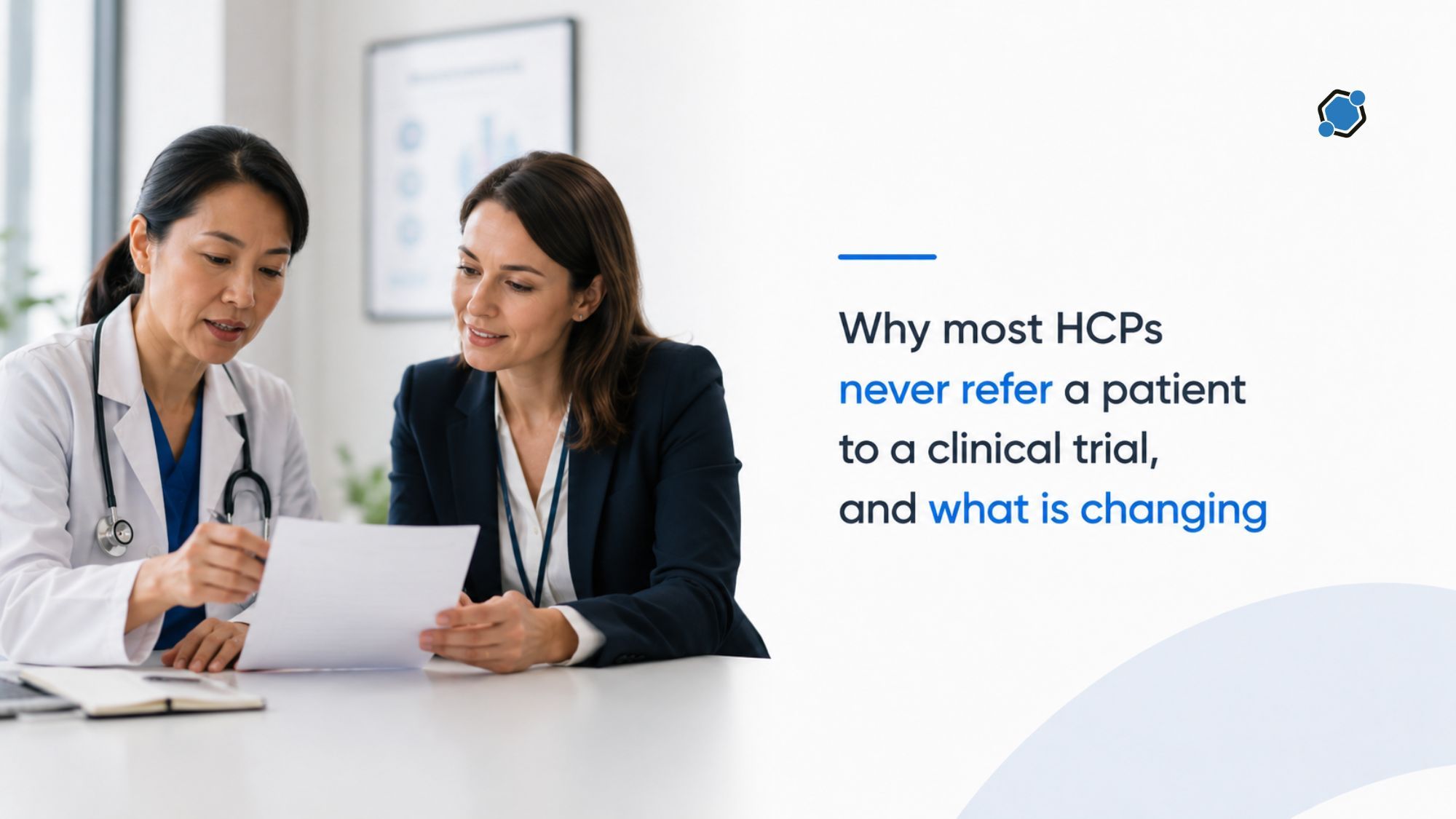
Clinical trial recruitment depends on healthcare professionals (HCPs) referring patients into research studies. The gap between how many referrals the recruitment pipeline could support and how many actually move through it has been one of the most stable patterns in clinical research for more than a decade. The pattern does not reflect a lack of interest in research among practicing physicians. It reflects the way routine care, trial design, and the referral infrastructure have not historically been built to work together.
This is the practical reality of the HCP referral gap. The friction has been structural, not motivational. And for the first time in years, several of those structural problems are starting to give way under a combination of AI-assisted matching tools, pre-screening capacity outside the practice, and structured referral workflows that protect the physician's time and the patient's continuity of care. This article looks at where the friction has lived, why it has been so persistent, and what is beginning to change.
The referral gap is structural, not motivational
The picture from industry research has stayed remarkably stable for more than a decade. The overwhelming majority of physicians surveyed about clinical research describe themselves as comfortable with the idea of trial referrals, supportive of patient access to research, and willing to discuss trials with eligible patients. Actual referral volume from routine clinical care has been much lower than that intent would suggest, and the reason sits in the system around the physician rather than in the physician's willingness to participate.
When industry analysts describe what makes trial referrals hard, the same handful of structural factors come up: visit time is short and getting shorter, the tools for finding recruiting trials are not built into routine workflow, the eligibility criteria of any given trial are difficult to verify against a chart in real time, the referral itself takes the physician outside their usual care network, and the activity does not appear in the standard revenue model. Physicians have been working inside those constraints. The constraints are what need to change, and what are now starting to.
The downstream effect on clinical research has been a pipeline that depends on referrals but does not receive enough of them, and a recruitment phase expensive enough that delays at the time-to-first-patient stage of a clinical trial often dictate the budget profile of the entire study.
Where the structural friction has lived
The friction has rarely been a single barrier. It has been a stack of small ones built into the system around the physician, each individually manageable, and collectively heavy enough to make most referrals unworkable in routine practice.
Time is the most consistent. Visit lengths are short. Documentation requirements have grown. Conversations about research, even at their most efficient, take time the visit structure does not allocate.
Awareness is the second. Most practicing physicians cannot, on the spot, name a recruiting trial that matches their patient's condition and location. National registries contain the information in principle, but searching them mid-encounter to verify eligibility criteria (the rules describing who can join a study) is not workable inside a fifteen-minute visit.
Verification is the third. Eligibility criteria are dense. A trial's inclusion and exclusion list runs to twenty or more clauses with thresholds on labs, medication exposures, comorbidities, and prior procedures. The chart is open in front of the physician, but there has been no built-in way to map the chart against the protocol.
Continuity and trust is the fourth. A trial referral is not a handoff to a colleague inside the physician's usual referral network. It is a handoff to a study team operating under a protocol the practice did not write, on a timeline the practice does not control. The clinician's role in expanding trial access for patients has long included a protective instinct toward the patient relationship, and the trial referral pathway has not historically come with the safeguards that would let physicians extend that protection through the handoff.
The fifth is the missing incentive. Time spent on referrals does not appear in the standard revenue model. Progress has been made on reimbursement for some trial-related activities, but the routine referral itself remains unreimbursed in most settings.
Why the traditional referral path was never built for trials
Specialist-to-specialist referrals run inside a defined care network. Clinical trial referrals do not. The study team typically sits outside the physician's usual referral network. It runs on a sponsor or contract research organization (CRO) timeline rather than a care timeline. And it uses eligibility criteria the practice has no built-in way to verify against the patient chart.
These mismatches are why the standard referral toolkit has not extended well to trials. A normal specialist referral fits inside the practice's existing workflow: the EHR (electronic health record) holds the receiving specialist's information, the office staff knows the routine, and the patient usually has a few options inside the network. None of that infrastructure has existed for trial referrals by default. The physician has had to find the study, evaluate the fit, identify the right contact, and trust an unfamiliar team to manage the next steps.
Some of this can be addressed with better directories or more reminders. But the deeper problem has been structural. The traditional referral system was built for patient handoffs within a care network. It was not built for handoffs into a research enterprise that operates on different incentives, different timelines, and different documentation requirements. Community physicians expanding clinical trial participant pools need a workflow built for trial referrals specifically, not a retrofit of the specialist-referral pattern.
What is changing the math now
Three shifts have begun to compress the structural friction that kept referral volume below where most physicians would have wanted it to be.
The first shift is AI-assisted matching against electronic health record data. Modern matching platforms read the patient chart, compare it against the eligibility criteria of recruiting trials, and surface candidate studies with the specific criteria that appeared to match. Peer-reviewed work published in 2025 and 2026 has shown that large language model-based matching can identify eligible patients at accuracy levels approaching expert physician review, and that these tools surface recruitable patients that routine screening would not have caught. Major academic medical centers in oncology and cardiology have moved AI-powered matching from pilot projects into operational systems over the past eighteen months. AI trial matching for HCPs is no longer a future-state capability.
The second shift is pre-screening offload. The historical bottleneck has been a workflow that expected the physician to do everything: identify the trial, verify the fit, talk the patient through it, and manage the referral. The newer model splits these tasks. A registered nurse working with the recruitment platform completes the initial pre-screening review of a patient who has expressed interest in research participation. The physician's role narrows to flagging the candidate and approving the referral; the platform team takes the next steps.
The third shift is closed-loop reporting. Referring physicians have historically had little visibility into what happened to the patient after the referral. The patient might have enrolled, been screened out, declined to proceed, or never followed up at all, and the practice would not know. Newer platforms send structured status updates back to the referring clinician at each stage of the referral, which makes the process feel less like an unsupported handoff and more like the continuity-respecting referral that the rest of the practice already runs. The physician learns whether the patient was enrolled, whether they declined, or whether the site research team identified an eligibility issue the chart alone could not have predicted, and that information flows back into the patient relationship the practice continues to manage.
Two additional currents reinforce these shifts. Policy attention to enrollment efficiency has grown across regulatory and payer conversations, and decentralized and hybrid trial designs have widened the pool of studies a community physician can practically refer to, since participation no longer requires a patient to travel weekly to an academic center for every visit.
Each of these shifts addresses one of the friction points named earlier. AI matching addresses the awareness and verification gaps. Pre-screening offload addresses the time and incentive gaps. Closed-loop reporting addresses the continuity-and-trust gap.
What stays with the physician
The new tools change the workflow. They do not change the lines of regulatory and ethical accountability, and they preserve the part of the relationship that belongs to the referring physician.
The referring physician retains the patient relationship and the ongoing clinical care. They are the person the patient knows and trusts. They are the one the patient calls when something feels off during the trial, even when the formal point of contact is the site research team.
The site research team retains the responsibility for everything that happens inside the trial itself. The principal investigator (PI), who is the licensed physician responsible for the study at the research site, oversees screening, eligibility determination, informed consent, dosing, monitoring, and any escalation. The site team operates under the protocol approved by an institutional review board (IRB) and complies with the framework of International Council for Harmonisation Good Clinical Practice (ICH-GCP) guidelines. Recruitment platforms and pre-screening services sit upstream of the site. They do not perform the formal eligibility determination or the consent walk-through; that work belongs to the research team, by regulation. Easier referral pathways for HCPs work because they tighten the handoff between the referring clinician and the site team, not because they blur the boundary between the two.
This split is the design point of the new referral model. A common misreading of platform-based recruitment is that it asks more of the referring physician than the traditional path did. The opposite is the case. The model exists specifically so that the physician's part of the workflow stays small, fast, and inside their scope of care.
How DecenTrialz fits the new referral path
DecenTrialz is a U.S.-based patient recruitment platform built around the workflow described above. The platform uses AI-assisted participant matching to surface candidate studies for patients in the system, a registered nurse completes the initial pre-screening review, and the structured referral is sent to the site research team that handles all of the formal eligibility determination, informed consent, and enrollment. The referring physician retains the patient relationship and receives status updates back through the platform without taking on any additional study-team responsibility.
For HCPs evaluating where to send patients who express interest in research participation, the platform is built to be a low-friction entry point: the physician flags the interest, the nurse pre-screens, the site team takes over from there, and the practice stays in the loop. Physicians can start by visiting DecenTrialz.
The platform does not promise that a referred patient will be eligible for a specific trial, will be enrolled, or will benefit clinically from participation. Those determinations belong to the site research team and depend on the patient's specific situation and the protocol's specific criteria. What the platform does is remove the structural friction that has kept referral volume below where physicians would have wanted it to be.
The referral gap is not new, but the structural answer to it is starting to look different. AI-assisted matching, pre-screening offload, and closed-loop reporting are changing the practical math for clinicians who have always been ready to refer patients into research and now have the workflow to support it. The gap between intent and action is finally narrowing, and the path that closes it is built around the principle that the physician's part of the work should stay small and the site research team should handle the rest. Practices that want to see how the model works in their own workflow can start at decentrialz.com.
Was this article helpful?

Similar Blogs
How to identify clinical trial candidates during a routine patient visit
The ability to identify clinical trial candidates during a routine patient visit is one of...
 Mahesh Upadrista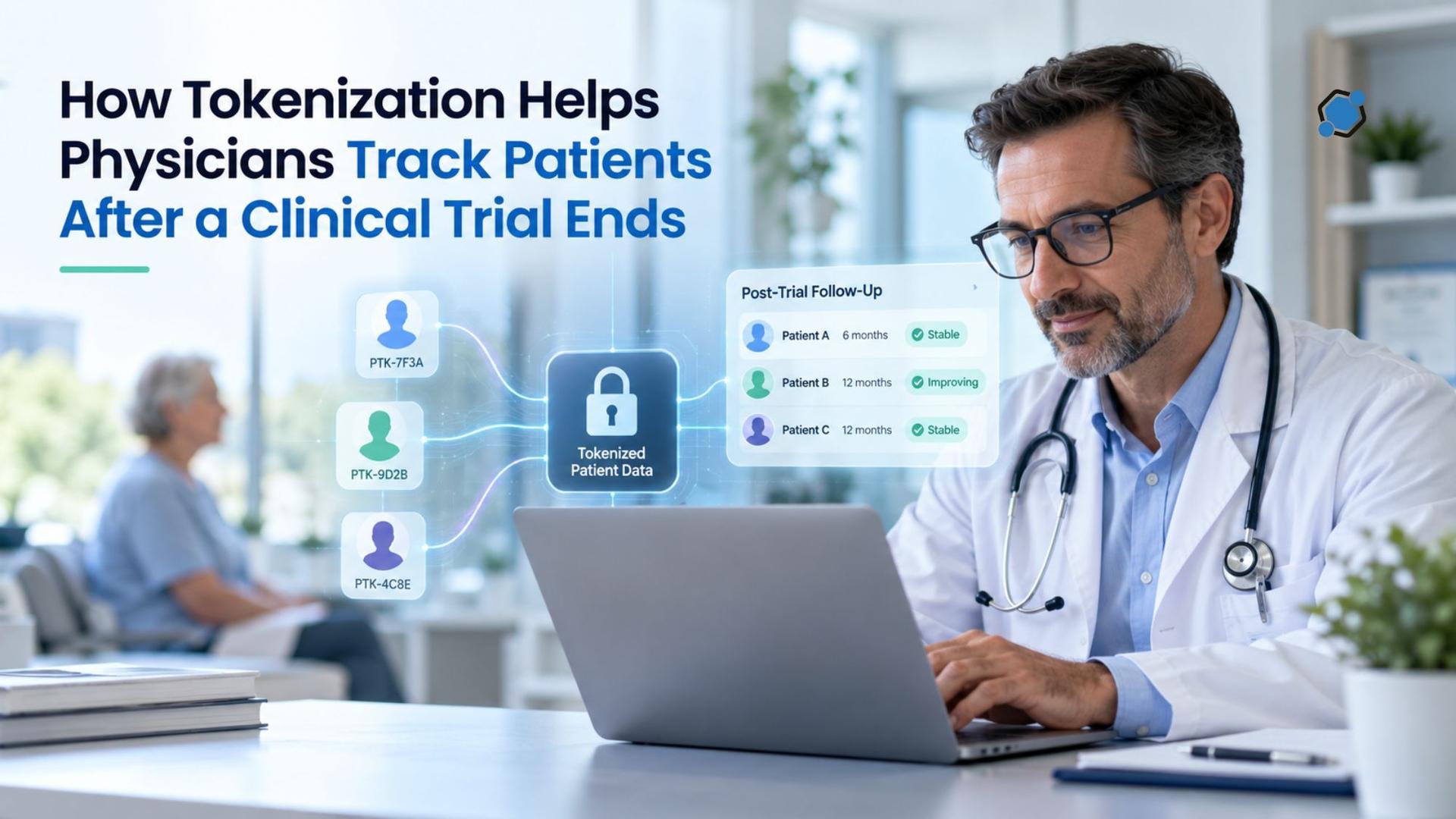
How Tokenization Helps Physicians Track Patients After a Clinical Trial Ends
Tokenization is changing how sponsors keep track of clinical trial participants long after...
Swaroop ESD
Digital Endpoints in Clinical Trials: What Wearable Data Measures and What It Does Not
Digital endpoints in clinical trials have changed both what a study measures and where the...
Mahesh UpadristaStay Informed. Stay Connected.
Get updates on verified clinical trials, emerging treatments, and research breakthroughs directly in your inbox. No spam, just science that matters.
