 HIPAA Compliant
 ISO 27001 Certified
How easier referral pathways help HCPs connect patients to clinical trials
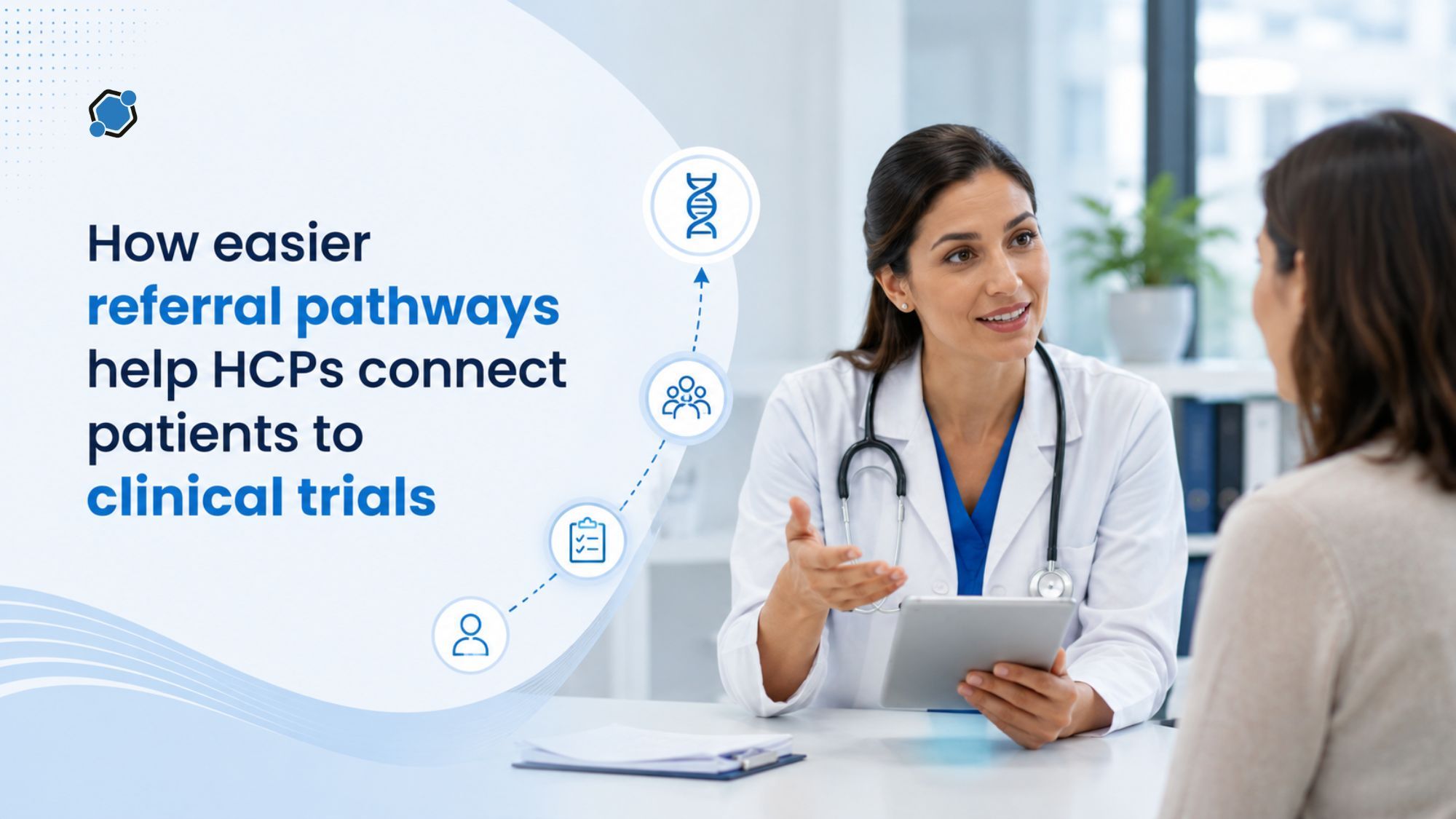
Clinical trial recruitment depends on healthcare professionals (HCPs) referring their patients into research studies. Yet referral activity from routine clinical care remains a small share of what the recruitment pipeline could support. The reason is rarely a lack of willingness. Survey research consistently finds that physicians and nurses report high comfort discussing clinical trial opportunities with their patients. The actual volume of referrals from primary care, specialty practices, and community clinics sits well below that comfort level. The gap between intent and action is the trial awareness gap. It is shaped by friction in the referral path, not by clinician motivation.
Easier referral pathways are the operational answer to that gap. They reduce the work of identifying, matching, and handing off a patient candidate, and they preserve the parts of the referral that depend on clinician judgement. This article walks through where the traditional referral path breaks down for physicians, what an easier pathway looks like in operation, the regulatory boundary that separates the referring clinician from the site research team, and how a defined platform changes the operational equation for practices that want to expand trial access for their patients.
The awareness and referral gap is wider than most clinicians realize
The same finding has appeared in survey after survey for more than a decade. The overwhelming majority of physicians and nurses are comfortable raising clinical trial participation with their patients. A much smaller share has actually referred a patient to a study. The proportion of patients seen in routine care who eventually enroll in a trial is a fraction of those who could plausibly qualify.
The gap widens further outside of oncology. Inside cancer care, dedicated research coordinators and established sponsor relationships keep trial awareness inside the clinic. In primary care and in specialties such as neurology, cardiology, and rheumatology, awareness drops sharply. Surveys of practicing physicians have repeatedly found that the majority describe themselves as not at all aware of trials being conducted in their area. Awareness is not a personality trait. It is a function of how trial information reaches the practice and how easy it is to act on once it does.
The barriers physicians cite most often are logistical. They include not knowing what is open, not having time to verify eligibility, and not seeing what happened after a referral was sent. The community-physician engagement experience documented in How Community Physicians Can Expand Clinical Trial Participant Pools has shown that motivation is rarely the bottleneck. Process is.
Where the traditional referral path breaks down
Specialist-to-specialist referrals run inside a defined care network. Clinical trial referrals do not. The study team often sits outside the physician's usual referral network. It runs on a sponsor or contract research organization (CRO) timeline rather than a care timeline. And it uses eligibility criteria that the practice has no easy way to verify against the patient chart. Four friction points show up repeatedly.
The first is discovery. There is no shared registry that surfaces recruiting trials at the moment of a patient visit. A physician would need to step outside the exam-room workflow, search a public registry, and parse eligibility text written for study teams rather than for referring clinicians.
The second is eligibility verification. Trial inclusion and exclusion criteria are long, dense, and written in research vocabulary. A practicing clinician cannot reasonably read the full list during an appointment and judge with confidence whether a patient qualifies.
The third is transmission. Even when a physician knows about a relevant trial, sending the referral usually means an email or phone call to a coordinator they have not met. There is no template for what information to share or how to share it securely.
The fourth, and most underrated, is feedback. Most clinicians who refer a patient never learn what happened. Did the patient screen in? Screen out? Enroll? Did the study team contact them at all? Without that loop, the practice has no way to refine future referral decisions, and confidence in the workflow erodes. Bridging the Gap: How HCPs Can Talk to Patients About Research Opportunities explores how the clinician-patient conversation about research is shaped by these unresolved frictions.
What an easier referral pathway actually looks like
An easier pathway is a defined sequence that takes the clinician from intent to action in a few steps. The steps the clinician does not need to handle are removed from their workload entirely. Five components define the shape.
A single intake point. The clinician refers a patient through one consistent entry, not a different system for every trial. The form collects only the information needed to determine candidacy at a first pass.
AI-assisted matching. Once the patient profile is submitted, software compares the patient against currently recruiting trials and surfaces the studies that are a plausible fit. The physician does not have to know which trials are open. The matching layer does.
Registered nurse pre-screening. A licensed clinician reviews the matched candidates, completes an initial pre-screening conversation with the patient, and confirms the basics before the patient reaches the study team. This is the layer that reduces screen failures downstream.
A structured handoff to the site. When a candidate clears pre-screening, the referral moves to the research site running the study, with the relevant information packaged in a format the site team can act on. The practice does not chase the handoff.
Closed-loop feedback. The referring physician is notified when the patient is contacted, when a screening decision is made, and when the patient enrolls or declines. This is what turns a one-time referral into a sustainable practice habit. The pre-screening logic underneath this kind of pathway is described in Pre-Screening Smarter: How Technology Reduces Screen Failures at Sites.
How easier pathways change the math for practice time
Time inside the practice is the most expensive resource a clinician allocates. Anything that asks for time outside of patient care gets deprioritized quickly. Traditional clinical trial referral has historically asked for a lot of it. Registry searches, eligibility reviews, coordinator outreach, and follow-up calls all sit on the clinician's desk. None of that work is clinically necessary at the practice level. All of it can move upstream.
When matching and pre-screening run on a platform, the clinician's time commitment narrows to two distinct moments. The first is the referral itself, which takes a few minutes inside or immediately after the patient visit. The second is the feedback acknowledgement, which usually takes less. Everything between those two moments is handled by the matching layer and the pre-screening nurse, not by the practice.
The result is a referral pattern where the clinician invests time in clinical judgement, the part no platform can or should automate, and offloads the rest. The distinction matters because it preserves the patient-care relationship as the focal point of the visit. The platform handles the operational work. The physician handles the clinical conversation and the patient relationship.
Patient continuity does not end at referral
A persistent barrier to clinician referral is the belief that sending a patient to a clinical trial means losing them from the practice. The evidence consistently shows otherwise. Most patients who participate in a trial remain in active care with their referring physician throughout the study. Many describe the referral as a moment of trust in the physician-patient relationship rather than a transition away from it.
A well-designed pathway reinforces this continuity. The patient continues to see their physician for routine care during the trial. The study-related procedures happen at the research site on the protocol's schedule. The study team coordinates with the referring physician on relevant medical updates when the patient consents to that exchange. The physician retains the relationship. The site team takes on the trial-specific work.
This split is also what makes trial participation an addition to standard care rather than a replacement for it. The patient does not lose access to the physician they trust, and the physician keeps the longitudinal view of the patient's health that no study team can fully reproduce. When Doctors Partner With Research: Benefits for Practice and Patients documents how this relationship pattern plays out across a range of practice settings.
Where referring clinician responsibility ends and the site research team begins
Easier referral pathways sharpen the line between routine care and clinical research rather than blurring it. The referring clinician retains responsibility for the patient's ongoing care and for the clinical judgement that led to the referral. Everything that falls under the research protocol moves to the site team running the study.
Under International Council for Harmonisation Good Clinical Practice (ICH-GCP) guidelines and United States investigator responsibilities, several obligations sit with the principal investigator (PI) and site research staff. Study-specific screening assessments must be conducted under institutional review board (IRB) approval and cannot begin before that approval is in place. Informed consent must be obtained by the study team before any protocol-mandated procedure. The case history for every screened candidate, including those who do not enroll, is documented by the site as part of the trial record. Final eligibility verification and the decision to enroll always belong to the study team.
The referring clinician's role in this division is the part of the workflow where their judgement, their patient relationship, and their clinical familiarity matter most. They identify a patient who could plausibly benefit from research participation, and they refer through a pathway that respects the practice's time. The Clinician's Role in Expanding Trial Access for Patients covers this scope question in more depth.
How DecenTrialz delivers easier referral pathways for healthcare professionals
DecenTrialz is a participant referral, matching, and pre-screening platform for clinical trials in the United States. The clinician-facing pathway is designed around the constraints described above. Minimum time inside the practice. No manual registry searches. No eligibility-document review. A closed-loop feedback structure that lets the referring physician know what happened with each patient.
After the clinician submits a referral with the patient's consent, the platform's AI-assisted matching layer compares the patient profile against currently recruiting trials and surfaces the candidates that are a plausible fit. A registered nurse then completes an initial pre-screening review with the patient before the referral is handed off to the research site running the study. The site research team handles the study walk-through, the final eligibility verification, the informed consent conversation, and enrollment, since they are the ones responsible for the participant's care during the trial.
The feedback loop closes back to the referring clinician at the points that matter. When the patient is contacted, when a screening decision is made, and when enrollment status is finalized. Practices interested in offering trial referrals to their patients can learn more at decentrialz.com.
The trial awareness gap is not a problem of individual willingness. It is a structural problem about how information moves between research teams and practicing clinicians, and how much friction that movement adds to a workday that has no extra time to give. Easier referral pathways close the gap at scale because they reduce the work the practice does not need to do and preserve the parts where clinician judgement is essential.
Clinicians who want to expand trial access for their patients without adding operational burden to the practice can start a referral conversation at decentrialz.com.
Was this article helpful?

Similar Blogs
Digital Endpoints in Clinical Trials: What Wearable Data Measures and What It Does Not
Digital endpoints in clinical trials have changed both what a study measures and where the...
 Mahesh Upadrista
Digital Endpoints in Clinical Trials: How HCPs Interpret Wearable Data From Their Patients
Wearable devices now generate a substantial share of the data collected during modern clin...
Deeksha Gitta
Point-of-care clinical trials: how research fits inside routine practice
Clinical research and clinical care have long operated as parallel systems. Patients recei...
 Anish Teepireddy
Stay Informed. Stay Connected.
Get updates on verified clinical trials, emerging treatments, and research breakthroughs directly in your inbox. No spam, just science that matters.
