 HIPAA Compliant
 ISO 27001 Certified
World Alzheimer's Month 2026: What Clinical Research Means for the Future of Alzheimer's Care
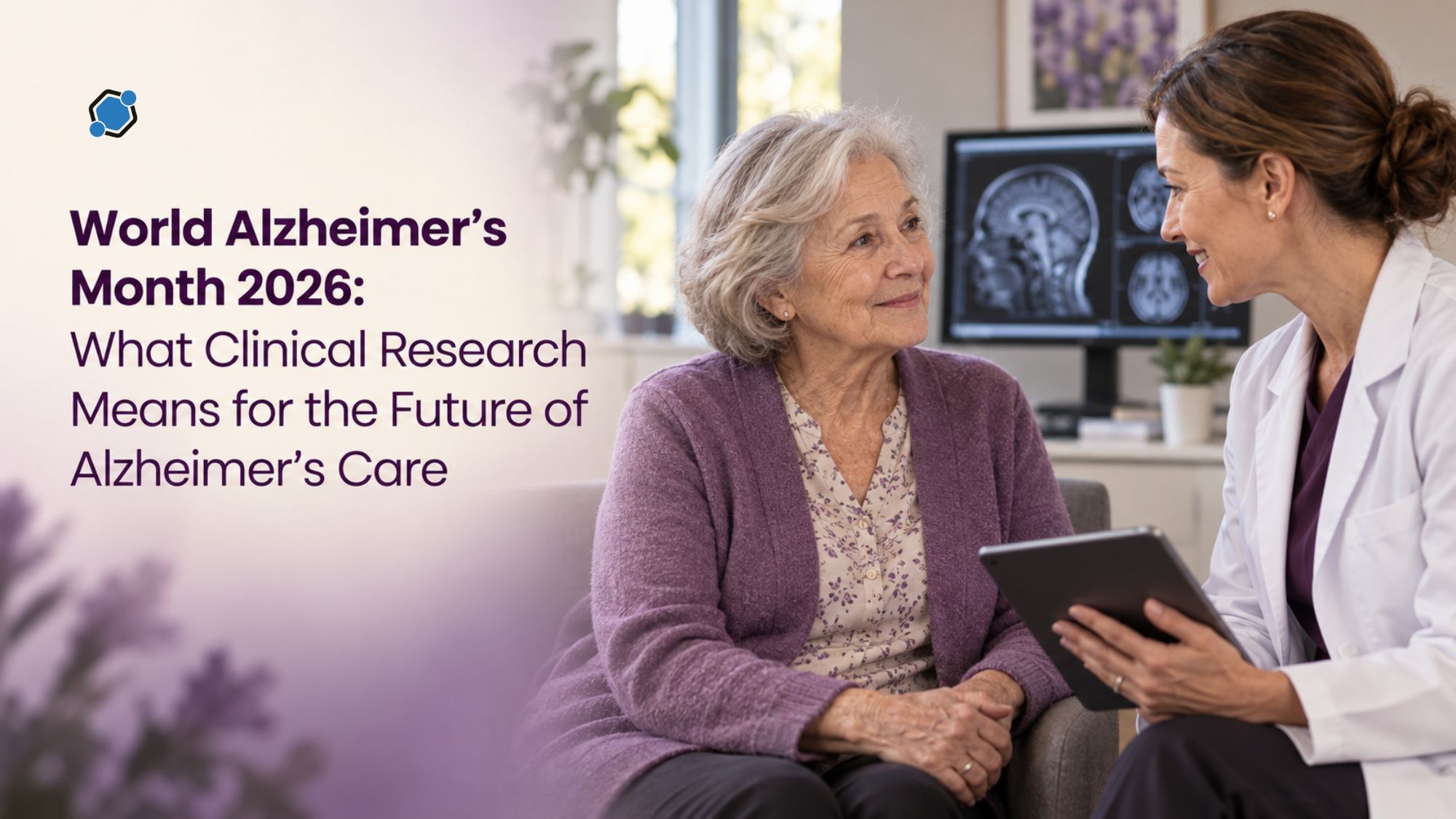
Every September, Alzheimer's Disease International leads World Alzheimer's Month, a global campaign that focuses attention on a condition affecting millions of families worldwide. The 2026 theme, "The Earlier You Know, The More You Can Do: A Dementia Diagnosis Matters," places early recognition and action at the center of the conversation. Alzheimer's Disease International has also announced that its 2026 World Alzheimer Report will focus specifically on clinical trials, describing research as the essential pathway for turning discoveries into care that reaches people.
That framing sets the tone for this article. Progress against Alzheimer's disease has never come from awareness alone. It has come from carefully designed studies and from the participants, study partners, physicians, and research teams who guided each step. This blog explains what Alzheimer's disease is, how clinical research is reshaping what is possible, what a person can expect if they consider taking part, and how someone finds a study that fits their situation.
What World Alzheimer's Month is and why September matters
World Alzheimer's Day, observed every September 21, was launched in 1994 by Alzheimer's Disease International, a federation of Alzheimer and dementia associations working in more than one hundred countries. World Alzheimer's Month, which extends that single day into a full September campaign, began in 2012. Both dates are officially recognized by the World Health Organization.
The campaign has several linked goals. It raises public understanding of dementia, challenges the stigma that still surrounds a diagnosis, encourages earlier evaluation when memory or thinking changes appear, and highlights the role of research in shaping better care. Purple ribbons, community walks, and educational events across many countries all point to the same message: dementia is a health priority, and progress depends on public engagement, informed families, and volunteers who take part in research.
The 2026 focus on clinical trials is significant. Alzheimer's Disease International frames trials as the driving force behind every emerging option that eventually reaches a clinic. That framing is worth carrying into any conversation about the disease this September.
Understanding Alzheimer's disease and how it differs from dementia
The two words are often used interchangeably, and that is one of the most common sources of confusion. Dementia is an umbrella term for a group of symptoms, such as memory loss, confusion, and difficulty reasoning, that are severe enough to interfere with daily life. Alzheimer's disease is one specific illness, and the most common one, that causes dementia. Every person with Alzheimer's disease has dementia, but every case of dementia does not come from Alzheimer's.
Inside the brain, Alzheimer's disease is linked to several changes that can begin a decade or more before the first noticeable symptoms. Sticky clumps of a protein fragment, called amyloid plaques, build up in the spaces between nerve cells and interfere with how those cells communicate. Twisted strands of another protein, called tau tangles, form inside nerve cells and disrupt the internal transport system the cells need to survive. As plaques and tangles spread, nerve cells are damaged and die, and the affected regions of the brain gradually shrink, a process known as atrophy. Readers tracking brain health may find related context in the earlier blog on everyday prevention and access.
The symptoms of Alzheimer's are different from typical age-related changes. Occasional forgetfulness that resolves is common at any age. Memory loss that disrupts daily life, difficulty planning familiar tasks, confusion about time or place, misplacing items without being able to retrace steps, changes in mood or personality, and withdrawal from work or social activities are more serious signals and warrant medical evaluation. Age is the single largest risk factor. Family history, a common gene variant called APOE-e4, cardiovascular health, head injury, and lifestyle factors also influence risk, although carrying a risk factor does not mean a person will definitely develop the disease.
How clinical research drives progress against Alzheimer's
For most of the past century, Alzheimer's research produced insights faster than it produced options. That balance has begun to shift. A new class of anti-amyloid antibody therapies has become the first group of study interventions shown to modestly slow decline in people with early, biomarker-confirmed disease. The first blood-based biomarker tests have reached the clinic, offering a less invasive way to detect Alzheimer's-related brain changes than spinal fluid tests or specialized brain scans. Advances in a scan called positron emission tomography, or PET, now allow researchers to see amyloid and tau buildup in the living brain. A large lifestyle-intervention study conducted across multiple United States sites recently reported that a structured program combining physical activity, better nutrition, cognitive engagement, and health monitoring improved thinking more than a self-guided program in older adults at higher risk.
Each of these advances moved from an idea to a testable question through a sequence of clinical trials. In Phase 1, a small group receives a study drug so researchers can check safety and identify side effects. In Phase 2, a larger group helps assess safety further and gather early signals of whether the approach works. In Phase 3, a large study confirms whether the approach is effective and continues to monitor safety. After approval, Phase 4 studies continue to track how the option performs in wider use. Studies that test a behavior or lifestyle change follow similar steps.
Alzheimer's research includes several study types. Observational and biomarker studies collect information over time without giving an intervention. Prevention trials enroll people who do not yet have symptoms or who are at higher risk. Early intervention trials enroll people with mild cognitive impairment or early disease. Symptomatic studies test approaches that ease symptoms, while disease-modifying studies test approaches aimed at the underlying disease process. Caregiver and behavioral studies test ways to improve care, support, and quality of life. Readers looking for a broader awareness overview can also see the earlier post on why brain awareness month matters.
One barrier that the research system itself has worked to address is representation. Communities that carry a higher burden of Alzheimer's and related dementias have historically been underrepresented in studies. When studies include diverse participants, the findings apply to more people, and researchers can better understand how the disease and potential interventions affect different communities.
What taking part in an Alzheimer's study involves
Alzheimer's studies typically include a combination of assessments. Cognitive and memory testing uses paper-and-pencil or computer-based tasks that measure attention, memory, and thinking. Brain scans may include magnetic resonance imaging, called MRI, which uses strong magnets rather than radiation to produce detailed images of the brain, and positron emission tomography, called PET, which uses a small amount of a tracer to show buildup of amyloid or tau. Blood tests measure general health markers and, increasingly, Alzheimer's-related proteins. Some studies offer an optional lumbar puncture, also called a spinal tap, in which a thin needle is inserted into the lower back to collect a small amount of the fluid that surrounds the brain and spine.
Most Alzheimer's studies require each participant to enroll with a study partner. A study partner is someone who knows the participant well, usually a family member or close friend, who attends some visits and reports on changes in memory, thinking, and daily function over time. This two-person enrollment is largely unique to Alzheimer's and dementia research and reflects how the disease is measured and monitored.
Participation is voluntary and protected. Before joining, every person completes informed consent, a document and conversation that explains the study's purpose, procedures, risks, potential benefits, and what participation involves. A participant may leave a study at any time, for any reason, without penalty or loss of the care they would otherwise receive. An independent ethics board, called an Institutional Review Board, or IRB, made up of physicians, researchers, and community members, reviews and monitors the study to protect participants' rights and safety. Some trials include a placebo, an inactive look-alike used for comparison, and this possibility is explained during informed consent. A clear walk-through of the paperwork itself is available in the earlier post on reading an informed consent form.
How a person finds and considers an Alzheimer's study
The first step is usually a conversation with a physician. A doctor familiar with the person's medical history can help identify studies that may be a good match and can flag any conditions that might affect eligibility. Many participants also search the federal public trial registry, which lists studies open to enrollment across the country. Others sign up with registries or use platforms that connect people to studies based on their health profile.
DecenTrialz is one such platform. It shares information about active studies, matches interested participants using an AI-assisted process, and then connects them with a registered nurse who completes an initial pre-screening review. DecenTrialz handles AI matching and nurse pre-screening only; final eligibility determination, informed consent, study walk-through, and enrollment always belong to the research site team.
Before committing to any study, a few questions help clarify fit. What tests or procedures are involved, and will any of them be uncomfortable? How long is the study, and how often are visits? Is there a chance of receiving a placebo? Who is the contact for questions between visits? What happens if health changes during the study? Anyone preparing for an early appointment may find it useful to read the earlier post on a first screening visit beforehand.
It is important to keep the nature of research in view. A study is research, and a specific outcome is never guaranteed. A study intervention may not improve symptoms, and the purpose of a trial is to answer a scientific question that will inform care for many people, rather than to promise a result for any single participant.
Frequently asked questions
Is Alzheimer's the same as dementia?
The two are related but different. Dementia is an umbrella term for symptoms such as memory loss and confusion that interfere with daily life. Alzheimer's is the most common disease that causes dementia.
Can Alzheimer's be prevented or reversed?
Alzheimer's cannot be reversed, and there is no cure. Research shows that structured healthy-lifestyle programs can help protect thinking and memory in older adults at higher risk, and a newer class of study interventions can modestly slow decline in early disease. Prevention research continues to grow.
Do participants need to have symptoms to join a study?
Symptoms are required for some studies but not for others. Certain studies enroll healthy volunteers or people at higher risk, while others are designed for people at a specific stage of the disease. Study partners are also needed in most Alzheimer's studies.
Are Alzheimer's trials safe?
Studies follow strict safety monitoring, an informed consent process, and independent IRB oversight. Risks still exist, and the research team explains them clearly before a person decides to join.
Do participants receive placebos?
Some trials include a placebo, an inactive look-alike used for comparison. Participants are informed about this possibility during the consent process. A closer look at how modern trials use placebos and related designs is available in the earlier post on placebo assignment in a clinical trial.
What is a study partner, and is one required?
A study partner is someone who knows the participant well and can report on changes in memory, thinking, and daily function. Most Alzheimer's studies require one because the assessments rely on observations from both the participant and someone close to them.
Moving forward this September
World Alzheimer's Month is a reminder that progress against a complex disease depends on many decisions made by many people. Some are made by scientists, others by physicians, and many by the participants and study partners who choose to spend time in a research setting. Every step contributes to the shared body of evidence that shapes future care. For anyone weighing whether to explore a study, the most useful next steps are simple: talk with a physician, learn what type of study might apply, ask the questions that matter for daily life, and remember that any decision to take part is voluntary, informed, and protected at every stage.
Was this article helpful?

Similar Blogs

Prediabetes symptoms: what the early signs are and how prediabetes is reversed
Prediabetes means blood sugar is higher than normal, but not yet high enough to be called ...
 Deeksha Gitta
World Sepsis Day: What Are the Warning Signs of Sepsis, and How Is Research Changing Care?
Sepsis is not the infection itself. It is the body's overwhelming and self-damaging respon...
Swaroop ESD
National Sickle Cell Awareness Month: What Is Sickle Cell Disease and How Is Research Changing Care?
Every September, communities across the United States observe National Sickle Cell Awarene...
ParamrajStay Informed. Stay Connected.
Get updates on verified clinical trials, emerging treatments, and research breakthroughs directly in your inbox. No spam, just science that matters.
