 HIPAA Compliant
 ISO 27001 Certified
World Sexual Health Day 2026: What Is It, and Why Does Sexual Health Research Matter?
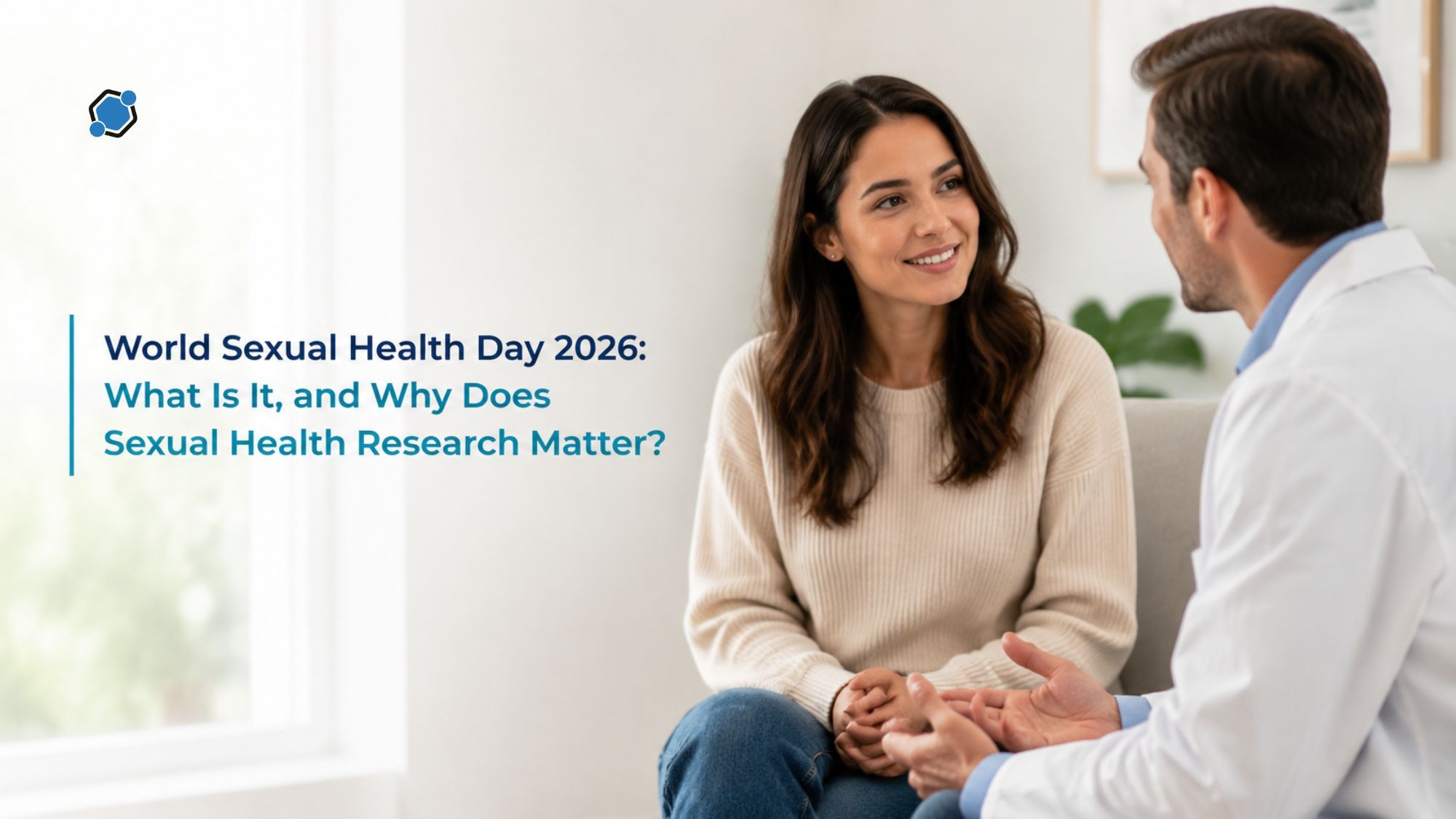
Sexual health covers considerably more ground than most people assume. The World Health Organization describes it as a state of physical, emotional, mental, and social well-being in relation to sexuality, and states plainly that it is not merely the absence of disease or dysfunction. That framing places sexual health alongside heart health, hormonal health, and mental health as an ordinary part of general well-being rather than a separate or private category.
World Sexual Health Day exists to make that point publicly, and to draw attention to how much about sexual and reproductive health remains incompletely understood. For anyone curious about how medical knowledge in this area advances, the observance is also a useful entry point into clinical research.
What is World Sexual Health Day, and when is it observed?
World Sexual Health Day falls on September 4 every year. It was established in 2010 by the World Association for Sexual Health, a global professional organization founded in 1978 whose members work across medicine, psychology, public health, and education. The first observance carried the slogan "Let's talk about it," chosen because silence around sexuality makes it harder for people to describe symptoms accurately or to seek care at all.
The theme for 2026 is "Every Body." The organizing body frames it as a statement that sexual health, rights, justice, and pleasure belong to every person, in every body, without exception. The theme deliberately raises the question of whose needs tend to be left out of the conversation, including older adults, disabled people, and people managing a serious illness such as cancer.
Underpinning the observance is the Declaration of Sexual Rights, first proclaimed in Valencia, Spain, in 1997 and updated to its current form in 2015. Among the rights it lists are the right to information, the right to education, the right to privacy, and the right to enjoy the benefits of scientific progress and its application. That last point connects the observance directly to research.
In the United States, the day is marked largely by universities, medical groups, research institutes, and non-profit health organizations, which host panels, publish patient-facing explainers, and run public education campaigns. It sits within a wider calendar of health observances that pair public awareness with research visibility, in the same way that a day built around testing and research encourages people to act on information rather than simply receive it.
What does sexual health actually include?
The widely used definition rests on four dimensions, and each one carries practical meaning for a reader trying to work out whether a concern of theirs counts.
- Physical: function, comfort, pain, fertility, hormones, and the prevention and management of infections and disease.
- Emotional: desire, satisfaction, confidence, and how a person feels about their own body.
- Mental: the effect of conditions such as depression or anxiety, and the effect of medications taken for them.
- Social: relationships, consent, identity, access to accurate information, and freedom from coercion and violence.
A common assumption is that sexual health means testing for sexually transmitted infections, meaning infections passed on through sexual contact. Prevention and testing are part of it, but they are one component of a much wider field.
Sexual health also overlaps with conditions that readers may not connect to it. Erectile dysfunction, meaning persistent difficulty getting or keeping an erection, can reflect damage to the lining of blood vessels, known as endothelial dysfunction, and that same underlying process is central to cardiovascular disease. Because the blood vessels involved are small, the difficulty can appear before a heart problem becomes clinically evident, which is why clinicians treat it as a signal worth investigating rather than an isolated complaint. Diabetes sits behind both. Falling hormone levels around menopause affect comfort and function. Depression and some medication classes, including certain antidepressants, commonly affect desire and response.
Cancer care intersects here as well. Sexual difficulties are among the most common and least discussed long-term effects reported by people who have completed cancer care, and survivorship programs increasingly treat them as part of follow-up rather than an afterthought. Research into cancers of the reproductive organs, discussed in the context of an observance focused on ovarian cancer, sits at that intersection.
Which sexual and reproductive health conditions are actively studied in clinical research?
A substantial amount of clinical research addresses sexual and reproductive health, and several of the conditions involved are common enough that most readers will recognize at least one.
- Endometriosis: tissue similar to the lining of the uterus grows outside it, causing pelvic pain, painful periods, pain during sex, and sometimes difficulty conceiving.
- Uterine fibroids: non-cancerous growths in the muscular wall of the uterus that can cause heavy or painful periods and pressure symptoms such as frequent urination.
- Polycystic ovary syndrome: a hormonal and metabolic condition involving irregular periods, raised levels of androgen hormones, and links to insulin resistance.
- Vulvodynia: persistent pain or burning at the vulva, the external female genitals, without an identifiable cause.
- Genitourinary syndrome of menopause: a cluster of genital, sexual, and urinary symptoms caused by falling estrogen levels. The term was agreed in 2014 by two professional societies to replace narrower language.
- Pelvic floor disorders: weakness or dysfunction in the muscles supporting the pelvic organs, leading to incontinence, prolapse, pain, or sexual difficulty.
- Infertility, erectile dysfunction, prostate conditions, human papillomavirus and the cancers linked to it, human immunodeficiency virus prevention, and other sexually transmitted infections, all of which carry active research programs.
Open questions remain across this list. Endometriosis has historically required surgery to confirm, so simpler diagnostic tests are an active research goal. Researchers continue to debate whether polycystic ovary syndrome is one condition or several. The evidence base for vulvodynia therapies is thin, with no single approach that works for everyone. Awareness efforts such as the annual focus on fibroid research exist partly because these gaps are visible to the people living with the conditions.
Why does the evidence base in sexual health lag behind other fields?
Several features of the research and care system explain the gap, and none of them reflect a lack of interest among the people affected.
Inclusion came late. Until the NIH Revitalization Act of 1993, federally funded clinical research in the United States was not required to include women as participants, and laboratory work relied heavily on male animals. That law also created the NIH Office of Research on Women's Health. Representation in federally defined clinical research improved substantially afterward, but decades of missing evidence cannot be regenerated quickly.
Funding has also tracked below disease burden. Conditions that predominantly affect women continue to receive research support that sits well below what their prevalence would suggest, and national reviews of research portfolios have repeatedly identified the imbalance.
Diagnosis takes time. For endometriosis and polycystic ovary syndrome, the interval between first symptom and confirmed diagnosis is commonly measured in years. The drivers are structural: menstrual pain is often normalized within routine care, clinician familiarity varies, specialist access depends on geography and insurance, and until recently no simple confirmatory test existed for endometriosis.
Conversations also fail to start. Embarrassment is the barrier patients most often cite, and surveys consistently find that most people would prefer the clinician to raise the subject first, while training in sexual health remains uneven across medical education. When the topic goes unmentioned, symptoms go unreported and research volunteering goes unconsidered. The same dynamic contributes to under-representation of LGBTQ+ people, older adults, and racial and ethnic minority groups, compounded by inconsistent collection of sexual orientation and gender identity information across clinical and research settings. Discussion of wider gaps in women's health research covers much of the same terrain.
How does taking part in a study on a sensitive health topic work?
Every study defines who can take part through inclusion and exclusion criteria, covering factors such as age, confirmed diagnosis, symptom severity, and medical history. Those criteria exist to answer the research question reliably and to protect participant safety, which is why many interested people will not match a given study.
Confidentiality in this area rests on several overlapping protections. Health information is covered by the Health Insurance Portability and Accountability Act, commonly shortened to HIPAA. Federal Certificates of Confidentiality protect identifiable, sensitive research information from being compelled for disclosure in legal or administrative proceedings, and they apply automatically to relevant federally funded research. An institutional review board, an independent committee that reviews the study plan, consent documents, and recruitment materials, provides oversight for the duration of the study. Research data are also de-identified, meaning personal identifiers are removed or replaced with a code.
Informed consent is a process rather than a signature on a form. A member of the research site team explains the purpose, procedures, risks, potential benefits, alternatives, and the right to withdraw at any point without penalty, and answers questions before anything begins. Reading through what a consent form contains in advance makes that conversation easier to follow.
Pre-screening sits earlier still. It is a brief check of basic eligibility carried out before a person commits to travel or an in-person appointment, and it exists so that nobody spends a day at a research site only to learn they do not match the study.
DecenTrialz is a clinical trial recruitment and pre-screening platform that uses AI-assisted participant matching alongside pre-screening led by registered nurses, then passes qualified referrals to research sites. For a sensitive topic, that structure means the first conversation happens privately with a nurse rather than in a waiting room. The research site team, not DecenTrialz, determines final eligibility, conducts informed consent, walks each person through the study, and handles enrollment. Anyone curious about studies relevant to their own health can begin with a pre-screening conversation and decide from there whether to be referred.
Frequently asked questions
When is World Sexual Health Day?
It is observed on September 4 each year, and campaign activity often continues through the rest of September.
What is the theme of World Sexual Health Day 2026?
The theme is "Every Body," which frames sexual health, rights, justice, and pleasure as belonging to every person without exception, and highlights groups whose needs are frequently overlooked.
Is sexual health only about sexually transmitted infections?
No. Infection prevention and testing form one part of it. The accepted definition also covers physical function and comfort, fertility, hormonal changes, emotional well-being, mental health, relationships, consent, and access to accurate information.
Who started World Sexual Health Day?
The World Association for Sexual Health established it in 2010. The same organization produced the Declaration of Sexual Rights that underpins the observance.
Is information shared during a clinical study kept confidential?
Research studies operate under HIPAA, institutional review board oversight, and de-identification of study data, and federally funded research handling sensitive information is also covered by Certificates of Confidentiality. The consent conversation at the research site covers exactly how a specific study handles information, and asking about it directly is reasonable.
How one observance supports better sexual health care
World Sexual Health Day works by making an ordinary subject speakable. When sexual health is discussed as a component of general health, symptoms get reported earlier, clinicians raise the topic more readily, and the conditions that have historically been under-studied become easier to research. The 2026 theme extends that to people whose needs are routinely skipped, which is also where the evidence is thinnest.
Anyone weighing whether their own concern is worth mentioning to a clinician has a reasonable answer available: if it affects daily life, comfort, relationships, or confidence, it belongs in the conversation. Nothing here replaces individual medical advice, and outcomes vary from person to person.
Was this article helpful?

Similar Blogs
Clinical Nurse Specialist Recognition Week 2026: What Is a CNS and Why Does the Role Matter?
September 1 is the birthday of Hildegard Peplau, an American nurse and theorist who argued...
 Vamshi Kantoju
Breast Cancer Stages: What Stage 0 to Stage 4 Mean and How Doctors Determine Them
Stage is one of the first facts a person learns after a breast cancer diagnosis, and it sh...
Paramraj
BMI Limitations: How Body Mass Index Works and Why Clinicians Look Beyond It
Body mass index, usually shortened to BMI, is one of the most widely used numbers in healt...
Deeksha GittaStay Informed. Stay Connected.
Get updates on verified clinical trials, emerging treatments, and research breakthroughs directly in your inbox. No spam, just science that matters.
