 HIPAA Compliant
 ISO 27001 Certified
What is Fibroid Awareness Month, and why does fibroid research matter?
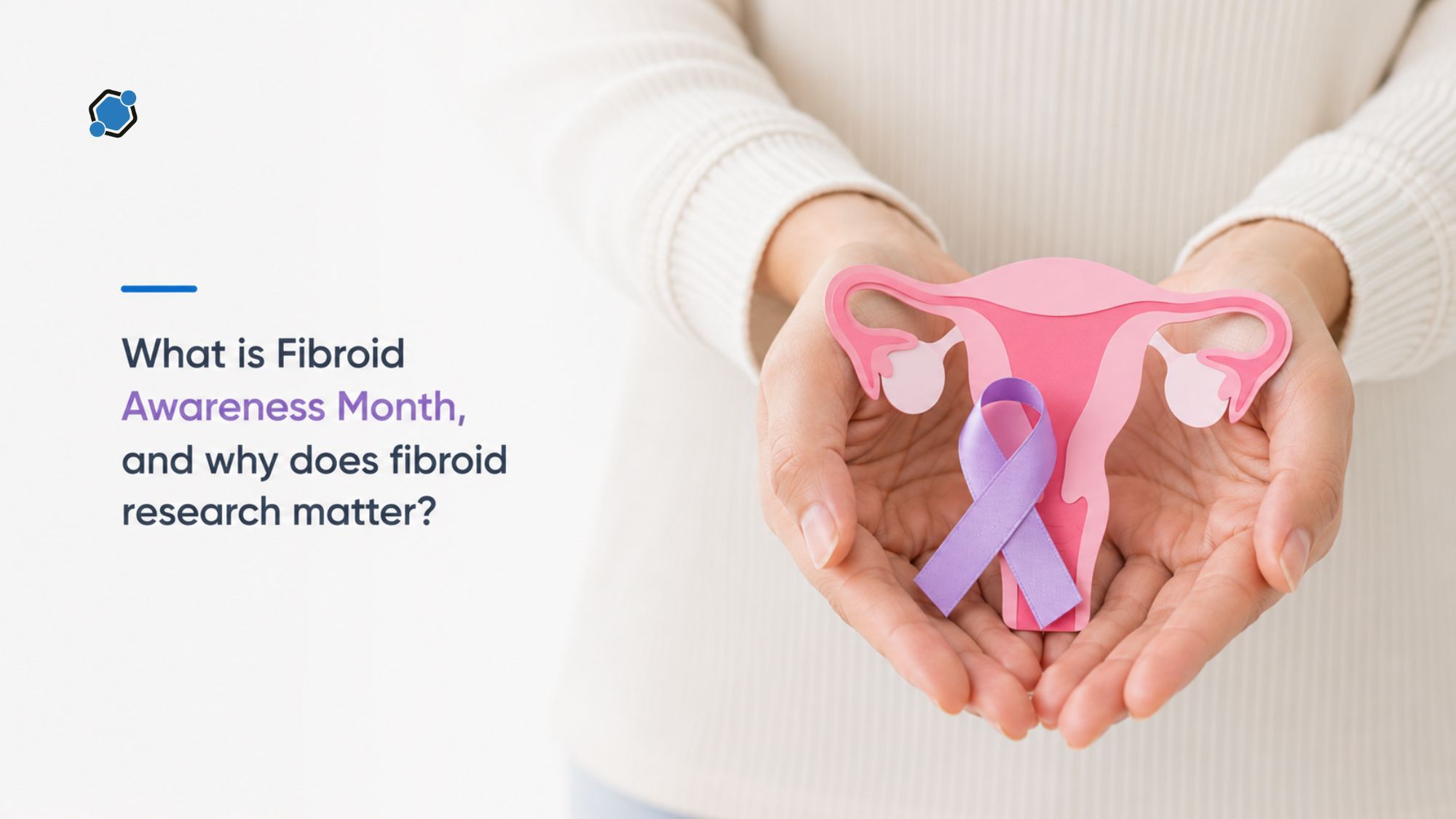
Uterine fibroids affect a majority of women at some point during their reproductive years, yet the condition remains one of the most underdiagnosed and underdiscussed issues in women's health. Fibroid Awareness Month, observed each July, exists to change that. It is a coordinated push by patient advocates, medical societies, and legislators to expand education, improve access to care, and increase investment in research on a condition that touches millions of lives.
The scale of the condition often surprises people who are new to it. Research suggests that between 70 and 80 percent of women will develop uterine fibroids by age 50, and roughly one in four experiences symptoms significant enough to require medical attention. Symptoms can range from heavy menstrual bleeding and pelvic pain to fatigue, fertility complications, and interference with daily life. Yet public understanding lags well behind these numbers, and many women live with symptoms for years before receiving a formal diagnosis.
This article covers what Fibroid Awareness Month is, what uterine fibroids actually are, the symptoms and diagnosis gaps that patients often encounter, current treatment options, and where clinical research is heading. Along the way, it explains why participation in research matters for improving care in the years ahead.
What Fibroid Awareness Month is
Fibroid Awareness Month is a public health observance held throughout July in the United States and in several other countries. It began as a coordinated effort by advocacy organizations and women's health groups to address long-standing gaps in fibroid diagnosis, treatment access, and research funding. Individual U.S. states have adopted their own formal designations over the past several years, and in the current session of Congress a resolution has been introduced to formally designate July as Uterine Fibroids Awareness Month at the federal level.
The month centers on three practical goals. The first is to educate the public about a condition that most people know surprisingly little about. The second is to dismantle the stigma and normalization of symptoms that keep many women from seeking evaluation. The third is to press for greater investment in fibroid research, including studies that examine why the condition disproportionately affects certain populations.
Community events, patient stories, and clinician-led information sessions typically run throughout July, sometimes coordinated with formal proclamations at the city or state level. Other women's health observances follow similar patterns of clinical education paired with research advocacy. For a look at how a comparable observance connects public awareness to clinical trial participation, see Why World Ovarian Cancer Day 2026 Matters for Clinical Trials.
Uterine fibroids, in plain terms
Uterine fibroids, also called leiomyomas or myomas, are noncancerous growths that develop from the smooth muscle cells of the uterus. Their size ranges from smaller than a pea to as large as a grapefruit or bigger. Some women have a single fibroid; others develop many at once. Fibroids are classified by where they sit in relation to the uterine wall. Submucosal fibroids bulge into the uterine cavity, intramural fibroids grow within the muscular wall, subserosal fibroids grow on the outer surface, and pedunculated fibroids grow on a stalk attached to the uterus.
Estrogen and progesterone, the two main hormones that regulate the menstrual cycle, appear to play a central role in fibroid growth. This is one reason fibroids are more common during the reproductive years and often shrink after menopause. Family history, early onset of menstruation, obesity, vitamin D deficiency, and certain dietary factors have all been associated with fibroid risk in research studies, though the exact biological causes remain under active investigation.
The prevalence numbers are striking, but the burden is not distributed evenly. Studies have consistently shown that Black women are three to four times more likely to develop fibroids than White women, tend to be diagnosed at younger ages, and often experience more severe symptoms. Understanding why this disparity exists, and improving care for the women most affected, is one of the central goals of Fibroid Awareness Month. It is also one of the clearest examples of why representation in clinical research matters, a theme explored in Women's Health Month 2026: Why Clinical Trials Need More Women.
Symptoms and the diagnosis gap
Many uterine fibroids cause no symptoms at all and are discovered incidentally during a pelvic exam or imaging performed for another reason. When symptoms do occur, they can significantly affect daily life. The most common include heavy or prolonged menstrual bleeding, bleeding between periods, pelvic pain or pressure, frequent urination or difficulty emptying the bladder, constipation, pain during intercourse, lower back pain, and fatigue linked to iron deficiency anemia from chronic blood loss.
The interval between the first symptom and a formal diagnosis is often measured in years. Several factors contribute to this delay. Menstrual symptoms are still frequently normalized in everyday conversation and in clinical encounters, and women who describe severe bleeding or pelvic pain may be told that discomfort is a routine part of the cycle. Symptoms can also overlap with other gynecologic conditions such as endometriosis, adenomyosis, and ovarian cysts, which can complicate the diagnostic path. Diagnostic imaging, typically pelvic ultrasound, is fast and widely available, but it is only ordered when a clinician suspects fibroids in the first place.
The long-term consequences of a missed or delayed diagnosis can be significant. Untreated heavy menstrual bleeding can lead to chronic iron deficiency anemia. Very large fibroids can press on the bladder or bowel and, in rare cases, cause obstructive urinary problems. Fibroids can also complicate fertility and pregnancy, depending on their size, number, and location. Long-term observational research that follows patients before, during, and after diagnosis helps researchers understand these trajectories, a study design explained in What Is a Natural History Study?.
Current treatment options and their limits
Treatment decisions for uterine fibroids depend on symptom severity, fibroid size and location, the patient's age, and future reproductive plans. There is no single approach that fits every patient, and options range from active monitoring to major surgery.
For women with mild or no symptoms, watchful waiting is often appropriate. Regular clinical check-ins allow the care team to track changes in fibroid size or symptom pattern without intervening on growths that are not causing harm.
Medical management is often the next step. Hormonal contraceptives, hormonal intrauterine devices, and gonadotropin-releasing hormone (GnRH) analogs can reduce heavy bleeding or temporarily shrink fibroids. These options manage symptoms rather than resolve the underlying condition, and each carries its own considerations around side effects, cost, and duration of use.
Minimally invasive procedures target the fibroids while preserving the uterus. Uterine artery embolization blocks the blood supply to fibroids, causing them to shrink over time. Magnetic-resonance-guided focused ultrasound uses focused sound waves to destroy fibroid tissue noninvasively. Myomectomy, the surgical removal of individual fibroids, can be performed laparoscopically, hysteroscopically, or through open surgery depending on fibroid characteristics. For women who no longer wish to preserve fertility and who have not responded to less invasive approaches, hysterectomy remains the definitive option.
Access to the full range of options varies widely in practice. Insurance coverage, geographic location, and clinician familiarity with fertility-sparing procedures all shape which treatments are actually offered to individual patients. Real-world outcomes can also differ from the results reported in tightly controlled clinical studies, a distinction explored in Efficacy vs. Effectiveness in Clinical Trials.
Where fibroid clinical research is going
Clinical trials remain a central mechanism for improving fibroid care. Based on a search of public clinical trial registries in July 2026, roughly 40 studies are actively recruiting worldwide for uterine fibroids, with additional trials focused on related symptoms such as heavy menstrual bleeding. These counts shift regularly as trials open and close.
Several research directions stand out. Fertility-sparing therapies are a major focus, given how many women affected by fibroids are of reproductive age and want to preserve the option of pregnancy. Long-term studies such as the Study of Environment, Lifestyle, and Fibroids (SELF), led by the National Institute of Environmental Health Sciences, are examining how genetics, environment, and lifestyle influence fibroid development. Investigators are also studying nonhormonal medications, next-generation minimally invasive procedures, and imaging techniques that could improve early detection and treatment planning.
Diversity in clinical trial participation is a particular focus for fibroid research. Because Black women are disproportionately affected, robust representation in fibroid trials is essential for producing findings that reflect the full patient population. Advocacy groups have increasingly emphasized this point, and several current trials are designed with community engagement built into recruitment.
Participation in a clinical trial is entirely voluntary and takes place under strict ethical oversight. For women considering it, the process usually begins with an initial pre-screening step to review basic eligibility, followed by a formal screening visit at the research site. The site team explains the study in detail, reviews the informed consent form, and makes the final eligibility determination. A step-by-step view of what that visit looks like is available in Your First Clinical Trial Screening Visit: What to Expect Step by Step.
Bringing Fibroid Awareness Month home
Fibroid Awareness Month is a reminder that a common, treatable, and often disabling condition still receives less attention than its prevalence would suggest. Women who are experiencing potential fibroid symptoms should discuss them with a healthcare provider rather than dismissing them as routine. Those already living with fibroids can use the month to review their care plan and consider whether new options may have become available since their last consultation.
Clinical research is one path forward. DecenTrialz supports the earliest stages of that path. It uses AI-assisted matching to identify studies for which someone may be a fit, and its registered nurse team conducts an initial pre-screening conversation to review the basics before connecting the person with a research site. From that point on, the site's own study team takes over. They explain the trial in depth, complete the formal eligibility assessment, walk through informed consent, and manage enrollment and study visits.
For anyone whose experience with fibroids has left them curious about what research is exploring next, Fibroid Awareness Month is a good moment to ask the question. Learning what studies are open, and what participation actually involves, is a meaningful first step regardless of what someone ultimately decides.
Was this article helpful?

Similar Blogs

Health Unit Coordinator Day: the behind-the-scenes team that helps clinical trials run
Every August 23, the United States recognizes Health Unit Coordinator Day. The date honors...
 Paramraj
Home nursing visits in clinical trials: what participants can expect
Clinical trial visits are starting to look different. In a growing number of studies today...
Vamshi Kantoju
World Mosquito Day 2026: How clinical trials are advancing mosquito-borne disease prevention
Mosquitoes are often described as the deadliest animal on the planet, and the reason is no...
Mahesh UpadristaStay Informed. Stay Connected.
Get updates on verified clinical trials, emerging treatments, and research breakthroughs directly in your inbox. No spam, just science that matters.
