


CIDP Clinical Trials in 2026: Current Research and Advances

For most of the last thirty years, treating CIDP has meant one of three things: immunoglobulin infusions, plasma exchange, or corticosteroids. That short list is finally getting longer.
In 2026, more lines of CIDP research are active at once than at any point in living memory. Some are refining how immunoglobulin therapy is delivered. Others are testing medications that go after the disease through entirely new biological pathways. A few are aimed squarely at the people who have been hardest to help. This guide walks through what clinical trials are, what CIDP clinical trials are studying right now, and what taking part in a study generally involves.
What are CIDP clinical trials? CIDP clinical trials are research studies testing new treatments for chronic inflammatory demyelinating polyneuropathy. In 2026, active studies are evaluating refinements to immunoglobulin therapy, medications targeting the immune system through new pathways, and approaches for people whose disease has not responded to current treatments.
What clinical trials are
A clinical trial is a research study, run in people, that asks a specific question about a treatment. Does it work? Is it safe? Does it work better than what people are already taking? Every medication used in CIDP today, including the immunoglobulin most patients know intimately, exists in routine care because thousands of people once took part in the studies that proved it does what it claims to.
Trials are run by research teams at hospitals, university medical centers, and specialized research sites. A neurologist leads each study, and a team of coordinators, nurses, and study staff handles the day-to-day work. Independent review boards approve every protocol before enrollment opens, to confirm the science is sound and participants are protected. A plain-language beginner's guide to clinical research covers the basics.
Why clinical trials matter
Without clinical trials, medicine stops moving. No new medication can be approved. No new way of delivering existing therapy can replace the old way. The immunoglobulin therapies, plasma exchange protocols, and corticosteroid regimens in the current CIDP toolkit are part of standard care because trials proved they work.
That doesn't mean people who take part in research are expected to carry the risks alone. Trial design has changed substantially over the past several decades, and the layers of protection built into modern studies are more rigorous than most people realize:
- Independent ethical review approves every protocol before enrollment opens.
- Informed consent documents explain the study in plain terms to every prospective participant.
- The right to leave at any time, for any reason, is preserved throughout the study, without affecting future medical care.
- Continuous safety monitoring is often handled by an independent group whose only job is to watch for problems.
A separate guide on how clinical research advances medicine covers the protections built in. Many also find the close clinical follow-up during a study more thorough than typical care: more eyes on symptoms, more frequent check-ins, more conversation about what is working.
How clinical trials are organized
Clinical trials are organized into phases, and the phase a trial is in signals what kind of question it is trying to answer.
- Phase 1 trials are the earliest human studies, usually small, focused mostly on safety and dosing.
- Phase 2 trials are larger and look at whether the treatment is doing anything useful.
- Phase 3 trials are larger still, sometimes enrolling hundreds of people across many research sites, and produce the evidence regulators use to decide whether a treatment can be approved.
- Phase 4 trials happen after approval and keep tracking safety and real-world performance over time.
Trial design uses techniques to make sure the answer is reliable. Most CIDP trials are randomized, meaning participants are assigned to a treatment group by chance rather than by choice. That prevents subtle bias. Many are blinded, meaning some or all of the people involved do not know which treatment a participant is receiving until the study ends. Blinding matters because expectations can shape how symptoms are reported, even when everyone is trying to stay objective. A companion article on the difference between open-label and blinded studies goes deeper.
Before joining any trial, prospective participants review and sign an informed consent document covering the study's purpose, the schedule of visits, known risks and benefits, and their rights at every stage. A walk-through of what an informed consent document covers explains the details.
The state of CIDP research today
For most of the last thirty years, the mainstays of CIDP treatment did not change much. Immunoglobulin therapy, given by infusion every few weeks, was the workhorse. Plasma exchange and corticosteroids were the alternatives for people who could not tolerate immunoglobulin or did not respond to it. The combinations were familiar, the side effects well-documented, the schedules predictable. They helped most people, but not everyone, and even the ones they helped often lived with residual symptoms the treatments did not fully resolve.
That landscape started shifting in 2024. Two new options were approved that year, both meaningful: a more convenient subcutaneous immunoglobulin formulation with longer intervals between infusions, and a first-in-class medication that lowers harmful antibodies through a mechanism not previously used in CIDP. Together they marked the biggest expansion in the toolbox in a generation.
The momentum has not slowed. Multiple research programs are active at once: ongoing refinements to immunoglobulin therapy, more medications targeting the antibody-lowering pathway, and earlier-stage work on the complement system, B-cell biology, and cell-directed approaches. A separate article covers the current generation of CIDP treatments in more depth.
Notable advances in CIDP research
CIDP research is moving faster now than at any point in the last 30 years. Five lines of work are particularly worth knowing about. Each one goes at the disease from a different angle, and each one aims to fill in a different gap in current care.
Fine-tuning how immunoglobulin therapy is delivered
Immunoglobulin has been the backbone of CIDP treatment for so long that it can be easy to assume the way it is delivered today is the way it must be. It is not. Researchers are still asking basic questions. How much is the right amount for long-term use? Could a lower dose work just as well, with fewer side effects and shorter infusions? Could the gap between infusions be longer for some people without losing the benefit?
The answers are not academic. For someone whose treatment schedule means missing a morning at work every three weeks, or rearranging family plans around a clinic visit, even a modest improvement can change daily life in concrete ways. Research underway is testing these refinements, and the answers will shape immunoglobulin prescribing in the next generation of guidelines.
A new way to lower the antibodies driving the disease
In CIDP, the immune system makes a mistake: it produces antibodies that attack the protective coating around nerves, causing the weakness, numbness, and fatigue that come to define the condition. For decades, treatments worked by overwhelming or filtering those antibodies after they had already been made.
A newer approach is changing the script. Instead of replacing or removing antibodies, it lowers the body's ability to keep them in circulation. It does this by blocking a specific receptor that normally recycles antibodies. Block the receptor, and the level of harmful antibodies drops. Research on medications using this mechanism is among the most active areas in CIDP today, and early signals have been strong enough that this class is expected to play a growing role in how the disease is managed.
Targeting the complement system
The complement system is part of the immune response that amplifies inflammation. Until recently, it was not on the radar as a CIDP treatment target. That changed quickly. Researchers now see the complement cascade as a meaningful contributor to nerve damage, and research programs are testing medications that interrupt specific steps in it.
Early findings have been encouraging. Quieting the complement response appears to improve strength and reduce markers of active disease. Because the complement pathway works differently from the antibody-recycling pathway, complement-blocking therapies could eventually become a real option for people whose disease has not responded to other treatments. The work is earlier than antibody-lowering research, but moving.
Research aimed at the people who have not been helped
A subset of people with CIDP, sometimes called the refractory population, keep getting worse despite immunoglobulin therapy, corticosteroids, and everything else the current toolkit offers. For these patients, the question is not whether treatment helps. It is whether anything can stop the disease from continuing to take what it takes.
New research is testing whether complement-targeting medications and other novel mechanisms can help people who have not done well on current standards. The stakes here are different. For most patients with CIDP, the difference between options is meaningful but not existential. For the refractory population, the difference between current options and a treatment that works can mean the difference between losing function year after year and finally being able to hold the line.
The next wave: convenience, precision, and resetting the immune system
Beyond what is in late-stage testing, three further fronts are worth knowing about:
- Convenience. Subcutaneous versions of medications that currently require intravenous infusion are in development, designed to be given at home, in minutes, with much smaller volumes.
- Precision. CIDP is less one disease than a family of related ones, and figuring out which patients respond best to which medication is the work of the next decade.
- Resetting the immune system. Cell-directed therapies, including approaches adapted from cancer treatment, are being tested for whether they can reset immune activity itself, potentially offering long-lasting control without ongoing treatment.
Within the next decade, the CIDP toolkit is likely to look substantially different from what has defined care for most of the past generation. Some of what is being tested now will not pan out. Some of it will.
What participating in a CIDP trial involves
Most people who consider joining a CIDP clinical trial start by reviewing current CIDP research. A screening visit follows, where a research team reviews medical history, current symptoms, and treatment history to see whether the trial's eligibility criteria are met. Participation is always voluntary. Anyone can withdraw at any time without it affecting their ongoing medical care. A walk-through of what a first screening visit involves covers the basics, and a separate guide on what a clinical trial involves day to day follows the experience from enrollment through follow-up.
Frequently asked questions
What is the difference between a clinical trial and standard CIDP treatment?
Standard CIDP treatment uses therapies already approved by regulators and prescribed by a neurologist as part of routine care. A clinical trial is a research study testing a treatment that is still being evaluated for safety, effectiveness, or both. Participants follow a study protocol with specific visit schedules and assessments, and are typically monitored more closely than people receiving routine care. The treatment being tested may eventually become a new standard, or it may not, depending on what the study finds.
Are there risks to joining a CIDP clinical trial?
Every clinical trial carries some risk, and protocols are required to explain those risks in detail through the informed consent document. Possible risks include side effects of the investigational treatment, time and travel commitments, and the chance that the treatment may not work for a given participant. Independent ethical review boards approve every trial before it begins, and safety monitoring continues throughout. By the time an experimental therapy reaches Phase 2 or Phase 3, it has already cleared earlier safety thresholds.
Will every participant in a CIDP trial receive the investigational treatment, or could some receive a placebo?
It depends on the trial's design. Some trials are placebo-controlled, meaning some participants receive the investigational treatment and others receive an inactive substance for comparison. Other trials compare an investigational treatment against an active treatment like standard immunoglobulin therapy, so every participant receives a real medication. The informed consent document for any specific trial explains how assignment works and what each group receives.
How does someone find out if they qualify for a CIDP clinical trial?
Eligibility is determined by the research site after a screening visit. Most studies publish their high-level criteria, including age range, diagnosis confirmation, and treatment history. A separate article covers why not every applicant qualifies. The process of connecting with a study site and starting the conversation is straightforward, though final eligibility always requires direct evaluation by the trial's medical team.
Talking with a neurologist about clinical trial options
For people living with CIDP, the conversation about clinical research almost always begins in the same place: at a neurologist's office, with the doctor who knows the case best. No website or recruitment partner can match what a treating neurologist already knows about a patient's history, treatment response, and current trajectory. A productive conversation often starts with a handful of specific questions:
- Is current treatment performing as well as it could?
- Are there gaps in the response that an ongoing trial might address?
- Would a referral to a research center make sense to explore?
A separate article on how to think about whether a specific trial might be a fit covers what to weigh. Clinical trial participation is one of several options, and a well-informed conversation turns it into a confident one.
Was this article helpful?
Similar Blogs

Juvenile Arthritis Awareness Month 2026: Symptoms, Subtypes, and Pediatric Research
Roughly 300,000 children and teens in the United States live with some form of arthritis, ...
 Paramraj
Sarcoma and Bone Cancer Awareness Month 2026: Rare cancers, research, and clinical trials
What sarcoma is Sarcoma is a cancer that starts in the body’s connective tissues. Connecti...
Vamshi Kantoju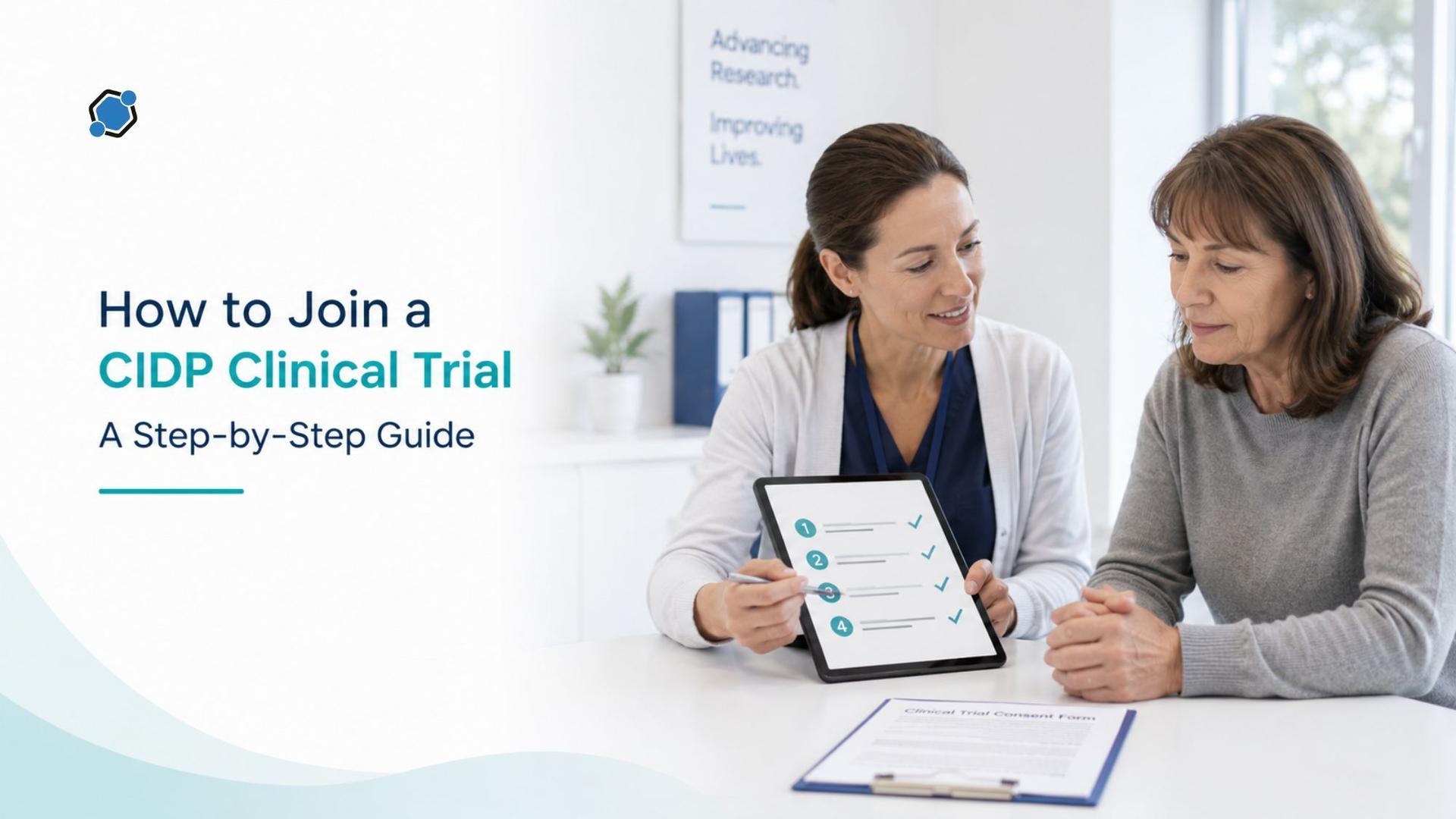
How to Join a CIDP Clinical Trial: A Step-by-Step Guide
Joining a CIDP clinical trial involves more than simply signing up for a study. Participan...
 Kantoju Harshavardhan
 Stay Informed. Stay Connected.
Get updates on verified clinical trials, emerging treatments, and research breakthroughs directly in your inbox. No spam, just science that matters.
