 HIPAA Compliant
 ISO 27001 Certified
Open-label vs blinded clinical trials: What the difference means for participants
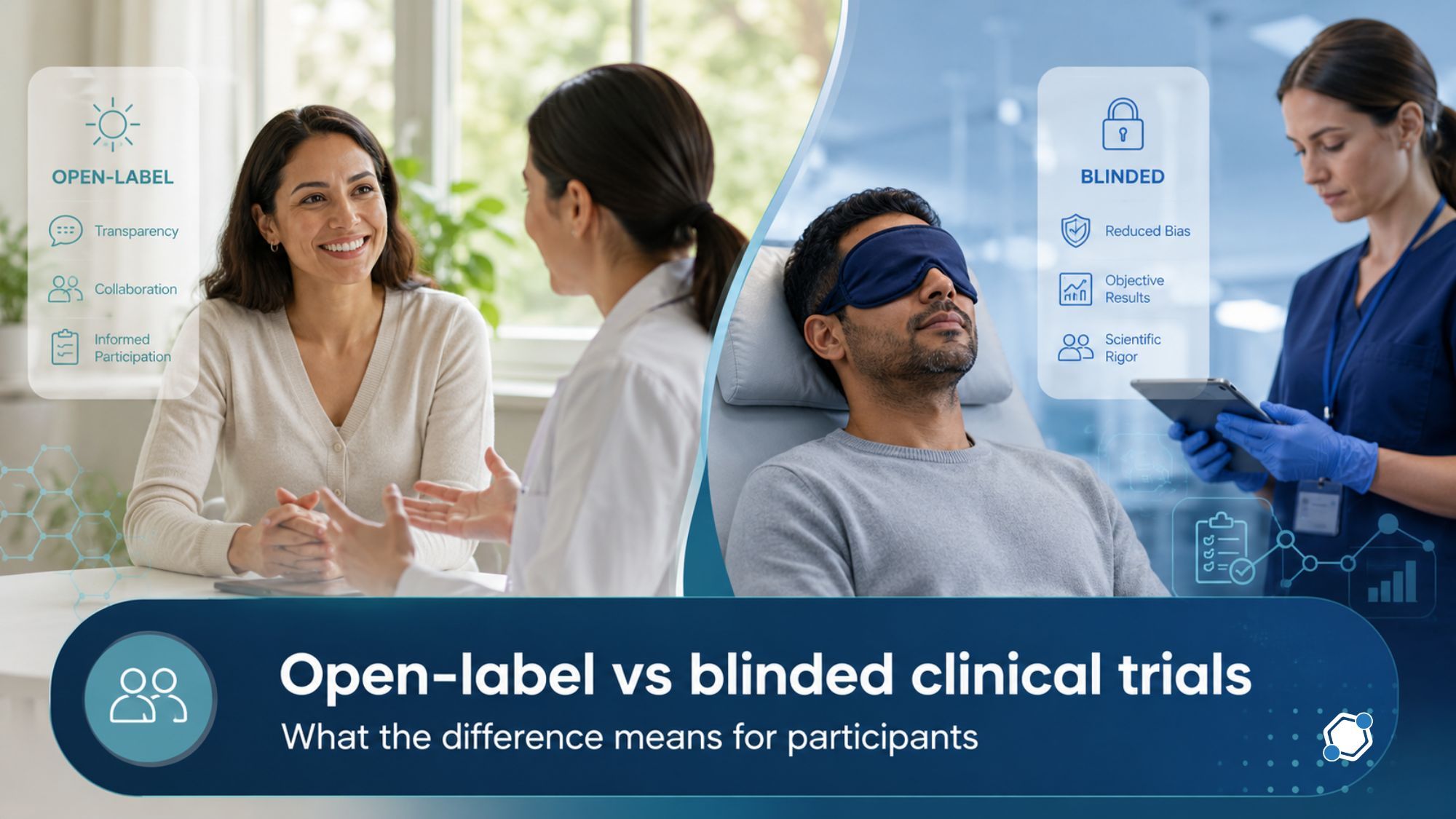
When someone joins a clinical trial, the design of the study shapes how much that person is told about what they are receiving. In some trials, the participant and the study team both know exactly what is being given. In others, one or both sides are kept in the dark on purpose. These two approaches are called open-label and blinded.
The choice between them is not random. It affects what a participant signs up for, what the experience feels like, and how the data from the study gets read at the end. This article walks through the difference in plain language, explains why each design exists, and answers the practical questions someone considering a trial is most likely to have.
What "open-label" and "blinded" actually mean
An open-label clinical trial is one in which both the participant and the people running the study know which group the participant has been assigned to and what they are receiving. There is no hidden information. The label is on the bottle, and everyone can read it.
A blinded clinical trial is the opposite. Some information about the assignment is intentionally withheld so that it cannot influence how participants behave or how the study team measures the results. Blinding is also called masking, and the two words mean the same thing in clinical research.
Within blinded trials, there are two common levels:
- A single-blind trial is one in which the participant does not know which group they are in, but the study team does.
- A double-blind trial is one in which neither the participant nor the study team handling day-to-day visits knows the assignment. A separate group, usually a sponsor team or independent statistician, holds the code.
A few trials add even more layers of blinding (for example, blinding the people who analyze the data), but for participants the practical distinction is open-label, single-blind, or double-blind.
If clinical trials in general are an unfamiliar idea, Clinical Trials Explained: Simple Guide for Beginners covers the basics of how studies are structured before getting into the design details below.
Why blinding exists in clinical research
Blinding exists because human expectations affect human behavior, and human behavior affects what a trial measures. If a participant knows they are receiving a new study drug, they may report symptoms differently than someone who knows they are receiving a placebo. A placebo is an inactive substance, often a sugar pill or saline solution, designed to look identical to the active product so that any difference in outcome can be traced to the product itself rather than to the expectation that something is working.
The same effect runs in the other direction. A study doctor who knows a participant is on the active product may interpret a side effect more cautiously, schedule an extra check-in, or word an assessment in a way that is shaped by what they already believe should happen. None of this is dishonest. It is how human attention works.
Blinding takes that distortion out of the picture. When neither side knows the assignment, both groups are observed and reported the same way, and any difference in outcome at the end can be attributed to the product, not to the expectation around it.
A simple parallel: a taste test where the labels are covered tells the researchers something about the drinks. A taste test where everyone sees the labels tells the researchers something about the labels. Clinical trials care about the drinks.
This is also why blinding matters for the public conversation that follows a trial. The effectiveness of a product in a real-world setting depends on how reliably it was measured during research. The article on Efficacy vs. Effectiveness in Clinical Trials explains the distinction between what a study can prove under controlled conditions and what happens once a product is used in everyday care.
What each design looks like for you as a participant
For a participant, the day-to-day experience of a blinded trial and an open-label trial looks more similar than it sounds. Both have the same kinds of visits, the same lab work, the same questionnaires, and the same safety monitoring. The difference is in what is on the label of the medication and what the study team tells the participant about the assignment.
In an open-label trial, a participant is told which group they are in. If two doses of the same product are being compared, the participant knows which dose they are on. If a study drug is being compared to standard care, the participant knows which arm they have been placed in. There is no placebo confusion to manage, because either there is no placebo or the participant is told if they are on it.
In a blinded trial, the medication usually looks identical across groups. The bottles match. The pills match in shape and color. The injection looks the same. The participant takes what they are given on the schedule the study lays out, without knowing which arm they are in. The information is held centrally and revealed only at the end of the study, or earlier if a safety situation requires it.
Some trials combine elements of both. In a crossover design, a participant receives one assignment for a set period, then switches to a different assignment for a second period, with the order randomized. The article on Crossover Clinical Trials explains how these trials work and what to expect when joining one.
Randomization is the process of assigning participants to groups by chance, usually by a computer algorithm. It is used in most clinical trials because it keeps the groups balanced and prevents anyone, including the study team, from deciding who gets what. Randomization and blinding are separate ideas, but they often appear together in the same study design.
Safety is the same in both designs
A common concern about blinded trials is whether not knowing the assignment puts a participant at greater risk. The short answer is no. Safety monitoring is built into clinical trial design at a level that does not depend on whether the participant or the study team knows the arm.
In every trial, regardless of design, participants follow a schedule of visits and tests designed to catch problems early. Lab work checks how the body is responding. Adverse events, which are any unwanted medical issues that come up during a trial, are recorded and reviewed regardless of whether the cause is known. The study team is required to report serious adverse events to the sponsor and regulators quickly.
For blinded trials specifically, there is a planned process for emergency unblinding. If a participant has a medical emergency and a treating doctor needs to know which product the participant received in order to make a medical decision, the assignment can be revealed through a defined protocol. Most studies set this up to be reachable around the clock by phone or through a secure system that releases the code only for the participant in question. Unblinding one participant does not unblind the rest of the study.
Independent oversight also runs in parallel. A Data Safety Monitoring Board, or DSMB, is a group of outside experts, including doctors and statisticians, who are not running the trial themselves. The DSMB reviews safety data on a set schedule and, in blinded trials, often sees the unblinded version of the data so they can spot patterns that the study team cannot see yet. If the DSMB finds a safety signal, they can recommend changes to the trial, pause enrollment, or stop the study entirely. The article on What Is a Data Safety Monitoring Board (DSMB)? explains how this oversight works in more detail.
How to know which kind of trial you are looking at
The design of a clinical trial is disclosed before anyone enrolls, in the document called the informed consent form. The form lays out what the study is testing, what participants will be asked to do, what the known risks and possible benefits are, and which group assignments are in use. If a study is blinded, the consent form says so. If a placebo is being used, the consent form says so. If the design is open-label, the consent form says so.
The study team is also expected to walk through the design in conversation before a participant signs anything. Reading the form alone is not the only chance to understand the design. Asking questions in that conversation is part of how informed consent is supposed to work.
A few questions worth asking when reviewing the design:
- Is this study open-label, single-blind, or double-blind?
- If it is blinded, is a placebo one of the assignments, and if so, what is the chance of being on it?
- When will the assignment be revealed to me?
- Is there an open-label extension after the blinded portion, where everyone has the option to receive the active product?
- Who do I contact if my doctor outside the study needs to know what I am taking in an emergency?
The piece on How to Read Your Informed Consent Form Before Joining a Clinical Trial goes through the consent document section by section, including the parts that describe the design and the randomization process.
Next steps if you are considering a clinical trial
The choice between an open-label design and a blinded design is made by the people designing the study, based on what the study is testing and how the results need to be measured. As a participant, the design is something to understand before enrolling, not something to choose between. Most participants do not pick a trial based on whether it is open-label or blinded. They pick a trial because it fits their condition, their schedule, and their goals for participating, and then they read the consent form to understand the design before signing.
DecenTrialz is a clinical trial recruitment platform based in the United States. The way it works for participants is straightforward: a person shares some basic information about themselves, gets matched with trials that may fit, and talks with a nurse who walks through what each study involves, including the design, before any decision is made. The research site and the study team running the trial handle eligibility, informed consent, and enrollment. You can start a search at DecenTrialz.
If a study turns out to be blinded, that is not a reason to walk away. It is a design choice made for a reason, and the safety monitoring around it is built to be the same as any other trial. The questions worth asking are about what the design means for the visit schedule, the medication, and the timing of when the assignment will be revealed. The study team can answer all of them.
Was this article helpful?

Similar Blogs
Blood Pressure Numbers: What Do Systolic and Diastolic Actually Mean?
A blood pressure result contains two numbers, and most people are never told what either o...
 Paramraj
National HIV/AIDS and Aging Awareness Day 2026: What Aging With HIV Looks Like Today
The population of people living with HIV in the United States has aged in a way few would ...
Mahesh Upadrista
Prediabetes symptoms: what the early signs are and how prediabetes is reversed
Prediabetes means blood sugar is higher than normal, but not yet high enough to be called ...
Deeksha GittaStay Informed. Stay Connected.
Get updates on verified clinical trials, emerging treatments, and research breakthroughs directly in your inbox. No spam, just science that matters.
