 HIPAA Compliant
 ISO 27001 Certified
How to Find Clinical Trials Across 35+ Conditions with DecenTrialz
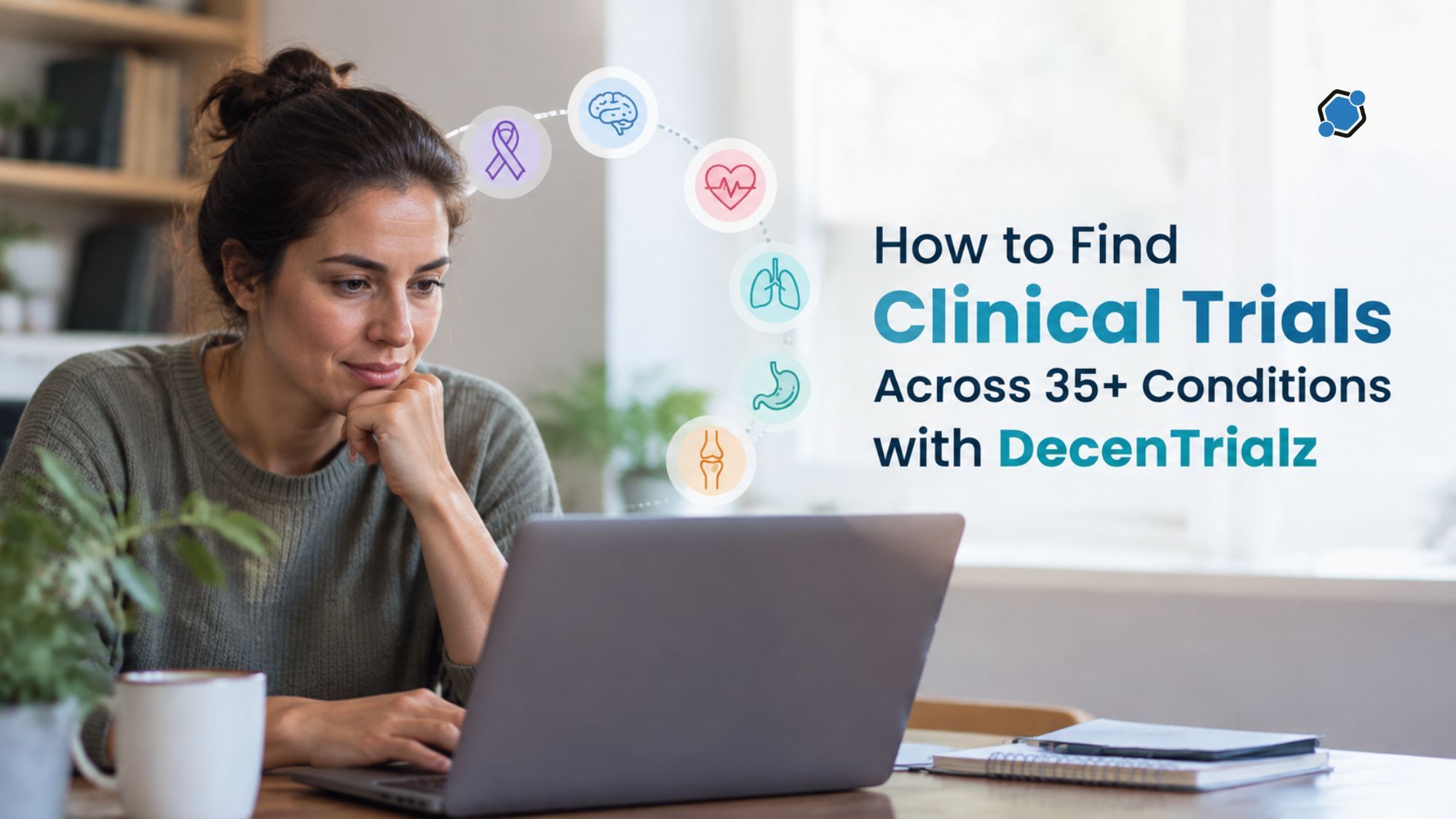
Anyone who has looked for a clinical trial online quickly discovers that trial finders come in different shapes. Some are large registry-style databases with long lists and dense filters. Some are run by nonprofits or advocacy organizations dedicated to a single condition. Some cover a broader disease area such as cancer or rare disease. Each of these tools is useful in its own way, but each is also built around a narrow assumption: that a person searching for a trial has one clearly defined condition and knows exactly what to look for.
That assumption does not match how most adults actually live. Many people manage more than one health condition at the same time. Some are still working through diagnosis. Others are caregivers searching on behalf of a parent, a spouse, or a child, and the people they care for rarely fit into a single category either. For these searchers, a trial finder that only covers one condition is the wrong shape for the question they are trying to answer. This is where a multi-condition matching platform earns its place.
The Four Main Types of Clinical Trial Finders, Explained
Before comparing breadth to specialization, it helps to understand what different clinical trial finders actually do. A clinical trial is a research study in which volunteers help test whether a new medical approach, called a study intervention, is safe and works as intended. Finders help people discover trials they might qualify for, but they do not all work the same way.
Registry-style listings
A trial registry is a large, public library of clinical studies. Registry-style listings are broad and authoritative, and they are usually free to search. Their main strength is completeness. Their main limit is that they are not designed for a lay reader. Eligibility criteria, the requirements that decide who can join a study, are written in clinical language and can span dozens of inclusion and exclusion rules per trial. Basic filters exist, but a registry does not interpret a person's profile or rank the results by fit.
Single-condition nonprofit finders
These finders are run by patient organizations focused on one condition. They are curated with care, often paired with education and community support, and trusted within their communities. Their limit is that they only cover the condition they are built for. A searcher with a second condition, or one whose diagnosis is unclear, must start over somewhere else.
Disease-area finders
Some finders cover a therapeutic area such as cancer, cardiovascular disease, or rare disease. They are more flexible than a single-condition site because they include multiple subtypes, but they are still bounded to one broad area. A person whose health picture crosses several areas will need to search in more than one place.
Multi-condition matching platforms
A matching platform takes a different approach. Instead of asking a person to hunt through lists, it collects information once, matches that information against many trials across many conditions, and produces a ranked shortlist of studies the person is likely to fit. It also connects the person to a research site so a real conversation can happen. DecenTrialz is a multi-condition matching platform that spans 35+ conditions, from common chronic diseases to less common ones, all through a single guided intake, with AI matching and nurse pre-screening feeding each referral.
Why Breadth Matters When Real Lives Do Not Fit One Category
The strongest argument for breadth is that most adults are not single-condition. Multimorbidity, the presence of more than one chronic condition in the same person, is the norm rather than the exception, particularly with age. When someone lives with, for example, both diabetes and hypertension, or a mood disorder alongside a sleep condition, a single-condition finder can only ever answer part of the question. Trials that would consider that person because of a second condition, or because of a combination, simply never appear.
Breadth also helps people whose diagnosis is not yet firm. A diagnostic search can take years, especially for rare and less common conditions. Someone in that position does not know which single-condition finder to visit first. A platform that can reason across many conditions and symptoms is more useful to them than any narrow tool.
Caregivers are another group breadth serves well. Many searches are done by a family member or friend, often on behalf of more than one person. Managing separate accounts and repeated intake forms across several single-condition sites is exhausting. One profile that can be matched against many conditions reduces that burden and keeps the search organized in a single place. If you would like a deeper look at how this compares to older recruitment approaches, our overview of full-service matching versus self-service trial search explains the difference in practice.
Registry vs. Matching Platform: What Actually Happens Behind the Search
A registry gives back what a person types in. A matching platform gives back what a person likely fits. That difference sounds small, but it shapes the whole search experience.
With a registry, the searcher does the interpretation. They choose keywords, guess synonyms, read long criteria lists, and try to figure out whether a study is realistic for them. Two searches with slightly different terms can return very different results because the tool matches words, not meaning. A matching platform, by contrast, takes a person's information once and applies AI-assisted matching to compare that profile against many trials at once. AI-assisted matching is a way for software to understand the intent behind a person's information, not just the words they used. The result is a shorter, ranked list that is more likely to be relevant, along with clearer next steps. Our explainer on why matching beats a public registry listing walks through this comparison in more detail.
Why Matching Quality Matters More Than the Length of the List
A common mistake when comparing trial finders is to focus on which one returns the most results. In practice, a long list of loosely relevant trials is often less useful than a short list of well-fitted ones. Every trial has eligibility criteria that a person must meet, and screening for a trial takes time and energy. If most of the studies on a list will not accept a person for reasons they cannot see from the outside, they may spend hours making contact with sites only to be turned away.
The industry has a term for this: a screen failure. A screen failure happens when someone starts the formal evaluation for a trial but is then found not to meet the criteria and cannot enroll. Screen failures cost the searcher time and can be discouraging. Higher-quality matching before that stage reduces the chance of getting to a formal evaluation only to be turned away.
This is where pre-screening comes in. Pre-screening is an informal early check, usually by phone or a secure online conversation, that happens before any consent form is signed. It is different from screening, which is the formal in-person evaluation with labs and tests. On DecenTrialz, this early check is led by registered nurses, who bring clinical judgment to the conversation and can catch mismatches that a purely automated tool might miss. If you want to understand what a nurse review adds beyond software alone, our piece on what nurse review adds to AI matching covers this in depth.
What Happens After a Match: The Scope Boundary That Protects Participants
A matching platform is only one part of the clinical trial journey, and it is important to be clear about where its role ends. DecenTrialz pre-screens only. The research site team owns eligibility determination, informed consent, the study walk-through, and enrollment. That boundary exists to protect the participant and to keep every clinical decision in the hands of the qualified professionals running the study.
In plain terms, once a person is matched and has had a pre-screening conversation, a structured referral is sent to a research site interested in candidates like them. A referral is a documented handoff to a specific site's study coordinator, who then reaches out to arrange the next steps. From that point, the site team explains the study in detail, walks through the consent form, answers questions, performs formal screening if the person wants to proceed, and makes the final decision about enrollment. Our article on the site eligibility funnel from referral to randomization maps out exactly what that process looks like from the site's perspective, which many searchers find reassuring.
Frequently Asked Questions About Multi-Condition Trial Matching
How do I find a clinical trial if I have more than one health condition?
Using a multi-condition matching platform is the most efficient option because it can consider all of your conditions at once. Registry-style listings and single-condition finders can also help, but you will likely need to search each one separately and interpret dense eligibility text yourself.
What is the difference between a trial registry and a matching platform?
A registry is a searchable library where you type keywords and read the results. A matching platform takes your profile and does the searching and ranking for you, then connects you with a research site if there is a good fit.
Can one platform really cover many different conditions well?
Yes, when it is built for it. DecenTrialz uses AI-assisted matching across 35+ conditions and adds nurse-led pre-screening so that breadth does not come at the cost of quality. The site team still makes the final eligibility and enrollment decision.
What happens after I am matched with a trial?
You are contacted for a short pre-screening conversation led by a registered nurse. If it looks like a good fit, a structured referral is sent to the research site. The site's study coordinator then reaches out to explain the study, walk you through informed consent, and arrange formal screening. From that point, every clinical decision, including final eligibility and enrollment, is made by the site team.
Do I have to pay to use a trial-finding platform?
No. Reputable trial-matching platforms do not charge searchers, and participants are never asked to pay to join a clinical trial.
Is my personal information safe when I use a matching platform?
A trustworthy platform will follow U.S. health-privacy standards, encrypt your information, and only share what is needed with a research site after you agree. Always look for a clear privacy policy before submitting your details.
Finding a Trial That Fits the Whole Picture
Choosing where to search for a clinical trial is not just about which tool has the biggest database. It is about whether the tool fits the way a person actually lives. For someone with a single, well-defined condition, a specialist finder can be a fine starting point. For everyone else, and that is most people, breadth combined with matching quality is what turns an overwhelming search into a manageable one.
DecenTrialz is built for that reality. By covering 35+ conditions in a single guided intake, adding AI-assisted matching to rank options by fit, and using nurse-led pre-screening before any structured referral, the platform is designed to help searchers get to the right conversation faster. From there, the research site team takes over, and the participant is in expert hands for every clinical decision that follows.
Was this article helpful?

Similar Blogs
What is a hypertensive crisis? Blood pressure warning signs and when to call 911
A hypertensive crisis is a sudden, severe rise in blood pressure to 180/120 millimeters of...
 Deeksha Gitta
National Women's Health and Fitness Day 2026: Fitness, Research, and Women's Health
The last Wednesday of September is set aside each year for National Women's Health and Fit...
Swaroop ESD
World Heart Day 2026: What Causes Heart Disease, and How Do Clinical Trials Help Protect the Heart?
Cardiovascular disease, the group of conditions affecting the heart and blood vessels, rem...
ParamrajStay Informed. Stay Connected.
Get updates on verified clinical trials, emerging treatments, and research breakthroughs directly in your inbox. No spam, just science that matters.
