 HIPAA Compliant
 ISO 27001 Certified
How AI matching and nurse pre-screening simplify clinical trial referrals for clinicians
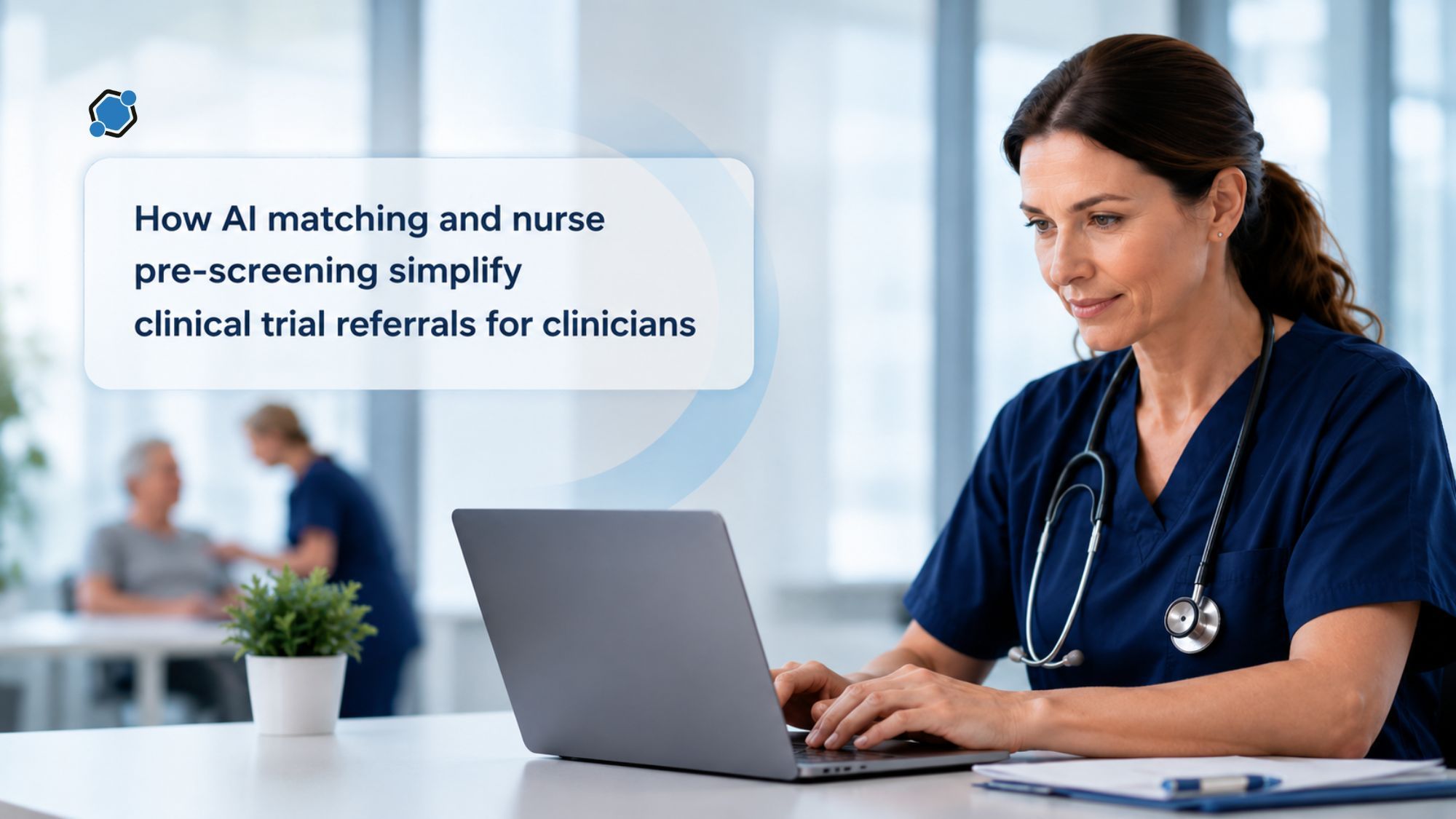
Where the clinical trial referral workflow breaks down today
A physician sees a patient who might benefit from research. The clinical opportunity exists, the patient is often open to hearing about it, and the physician wants to help. What happens next in the traditional workflow is where the process starts to fail.
The clinician has to locate an open study relevant to the patient's condition, interpret the eligibility criteria (the specific medical and demographic requirements a person must meet to enroll), estimate whether the patient is likely to qualify, and initiate outreach to the research site. Each of those steps sits outside the electronic health record (EHR) workflow and outside the reimbursable visit. Peer-reviewed work has shown that eligibility screening alone can range from 10 minutes to more than two hours per patient in traditional settings, and coordinators at research sites spend roughly a third of their time on that screening effort.
The result is a documented referral gap. A large survey by the Tufts Center for the Study of Drug Development found that physicians referred a median of five patients per year to clinical research, and nurses a median of two. That is a fraction of a percent of the patients passing through those practices annually. Patient interest is not the constraint. Published survey work shows more than four in five patients would consider joining a trial if their physician recommended one.
The bottleneck lives in the workflow, not in intent. When clinicians are asked directly why they do not refer more often, they name extra paperwork, protocol lookup burden, and time constraints, well ahead of any lack of interest in research. Practical guidance on how these conversations tend to unfold at the visit level is discussed in Bridging the Gap: How HCPs Can Talk to Patients About Research Opportunities.
Why the referral gap is a system problem, not a clinician problem
The most rigorous framing of the referral gap comes from a meta-analysis published in the Journal of the National Cancer Institute in 2019. In oncology settings, that work found that no trial was available at the patient's institution for more than half of patients, and among those who did have an available trial, roughly one in five were ineligible before any clinician-patient conversation began. Structural and clinical barriers, by themselves, closed the door for the majority of patients before the referral question ever landed with the physician.
Those barriers are not clinician-generated. They are properties of the system: which trials open at which institutions, how eligibility criteria are written, how protocol information is distributed, and how referral pathways are built into or bolted onto everyday clinical workflows. A recent cross-specialty survey of primary and urgent care providers named the absence of a clinic-wide referral process as one of the top barriers to supporting research. That is a system-design gap, not an individual-effort gap.
The framing matters for how the field solves the problem. If the referral gap is treated as a clinician-attention issue, the response is more education and more requests for physician time. If it is treated as a system-design issue, the response is different: build the infrastructure that identifies likely-eligible patients, moves the triage work off the clinician's desk, and delivers a pre-screened candidate to the research site. That second path, and what it means for the clinician's professional role, is explored further in The Clinician's Role in Expanding Trial Access for Patients.
How AI-assisted matching closes the "I don't know what's open" gap
The first place a compressed referral workflow saves clinician time is discovery. Traditional trial identification requires a physician or clinic staff member to know which studies are recruiting, know the eligibility criteria for each, and hold that knowledge in working memory during a short visit. That is an unreasonable ask, and the data reflect it. A cross-specialty survey in 2020 found that only a small share of U.S. adults had full awareness of clinical trials, and clinician awareness of specific open protocols has been documented as similarly uneven.
AI-assisted matching addresses this by inverting the workflow. Instead of asking a clinician to search across studies for a patient, the system reads structured and unstructured clinical data and surfaces the studies for which a specific patient is likely to qualify. Published work on natural language processing (NLP) approaches, which use software to interpret free-text clinical notes, has demonstrated substantial reductions in manual screening time. One peer-reviewed study of an automated screening system in an emergency department setting reported a 34 percent reduction in patient screening time and measurable improvements in the share of patients screened, approached, and enrolled.
The mechanism is important to name plainly. AI matching does not replace clinical judgment. It removes the discovery burden by narrowing a universe of hundreds of thousands of registered studies down to a small, relevant set for a specific patient. The clinician's role becomes what it should have been from the start: a conversation with the patient about whether research is a reasonable next step. A broader view of how AI is reshaping the referral relationship between clinicians and research is available in AI and Doctors Unite: New Era of Clinical Trial Referrals.
What a registered nurse pre-screening layer actually does
The second compression happens after the clinician makes the referral. In a traditional workflow, once a clinician decides a patient might qualify, the clinician or clinic staff still owns the follow-up: contacting the site, sharing records, answering eligibility clarification questions, and updating the patient on next steps. That downstream churn is what makes willing referrers stop referring.
A registered nurse (RN) pre-screening layer sits between the referral and the research site. The nurse conducts an initial pre-screening review, which means confirming the basics of the eligibility profile and gathering the information the site will need to make its own final determination. The nurse does not perform final eligibility determination, does not walk the participant through study details, and does not handle informed consent (the formal process by which a participant agrees to join a study after understanding its risks and procedures). Those decisions belong to the research site team.
That scope boundary is a compliance feature, not a limitation. It aligns with Good Clinical Practice (GCP) staffing conventions, which separate initial screening from investigator-level eligibility and consent responsibilities. It also solves a specific problem for the referring clinician: the outreach, records collection, and eligibility clarification that used to sit on the clinic no longer does. Peer-reviewed navigation research, particularly in oncology settings, has shown that a dedicated navigation and pre-screening layer can double referral volume for underrepresented patient populations and substantially improve retention through the enrollment process. Those studies are oncology-specific, but the operational principle applies across specialties: someone other than the referring clinician does the triage work, and the clinician sees the load lift. The community-practice angle on this workflow shift is developed in How Community Physicians Can Expand Clinical Trial Participant Pools.
How compressed referral workflows change the clinician's day
Compressed referral workflows change what the clinician actually does during a visit. The clinician does not search protocol databases, does not memorize eligibility criteria, does not draft site outreach, and does not manage the record request. The clinician identifies a patient who might benefit from research, discusses the option, and passes the referral into a system that runs the rest of the process.
Three practical changes follow. First, the referral fits inside a normal visit because the friction sits somewhere else. Second, the quality of participants reaching the research site improves, because a pre-screened candidate has already cleared a first-pass review against the eligibility profile, which reduces downstream screen failures (participants who are referred but ultimately do not qualify) and the follow-up questions that come back to the clinic. Third, the clinician receives closed-loop updates on whether the referral progressed, without having to chase the site.
The larger direction of the field supports this model. The U.S. government has moved toward broader interoperability standards, and in September 2024 the FDA finalized guidance on decentralized clinical trials, which explicitly recognizes local healthcare providers as part of the participation pathway. The infrastructure the system has been missing, matching plus a nurse-led pre-screening bridge, is now consistent with where regulators expect research to operate. A closer look at how clinicians can position their practice within that direction is offered in From Clinic to Trial: How HCPs Can Advocate for Research.
How DecenTrialz fits into the HCP referral pathway
DecenTrialz uses AI-assisted participant matching and registered nurse-led pre-screening to connect people with research sites. For a referring clinician, that means two things happen after a referral is initiated. The matching layer identifies studies for which the patient is likely to qualify. A DecenTrialz nurse then conducts an initial pre-screening review and prepares the candidate for the research site.
The scope boundary is explicit. Final eligibility determination, informed consent, study walk-through, and enrollment are always handled by the research site team. The DecenTrialz nurse pre-screens only. She does not walk participants through study details, does not determine final eligibility, and does not handle consent. That separation is what allows a compressed HCP-facing workflow to sit within GCP-aligned recruitment practice.
For clinicians, the pathway compresses to what it should be: identify a patient, initiate a referral, and step back into the rest of the visit. Learn more about how the referral pathway operates at decentrialz.com.
Refer a patient without absorbing the workflow
Clinicians should not have to carry the operational cost of a clinical trial referral to make research accessible to their patients. The workflow can compress, the discovery load can move to a matching layer, and the triage load can move to a nurse-led pre-screening bridge. What remains for the clinician is the clinical judgment call and the conversation. To see how the DecenTrialz referral pathway works for a practice, visit decentrialz.com.
Was this article helpful?

Similar Blogs
Digital Endpoints in Clinical Trials: What Wearable Data Measures and What It Does Not
Digital endpoints in clinical trials have changed both what a study measures and where the...
 Mahesh Upadrista
Digital Endpoints in Clinical Trials: How HCPs Interpret Wearable Data From Their Patients
Wearable devices now generate a substantial share of the data collected during modern clin...
Deeksha Gitta
Point-of-care clinical trials: how research fits inside routine practice
Clinical research and clinical care have long operated as parallel systems. Patients recei...
 Anish Teepireddy
Stay Informed. Stay Connected.
Get updates on verified clinical trials, emerging treatments, and research breakthroughs directly in your inbox. No spam, just science that matters.
