 HIPAA Compliant
 ISO 27001 Certified
Digital Endpoints in Clinical Trials: How HCPs Interpret Wearable Data From Their Patients
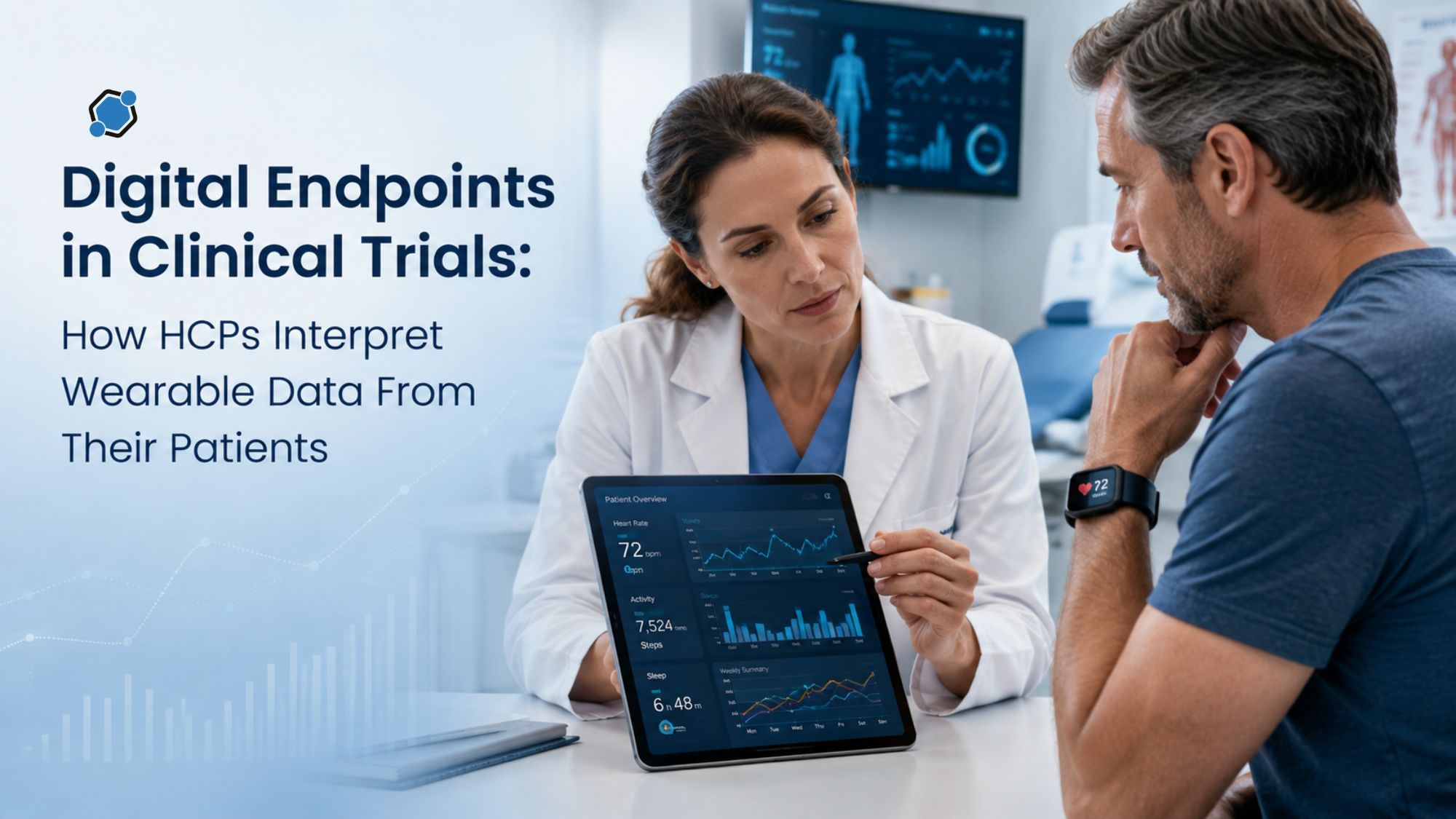
Wearable devices now generate a substantial share of the data collected during modern clinical trials. When a patient in a trial arrives at a routine office visit wearing an actigraphy monitor, a continuous glucose sensor, or a smartwatch supplied by the study team, the treating clinician often becomes the first point of contact for questions about what those readings mean. Interpreting that data, without stepping into the trial investigator’s role, requires an understanding of what digital endpoints are, how they are validated, and where sensor signals stop and clinical judgment begins.
What digital endpoints are and why they appear in modern trials
Digital endpoints are pre-specified measurements derived from data captured by digital health technologies, also referred to as DHTs. The FDA defines a digital health technology as a system that uses computing platforms, connectivity, software, and/or sensors for a healthcare-related purpose. In practice, that includes wearable biosensors, mobile phone applications used for symptom logging, contactless in-home sensors, and implantable monitors that transmit readings to a cloud database.
The regulatory framework came into sharper focus in December 2023, when the FDA issued its final guidance titled Digital Health Technologies for Remote Data Acquisition in Clinical Investigations. That document set out expectations for how sponsors should select, validate, and document DHTs used to capture study data outside a clinic setting. Digital endpoints derived from those tools may serve as primary, secondary, or exploratory measures depending on how well the endpoint has been validated as fit-for-purpose for its specific context of use, meaning the disease, the population, and the role the endpoint plays in the study. The evidentiary bar is highest for a primary endpoint that supports a labeling claim, and lower for exploratory or hypothesis-generating measures.
Regulatory qualification of digital endpoints has moved fastest in Europe. In August 2023, the European Medicines Agency qualified Stride Velocity 95th Centile, a wearable-derived measure of ambulation, as a primary endpoint for superiority studies in ambulant Duchenne muscular dystrophy patients aged four and above. It is widely cited as the first regulatory qualification of a wearable-derived measure at primary-endpoint level. As of 2026, no digital endpoint has yet been fully qualified as a primary endpoint through the FDA Drug Development Tool program, though sensor-derived measures have been accepted as exploratory or secondary endpoints in specific programs.
Sponsors adopt digital endpoints for reasons clinicians will recognize. Continuous or high-frequency capture reveals fluctuations that a scheduled office visit cannot see. A patient with epilepsy wearing a movement sensor generates a longer, more granular record of seizure-related activity than a clinic encounter can produce, and a person in a cardiovascular study wearing a continuous electrocardiogram patch produces rhythm data across weeks of daily life. The tradeoff is that this data volume arrives without the interpretive context clinicians are trained to provide. For a broader introduction to the technology landscape, see Wearables, Sensors and ePROs: Technology in Clinical Trials.
Categories of wearable data HCPs encounter during patient visits
The wearables used in clinical trials fall into distinct categories that shape how the data should be read. Activity and movement monitors, typically built around accelerometry (a technology that measures motion in multiple directions), capture step counts, sedentary time, sleep-wake cycles, and gait characteristics. Physiological sensors record heart rate, heart rate variability, respiratory rate, blood oxygen saturation, and skin temperature. Metabolic monitors, such as continuous glucose monitors used in diabetes and metabolic studies, produce interstitial glucose readings at short intervals. Neurological sensors capture tremor amplitude, dyskinesia (involuntary movements often seen in Parkinson disease), gait velocity, and postural sway.
Wearable blood pressure devices sit within this technology category, but current cardiology guidance advises caution. The American Heart Association and American College of Cardiology have recommended against relying on cuffless wearable blood pressure devices for clinical decision-making, because standard regulatory clearance for these devices does not require the same accuracy testing used to validate cuff-based measurement. Such readings may appear in trial datasets or be brought to a clinician by a patient, but they should not be treated as diagnostic-grade without corroboration.
Some trials also use environmental or contextual sensors placed in a participant’s home. These devices track factors such as ambient temperature, air quality, or nighttime disturbances that may influence a study’s primary endpoint. Contactless in-home sensors have been identified by regulators as an active area for endpoint development, including in pediatric research such as sleep and apnea studies.
When a patient brings this data to an office visit, the readings often arrive in three forms. The first is a dashboard summary generated by the sponsor’s study portal. The second is a raw or semi-processed report accessed through the wearable manufacturer’s consumer application, which may or may not match the study dataset. The third is verbal, when the patient describes what the wearable indicated without any printed record.
Interpreting wearable data without stepping into the investigator role
The clearest boundary in this space is between clinical interpretation and study interpretation. Under ICH E6 Good Clinical Practice, the investigator carries responsibility for all trial-related medical decisions. Only the investigator and the site’s designated study team can make decisions tied to the study protocol, such as adjusting study drug dosing, interpreting a value against protocol-defined criteria, or determining whether a wearable reading constitutes an adverse event within the trial’s safety definitions. Those responsibilities remain with the research site that enrolled the participant.
An HCP outside the study team can still address several legitimate questions. A patient may ask whether an unusual heart rate spike shown on a smartwatch reflects a symptom that warrants care unrelated to the trial. Standard clinical reasoning applies. The clinician evaluates the finding as they would any patient-generated data, considering the sensor’s known limitations, the patient’s baseline, and whether the reading correlates with symptoms. If the finding raises concerns about the trial, the appropriate action is to direct the patient back to the investigator or study coordinator rather than adjusting the study intervention.
Consumer-grade wearables, such as widely available smartwatches and fitness bands, present a distinct interpretive challenge. Their heart rate and rhythm signals can be clinically useful in specific contexts, but the algorithms behind their outputs are proprietary and rarely disclosed at the level required for medical decision-making. In a trial, the sponsor-provided device is the source of record for study endpoints. A patient’s personal smartwatch reading is not.
Common pitfalls in reading trial-generated wearable data
Several recurring problems complicate interpretation. Data volume without context is the most frequently reported clinician frustration. Passive sensing generates continuous streams that lack the contextual detail present in a clinic encounter. A drop in step count over a week may reflect illness, weather, a family event, a mood change, or simply reduced motivation. Without narrative from the patient, the data alone often will not explain itself.
Adherence gaps distort what looks like a longitudinal record. Wearables that require charging, syncing, or manual activation produce missing intervals that can appear indistinguishable from genuine physiological changes. In clinical trial datasets, statisticians are trained to flag those gaps, but the report a patient shows a clinician may not.
Photoplethysmography-based heart rate sensors, which use light to detect pulse under the skin, are most reliably degraded by motion. Skin pigmentation has been reported as a secondary factor in some device-specific studies, but a well-known analysis found that once motion was controlled for, skin tone was not a systematic source of error. The practical takeaway is that photoplethysmography accuracy is device-dependent and highly sensitive to motion; the same brand can perform very differently on the same patient at rest versus during vigorous activity. Tattoos and dense body hair over the sensor site also degrade signal.
Sleep and glucose measurements carry their own caveats. Accelerometer-based wearables perform reasonably well at distinguishing sleep from wake, but are considerably weaker at classifying sleep stages such as light, deep, and REM sleep. Polysomnography, the laboratory-based reference standard, remains substantially more accurate for staging. Continuous glucose monitors show a well-documented lag relative to fingerstick blood glucose that reflects both a physiologic delay of roughly five to six minutes for glucose to move from blood into interstitial fluid, and additional delay from the sensor tissue interface and internal signal-smoothing algorithms. The total delay can reach 15 to 20 minutes when glucose is changing rapidly, such as after meals or during exercise.
Data reliability concerns also arise around who is wearing the device. FDA guidance on electronic systems in clinical investigations, finalized in October 2024, specifically addresses this: sponsors are expected to implement access controls and to instruct participants that only they should wear or use the DHT, with the discussion documented in the study record. Clinicians should not assume authentication has been confirmed simply because data exists. Wearable outputs also do not replace patient-reported experience; the two are complementary, and one cannot substitute for the other.
Talking with trial participants about what their wearable data shows
HCPs are often the professionals patients trust most, and participants frequently ask for a clinical read on what their trial device is measuring. A few communication practices help preserve the boundary between routine clinical care and trial oversight.
Anchor the conversation in the protocol’s stated purpose. If the patient can describe what the device is intended to measure and how the study defines a meaningful change, the discussion becomes easier to shape. If the patient does not know, that is a reasonable prompt to direct them to the study team for clarification.
Distinguish study-owned data from consumer-owned data. A patient may show a clinician three sources at once: the study-issued device, a personal fitness tracker, and a phone application that logs symptoms. Only the first is part of the trial dataset. The others can inform clinical care but should not be confused with the endpoints the sponsor will analyze.
Recognize when a finding warrants escalation. Unexpected patterns visible on a wearable, such as arrhythmias, oxygen desaturation events, or persistent overnight tachycardia, may reflect a clinically significant issue independent of the trial. Standard clinical evaluation applies, and the study team should also be informed so the finding can be assessed within the trial’s safety framework. For guidance on framing broader research conversations with patients, see Bridging the Gap: How HCPs Can Talk to Patients About Research Opportunities.
Frequently asked questions from HCPs about digital endpoints
Are digital endpoints regulated the same way as traditional endpoints? Digital endpoints follow the same regulatory principles as any endpoint used in a clinical investigation. The FDA and other health authorities expect verification, validation, and usability evaluation to demonstrate that the DHT measures the intended parameter accurately in the target population. Whether an endpoint is primary, secondary, or exploratory depends on the strength of supporting evidence and the intended context of use.
Should a clinician adjust patient management based on a consumer smartwatch reading? Clinical judgment applies. Standard evaluation of the underlying complaint is appropriate. The wearable reading is one input among many, and consumer-grade device outputs are not diagnostic instruments. Cuffless wearable blood pressure readings, in particular, should not be treated as diagnostic without corroboration.
What happens if a patient stops wearing their study device? Missing data affects the sponsor’s ability to analyze the endpoint and can influence how the participant’s record is handled in the final dataset. HCPs who learn of adherence issues can encourage the patient to contact the study coordinator, who owns the response.
Supporting patient access to trials involving digital endpoints
DecenTrialz is a United States-based clinical trial recruitment and pre-screening platform that supports HCPs, sponsors, CROs, and research sites through AI-assisted matching and RN-led pre-screening. Research sites retain full responsibility for eligibility determination, informed consent, and enrollment. For clinicians whose patients may be candidates for trials that use digital endpoints, DecenTrialz can serve as a structured referral pathway to recruiting sites, so that clinical judgment stays with the treating clinician and study-related decisions remain with the investigator. For a related view on how wearable-generated data intersects with the broader real-world evidence landscape, see The Role of Real-World Data in Decentralized Clinical Trials.
Was this article helpful?

Similar Blogs
How Tokenization Helps Physicians Track Patients After a Clinical Trial Ends
Tokenization is changing how sponsors keep track of clinical trial participants long after...
 Swaroop ESD
Digital Endpoints in Clinical Trials: What Wearable Data Measures and What It Does Not
Digital endpoints in clinical trials have changed both what a study measures and where the...
Mahesh Upadrista
Point-of-care clinical trials: how research fits inside routine practice
Clinical research and clinical care have long operated as parallel systems. Patients recei...
 Anish Teepireddy
Stay Informed. Stay Connected.
Get updates on verified clinical trials, emerging treatments, and research breakthroughs directly in your inbox. No spam, just science that matters.
