 HIPAA Compliant
 ISO 27001 Certified
How Tokenization Helps Physicians Track Patients After a Clinical Trial Ends
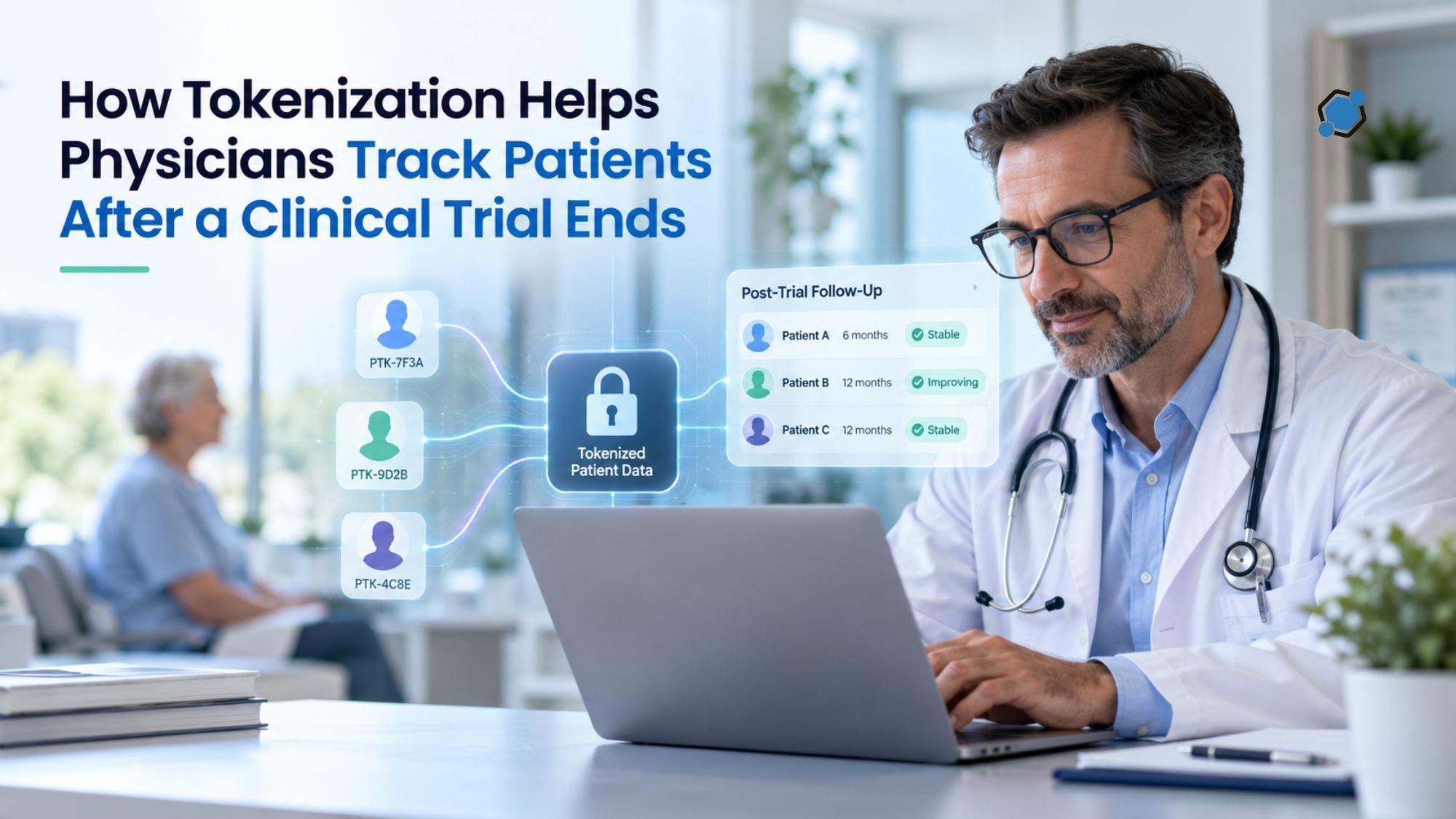
Tokenization is changing how sponsors keep track of clinical trial participants long after the last study visit. By linking a coded, de-identified version of each participant's identity to routine health records, insurance claims, and death registries, sponsors can follow participants for years without asking them to return to the research site. Community physicians, primary care providers, and specialists sit at the center of this model, because the records they create during everyday care become the long-term safety evidence for the study. This article explains how tokenization works, what federal guidance expects during long-term follow-up, and what practical steps clinicians can take when a former trial participant sits in front of them at a routine visit.
What Is Patient Tokenization in Clinical Trials?
Patient tokenization is a privacy-preserving method that replaces personally identifiable information, such as first name, last name, sex, date of birth, and postal code, with a coded string called a token. The token is generated through a salted one-way cryptographic hash, meaning a mathematical function that scrambles identifiers with a secret added value so the result cannot be reversed to reveal the person behind it. Because the same algorithm runs at the research site and at each real-world data source, the same person generates the same token in both places, which allows the two records to be linked without exchanging names.
Real-world data refers to health information collected during routine care, including electronic health records (EHRs), insurance claims, pharmacy dispensing records, laboratory results, and disease registries. Two matching approaches are common: deterministic matching, which links records only when a defined set of identifiers matches exactly, and probabilistic matching, which estimates the likelihood that two records belong to the same person when some identifiers differ or are missing. Federal guidance published in 2024 on the assessment of EHR and medical claims data notes that both approaches can add value depending on the setting and refers to linkage tokens as one way to maintain traceability without re-identifying patients.
For the parallel sponsor-side perspective on how these token workflows are commissioned and governed, clinicians can review the sponsor's view of patient tokenization.
Why Do Gene and Cell Therapy Trials Require Such Long Follow-Up?
Some investigational products are designed to change the body permanently or for a very long time. The federal January 2020 guidance on long-term follow-up after gene therapy administration recommends up to fifteen years of follow-up for integrating vectors, meaning engineered viruses such as gammaretroviruses and lentiviruses that insert genetic material into a patient's DNA. Genome editing products carry a similar recommendation. Non-integrating adeno-associated virus (AAV) vectors typically warrant a shorter window. For the first five years, the guidance recommends yearly examinations by a healthcare provider, followed by at least annual contact by telephone or questionnaire.
Chimeric antigen receptor T-cell (CAR-T) products, in which a patient's own immune cells are genetically modified to target cancer, added further urgency in April 2024, when federal regulators required a boxed warning for T-cell malignancies across approved BCMA-directed and CD19-directed CAR-T products. Product labeling instructs that patients and clinical trial participants who receive these study drugs should be monitored lifelong for new cancers. The commercial approvals also carry postmarketing requirements to conduct fifteen-year observational safety studies.
Traditional follow-up depends on participants returning to a research site year after year. Many participants move, change insurers, recover, or simply stop attending. The 2020 federal guidance urges sponsors to make every effort to prevent loss to follow-up, which is one reason tokenized data linkage has drawn regulatory interest. A related consideration is that the follow-up record does not disappear when the active study closes.
Clinicians who want to understand data flow after the last participant visit can review what happens to trial data after a study closes.
How Does Tokenization Enable Passive Follow-Up With Less Participant Burden?
Passive follow-up means collecting outcome information from records that already exist, rather than scheduling new study visits. When a participant agrees to tokenization at enrollment, the sponsor can later link that token to EHR data, claims, pharmacy fills, cancer registries, and mortality sources such as the federal death index and the Social Security death file. Hospitalizations, new diagnoses, and survival can then be observed across the full follow-up window, even after the participant has left the study region.
A September 2025 draft federal guidance on postapproval methods to capture safety and efficacy data for cell and gene therapy products names EHRs, medical claims, vital statistics, and disease registries as postapproval data sources and describes decentralized collection as more accessible and less burdensome. The same draft cautions that these sources were not designed for safety research, citing fragmented records when patients switch insurers or providers and delays in medical coding. Institutional review board oversight and informed consent requirements continue to apply in the postapproval setting.
Privacy protections rest on the federal health privacy rule. Guidance from the Office for Civil Rights describes two routes to de-identification: the Safe Harbor method, which removes eighteen specified identifiers, and Expert Determination, in which a qualified expert documents that re-identification risk is very small. That guidance recognizes that codes created with cryptographic hash functions may be part of a de-identified data set under Expert Determination, provided the keys are not disclosed. The rule also cautions that de-identified data retain some residual risk that is not zero.
For the operational side of building and maintaining these linkages across studies, see how CROs handle real-world data linkage.
What Does the Physician Do in Tokenized Long-Term Follow-Up?
Tokenization changes how data travel, not who provides care. The physician who sees a former participant at a routine visit is creating the record that will eventually become study evidence, and several responsibilities follow from that role. Communication begins at enrollment. The internationally harmonized Good Clinical Practice guideline finalized in 2025 states that the investigator should inform the participant's primary physician about trial involvement when the participant agrees. The 2020 federal guidance goes further and recommends that long-term follow-up protocols identify suitable healthcare providers, including the participant's primary care provider, whose observations can be used to detect delayed adverse events.
Practical actions that support tokenization in clinical trial follow-up include:
- Flagging trial history in the problem list, including the study intervention name or class and the research site's contact details.
- Documenting diagnoses with specific, structured codes, because linked data sets rely heavily on coded fields and may miss important detail held only in free-text notes.
- Watching for the delayed events named in federal gene therapy follow-up guidance: new cancers, and new or worsening neurologic, rheumatologic, autoimmune, or hematologic disorders.
- Contacting the research site promptly about any serious or unexpected event, and following the protocol's instructions for events that may be related to the study intervention. Federal instructions specify that events involving investigational products should be reported through the study protocol contacts rather than through the voluntary consumer reporting program.
- For approved cell and gene therapy products, reporting new cancers to the manufacturer and to the federal safety reporting program, and asking about instructions for preserving tissue samples for testing.
- Supporting pediatric participants as they move into adult care, since long follow-up periods often require fresh consent once the participant reaches adulthood.
Duty of care remains unchanged. Linked data arrive months after an event and never alert the clinician in real time, so tokenization cannot replace clinical judgment, standard screening, or a direct call to the research team. Referring physicians can also help participants understand tokenization before a study visit, explaining in plain terms that a coded identifier may connect future health records to the study. The research site and study team conduct the formal consent discussion.
Physicians preparing for these conversations may find it useful to review the referring physician's ongoing role in more detail.
How DecenTrialz Supports Referring Clinicians in Tokenized Follow-Up Pathways
DecenTrialz is a United States based clinical trial recruitment and pre-screening platform that combines AI-assisted participant matching and registered nurse-led pre-screening to connect potential participants with research sites. For referring clinicians, that means patients arrive at a research site better informed about study requirements, including long follow-up commitments and data linkage expectations that the study team will explain in detail. Registered nurses can flag early questions about follow-up duration or data sharing so the site is prepared to address them at the consent visit.
Final eligibility determination, informed consent, the study walk-through, and enrollment remain with the authorized research site and study team.
Clinicians interested in the referral workflow itself can review how nurse pre-screening streamlines referrals.
Frequently Asked Questions
Does tokenization give researchers access to a patient's full medical record?
Tokenization links de-identified records; it does not hand over the full chart. Researchers see coded data elements defined in the protocol, and the data use must stay within consent, institutional review board approval, and federal health privacy requirements.
Does a patient need to consent again for tokenized follow-up?
Consent is generally obtained at enrollment, and linkage then proceeds within that scope. Any new use outside the original consent requires review by the institutional review board and may require new consent. Pediatric participants typically need to provide their own consent after reaching adulthood.
Can a participant withdraw from tokenized follow-up?
Participation in research remains voluntary. The informed consent document explains how withdrawal works and how previously collected data are handled after withdrawal.
Does tokenized follow-up replace annual visits?
It can reduce visits but seldom removes all of them. Some protocols still require physical examinations, blood tests for vector persistence, or tissue collection that only direct contact can provide.
Is a tokenization token the same as a blockchain token?
The terms are unrelated. In health research, a token is a coded identifier for record linkage and has nothing to do with cryptocurrency or distributed ledgers.
Supporting Former Participants Over the Long Term
Tokenized long-term follow-up is making it possible to learn about the durability and late risks of gene and cell therapies without asking participants to travel to research sites for fifteen years. The system works best when community physicians keep accurate records, stay in contact with research sites, and report serious or unexpected events promptly. Clinicians who want to connect eligible patients with appropriate studies can explore DecenTrialz as a referral partner, with each research site guiding the consent and enrollment process.
Was this article helpful?

Similar Blogs
Digital Endpoints in Clinical Trials: What Wearable Data Measures and What It Does Not
Digital endpoints in clinical trials have changed both what a study measures and where the...
 Mahesh Upadrista
Digital Endpoints in Clinical Trials: How HCPs Interpret Wearable Data From Their Patients
Wearable devices now generate a substantial share of the data collected during modern clin...
Deeksha Gitta
Point-of-care clinical trials: how research fits inside routine practice
Clinical research and clinical care have long operated as parallel systems. Patients recei...
 Anish Teepireddy
Stay Informed. Stay Connected.
Get updates on verified clinical trials, emerging treatments, and research breakthroughs directly in your inbox. No spam, just science that matters.
