 HIPAA Compliant
 ISO 27001 Certified
Direct-to-Patient Drug Shipments at Clinical Trial Sites: What Are They and How Do Sites Stay Compliant?
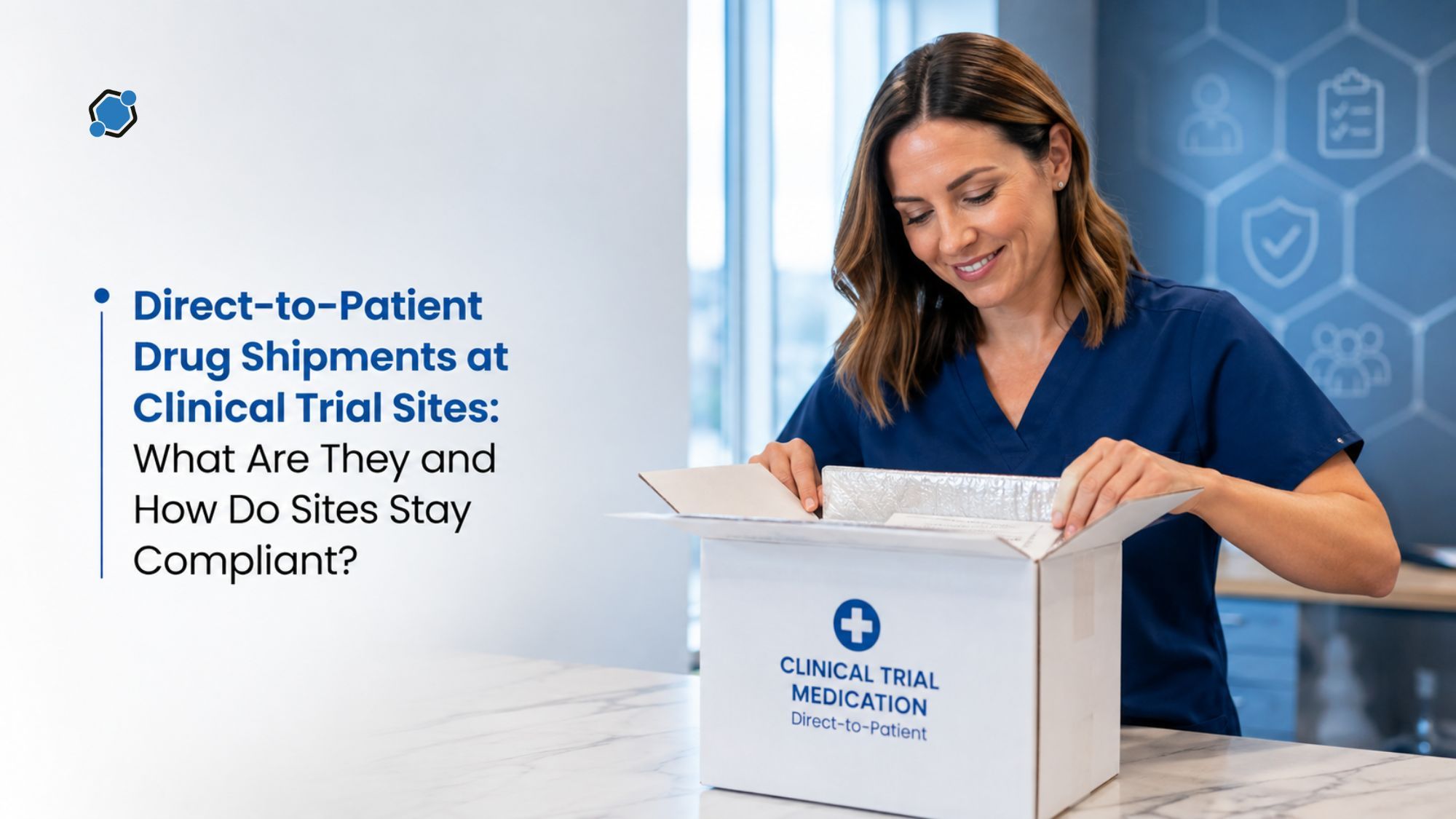
Direct-to-patient shipment moves the study drug from the research site to the participant's home, and the research site retains full accountability for that drug from the moment it enters the supply chain until it is used, returned, or destroyed. As decentralized and hybrid protocols become standard, site teams are asked to manage an investigational product supply chain that extends past the site's own walls. This article explains what direct-to-patient shipment involves, where the operational friction sits, and how site teams can build workflows that hold up to inspection.
What direct-to-patient shipment means for the site
Direct-to-patient (DTP) shipment is the delivery of the investigational product, the study drug being evaluated in a clinical trial, to a participant's residence rather than dispensing it during an on-site visit. It is a defining feature of the decentralized clinical trial, a trial in which some study procedures occur away from the traditional site. In the most common United States model, the study drug arrives at the site first and then ships from the site to the participant. A model in which a central depot ships directly to the home is used less often, because state law generally requires a pharmacist in the dispensing step.
The United States Food and Drug Administration (FDA), the federal agency that regulates drugs and clinical research, finalized guidance on decentralized elements in September 2024 that directly addresses shipping study drug to participants. The system treats DTP as an extension of site dispensing, not a handoff of responsibility. Study drugs with stable storage profiles are the best candidates, while products that need specialized handling or intensive monitoring after dosing are weaker fits. Sites weighing whether a protocol can be run partly at home should read DTP alongside broader hybrid clinical trial visit decisions.
Where site accountability begins and never ends
Under federal regulation, the investigator must maintain adequate records of study drug disposition, including dates, quantity, and use by each participant. International good clinical practice standards place responsibility for study drug management, including accountability, handling, dispensing, administration, and return, with the investigator and institution. The system permits delegation of tasks; accountability itself does not transfer.
For site teams, that means the investigational product accountability log must reconcile every unit even when the drug never sits on a site shelf for long. The site authorizes release of the shipment, confirms the participant received it, and documents the return or destruction of unused product. When an inspector reviews the study, that log is examined line by line, so it must stay current at all times. Sites already working through ICH E6(R3) readiness will find that the same investigator oversight principles apply directly to DTP.
The operational friction points sites should plan for
The system introduces friction the moment the drug leaves the site. A temperature excursion, meaning any deviation outside the study drug's labeled storage range during transit, requires the affected product to be quarantined and held for a documented disposition decision before any use. The data logger that travels with the shipment must be reviewed at receipt rather than filed unread. Delivery can fail when the participant is not home or the address has changed. Communication can break down across the site, the courier, the sponsor, and the participant.
Controlled substances add another layer. Federal drug enforcement rules make shipping controlled substances directly to a participant's home heavily restricted, and many protocols simply prohibit it. State pharmacy law adds further variability, because most states require a pharmacy to hold a nonresident license before shipping medication across state lines. A participant who relocates mid-study can create a compliance gap overnight. When a home health nurse is added to the model, additional oversight questions emerge that overlap with broader site oversight of home nursing and mobile phlebotomy responsibilities.
Building workflows that hold up to inspection
Strong site programs start with a standard operating procedure written specifically for DTP, supported by delegation of authority log entries for every DTP task. The interactive response technology system, the platform that manages randomization and trial supply, can trigger shipments and let participants confirm receipt. Pre-shipment confirmation calls, backup delivery windows, and clear sponsor escalation paths reduce failed deliveries and lost time. Site teams should also treat DTP oversight as real labor and confirm the study budget reflects that work rather than absorbing it informally.
Because investigational product accountability is a recurring focus in regulatory inspections, sites benefit from folding DTP documentation into their broader continuous inspection readiness workflow rather than treating it as a separate binder. That approach keeps the accountability log audit-ready alongside every other essential document, and it aligns with the foundational expectations set out in general clinical trial site compliance practice.
Frequently asked questions about direct-to-patient shipments
Who is legally responsible if a shipment is lost or damaged?
The sponsor bears ultimate responsibility for the study drug, but the investigator retains site-level accountability. Contemporaneous documentation of any loss, damage, or exception is essential, along with prompt notification of the sponsor per the delegated communication plan.
Can controlled substances be shipped direct-to-patient?
Generally no. Federal drug enforcement rules make direct-to-home shipment of controlled substances heavily restricted, and most protocols prohibit it. Sites should confirm the classification of every study drug before agreeing to a DTP model.
How does the site document a temperature excursion?
Quarantine the affected product, review the data logger record shipped with the product, and hold the shipment for a documented disposition decision from the sponsor or qualified quality function before any use. Every step is recorded contemporaneously.
How does the site verify the participant actually received the study drug?
Verification is captured through signature on delivery and confirmation entered into the trial supply system. Many programs add a pre-shipment call and a post-delivery check-in to close any gap.
What happens if the participant is not home at delivery?
The shipment enters exception handling, which can threaten cold chain integrity and dosing timing. Backup delivery windows, alternate address rules defined in the protocol, and a scripted escalation path help the site recover the shipment without protocol deviation.
Does the site pharmacist need to be involved?
In most United States models, yes. State pharmacy law generally requires a pharmacist in the dispensing step, so the site pharmacy is typically the release point for the shipment.
How do state pharmacy laws affect shipping study drug across state lines?
Most states require a pharmacy to hold a nonresident pharmacy license before shipping medication into that state. A participant who moves across state lines during a study can create a compliance gap, so the site should confirm nonresident licensure coverage during feasibility and again at any address change.
How DecenTrialz supports sites running decentralized protocols
DecenTrialz is a United States clinical trial recruitment and pre-screening platform that connects potential participants with research sites using AI-assisted matching and registered nurse-led pre-screening. The research site owns final eligibility determination, informed consent, the study walk-through, and enrollment. Site teams evaluating decentralized protocols can lean on that pre-screening support to reduce front-end burden while keeping full control of the operational and regulatory responsibilities described above. To learn how structured pre-screening can lighten the recruitment side of a decentralized study, connect with the DecenTrialz team.
Was this article helpful?

Similar Blogs

How CROs use predictive feasibility modeling to select clinical trial sites
Predictive feasibility modeling has moved from a data science experiment to an increasingl...
 Anish Teepireddy
Building external control arms: how CROs source data and clear regulatory review
External control arms have moved from a niche design tool to a recurring conversation betw...
 Swaroop ESD
Tokenization in clinical trials: how CROs link real-world data
Tokenization has moved from research curiosity to operational plumbing in the clinical tri...
ParamrajStay Informed. Stay Connected.
Get updates on verified clinical trials, emerging treatments, and research breakthroughs directly in your inbox. No spam, just science that matters.
