 HIPAA Compliant
 ISO 27001 Certified
How patient advocacy groups guide their community to clinical trials
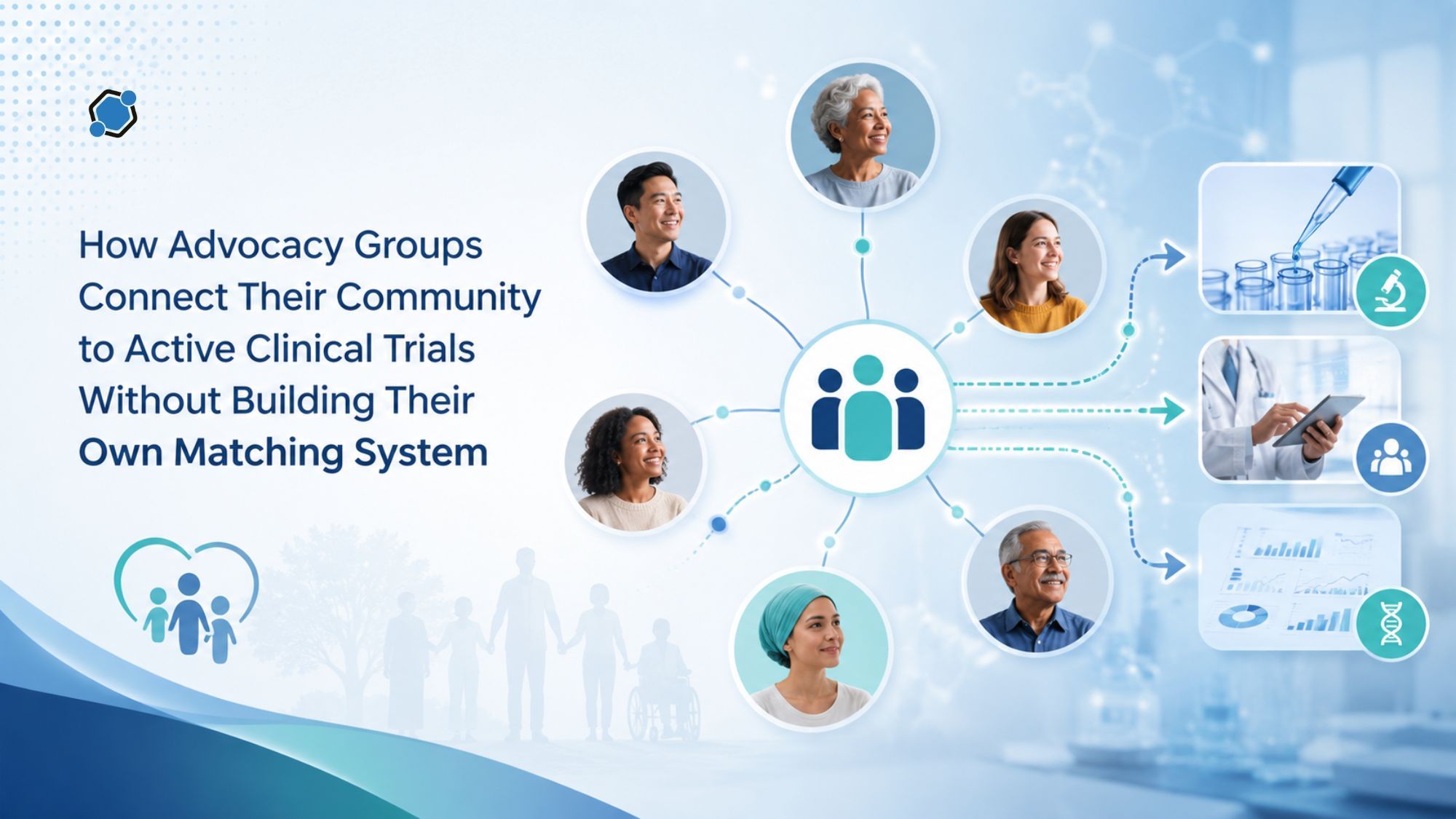
A person who has just been diagnosed with a serious illness rarely calls a pharmaceutical company first. They often do not call their hospital research office either. They call the organization that has been there for them since before the diagnosis, the patient advocacy group that runs the support meetings, hosts the educational webinars, and publishes the plain-language explainer when a new option becomes available.
When that same person eventually asks the advocacy group about clinical trials, the question is simple but the work behind a useful answer is not. Matching a member to a study that may fit, checking whether they qualify, and walking them through what the study would involve takes operational tools that an advocacy group is not built to run. What the group can do, and what it does extremely well, is guide. Doctors play a parallel role on the clinical side, which Bridging the Gap: How HCPs Can Talk to Patients About Research Opportunities explores. This piece walks through how the advocacy guidance actually works, and how a matching platform fits behind the scenes so the group can stay in the lane where its value is highest.
The role patient advocacy groups already play in clinical research
Patient advocacy groups are built around one thing the rest of the clinical research system does not have, which is sustained trust with the community they serve. Many are founded by people who live with the condition, or who care for someone who does. Most run on a mix of education, peer support, fundraising, and policy work. Over time they accumulate the most valuable thing any clinical research effort can hope to access, which is an audience that opens the email, reads the article, and shows up to the community call.
That trust shapes how members find clinical trials. A person who has spent years receiving newsletters, attending webinars, and reading the explainer articles from an advocacy group is far more likely to take a study suggestion seriously when it appears in those same channels. The newsletter, the website resource page, the support meeting, the conference. None of these were designed as recruitment infrastructure. All of them work as something better, a place where credible information lives because the source has earned the right to be heard.
For rare diseases especially, advocacy groups have often been the engine that brought research forward at all. Where the patient population is small and scattered, sponsors and research sites cannot find participants without help, and the group that has the registry, the conference, and the trusted email list is the one that knows where the patients are. Hope in Research: How Clinical Trials Are Transforming Rare Disease Treatment covers that story in more detail.
Where guidance ends and the operational work begins
There is a misconception worth naming directly: that the natural next step for advocacy groups should be to build their own trial matching system. To stand up a software product that asks members questions, compares answers against eligibility lists, sorts who qualifies for what study, and routes them to the right one. The argument usually goes that the group has the audience already, so why not own the technology too.
This argument misunderstands what running a matching system actually involves. The work is not just the matching itself. It is also the ongoing maintenance of the eligibility database as studies open and close, the privacy and consent infrastructure that has to satisfy federal and state law, the clinical staff who pre-screen each candidate before any referral can be made, the integrations with research sites that close the loop on whether a referral became an enrollment, and the dashboards that surface where the flow is breaking. None of this is what an advocacy group is built to do. Trying to take it on usually means hiring engineers, lawyers, nurses, and analysts, which is a different business altogether.
There is also an opportunity cost. Every hour spent building software is an hour not spent on education, policy work, support programming, and the day-to-day community presence that makes the group trustworthy in the first place. The trust is the asset. Burning it to chase a technology project is rarely a good trade.
The cleaner answer is to recognize that the matching, pre-screening, and referral work belongs to a different kind of organization. Modern matching platforms now use AI-assisted methods to compare a member’s information against active study criteria in seconds, a piece of the operational work that has changed substantially in recent years. AI in Clinical Trials: How It Is Changing Study Design and Patient Recruitment covers that shift.
How advocacy group trial matching works through a partner platform
The most useful way to think about advocacy group trial matching is as a handoff sequence rather than a single transaction. Each step is done by the party best suited to do it.
The advocacy group provides the entry point. A trusted link in the newsletter, a resource page on the website, a mention in the community call, or a session at the annual conference. The link goes to a matching platform the group has vetted and chosen to partner with. The endorsement is implicit in the placement. Members trust the group, the group trusts the platform, and that chain of trust is what gets the member to actually try the next step instead of closing the tab.
The platform handles the matching. The member enters basic information about themselves, their condition, their location, and any details that affect eligibility. The platform compares that information against studies that are currently recruiting and surfaces the ones that may fit. Modern matching uses AI-assisted models to narrow a long list of possible studies to a short list of plausible ones, which benefits from running across thousands of candidates rather than dozens.
A registered nurse handles the pre-screening. Pre-screening is a structured conversation that confirms key eligibility details an online form cannot fully verify, such as recent test results, current medications, and any conditions that affect study fit. The nurse is not making the final decision on whether the member can join a study. The nurse is doing the first practical check before the research site is involved, which saves the member from being sent to a site for a study they were never going to qualify for. International Nurses Day 2026: Nurses in Clinical Trials explains that pre-screening role in more depth.
The research site takes over from there. The site team is the group of clinicians and coordinators who actually run the study day to day. They review the pre-screening notes, contact the member to schedule a visit, verify final eligibility against the full study protocol (the document that defines exactly how the study is run), explain the study in detail through the informed consent process (the structured conversation by which a person is told everything they need to know before agreeing to take part), and make the final decision on whether the member can enroll.
In that sequence the advocacy group has done exactly one thing: send a trusted member through a door it has already vetted. That single action carries enormous weight. It does not require the group to interpret protocol criteria or track outcomes. It requires only that the partnership behind the door is one the group has chosen carefully and stands behind.
What members can expect when an advocacy group points them to a platform
For a member reading this, the question is more practical: what actually happens after clicking the link?
The first step is a short form. The platform asks for information about the person, their diagnosis, their location, and other details that affect what studies might be available. None of this requires medical literacy. The form is written for the same audience that reads the advocacy group’s newsletter.
What happens next depends on whether any current studies match. If studies are found, the platform shows them. Sometimes there are several, sometimes there are one or two, and sometimes there are none yet, which happens often when a condition is rare or when local studies are not currently recruiting new participants. None of those outcomes is a failure of the system. It is the system being honest about what is actually available right now.
If there is a possible match, a nurse contacts the member to do a pre-screening conversation. The conversation usually covers current medications, recent test results, recent procedures, and how the condition is affecting daily life. The nurse is not a substitute for the member’s own doctor and does not give medical advice. The nurse is doing the operational check that decides whether it makes sense to send the member to a research site for a closer look.
Not every member who gets to this point will end up in a study. Eligibility criteria are usually narrow, sometimes for reasons that are easy to understand (an age range, a specific stage of disease) and sometimes for reasons that take a paragraph to explain (a medication that interacts with the study drug, a recent procedure that creates a safety question). Eligibility Explained: Why Not Everyone Qualifies for a Trial covers the most common reasons in plain language.
If pre-screening goes well, the member is referred to the research site. From there, the site team handles the full screening visit, the informed consent conversation, and the decision on enrollment. The advocacy group is not involved in those steps and should not be. Those steps belong to the people who will be responsible for the member’s care during the study.
The whole flow is meant to protect the member from two common problems with finding a clinical trial alone: being overwhelmed by registries that list thousands of studies with no way to know which fit, and being sent to a site for a study they were never going to qualify for. A platform partnership reduces both by doing more of the work upstream.
How DecenTrialz supports patient advocacy groups
DecenTrialz is a clinical trial pre-screening and referral platform based in the United States. The platform identifies studies a person may be eligible for using AI-assisted matching, a registered nurse completes an initial pre-screening review, and the person is then referred to the research site running the study. Final eligibility verification, informed consent, and enrollment are handled by the study team, which is the group responsible for the participant’s care during the trial.
For a patient advocacy group, the practical fit is that DecenTrialz handles the operational matching and pre-screening work the group does not want to build, while the group keeps its role as the trusted entry point. A link in the newsletter, a resource page on the website, a referral from a support call. The platform handles what happens next.
The dashboards built into the platform give the advocacy group visibility into how the partnership is performing for its members without exposing private health information. Group leaders can see how many members started a search, how many were matched to active studies, and how many moved into pre-screening. That visibility is what turns a referral arrangement into an actual partnership, because the group is no longer sending members into a process it cannot see.
The advocacy group’s value to its community is not measured by whether it built a piece of technology. It is measured by whether members reached the studies they were considering, with the right information, at the right time. The right partnership lets the group focus on what only it can do, while a platform handles the operational work.
For an advocacy leader setting up that partnership, or a member pointed to a matching platform by a trusted group, the next step is to look at the platform itself. You can start a search at decentrialz.com.
Was this article helpful?

Similar Blogs
Clinical Trial Data Governance: What Advocacy Groups Should Verify Before Endorsing a Study
Patient information now travels further than most study participants expect. A study that ...
 Swaroop ESD
Tokenization in Clinical Trials: What Should Advocacy Groups Ask Sponsors About Patient Privacy
Tokenization has become one of the most widely adopted data techniques in modern clinical ...
Mahesh Upadrista
How advocacy groups turn patient registries into clinical trials
For most rare and chronic disease communities, the biggest obstacle to research is not sci...
Deeksha GittaStay Informed. Stay Connected.
Get updates on verified clinical trials, emerging treatments, and research breakthroughs directly in your inbox. No spam, just science that matters.
