 HIPAA Compliant
 ISO 27001 Certified
What are clinical trial stopping rules, and why would a study end early?
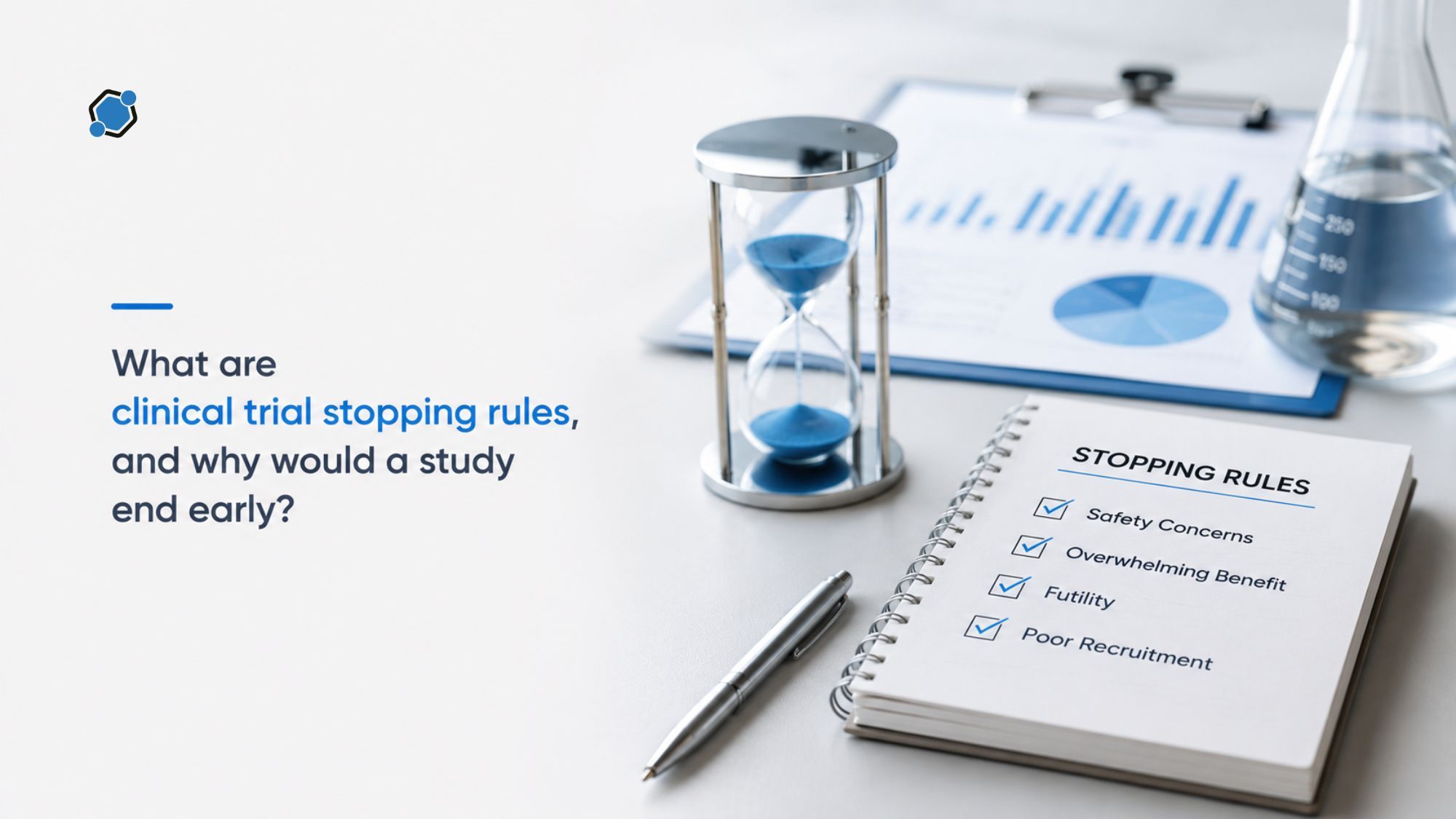
Every clinical trial has a plan for how it will end. Most of the time, that plan involves reaching the number of participants and follow-up visits the researchers set at the beginning. There is also a second possibility written into every well-designed study: the trial may end early. When that happens, it is rarely because something went wrong at random. Almost always, it happens because a stopping rule was met.
A stopping rule is a decision, made in advance, about the specific conditions under which a clinical trial should end before it finishes its planned course. These conditions are written into the study protocol, the master document that describes how the trial will run, before the first participant enrolls. They are not made up on the fly, and they are not the personal call of one researcher.
For anyone considering joining a study or already enrolled in one, understanding how stopping rules work is worthwhile. They are not a sign of failure. They are one of the strongest safety features built into modern clinical research.
What a stopping rule actually is
A stopping rule is a pre-set trigger. If a specific pattern shows up in the trial's data, the study ends. The trigger might be a certain number of serious side effects. It might be a statistical threshold showing that the study intervention, meaning the new drug, device, or procedure being tested, is clearly working better than the comparison. It might be a signal that no matter how long the trial continues, it will not produce a clear answer.
Because the rule is decided in advance, no single person can move the goalposts once the trial is underway. Regulatory bodies such as the U.S. Food and Drug Administration (FDA) expect trials to have these rules built in, particularly for studies involving serious conditions or higher-risk interventions.
The rule is not enforced by the researchers running the study day to day. That role belongs to an independent panel called a Data Safety Monitoring Board, or DSMB. This group of doctors, statisticians, and ethicists reviews the trial's data at scheduled points and decides whether the conditions for stopping have been met. To understand who this group is and what it does, see What Is a Data Safety Monitoring Board (DSMB)?.
When a study ends because the intervention is clearly helping
The first reason a clinical trial can stop early is a good one. Sometimes, well before the planned end date, the data show that the investigational product, meaning the drug or device under study, is working much better than the comparison. The difference is so clear that continuing the study would mean keeping some participants on the older, less effective option longer than necessary.
This is called stopping for efficacy. Efficacy means the intervention produces the intended result under the controlled conditions of the trial. It is a slightly different idea from effectiveness, which measures how well an intervention works in everyday clinical use. If the distinction matters to a study, it usually shapes how the stopping rule is written. For more on the difference, see Efficacy vs. Effectiveness in Clinical Trials.
Stopping for efficacy is uncommon but not rare. When it happens, participants who were receiving the comparison, or a placebo (an inactive substance used for comparison), are usually offered access to the investigational product afterward, where appropriate and permitted.
When a study ends for safety reasons
The second reason is the one people worry about the most. If early data show that participants are experiencing serious side effects at a rate the study was not willing to accept, the DSMB can call for the trial to stop. This protects everyone still in the study, and it prevents future participants from being exposed to a risk that was not clear at the start.
Safety stopping is not the same as saying the intervention is unsafe in all cases. Sometimes it means the intervention should not be given at that dose, or to that specific group of participants, or in combination with other medications. What the trial has revealed is that continuing under the current design carries more risk than the potential benefit can justify.
To keep the analysis honest, the DSMB usually looks at data that the researchers running the study cannot see, particularly in blinded trials where neither participants nor investigators know who is receiving which option. That structure exists so that the people making the go or no-go call are not influenced by their own hopes for the results. For a fuller picture of how blinding works in a trial, see Open-Label vs Blinded Clinical Trials.
When a study ends because it cannot answer its question
The third reason is less dramatic but just as important. It is called stopping for futility. A trial stops for futility when the data collected so far, combined with what could realistically be collected in the time remaining, make it very unlikely that the study will produce a clear answer either way.
This can happen for several reasons. Enrollment may be slower than expected. The difference between the investigational product and the comparison may be too small to detect with the planned number of participants. The condition being studied may behave differently in the real world than the researchers assumed. When none of these can be corrected, continuing the study would ask more of participants without any real prospect of a useful result.
Futility stopping is a form of respect for the people already in the study. It says that the question this trial was designed to answer is no longer answerable, and asking participants to continue with study visits, tests, and procedures cannot be justified. Every participant who signs an informed consent form, the document that explains the study and the participant's rights before enrollment, is agreeing on the understanding that the study is scientifically meaningful. Futility rules honor that agreement. For a walk-through of what a consent form actually contains, see How to Read Your Informed Consent Form Before Joining a Clinical Trial.
If you are exploring participation in a clinical study, you can search U.S. trials, learn what each one is asking of participants, and speak with a registered nurse about your options at decentrialz.com.
What early termination means if you are already in the study
Participants are not left in the dark when a trial ends early. The study team notifies enrolled participants directly, usually starting with the clinical research coordinator, who is the primary point of contact for most participants throughout a study. To learn more about this role, see What Is a Clinical Research Coordinator?.
Several things happen when a study ends early:
- Participants are told why the study is stopping, in plain terms.
- Any follow-up visits related to safety continue as planned, so any lingering effects can be tracked.
- Data collected up to the stopping point are still analyzed. Ending a trial early does not throw the work away. Some notable findings in modern medicine have come from trials that stopped early.
- If the study intervention appeared to be helping, the sponsor (the company or institution running the study) may work with regulators to make it available through other pathways.
- Any injuries or health issues that the study protocol committed to covering remain the sponsor's responsibility, in line with what was agreed at enrollment.
An early stop does not undo the value of a participant's contribution. It usually means the study did its job faster, or that the safety monitoring system caught something before more people were exposed.
Understanding the safety system before you enroll
Stopping rules are one of the reasons modern clinical trials are considered a closely monitored path in health research. Independent review, pre-committed thresholds, and mandatory reporting mean that a study cannot quietly drift past a safety line. For anyone considering joining a trial, understanding the DSMB, the consent form, and the study's stopping criteria are three of the most useful questions to bring to a first conversation with the research team.
DecenTrialz helps people in the United States find clinical trials that may fit their situation. The platform uses AI-powered matching to surface relevant studies, and a registered nurse can pre-screen you by phone before any research site is involved. The research site team then handles the full eligibility walk-through, the informed consent conversation, and enrollment. To start exploring options, visit decentrialz.com.
Was this article helpful?

Similar Blogs
Direct-to-patient shipping in clinical trials: how study medication arrives safely at home
Home delivery of prescription medications has become a familiar part of everyday healthcar...
 Swaroop ESD
Women’s Equality Day: what does August 26 commemorate, and why does it still matter?
Every August 26, the United States marks Women’s Equality Day. The observance honors a sin...
Paramraj
Signs of Breast Cancer Other Than a Lump: What Adults Should Watch For
Most public awareness campaigns focus on finding a lump. That message has saved lives, but...
Vamshi KantojuStay Informed. Stay Connected.
Get updates on verified clinical trials, emerging treatments, and research breakthroughs directly in your inbox. No spam, just science that matters.
