 HIPAA Compliant
 ISO 27001 Certified

Stroke recovery timeline: what happens in the weeks, months, and years after a stroke?
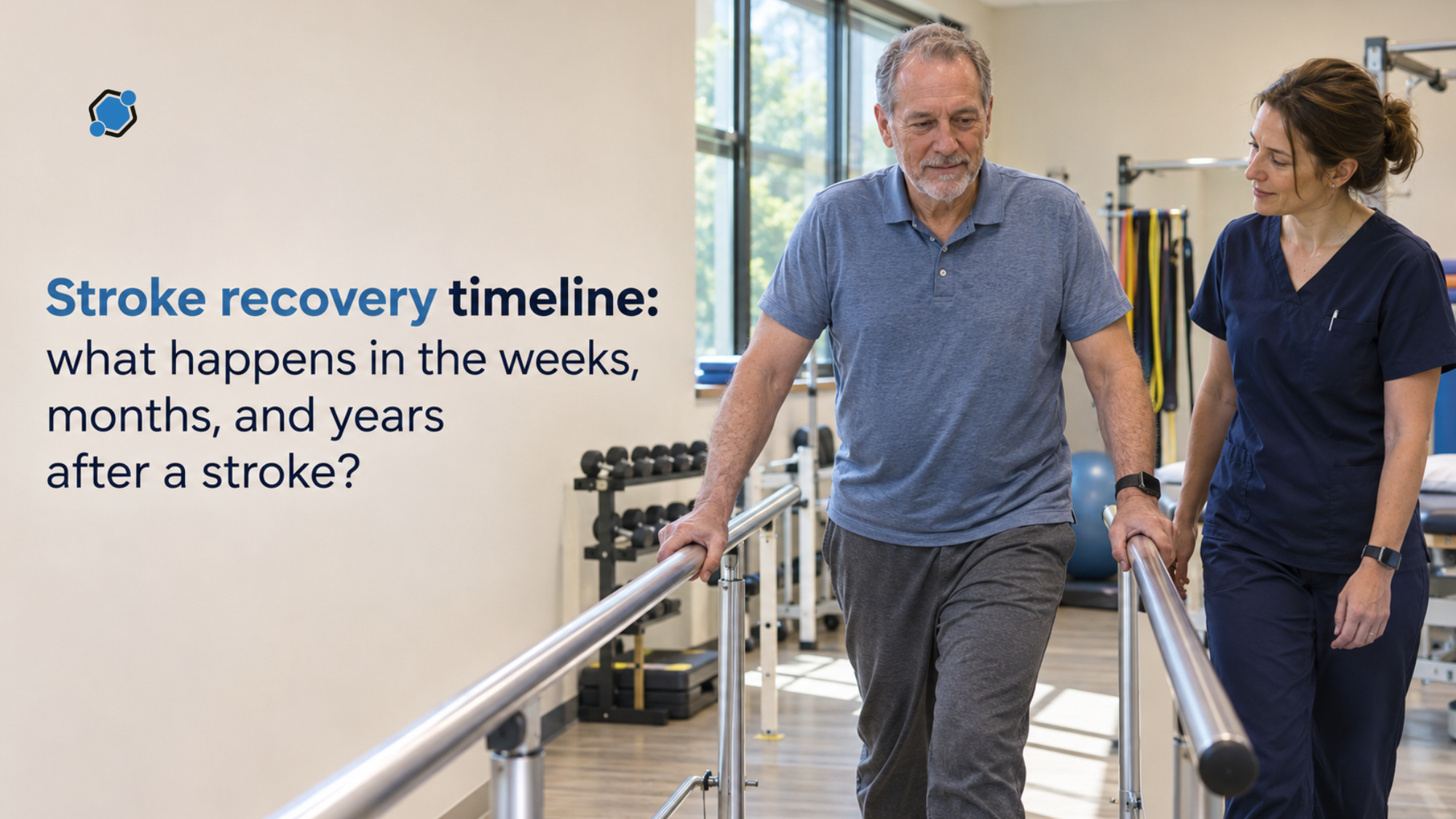
Many families hear that most stroke recovery happens in the first six months, and some take that to mean progress stops there. The research tells a more nuanced story. The stroke recovery timeline usually moves fastest in the first weeks and months, then slows, yet improvement can continue for a year or longer with ongoing practice. Every stroke is different, so the timeline describes a general pattern, not a promise for any one person.
The stroke recovery timeline at a glance
Stroke researchers divide recovery into five stages based on the time since the stroke. These stages help care teams plan therapy. They also help families understand why the focus of care keeps changing.
- First 24 hours (hyperacute stage): emergency care to restore blood flow or control bleeding.
- Days 1 to 7 (acute stage): hospital monitoring, finding the cause, and the first gentle rehabilitation.
- Week 1 to month 3 (early subacute stage): the period of fastest recovery and the most intensive therapy.
- Months 3 to 6 (late subacute stage): continued gains at a slower pace.
- Beyond 6 months (chronic stage): ongoing recovery, adaptation to daily life, and long-term prevention.
In the first hours, speed matters more than anything else. A stroke happens when a blood vessel in the brain is blocked by a clot or bursts and bleeds. Brain cells begin to die within minutes once they lose their blood supply. Emergency teams use a brain scan such as CT or MRI to see which kind of stroke it is, because the treatments differ. For a blocked vessel, a clot-dissolving medicine or a procedure that pulls the clot out through a thin tube may restore blood flow. Both work only within limited time windows.
During the first week, the hospital team watches for complications such as pneumonia, blood clots in the legs, and falls. Swallowing is checked before the person eats or drinks, because a weak swallow can let food or liquid slip into the lungs. Doctors also look for the cause of the stroke and start medicines to lower the chance of another one.
Rehabilitation usually begins in the hospital within a day or two, once the person is medically stable. Early movement helps, but more is not always better on the first day. In a large international study, very intensive out-of-bed activity in the first 24 hours led to slightly worse outcomes than usual care. Shorter, more frequent sessions appeared helpful.
What happens in the first three months after a stroke?
The weeks after the hospital stay are usually the busiest period of recovery. Two processes work together during this time. The first is spontaneous recovery: as swelling in the brain goes down, some stunned brain tissue starts working again. The second is neuroplasticity, the brain's ability to rewire itself so that healthy areas can learn to take over jobs from damaged ones.
Rehabilitation strengthens that rewiring through repeated practice, much like learning any new skill. Therapy is usually shared across three specialties:
- Physical therapy builds strength, balance, and walking.
- Occupational therapy focuses on everyday tasks such as dressing, bathing, cooking, and returning to work.
- Speech-language therapy addresses speaking, understanding, reading, writing, and swallowing.
Where therapy takes place depends on each person's needs and medical stability. An inpatient rehabilitation facility provides several hours of therapy on most days. A skilled nursing facility offers lower-intensity therapy alongside nursing care. Other people go home and continue with home health visits or outpatient sessions. Current U.S. guidance favors inpatient rehabilitation for people who qualify. It tends to bring more improvement in daily function by discharge.
Progress in this window can be quick. Older research found that most people reached their best walking ability within about three months. Arm recovery often peaked even sooner. Those studies are decades old and predate modern clot-removal treatment, so they describe a general pattern rather than a limit. The type of stroke matters too. Recovery after a bleeding stroke compared with a clot can follow a different pace, partly because the brain first has to clear the pooled blood and swelling.
Does stroke recovery stop after six months?
No. The idea that recovery ends at six months is one of the most persistent myths about stroke. Between three and six months, gains usually slow, and many people notice their progress flattening out. This is often called a plateau, but the term can be misleading.
A plateau in test scores does not always mean the brain has reached its limit. It can reflect less therapy once insurance coverage ends. It can also reflect untreated fatigue or depression, or rating scales that miss small changes. When therapy continues or changes approach, many people keep improving.
Research supports this longer view. In a large U.S. study of walking rehabilitation, some participants made meaningful gains as late as a year after their stroke. Language skills can continue to improve for many years. The 2026 U.S. guideline for adult stroke rehabilitation goes further. It describes recovery as a lifelong process with no fixed end point.
The chronic stage is also when long-term protection becomes a central part of care. Nearly one in four strokes happens to someone who has already had one. Ongoing management of risk factors therefore matters as much as therapy, especially blood pressure, which raises stroke risk in several ways.
How long does recovery take for movement, speech, swallowing, and mood?
Different abilities recover on different schedules, even within the same person. The patterns below are general.
Movement and walking
Weakness on one side of the body, called hemiparesis, is one of the most common effects of stroke. When that side is fully paralyzed, the term is hemiplegia. Walking often improves more completely than hand function, which tends to recover more slowly. Muscle stiffness called spasticity develops over weeks to months in roughly one in four survivors. Stretching, positioning, and medicines can help manage it.
Speech and language
Aphasia is difficulty speaking, understanding, reading, or writing caused by damage to the brain's language areas. It does not affect intelligence. About one in three stroke survivors has aphasia. Improvement is usually fastest in the first few months, but communication can keep improving for years with therapy, and research into aphasia continues to test new approaches.
Swallowing
Swallowing difficulty, called dysphagia, is very common in the first days after a stroke. Many people regain a safe swallow within weeks, while others need softer foods, thickened liquids, or longer-term therapy. Ongoing swallowing problems raise the risk of pneumonia, which is why swallowing is tested before the first meal.
Mood, thinking, and emotions
Emotional changes are among the most common and least discussed effects of stroke. About one in three survivors experiences depression at some point. Anxiety is also common and can persist for up to two years. Some people have sudden crying or laughing episodes that do not match how they feel, a condition called pseudobulbar affect. Problems with attention, memory, and planning can also occur.
Current guidance recommends repeated screening for depression and anxiety over time. These conditions are treatable, and when they go unrecognized, they can slow physical recovery.
What affects the pace of stroke recovery?
No two strokes follow the same path. The main factors that shape recovery include:
- Size and location of the brain injury. Larger strokes, and strokes in areas that control movement or language, usually take longer to recover from.
- Initial severity. Doctors often measure this with a bedside stroke scale scored from 0 to 42, where higher scores mean a more severe stroke.
- Speed of emergency treatment. Restoring blood flow sooner usually means less brain damage.
- Age and health before the stroke, including diabetes, heart disease, and earlier strokes.
- The timing, intensity, and setting of rehabilitation.
- Mood, fatigue, and sleep, which affect how fully a person can take part in therapy.
- Support at home and access to care, including transportation and insurance coverage.
Some researchers once described a “proportional recovery rule.” It suggested that many people regain a predictable share of lost movement in the first months. Later analyses showed the pattern was partly a statistical effect. It also did not apply to people with the most severe strokes. It describes groups, not what any individual should expect.
The risk of another stroke is highest early on. In one large analysis of people who had a minor stroke or mini-stroke, roughly six in ten of the strokes that occurred in the following year happened within the first three months. Knowing the warning signs of a new stroke, such as sudden face drooping, arm weakness, or trouble speaking, remains important at every stage of recovery.
Frequently asked questions about stroke recovery
Is fatigue normal after a stroke?
Fatigue is very common, affecting about half of stroke survivors, and it can last for months or years. It differs from ordinary tiredness and is often not relieved by rest. It is not a sign of laziness. It should be reported to the care team, because sleep problems, depression, and some medicines can contribute.
When can someone drive again after a stroke?
Common guidance is to wait at least one month after a stroke and then complete a formal driving evaluation. Vision, reaction time, attention, and physical control all need to be safe. Rules differ from state to state, so the treating doctor is the right person to advise on timing.
When can someone return to work after a stroke?
Return to work varies widely and depends on the type of job and the effects of the stroke. In several studies, fewer than half of working-age survivors were back at work a year later. Occupational therapy and vocational rehabilitation can help plan a gradual return, sometimes with adjusted hours or duties.
Can the brain heal after a stroke?
Brain cells that die during a stroke do not grow back. However, the brain can form new connections, and healthy areas can learn to take over some lost functions. This rewiring, called neuroplasticity, is what rehabilitation aims to strengthen through repeated practice.
What should happen if new stroke symptoms appear during recovery?
Anyone with new stroke symptoms should call 911 immediately, even if the symptoms are brief or go away. A new episode could be another stroke or a mini-stroke, and emergency treatment works best when it starts early.
Why recovery research continues long after the hospital stay
Because the stroke recovery timeline stretches over months and years, clinical research covers every stage. Studies of emergency treatments begin within hours of a stroke, usually in the hospital. Studies of rehabilitation often enroll people months or even years after their stroke. These include nerve stimulation paired with therapy, devices that read brain signals to move a hand brace, robotic training, and therapy by video at home. A few are approved for specific uses. Most remain under study, and none can promise a particular result.
DecenTrialz is a clinical trial recruitment and pre-screening platform that helps people find studies that may fit their situation. A person shares some health information, AI-assisted matching surfaces relevant studies, and a nurse-led pre-screening conversation reviews the details before a referral goes to the research site. DecenTrialz does not provide medical care or replace the treating team.
Final eligibility, informed consent, and enrollment are always handled by the research site team.
Stroke survivors and families interested in recovery research can explore studies through DecenTrialz at any stage of recovery. At every stage, one rule stays the same: anyone who shows new signs of stroke should call 911 immediately, even if the symptoms go away.
Was this article helpful?

Similar Blogs
Lumpectomy vs mastectomy: how is the right breast cancer surgery chosen?
Lumpectomy vs mastectomy is one of the first big decisions after an early-stage breast can...
 Mahesh Upadrista
Gastric bypass vs gastric sleeve: how do weight loss, risks, and recovery compare?
Gastric bypass and gastric sleeve are the two most common weight loss surgeries in the Uni...
 Anish Teepireddy
How does hypertension damage the heart? Signs of hypertensive heart disease
High blood pressure rarely causes symptoms, but over the years it can change the size, sha...
ParamrajStay Informed. Stay Connected.
Get updates on verified clinical trials, emerging treatments, and research breakthroughs directly in your inbox. No spam, just science that matters.
