 HIPAA Compliant
 ISO 27001 Certified
Master protocols and portfolio strategy: choosing between basket, umbrella, and platform designs

The default way to develop a drug used to be one trial per question. One asset, one indication, one protocol. That model still works, but it is slow and expensive when a sponsor has a compound library to triage, an asset that might work across several indications, or a disease with real molecular heterogeneity. Master protocols are the response. Instead of building and dismantling separate trial infrastructures over and over, a master protocol runs multiple coordinated substudies under one framework, sharing sites, systems, oversight, and often a single control arm.
Three design variants dominate: basket, umbrella, and platform. The strategic question is not which is best in the abstract. It is which fits a specific asset, indication landscape, and portfolio moment. This article covers what each design does, when it pays off, where the operational costs land, and what the current FDA framing looks like in 2026.
What a master protocol actually is
A master protocol is a single overarching trial framework built to answer more than one clinical question at the same time. Under that framework sit multiple substudies, each with its own objective. Substudies may test one drug against several diseases, several drugs against one disease, or an evolving mix of drugs that enter and exit over time.
The point is shared machinery. A master protocol typically uses a single protocol document, a common site network, a shared randomization and data-management system, one steering committee, one data monitoring committee, and often a central IRB submission pathway (IRB stands for Institutional Review Board, the ethics committee that reviews and approves the study). Many designs also share a control arm across substudies.
That structural choice changes the pace of decisions, the economics of screening, the shape of participant consent, and the governance a sponsor needs. It also changes how regulators evaluate the resulting evidence.
How basket, umbrella, and platform designs differ
The three designs answer different strategic questions.
A basket trial studies one investigational drug across multiple diseases that share a common biomarker or molecular target. A biomarker is a measurable biological indicator, often a gene mutation or a protein signature, that identifies a group of participants who share a specific characteristic. In a basket, patients with the same underlying molecular alteration are grouped across tumor types or disease categories, and one targeted drug is tested across all of them. The logic is that if a drug works because it hits a specific molecular target, participants who share that target may benefit regardless of where the disease originated. This design is most often used in early-phase oncology, where the goal is to identify which indications a drug is worth pursuing. For a sponsor-facing explainer of the design itself, see What Is a Basket Trial: The Clinical Trial Design That Tests One Drug Across Many Diseases.
An umbrella trial does the opposite. It studies multiple investigational drugs within a single disease, stratified by biomarker or molecular subtype. Participants with one disease are sorted into subgroups based on the molecular signature of their disease, and each subgroup is matched to the drug most rationally targeted to that subtype. Umbrellas tend to arrive later in development than baskets and often run several drug-biomarker pairings in parallel.
A platform trial is a standing, adaptive framework that evaluates multiple interventions against a common control and allows arms to enter and exit over time based on pre-specified decision rules. Platform trials have no fixed end date. New candidates can be added by amendment, weak arms are dropped when interim analyses signal futility, and the shared control arm persists across the life of the trial. Adaptive randomization and Bayesian statistical methods are common in this design. The model became widely visible during the pandemic response, when several large international platforms rapidly identified effective and ineffective interventions in months rather than years.
The categories are not mutually exclusive. A platform testing one drug across diseases behaves like a basket; a platform testing many drugs in one disease behaves like an umbrella. Real trials often combine features.
Where master protocols fit in portfolio strategy
A portfolio strategy is a set of decisions about how to allocate development capital across assets, indications, and time. Master protocols shape that allocation in four practical ways.
First, they replace sequential trials with parallel or continuous ones. Instead of testing a drug in one indication, waiting for readout, and then deciding whether to invest in a second, a basket lets a sponsor test multiple indications in parallel and read out signals in a single coordinated window. Time compresses.
Second, they concentrate resources on winning arms. Interim futility rules in platform designs allow underperforming arms to be dropped early, freeing enrollment capacity and capital for arms that are working. A fast, clean negative signal is the trial doing its job.
Third, they reduce per-comparison cost through shared infrastructure. One protocol, one site network, one central lab, one data system, and one oversight committee cost less in aggregate than the sum of separate independent trials. The shared control arm compounds the effect: fewer participants are randomized to control across the portfolio, and each active arm receives more participants for the same total enrollment.
Fourth, they raise the yield of every screened participant. In a master protocol with multiple substudies, one screening event, especially a biomarker panel, can route a participant to whichever substudy they qualify for. Screen failures carry real economic weight, and turning the screening funnel into a portfolio asset rather than a per-trial expense materially changes the arithmetic. Deeper background is in The Hidden Cost of Screen Failures in Clinical Trials.
None of this is free. The overhead moves upstream into design, statistics, governance, and IT. But when the underlying biology supports it, the arithmetic favors the master protocol.
When each design pays off for a sponsor
The three designs suit different situations, and the decision often comes down to what a sponsor already knows about the asset and the indication.
A basket design pays off when a sponsor has one asset with plausible activity across several diseases that share a molecular target, and the strategic question is which indications are worth pursuing. It is a signal-finding tool that works best when the biomarker hypothesis is sound. Shared biology does not guarantee shared response, so basket results should be read as an indication-selection filter, not a promise of uniform benefit.
An umbrella design pays off when a single disease has known molecular heterogeneity, the sponsor or a consortium has multiple candidate drugs, and a centralized screening platform can efficiently classify participants into subtypes. Umbrellas also improve screening yield when any individual biomarker is rare, because participants who miss one substudy may match another. Companion background on this design pattern is in What Is an Umbrella Trial: How Researchers Test Different Drugs for the Same Disease in Parallel.
A platform design pays off when a therapeutic area is evolving quickly, multiple sponsors or a consortium can share infrastructure and cost, adaptive decision-making genuinely adds value, and a shared control can be sustained for years. This is a heavy commitment, usually requiring either a large single sponsor with deep pipeline exposure to the disease or a public-private partnership.
Several situations argue against a master protocol entirely. A single-indication mature asset heading into a confirmatory trial does not gain enough from the shared infrastructure to justify the design overhead. An ultra-rare disease with a small patient pool may not sustain multiple arms and a shared control. Early exploratory work with an unvalidated biomarker hypothesis is risky because the whole efficiency case depends on the predictive assumption being correct. And any master protocol requires statistical, governance, and IT capacity that must exist or be built before launch.
What FDA's current thinking looks like
FDA has been signaling growing support for master protocols for nearly a decade, moving from an oncology-specific frame to a cross-therapeutic-area one. The 2022 final guidance on master protocols in oncology, jointly issued by CDER, CBER, and the Oncology Center of Excellence, laid out expectations for design, control choice, and statistical methods. A broader draft guidance in December 2023 extended those recommendations beyond oncology.
In June 2026, FDA issued a revised draft guidance that replaces the 2023 draft and adds a new section specifically on evaluating drug effects across multiple diseases or disease subtypes in basket trials. That revision responded to comments requesting more detail on basket-specific design questions and to statutory direction under the Food and Drug Omnibus Reform Act of 2022. The revised draft is open for public comment through August 2026, so specifics may still shift before finalization.
Several themes run through the current position. Comparative analyses should generally rest on a common control rather than on cross-arm comparisons between experimental drugs. Randomization ratios may need to shift as arms enter and exit. Statistical methods sit on a continuum depending on how much data are borrowed across substudies, and any borrowing needs prospective justification. Informed consent should ideally occur before randomization and cover all potential arms. A central IRB is recommended.
Master protocols now sit alongside other expedited pathways that shape sponsor strategy, including regulatory designations such as Breakthrough Therapy Designation, and the two often intersect in the same development program.
Where pre-screening determines the efficiency case
The efficiency argument for master protocols only holds if the screening funnel works. Biomarker-defined populations are, by definition, narrow. In large biomarker-screening initiatives, the majority of screened participants often do not carry the specific alteration required for a given substudy, and a smaller fraction still proceeds to arm assignment. Sub-study-level screen failures are expensive in time, in site coordinator hours, and in participant goodwill.
Three operational realities follow. Pre-screening has to be accurate upstream of the site, not just at the site. Screening infrastructure has to be modeled as portfolio infrastructure, budgeted centrally rather than absorbed by each substudy. And matching logic has to handle multi-criteria eligibility, since a single screening event may need to route participants across several potential arms based on clinical, laboratory, and biomarker inputs simultaneously.
Two mechanisms address these realities directly. AI-assisted matching can read structured and unstructured electronic health record data against complex multi-arm eligibility criteria at scale. Registered nurse pre-screening then adds clinically informed triage that reduces the volume of poorly matched referrals reaching site coordinators, protecting site capacity for participants who are likely to enroll. A structured view of what those funnel dynamics look like in practice is in Pre-Screening Funnel Metrics: From Clinical Trial Participant to Enrollment.
The design choice determines the strategy. The pre-screening choice determines whether the strategy actually delivers.
How DecenTrialz supports master protocol recruitment
DecenTrialz is a US-based clinical trial participant recruitment platform built around AI-assisted matching and registered nurse pre-screening. For master protocols, the platform layer sits upstream of the research site, routing potential participants through structured pre-screening that checks clinical criteria against multiple concurrent substudies before a referral reaches a site coordinator.
The registered nurse pre-screens only. Final eligibility determination, informed consent, study walk-through, and enrollment are handled by the authorized research site team. That boundary is deliberate and matters more, not less, in master protocols, where consent complexity is higher and site staff time is a scarce resource. By raising the referral-to-consent ratio and reducing the volume of poorly matched participants who reach the site, structured upstream pre-screening protects the operational case that justified the master protocol. Sponsors evaluating DecenTrialz as a recruitment layer typically look at how the platform models the screening funnel, how AI matching handles multi-arm criteria, and how RN pre-screening is documented for regulatory audit.
Explore master protocols with DecenTrialz
Master protocols reshape how a sponsor invests, decides, and reports across a portfolio. They also reshape recruitment. If the design choice is the strategy, pre-screening is the execution layer that makes the strategy real. Talk to the DecenTrialz team about how AI-assisted matching and registered nurse pre-screening can support a basket, umbrella, or platform program, from screening infrastructure design through funnel reporting.
Was this article helpful?

Similar Blogs
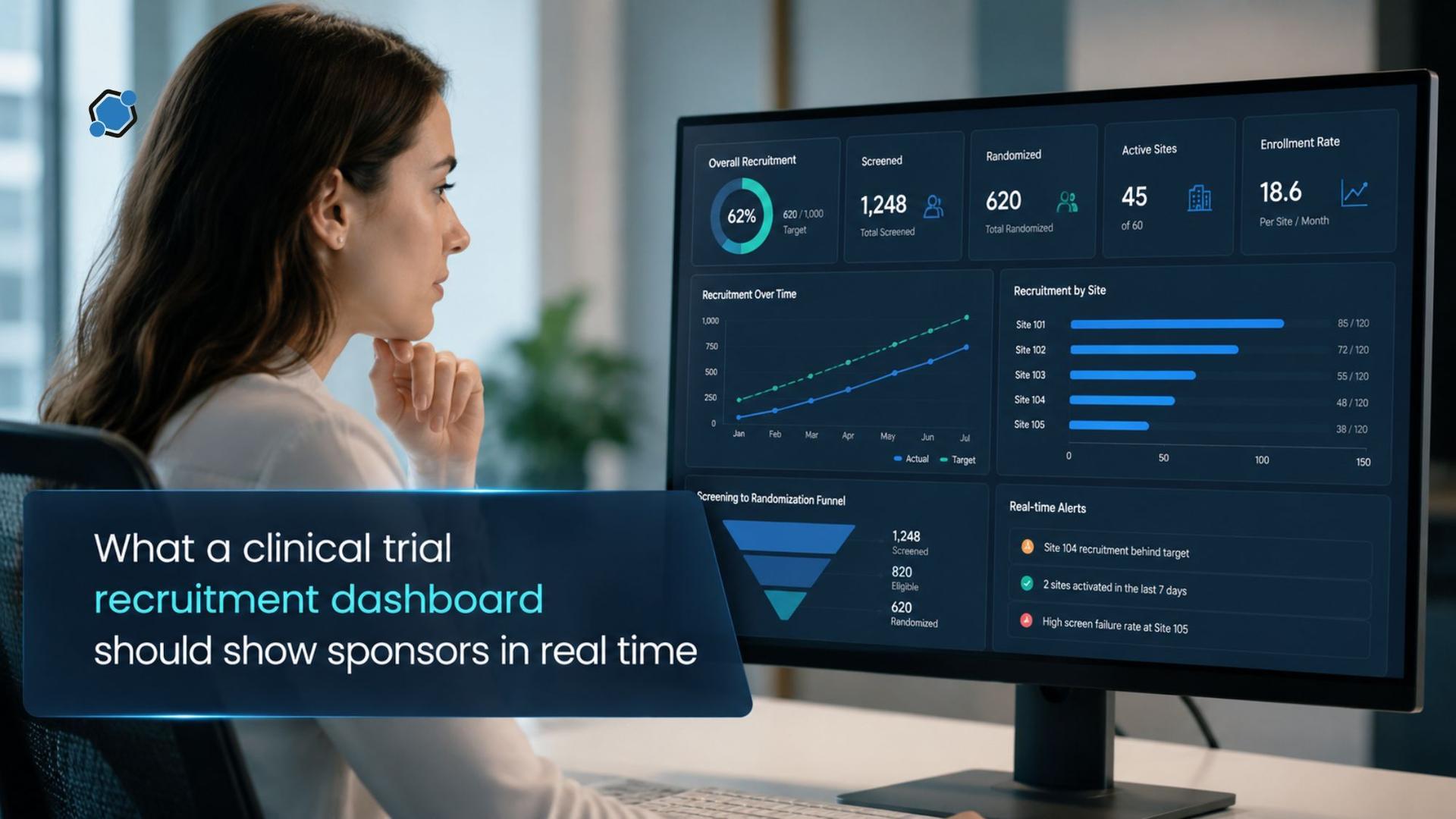
What a clinical trial recruitment dashboard should show sponsors in real time
Adding a site in month three of a twelve-month enrollment period is a routine operational ...
 Vamshi Kantoju
Choosing the right patient recruitment partner for your clinical trial
Few decisions shape a clinical trial as directly as the choice of a patient recruitment pa...
Vamshi Kantoju
How sponsors build a diverse enrollment pipeline without slowing the study
Diverse enrollment and fast enrollment tend to get talked about as if they were pulling ag...
Vamshi KantojuStay Informed. Stay Connected.
Get updates on verified clinical trials, emerging treatments, and research breakthroughs directly in your inbox. No spam, just science that matters.
