 HIPAA Compliant
 ISO 27001 Certified
What Is a Basket Trial? The Clinical Trial Design That Tests One Drug Across Many Diseases
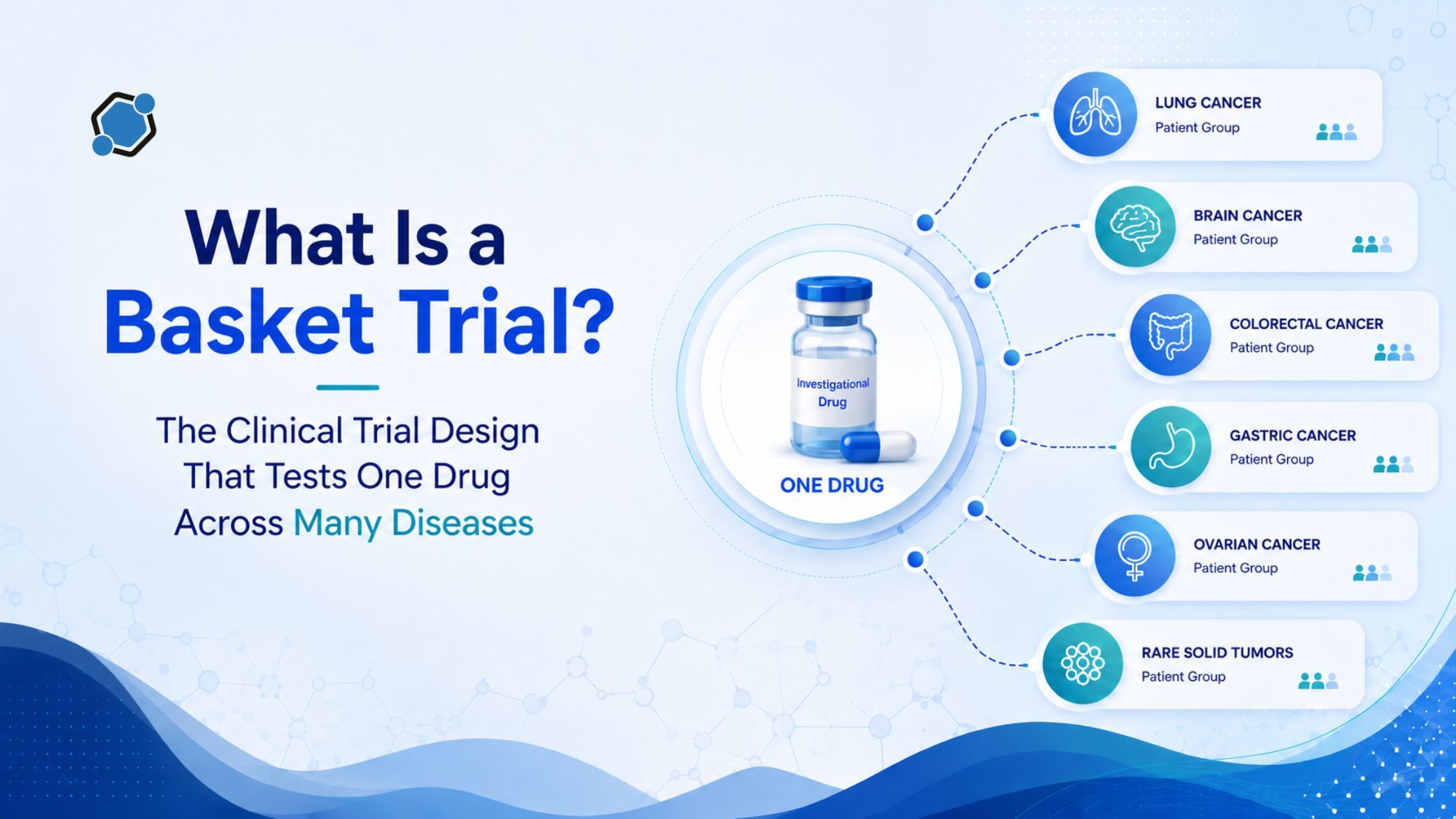
Most clinical trials study one disease at a time. One drug. One condition. One group of patients. A basket trial does something different. It tests the same drug in people with several different diseases at the same time. The only requirement is that all of those diseases share a common biological feature, such as a specific genetic change or molecular marker. This shift in how trials are designed has changed how new medicines move from research labs to real patients.
Basket trials started in cancer research. They have already led to several first-of-their-kind drug approvals. Researchers are now exploring whether the same idea can help in rare diseases, where finding enough patients for traditional trials is a constant problem.
What Is a Basket Trial?
A basket trial is a clinical trial that tests one drug across several different diseases. Everyone in the trial has something in common: a specific genetic change, biomarker, or molecular feature that the drug is built to act on. The diseases may look very different on the surface, but they share the same underlying target inside the body.
The name comes from how the trial is organized. Patients with each disease are placed in their own "basket" inside the same study. Every basket receives the same drug. Researchers then watch how each basket responds. The goal is to see whether the shared biological target, and not the disease name, is what decides if the drug works.
This is a real change from how trials have usually been run. For decades, clinical research has been grouped by the part of the body a disease affects. Lung trials studied lung disease. Colon trials studied colon disease. A basket trial assumes that the biology driving the disease matters more than where the disease shows up in the body. For readers new to how clinical trials work in general, Clinical Trials Explained: Simple Guide for Beginners is a useful starting point.
How Basket Trials Are Designed
A basket trial starts with one specific biological target. This is usually a gene mutation or molecular marker that researchers believe drives certain diseases. The drug being tested is built to act on that exact target.
Before joining, people are tested to see whether they have that biological feature. This means Eligibility Explained: Why Not Everyone Qualifies for a Trial in a basket trial is based less on which disease someone has and more on whether their disease carries the right target. Two people with very different diagnoses can join the same trial if their conditions share the same genetic change.
Once enrolled, each person is placed in a basket based on the disease they have. Each basket holds patients with one condition. All baskets receive the same drug. Researchers then measure how each group responds.
Most basket trials are run in Phase II. This is the stage of drug research focused on whether a treatment really works in patients. Many basket trials are single-arm studies, which means everyone receives the experimental drug and there is no separate comparison group. Many are also open-label, which means both the patient and the research team know which drug is being given. These design choices help researchers learn quickly. They also bring some limits, which come up later in this article.
Why Basket Trials Matter
Basket trials solve a problem that traditional trials struggle with. A drug that targets one biological feature may help patients across many different diseases. But testing it in each disease one at a time is slow and expensive. By studying several diseases together, a basket trial can produce results in roughly the time and cost of a single trial.
The clearest example of this comes from cancer. The U.S. Food and Drug Administration has now approved several cancer drugs based on a genetic feature rather than where the tumor sits in the body. Larotrectinib, approved in 2018, was the first. It treats cancers that carry a genetic change called an NTRK gene fusion, no matter where the cancer is found. Entrectinib followed in 2019 for the same marker. Pembrolizumab was approved in 2020 for cancers that carry a high number of genetic mutations, a measure known as tumor mutational burden. Dostarlimab was approved in 2021 for cancers with a specific DNA-repair problem called mismatch-repair deficiency. In each case, the approval covered many types of cancer, as long as the tumor carried the right biological signature.
These approvals reflect a bigger shift in how modern medicine thinks about disease. Treatments are being designed around the biology of a condition, not the organ where it appears. The same idea now shapes other areas of research, including the work covered in Gene Editing Has Reached Real Patients. Here's What CRISPR Clinical Trials Look Like Now.
Basket Trials vs. Umbrella Trials
Basket trials belong to a larger family of modern trial designs called master protocols. These designs let researchers study several things inside a single trial framework. The most common partner to a basket trial is an umbrella trial.
The difference between them is simple. A basket trial tests one drug across many diseases that share a common biological feature. An umbrella trial does the opposite. It tests many drugs against a single disease, with patients placed in different treatment groups based on the specific biology of their condition. Lung-MAP, a long-running study in lung cancer, is a well-known example of an umbrella trial.
Both designs come from the same idea: biology can help match the right patient to the right drug better than diagnosis based on body part alone. Readers interested in how other trial designs are changing may find What Is the Difference Between Pragmatic and Explanatory Clinical Trials? useful, as it covers a similar set of comparisons in modern clinical research.
The Limits and Future of Basket Trials
Basket trials are not without challenges. The biggest one is statistical. Each basket may include only a small number of patients. This makes it hard to draw firm conclusions about how well the drug works in any one disease. A few patients improving on a drug could mean the drug really works, or it could be chance.
Response rates can also vary widely between baskets. A drug may work strongly in one cancer type and barely at all in another, even when both share the same target. This raises a hard question. Did the drug really work because of the shared biology, or did other factors specific to that disease type play a role? Researchers continue to develop new statistical methods to handle this, including approaches that share data across baskets in carefully controlled ways.
The future of basket trials is moving beyond cancer. Researchers are looking at how the design could help in rare diseases, where the same problem of small patient numbers gets in the way of traditional studies. The idea is similar. Group several rare diseases that share the same biological cause, and test a treatment across all of them in one trial. The barriers are real. Many rare diseases do not yet have shared biomarkers across conditions, and regulators are still figuring out how to evaluate multi-disease trials outside cancer research. The potential, though, is significant, especially for conditions that have long lacked the funding and patient numbers needed for traditional research. Some of the policy support behind this work, including incentives for treating rare conditions, goes back to the law explored in The 1983 Law That Changed Rare Disease Research, and What It Means for Patients Today.
In the end, basket trials show how clinical research is adapting to a more precise understanding of disease. The next generation of medicines will increasingly target specific biological features that appear across many conditions. Trial designs have to evolve to match. And finding the right patients for those trials, people who carry the exact genetic or biomarker features a study is built around, is a different kind of challenge than traditional recruitment.
DecenTrialz is a U.S.-based platform that uses AI-assisted matching and nurse-led pre-screening to help connect participants with clinical studies they may be eligible for. Final eligibility, informed consent, and enrollment decisions are always made by the study team at the research site.
Was this article helpful?

Similar Blogs
International Week of Deaf People 2026: how can clinical research become accessible to Deaf participants?
More than seventy million people around the world belong to signing Deaf communities, and ...
 Deeksha Gitta
Visceral Fat Health Risks: What Makes Belly Fat Different From Other Body Fat?
Body fat is usually discussed as a single quantity, weighed on a scale and summarized in o...
 Anish Teepireddy
Blood Pressure Numbers: What Do Systolic and Diastolic Actually Mean?
A blood pressure result contains two numbers, and most people are never told what either o...
ParamrajStay Informed. Stay Connected.
Get updates on verified clinical trials, emerging treatments, and research breakthroughs directly in your inbox. No spam, just science that matters.
