 HIPAA Compliant
 ISO 27001 Certified
Men’s Health Month 2026: Partners in Care and clinical trial participation
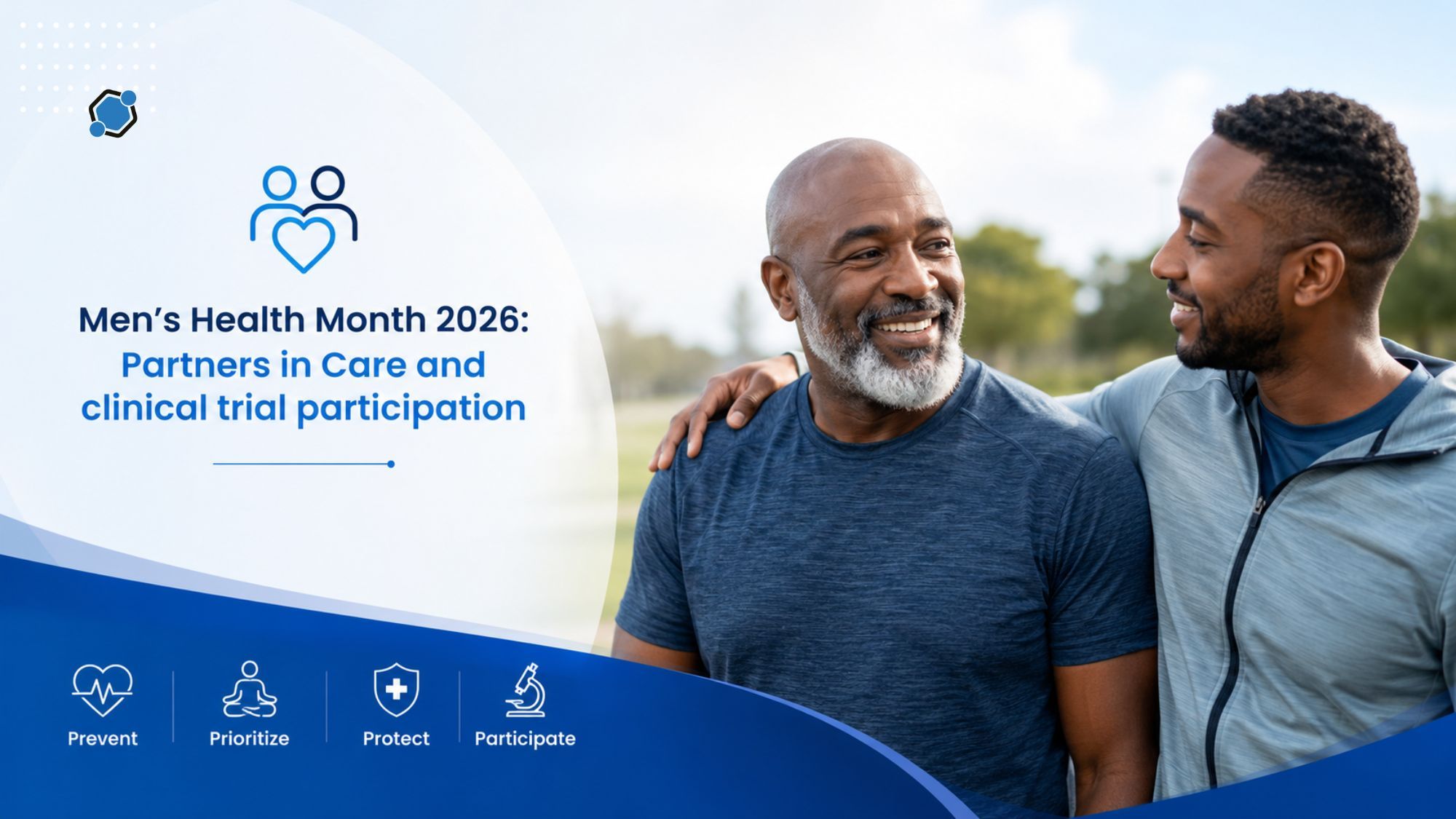
Every June, the United States observes Men’s Health Month, a nationwide campaign coordinated by Men’s Health Network to focus attention on the physical and mental health of men and boys. The 2026 theme, “Partners in Care: For Better Lifespans Across the Lifespan,” highlights something many awareness campaigns leave at the edges: the people standing next to a man as he makes health decisions. Spouses, parents, adult children, friends, primary care physicians, and research study teams all influence whether a man catches a symptom early, fills a prescription, follows through on a screening, or considers joining a clinical trial.
That framing has direct implications for clinical research. Men engage with the healthcare system differently than women, often less frequently and later in the progression of a condition, and that pattern carries through to research participation. Men’s Health Month 2026 is a useful moment to look at where men fit in clinical research today, why that matters for everyone, and how the partners-in-care framing can help close gaps that still affect men’s health outcomes.
What Men’s Health Month is and why “Partners in Care” matters in 2026
Men’s Health Month has been observed each June since the early 1990s, when Congress passed a resolution establishing National Men’s Health Week. Men’s Health Network has run the broader month-long campaign every year since, focusing on early detection of cancers, cardiovascular disease, mental health, and the routine screenings that often catch serious conditions before symptoms appear. Men’s Health Week 2026 falls on June 14 through 21, the week ending on Father’s Day.
The 2026 theme, “Partners in Care: For Better Lifespans Across the Lifespan,” builds on a body of evidence that men’s health outcomes improve when other people are involved. A man whose partner reminds him about a colonoscopy, a son whose father pushes him to talk to a counselor, a patient whose primary care physician keeps the conversation going about prostate screening: these are the relationships the campaign is naming this year.
The theme is also a useful lens for clinical research. Joining a study is almost never a solo decision, and it should not be treated as one. A parallel observance during Women’s Health Month covers why clinical trials need more women, and many of the structural patterns it identifies, including how recruitment depends on the existing healthcare relationships a population already has, apply just as directly to men.
Why men engage less with healthcare, including clinical research
The most cited statistics on men’s health point in one direction. The Centers for Disease Control and Prevention reports that men are less likely than women to schedule routine medical appointments, follow recommended screenings, maintain consistent sleep and exercise habits, or reach out for emotional support when they need it. Those gaps add up over a lifetime.
Mental health shows the pattern most starkly. The National Alliance on Mental Illness reports that men die by suicide at roughly four times the rate of women, and that approximately one in five men experiences a mental health condition in any given year. Despite similar or higher rates of depression, anxiety, and trauma compared to women, men are significantly less likely to seek professional help. NAMI and Men’s Health Network both attribute much of this to long-standing cultural pressure to “tough it out” or treat asking for support as weakness.
These patterns ripple into clinical research. Many clinical trials recruit participants through primary care physicians, specialists, and ongoing patient relationships. A man who has not seen a doctor in three years is invisible to most of those recruitment pathways, even when his condition would make him an ideal candidate for a study. This is part of how clinical trials contribute to public health as much as to individual outcomes: the populations that show up in trials shape the evidence base for everyone.
For research sites and recruitment teams, this is not a problem that can be solved at the eligibility-criteria stage. By the time a man is asked whether he meets a study’s inclusion criteria, the harder question, whether he is even in the room to be asked, has already been answered. Partners in care help bridge that gap.
Where clinical research is advancing men’s health right now
The men’s-health research landscape is wider than most people realize. Cardiovascular disease, which remains the leading cause of death for men in the United States, has roughly 2,360 recruiting clinical trials currently active in the country alone. The intervention mix runs from new medications and devices to behavioral and digital health approaches.
Prostate cancer research is similarly active. As of mid-2026, roughly 1,200 clinical trials studying prostate cancer are recruiting globally, with approximately 590 of those in the United States. These cover early detection, less invasive approaches, and follow-up monitoring for men who have completed initial care. Testicular cancer, while far less common, has roughly 66 active recruiting trials worldwide, many focused on more tolerable approaches to a disease that often affects men in their 20s and 30s.
Other condition areas commonly grouped under men’s health are smaller but still active. Benign prostatic hyperplasia, often shortened to BPH and one of the most common reasons men over 50 see a urologist, currently has roughly 23 recruiting trials in the United States. Hypogonadism, the medical term for low testosterone, has approximately 41 recruiting trials globally. Men’s mental health clinical trials are also expanding, with NAMI and other advocacy organizations pushing for both more enrollment of men in depression and anxiety studies and more research designed around how men present mental health symptoms differently than women.
Trial counts shift week to week as studies close and new ones open. The directional picture, though, is stable: men’s-health research is broad, ongoing, and looking for participants across most of the conditions that affect men over a lifetime.
Common concerns men have about joining a clinical trial
Three concerns surface repeatedly in conversations with men who are considering trial participation. Addressing them directly tends to be more useful than a general reassurance.
The first is the worry that joining a trial means giving up the care a man is already receiving. In most adult-disease trials, especially in cardiovascular disease, prostate cancer, and mental health, participants continue to receive standard of care (the current accepted approach to managing a condition) while the study adds or compares something new. Stopping a current medication is occasionally part of a study’s design, but it is described clearly in the consent process before a participant signs anything, and a participant always retains the right to withdraw.
The second is the concern that being assigned to a placebo means receiving nothing. In studies of active disease for serious conditions, placebo-only designs are uncommon for ethical reasons. Many trials use placebo on top of standard of care, meaning every participant continues to receive accepted care for their condition and the study compares standard of care plus the investigational product (a medication still being studied) against standard of care alone. The specifics are spelled out in the protocol (the document that defines how a study is run), and the research team explains them before consent.
The third concern aligns directly with the 2026 theme. Many men assume that joining a trial means navigating an unfamiliar process on their own, on top of managing a condition. In practice, the partners-in-care framing is built into how research operates. Study teams include nurses, coordinators, and the principal investigator (the licensed physician responsible for the study at a given site), and participants are encouraged to bring a partner, family member, or trusted friend to consent conversations and visits. Asking questions, asking for written materials, and asking for time to think are expected, not penalized. A prepared list of questions to ask before joining a clinical study can make the first conversation easier.
How DecenTrialz connects men to relevant clinical trials
DecenTrialz is a clinical trial matching platform built around the question of how to bring a wider set of people into research, including the men who are not currently in regular contact with the healthcare system.
You share basic information about yourself and the conditions you are interested in, get matched with clinical trials that may fit your situation, and a nurse pre-screens you before you are referred to the research team running a study. The research team makes all final eligibility and enrollment decisions, since they are the ones responsible for the participant’s care during the trial, and they are the ones who walk you through the specifics of the study before you sign anything. You can start a search at decentrialz.com.
The platform was built with the partners-in-care framing in mind. Family members, partners, or caregivers can help a man complete a profile, can sit in on the nurse pre-screening call, and can attend the first visit at the research site. The model recognizes that the decision to participate in a clinical trial is usually a shared one, and the workflow does not assume otherwise. A walk-through of how to search, read, and apply for clinical trials on the platform explains the steps in more detail.
Next steps
Men’s Health Month 2026 is, in the end, an invitation. The campaign asks men to do the things they have been told to do for years (schedule a screening, talk to a doctor, take mental health seriously) and asks the people around them to make those things easier. Clinical research fits naturally into that ask. A study that enrolls a more representative mix of men produces evidence that applies more broadly, and the men who participate often gain access to careful monitoring and emerging approaches they would not otherwise see.
For anyone considering trial participation this month, the starting point is straightforward: bring a partner into the conversation, ask the questions that come to mind, and explore what may be a good fit at decentrialz.com.
Was this article helpful?

Similar Blogs

Signs of Breast Cancer Other Than a Lump: What Adults Should Watch For
Most public awareness campaigns focus on finding a lump. That message has saved lives, but...
 Vamshi Kantoju
Health Unit Coordinator Day: the behind-the-scenes team that helps clinical trials run
Every August 23, the United States recognizes Health Unit Coordinator Day. The date honors...
Paramraj
Home nursing visits in clinical trials: what participants can expect
Clinical trial visits are starting to look different. In a growing number of studies today...
Vamshi KantojuStay Informed. Stay Connected.
Get updates on verified clinical trials, emerging treatments, and research breakthroughs directly in your inbox. No spam, just science that matters.
