 HIPAA Compliant
 ISO 27001 Certified
Risk-based quality management under ICH E6(R3): what sponsors need to understand
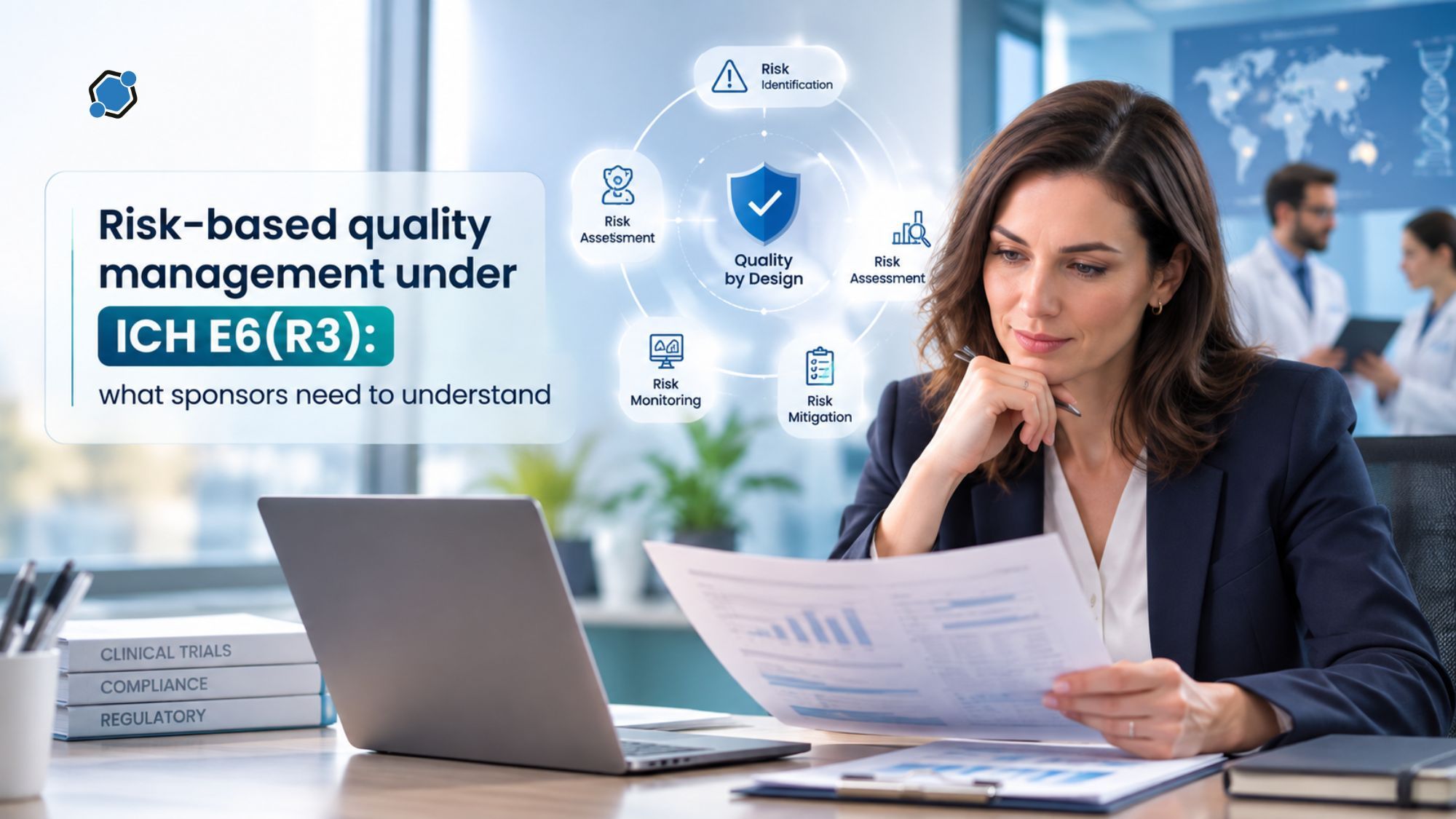
Clinical trial quality used to sit in a section. Under ICH E6(R3), it sits in the spine. The revised Good Clinical Practice guideline finalized by the International Council for Harmonisation in early 2025 does not treat risk-based thinking as a specialty topic tucked behind monitoring. It treats risk-based thinking as the operating logic of the entire trial, visible in the opening principles and threaded through every subsequent section.
For sponsors, that reframe changes the conversation. The question is no longer whether to adopt a risk-based approach. The question is how risk-based quality management, or RBQM, is documented, defended, and lived out across the trial lifecycle. And the vehicle for doing that documenting is a quality management plan, sometimes called a QMP, which is now expected to travel with the study rather than sit on a shelf.
This piece walks through what has actually changed, what RBQM means in plain language, what a quality management plan does, and where recruitment and pre-screening quality fit into the picture.
Where ICH E6(R3) stands right now
ICH E6(R3) reached Step 4, the final endorsement step in the ICH process, in January 2025. The revised guideline consists of an overarching Principles document plus Annex 1, which covers traditional interventional trials, with a second annex for non-traditional designs that reached Step 4 in mid-2026.
Adoption timing varies by region. In the European Union, ICH E6(R3) became effective in July 2025, and the same effective date applies in the United Kingdom and Switzerland. The U.S. Food and Drug Administration published the final guidance in September 2025. FDA guidance is nonbinding by design, meaning it represents current thinking and recommendations rather than legally enforceable requirements, and the agency has not set a formal U.S. compliance date. Sponsors running trials in the U.S. are therefore working from a guidance document that carries strong regulatory weight but no fixed deadline.
Annex 2, which addresses decentralized trials, pragmatic designs, and real-world data considerations, was finalized at the ICH level in June 2026 with an EU effective date in January 2027. Regional adoption in the U.S. remains in progress. For trials that touch decentralized elements, the safer position for now is to treat Annex 2 as an emerging reference point rather than a settled rulebook. Site teams working through their own readiness questions may find the plain-English ICH E6(R3) readiness guide for research sites useful as a parallel view.
Does ICH E6(R3) apply to trials running in the United States today?
The guidance is available and reflects FDA’s current expectations for Good Clinical Practice, but it is not a legally enforceable rule. For trials in Europe and the U.K., it is already the operative standard. Sponsors running multi-region trials generally align to the higher bar, which in practice means treating ICH E6(R3) as the working baseline regardless of geography.
What risk-based quality management actually means
Risk-based quality management is a documented, ongoing process for identifying what could go wrong in a trial, deciding which of those things would actually matter, putting proportionate controls in place, and adjusting as the trial unfolds. It is not a technique. It is the way the guideline expects sponsors to run quality across the whole study.
The cycle ICH E6(R3) sets out has six moving parts. Risks are identified before the trial starts and revisited throughout. Each risk is evaluated for how likely it is to occur, how detectable it would be, and how much it would affect participant protection and the reliability of results. Controls are then applied in proportion to the risk, which may mean adjustments to protocol design, monitoring, agreements with third parties, or training. Risks and controls are communicated to the people who need to act on them. The whole system is reviewed periodically to check whether the controls are still working. And important quality issues, along with the actions taken to address them, are reported in the clinical study report.
The critical shift compared with older practice is where this work begins. Traditional quality assurance often concentrated on catching errors after the fact, through 100 percent source data verification and heavy on-site monitoring visits. RBQM starts at protocol design. By the time a monitor arrives at a site, the sponsor should already know which risks are being watched, why they matter, and what the plan is if something drifts. A related view of how these expectations translate for contract research organizations is captured in ICH E6(R3) and what changes for CRO quality management at scale.
Critical-to-quality factors and why they anchor the approach
A useful working definition of quality in clinical research is the absence of errors that matter. Critical-to-quality factors, sometimes shortened to CtQ factors, are the attributes of a trial that meet that "matter" test. They are the things whose integrity is fundamental to protecting participants, to producing reliable results, and to supporting the decisions that will be made from those results.
ICH E6(R3) formally elevates critical-to-quality thinking through its sixth principle, which asks sponsors to identify these factors prospectively and design the trial around protecting them. This language aligns with ICH E8(R1), the general considerations guideline that popularized quality-by-design thinking for clinical studies. The two guidelines are meant to speak the same vocabulary.
What tends to qualify as critical varies by trial. In a vaccine study, specimen handling and cold-chain integrity are usually near the top. In an oncology imaging study, consistency in how images are captured and read matters more than in a study without imaging endpoints. In a trial using electronic clinical outcome assessments, the audit trail behind those entries becomes central. The point is not that there is a universal list. The point is that sponsors identify the short list that applies to their specific trial and build the quality system around protecting those things. This diagnostic mindset also shapes how sponsors think about downstream issues, as covered in how sponsors find the real cause of slow clinical trial enrollment.
What a quality management plan is and why it lives with the trial
A quality management plan is the document that captures how RBQM will actually be run for a specific study. It is sponsor-owned, and it is where the risk work becomes visible and auditable.
There is no mandated template. Plans in current practice tend to include a risk register listing the critical-to-quality factors and the risks associated with them, the controls chosen for each risk, the prespecified acceptable ranges that will trigger action if breached, the connections to the monitoring plan and to any centralized statistical monitoring approach, the escalation paths for when something crosses a threshold, and the roles and responsibilities of everyone involved, including any activities delegated to third parties.
The plan is expected to be a living document. Enrollment shifts, protocol amendments, emerging safety signals, and periodic risk reviews all trigger updates. A plan written at study start and never revisited is not aligned with the guideline. Sponsors who treat the quality management plan as a static artifact tend to run into inspection findings not because the plan itself was wrong, but because the plan and the trial stopped resembling each other. Sites navigating the same document-as-living-artifact expectation can look at the discussion of continuous inspection readiness and eTMF audit-proofing for a complementary view.
Delegation deserves a note here. A sponsor may transfer trial-related duties to a contract research organization or other service provider, but ultimate responsibility for participant safety and data reliability stays with the sponsor. ICH E6(R3) reinforces this and expands the language to cover all service providers, not only contract research organizations. Inspectors do not accept "the vendor handled it" as an answer. What they look for is the sponsor’s oversight trail.
Prespecified acceptable ranges: the terminology shift most readers miss
One of the quieter changes in ICH E6(R3) sits in the language around thresholds. The concept most readers know as quality tolerance limits, or QTLs, is still there, but the guideline now leads with the phrase prespecified acceptable ranges and mentions quality tolerance limits parenthetically as one example of what such a range can be called. The concept is retained. The primary wording changed.
Prespecified acceptable ranges are trial-level thresholds tied to critical-to-quality factors. When accumulating data crosses one, that crossing triggers a documented evaluation to determine whether a systemic issue is at play and whether action is warranted. They are pre-agreed, which means the response to a breach is not left to individual judgment in the moment. They are trial-level, which distinguishes them from key risk indicators. Key risk indicators, or KRIs, operate at the site or process level and support signal detection across the study. The mechanics of aggregating and analyzing these signals across sites are explored in centralized statistical monitoring in clinical trials: what CROs need to build.
Excursions beyond acceptable ranges, along with the actions taken in response, are summarized in the clinical study report per ICH E3. This closes the loop between what was planned, what happened, and how it was handled.
Three things risk-based quality management is not
RBQM is not less monitoring. It is targeted monitoring. The intent was never to reduce vigilance. The intent was to align monitoring effort with where the risks actually are, rather than treating every data point in every trial the same way. A trial running under RBQM often carries more analytical scrutiny than one running under traditional monitoring, just concentrated differently.
The quality management plan is not a one-time document. If the plan looks the same at database lock as it did at study start, something has probably gone wrong in the middle. Regulators expect to see updates that reflect what the trial actually encountered. Sponsors who want to see the operational visibility side of this in a different context can look at what a clinical trial recruitment dashboard should show sponsors in real time.
And risk-based does not mean risk-eliminated. The goal of RBQM is proportionate control of the risks that matter, not the elimination of every possible problem. A trial that spends resources trying to prevent every conceivable failure will underinvest in the failures that would actually damage participant safety or result reliability.
Where recruitment and pre-screening quality feed the system
Screen failure rate is often discussed as a recruitment statistic, but under an RBQM lens it functions as a quality signal. A persistently high screen failure rate usually indicates that inclusion and exclusion criteria are mis-calibrated against the real-world patient population, and eligibility criteria are themselves a critical-to-quality factor. A persistently low screen failure rate can also indicate a problem, such as eligibility variables not being fully captured. In both directions, the number tells the quality system something. The downstream financial and operational impact of that signal is unpacked in the hidden cost of screen failures in clinical trials.
Consent-timing discipline is another upstream input. Good Clinical Practice has always required informed consent before any trial-related procedure, and consent-timing failures remain one of the most commonly cited inspection findings in the U.S. Pre-screening activities that occur before consent must stay limited to minimal-risk eligibility questions. Anything more is a research procedure and requires prior consent and institutional review board oversight. Clean documentation at this stage keeps a common inspection risk from surfacing later.
DecenTrialz operates in this upstream zone. AI-assisted participant matching and registered nurse-led pre-screening are designed to improve the quality and reliability of the eligibility signal handed to the research site team, which reduces false positives and false negatives and produces cleaner screening-log data. That signal feeds directly into the kinds of quality indicators an RBQM system watches.
How DecenTrialz supports sponsors thinking in risk-based terms
For sponsors building or refining an RBQM approach, upstream quality is often the easiest place to lose ground and the hardest place to see problems in real time. DecenTrialz focuses that upstream layer through AI-assisted participant matching and registered nurse-led pre-screening, producing cleaner eligibility signals and better-documented screening data for the research site team.
Research site teams own final eligibility determination, informed consent, study walk-through, and enrollment.
Sponsors interested in how better upstream data quality connects to RBQM signal detection can learn more at decentrialz.com.
Bringing risk-based thinking into the next study
ICH E6(R3) is unlikely to be the last word on quality in clinical research, but it sets the direction for the next several years. Sponsors who treat critical-to-quality thinking as the starting point rather than a section in a plan will find themselves better positioned for inspections, cleaner in their data, and more efficient in where their oversight effort lands.
The work begins earlier than most sponsors expect, and it lives longer than most quality documents historically have. To see how DecenTrialz supports the upstream portion of that work, visit decentrialz.com.
Was this article helpful?

Similar Blogs

What is the FDA's draft AI guidance for sponsors?
In January 2025, the FDA released its first draft guidance dedicated to artificial intelli...
 Mahesh Upadrista
Predictive feasibility in clinical trials: what sponsors should check before committing to enrollment targets
Feasibility assessments decide who runs a study, where it runs, and how quickly it can enr...
Paramraj
Clinical Trial Patient Matching: Why Do Sponsors Need More Than a Public Registry Listing?
Every applicable clinical trial conducted in the United States must be registered in the f...
Swaroop ESDStay Informed. Stay Connected.
Get updates on verified clinical trials, emerging treatments, and research breakthroughs directly in your inbox. No spam, just science that matters.
