 HIPAA Compliant
 ISO 27001 Certified
How advocacy groups can lead community pre-screening for clinical trials
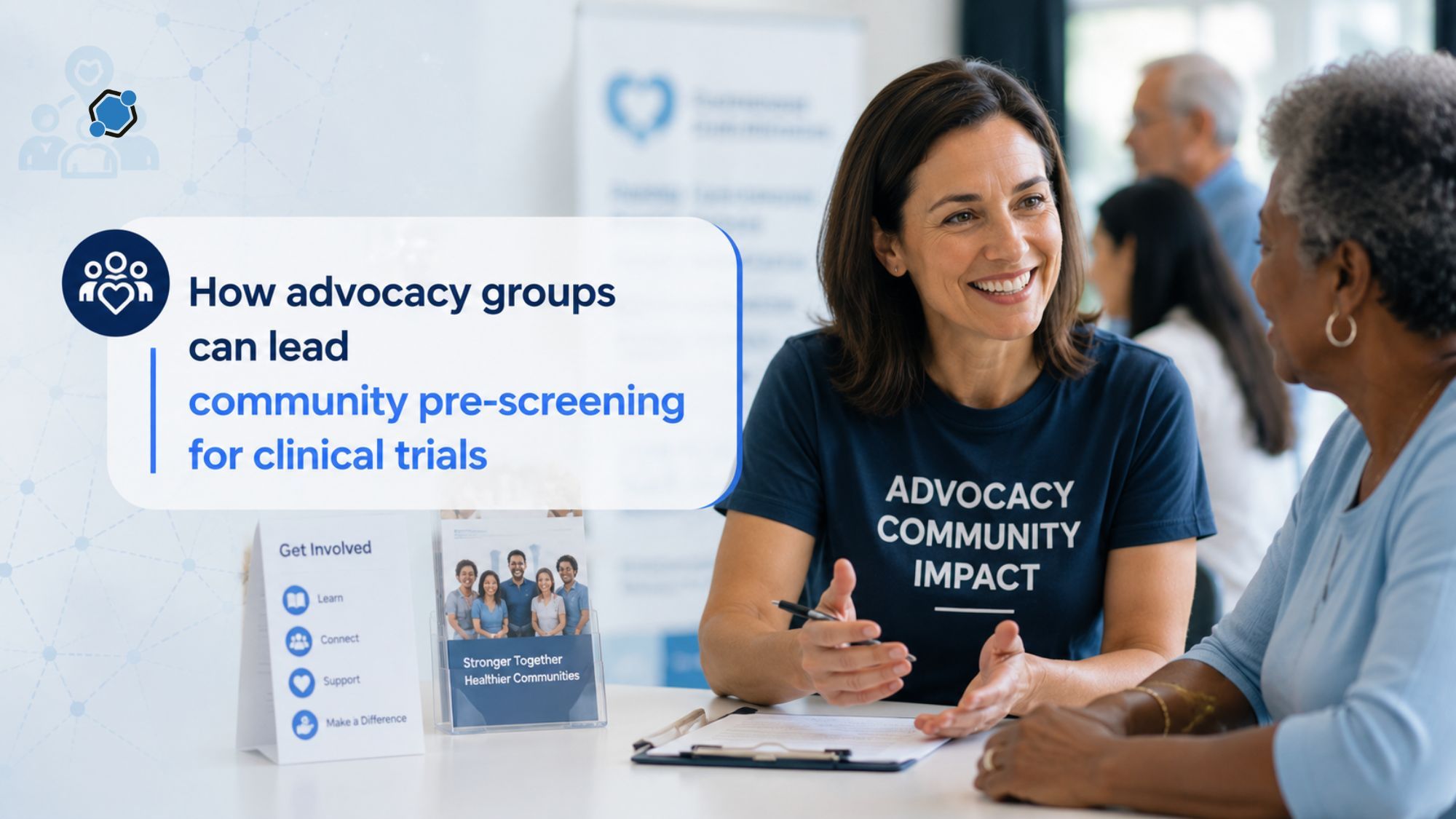
Advocacy groups have always sat close to the people clinical research most needs to reach. Members trust the organization. Families share diagnoses and lived experience across chapters. Community events, disease-specific newsletters, and peer networks reach populations that clinical research sites rarely touch on their own.
What is changing in 2026 is the recognition that this proximity has operational value, not only moral value. Federal guidance now names advocacy groups as a legitimate referral pathway into clinical trials. Recruitment platforms are building intake workflows that assume community partners will handle the first conversations. And the recruitment funnel itself is being redesigned around a stage that used to be invisible: community-level pre-screening.
This article explains what community-level pre-screening is, where the regulatory boundaries sit, and how an advocacy group can take on a larger triage role without stepping outside its mission or its legal footing.
What community-level pre-screening actually means
Pre-screening is the set of activities that happen before a person signs an informed consent form for a specific trial. Its purpose is to determine whether someone is potentially eligible and potentially interested, so that only well-matched candidates reach the research site for formal screening. Community-level pre-screening moves those first-touch activities out of the clinical setting and into the community organizations that already know the population.
In practice, that means an advocacy group can help a member understand what a trial involves in plain language, capture self-reported information about diagnosis, age, or general health status, and route a well-matched person toward a trial that fits. It does not mean the advocacy group is running the trial, judging medical eligibility, or replacing the research team.
Every clinical trial has a defined recruitment funnel that runs from awareness to referral to consent to screening to enrollment. Community-level pre-screening lives at the top of that funnel, where fit is roughly established and interest is confirmed before anyone contacts a site. For a stage-by-stage view of what happens after a community referral reaches a site, see From external referral to randomization: A stage-by-stage look at the site eligibility funnel.
Where federal rules draw the pre-screening line
The regulatory line between pre-screening and screening matters, because it defines what an advocacy group can and cannot do without additional oversight.
Under the Common Rule, activities that identify potentially eligible people, gauge their interest, and route them to a trial can be conducted without a signed informed consent, provided no research procedures occur. HIPAA allows access to protected health information for activities preparatory to research under specific conditions. The Food and Drug Administration's December 2025 final guidance on enhancing participation in clinical trials directly names advocacy groups, community leaders, and faith-based organizations as intentional outreach pathways for connecting underrepresented populations to research.
What advocacy groups cannot do at the pre-screening stage is conduct clinical assessments, run diagnostic tests, or perform any activity that meets the regulatory definition of research. Blood draws, physical examinations, cognitive assessments, and study-specific medical questionnaires all fall inside the site's responsibility after consent. Structured pre-screening tools that ask standardized questions should be reviewed by an institutional review board (IRB, the ethics body that oversees research involving human participants) before use, even when the questions look simple on paper.
The practical takeaway: advocacy groups can operate confidently in the education, awareness, and interest-confirmation zones, and can route matched people to the research team. Formal eligibility determination, informed consent, study walk-through, and enrollment always belong to the research site. A parallel framing for clinicians, Clinical trial referrals: how physicians can refer patients without doing the eligibility work, covers the same boundary from the referring provider's angle.
Why advocacy groups sit closer to eligible participants
Clinical research sites recruit through the tools available to them: their own patient records, physician referrals, digital advertising, and study listings. Those tools reach people who are already inside the healthcare system and already visible to a research infrastructure that has historically underrepresented several populations.
Advocacy groups reach differently. Members find the organization because they or someone they love received a diagnosis. Rare disease foundations run patient registries that capture people scattered across geographies too small for any single site to serve. Community-based organizations reach populations that clinicians rarely see, either because those populations do not have consistent primary care or because trust in medical institutions has been damaged by history.
That proximity translates into three concrete recruitment advantages. First, the initial conversation happens with someone the potential participant already trusts. Second, plain-language explanation of what a trial involves is easier when the person explaining shares the community's cultural context and vocabulary. Third, the population reached extends beyond the geographic and demographic footprint of any single research site.
These advantages are why federal guidance now explicitly recommends advocacy partnerships as a recruitment pathway. For a broader look at the community-guidance role, see How patient advocacy groups guide their community to clinical trials.
How community triage improves referral quality and access
The clinical trial recruitment system loses most of its candidates at the wrong stage. Industry reporting suggests that a meaningful share of people referred to a research site are ruled out before formal screening ever begins, because the referral was made without any check against the study's basic eligibility criteria. Every one of those failed referrals costs coordinator time at the site, extends the timeline for the sponsor, and creates a frustrating experience for the participant who traveled and hoped for a match.
Community-level triage attacks that waste directly. When an advocacy partner captures self-reported information at the first conversation, the referral that arrives at the site has already been filtered on the criteria the participant can answer honestly without a medical assessment. Age, general diagnosis, prior study participation, geography, and basic health history can be confirmed at the community level. The site then focuses its coordinator time on the medical eligibility work only clinicians can do.
The access effect matters just as much. When triage happens through a trusted community organization, participants who would never have found the trial on their own get a fair chance to be considered. That widens the pool of eligible candidates, and it does so from populations that make the study's results more generalizable to real-world practice.
The cost side of the equation is covered in more detail in The hidden cost of bad referrals for clinical research sites.
Governance, conflict of interest, and data protection
Taking on a triage role introduces governance questions that awareness-only outreach does not. Sponsor funding for advocacy-led recruitment programs is legitimate and common, but it also creates an institutional conflict of interest that members and regulators are right to scrutinize. The trust that makes advocacy triage valuable in the first place depends on protecting the perception that the organization is acting in the community's interest, first and always.
Advocacy groups moving into structured triage benefit from a standing ethics committee that reviews sponsored recruitment partnerships, transparent disclosure of funding sources on any recruitment-related communication, and a clear separation between educational programming and any single-sponsor referral activity. These are the governance patterns that make the difference between a sustainable community-triage program and one that erodes trust over a few funding cycles.
Data protection is the second governance frontier. Any information captured during pre-screening, even self-reported information, becomes personal health information that must be handled according to defined privacy protections. That means encrypted collection tools, defined retention periods, clear participant consent to be contacted, and a data-use agreement between the advocacy group and any recruitment platform or research partner that receives the information. These protections are not administrative burden. They are the reason the model can scale without eroding the trust it depends on.
Building a community triage model that holds up
An advocacy group ready to take on a larger triage role does not need to build everything from scratch. Several structural pieces determine whether the model will hold up under sponsor scrutiny, member scrutiny, and regulatory review.
Trained personnel are the first. Community health workers, patient navigators, and volunteer peer leaders can all deliver community-level pre-screening if they are trained on the boundary between education and clinical assessment, on plain-language explanation of common trial concepts, and on documentation practices that support a clean handoff to the research site.
A patient registry or contact database, governed by clear consent language, allows the organization to match members against multiple trials over time rather than starting from zero for each opportunity. A vetted technology partner handles the matching, the pre-screening capture, and the secure referral handoff, so the organization can focus its resources on the community relationships it uniquely provides. And a written scope-of-work with each sponsor or platform partner clarifies exactly which activities fall inside the advocacy group's role and which stay with the research site.
For a deeper look at how registries feed a triage pipeline, see How patient advocacy groups turn registries into clinical trial referrals.
How DecenTrialz supports advocacy-led community pre-screening
DecenTrialz is an AI-assisted clinical trial matching platform with registered nurse-led pre-screening, designed to support the exact model above. The AI-assisted matching layer identifies which active trials fit a member's self-reported information, so an advocacy partner does not have to track sponsor pipelines manually. The registered nurse layer then conducts a structured, IRB-appropriate pre-screening conversation with each matched candidate to confirm interest and check pre-consent eligibility criteria, so that only well-matched referrals reach the research site.
Formal eligibility determination, informed consent, study walk-through, and enrollment always remain with the research site team. The advocacy group retains full ownership of the community relationship, the outreach voice, and the data-governance decisions that protect member trust.
Learn more about how DecenTrialz supports advocacy partnerships at decentrialz.com.
Partner with DecenTrialz to expand community triage capacity
Advocacy groups do not need permission to take on a larger role in clinical trial triage. Federal guidance supports it. The recruitment system needs it. And the populations that clinical research has historically missed are already inside advocacy organizations, waiting for a fair chance to be considered.
The remaining infrastructure question is who will handle the matching, the nurse-led pre-screening, and the secure referral pathway to the research site, so the advocacy group can focus on what it does uniquely well. To explore a partnership that supports community-level pre-screening while protecting member trust, connect with the DecenTrialz team at decentrialz.com.
Was this article helpful?

Similar Blogs
Decentralized Clinical Trials: an advocacy checklist for digital inclusion
Decentralized clinical trials are being promoted as a way to bring research to the partici...
 Vamshi Kantoju
Clinical Trial Data Governance: What Advocacy Groups Should Verify Before Endorsing a Study
Patient information now travels further than most study participants expect. A study that ...
Swaroop ESD
Tokenization in Clinical Trials: What Should Advocacy Groups Ask Sponsors About Patient Privacy
Tokenization has become one of the most widely adopted data techniques in modern clinical ...
Mahesh UpadristaStay Informed. Stay Connected.
Get updates on verified clinical trials, emerging treatments, and research breakthroughs directly in your inbox. No spam, just science that matters.
