 HIPAA Compliant
 ISO 27001 Certified

BRCA1 and BRCA2 mutations: what they mean for breast cancer risk
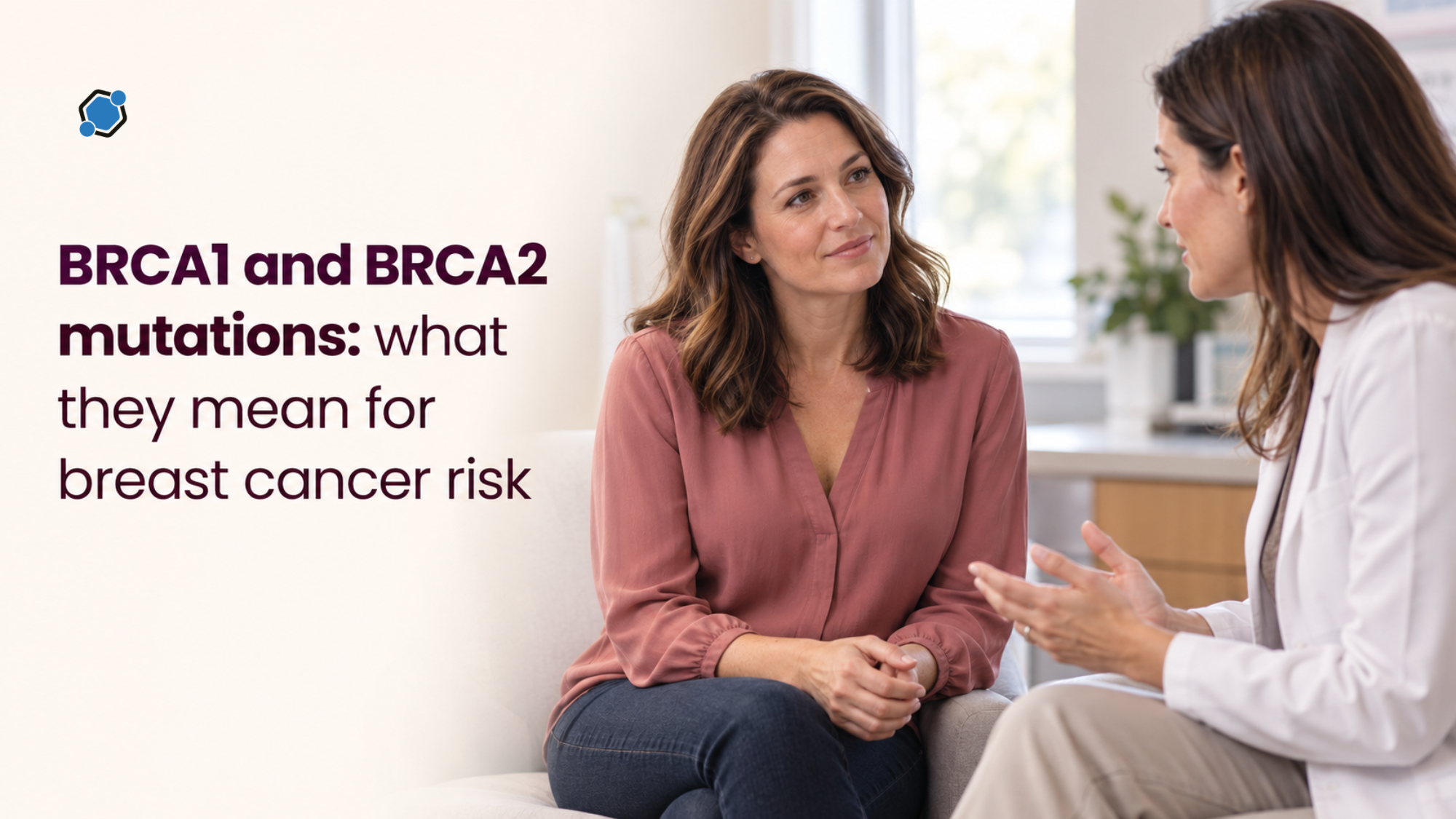
BRCA1 and BRCA2 mutations are inherited gene changes that raise the risk of breast, ovarian, and several other cancers. Every person has BRCA1 and BRCA2 genes, and in their normal form they help protect cells from cancer. A harmful change in one of them weakens that protection. This is why BRCA variants sit at the center of most talk about hereditary breast cancer risk. A BRCA mutation raises risk a great deal, but it is not a diagnosis, and many carriers never develop cancer.
What BRCA1 and BRCA2 genes do
Genes are sets of instructions stored in DNA, the code found in nearly every cell. BRCA1 and BRCA2 (short for BReast CAncer genes 1 and 2) hold the instructions for proteins that repair damaged DNA. Small breaks in DNA happen every day as cells divide. These repair proteins fix the damage before errors build up.
Because they help keep cell growth in check, BRCA1 and BRCA2 are called tumor suppressor genes. A useful comparison is a repair crew on a busy road. When the crew works well, small cracks get patched fast. When the crew is missing, cracks pile up. Some cells may then start to grow out of control, which is how cancer can begin.
How a harmful variant raises cancer risk
Every person inherits two copies of each BRCA gene, one from each parent. Labs usually call a harmful change a pathogenic variant, though the older word mutation is still common. A person who inherits one harmful copy still has one working copy, which is enough to protect most cells. Over a lifetime, though, the working copy can be damaged in a single cell. That cell then has no good repair system left, so it is more likely to become cancer.
So a BRCA variant does not cause cancer directly. It removes a layer of protection, which raises the chance of cancer over time. When cancer does develop, BRCA status also works as a biomarker that helps guide treatment.
How BRCA variants are passed down
BRCA variants follow a pattern called autosomal dominant inheritance. This means one altered copy is enough to raise risk. A parent with a harmful variant has a one-in-two chance of passing it to each child, like a coin toss, and each child gets a new toss. The variant can come from the mother or the father. Men carry and pass on BRCA variants as often as women, so the father’s side of the family matters just as much.
Harmful BRCA variants are uncommon in the general population. They are more common in groups that descend from a small number of shared ancestors, a pattern called a founder effect. People of Ashkenazi Jewish descent are the best-known example. Founder variants have also been found in other communities around the world.
How much BRCA mutations raise cancer risk
Breast cancer is the cancer most closely tied to BRCA variants. For women with a harmful BRCA1 or BRCA2 variant, current estimates put lifetime breast cancer risk at more than half. That is several times higher than the risk for the average woman. Estimates vary between studies, mostly because they measure risk to different ages and study different groups of families.
Ovarian cancer risk also climbs well above the low average risk, and the rise is larger with BRCA1 than with BRCA2. Unlike breast cancer, ovarian cancer has no reliable screening test. That gap shapes many prevention choices.
Differences between BRCA1 and BRCA2
The two genes overlap but are not the same. BRCA1-related breast cancers tend to appear at younger ages. They are also more often triple negative, which means the cancer cells lack the three receptors (estrogen, progesterone, and HER2) that many treatments target. BRCA2-related breast cancers more often rely on hormones to grow and tend to appear a bit later. BRCA2 is also more strongly linked to cancers in men.
Risks for men and other cancers
Men with a BRCA variant, especially BRCA2, face a higher risk of breast cancer than other men. They also have higher risks of prostate and pancreatic cancer. Women with a variant have a somewhat higher risk of pancreatic cancer too. Breast cancer in men is rare, so it is easy to miss. Knowing the signs of breast cancer beyond a lump helps anyone in a high-risk family notice changes early.
A higher risk is not a certainty. Some carriers never develop cancer. Family history, hormones, lifestyle, and other genes all affect how risk plays out for each person.
Who should consider genetic testing for BRCA mutations
Most breast cancers are not inherited, and most women who get breast cancer have no close relative with the disease. For that reason, current U.S. guidance does not call for BRCA testing for everyone. It recommends a family history review first. People whose history points to higher risk are then offered genetic counseling and, when it fits, testing. Signs that a family may carry a BRCA variant include:
- A relative with a known harmful BRCA variant
- Breast cancer diagnosed at a younger age, generally before 50, in the person or a close relative
- Ovarian, fallopian tube, or pancreatic cancer in the family
- Breast cancer in a male relative
- Triple negative breast cancer, or cancer in both breasts
- Several relatives on the same side of the family with breast, ovarian, prostate, or pancreatic cancer
- Ashkenazi Jewish ancestry
Guidance for people already diagnosed with breast cancer has also widened. Many patients are now offered testing at diagnosis, with or without a family history.
What the test results mean
A genetic counselor is a health professional trained to help people decide whether to test and to explain the results. A positive result means a harmful variant was found. It signals higher risk but cannot predict if or when cancer will develop.
A negative result is most useful when a relative’s known variant was tested for and not found. When no family variant is known, a negative result does not rule out inherited risk. Screening plans then still follow family history. A third result is a variant of uncertain significance (VUS), a change the lab cannot yet classify. Most are later found to be harmless, so medical decisions are generally not based on a VUS alone.
Home tests, relatives, and privacy
Some home DNA tests check only a small handful of the many known harmful BRCA variants. A negative home result does not rule out a BRCA variant, and a positive one should be confirmed with clinical testing. When a variant is found, relatives can be tested for that exact change. This is called cascade testing.
In the United States, the Genetic Information Nondiscrimination Act bars health insurers and most employers from using genetic results against a person. It does not cover life, disability, or long-term care insurance, a gap worth discussing with a genetic counselor before testing. Results can also matter for research, since some studies are open only to people with a confirmed variant. This is one example of how eligibility criteria are set for clinical trials.
How people with a BRCA mutation can manage risk
People with a harmful BRCA variant have several options. The right mix depends on age, the gene involved, family history, and personal goals. These choices are made with a care team, and no option removes risk entirely.
Enhanced screening
Screening for carriers usually starts earlier and happens more often than for other people. Widely followed advice calls for a yearly breast MRI from around age 25, with yearly mammograms added from about age 30. MRI finds more cancers in high-risk women, but it also causes more false alarms that lead to extra tests. Men with a BRCA2 variant may be advised to start prostate screening earlier than usual.
Risk-reducing surgery
Some carriers choose a risk-reducing mastectomy, which removes both breasts before cancer appears. This lowers breast cancer risk a great deal, though not to zero, because a small amount of breast tissue can remain. Removing the ovaries and fallopian tubes, called a salpingo-oophorectomy, is generally advised once a person has finished having children. Guidance often places it in the late 30s for BRCA1 carriers and the early to mid-40s for BRCA2 carriers. This surgery greatly lowers ovarian cancer risk. It also brings on early menopause, which has its own health effects.
Medicines and treatment
Some hormone-blocking medicines may lower breast cancer risk for certain carriers. When cancer does develop, BRCA status can shape treatment. A class of drugs called PARP inhibitors blocks a backup DNA repair path. This may leave BRCA-related cancer cells unable to repair themselves. These medicines are approved for certain BRCA-related breast cancers. Some chemotherapy drugs that damage DNA may also work well in this setting. This progress reflects years of steady advances in breast cancer research.
BRCA mutations and clinical trials
Clinical trials continue to shape care for BRCA carriers. Prevention studies are testing whether medicines can lower cancer risk in healthy carriers. Other studies compare screening methods and test new treatments for BRCA-related cancers. Some are checking whether removing the fallopian tubes first, and the ovaries later, can safely delay menopause. Many have not yet reported final results, and taking part never guarantees a particular outcome.
Who takes part also matters. Genetic testing and research have reached some communities less often than others, largely because of gaps in access to testing and specialist care. Some BRCA1 changes have been found mainly in African American families, so uneven testing can leave carriers in these communities unaware. Broader participation helps findings apply to more people.
DecenTrialz is a clinical trial recruitment and pre-screening platform that helps connect people with studies that may fit their health profile. A person shares some health information, and AI matching suggests studies that may be relevant. A registered nurse then reviews the information before a referral goes to the research site. The research site team makes the final eligibility decision, explains the study, handles informed consent, and manages enrollment. Knowing the difference between screening and enrollment helps set clear expectations for each step.
Frequently asked questions about BRCA mutations
Does a BRCA mutation mean cancer will develop?
No. A harmful BRCA variant raises the risk of certain cancers, but it is not a diagnosis. Some carriers never develop cancer, and screening and prevention can lower risk further.
Can men carry a BRCA mutation?
Yes. Men inherit BRCA variants as often as women and can pass them to their children. Male carriers, especially those with BRCA2, have higher risks of breast, prostate, and pancreatic cancer.
Can a BRCA mutation skip a generation?
The variant itself does not skip generations. It can appear to skip when it passes through a man or through a woman who never develops cancer, which hides it in the family history.
Does a negative BRCA test mean there is no inherited risk?
Not always. A negative result is most reliable when a known family variant was tested for. Without one, a strong family history may still call for closer screening. Testing a relative who has had cancer can help clarify the picture.
Should children be tested for BRCA mutations?
BRCA testing is generally not recommended before age 18, because risk management for these genes usually starts in adulthood. Waiting lets each person make an informed choice for themselves.
Turning genetic risk into an informed plan
BRCA1 and BRCA2 mutations are among the strongest known inherited risk factors for breast and ovarian cancer. Even so, a positive result is a starting point for planning, not a prediction. Family history review, genetic counseling, earlier screening, and preventive options give carriers and their relatives real choices. Those choices work best when made with a care team.
Research continues to improve prevention, screening, and treatment for people with BRCA variants. People who carry a variant, or whose family history raises questions, can explore studies that may be relevant through DecenTrialz as one part of a wider conversation with their care team.
Was this article helpful?

Similar Blogs

How do digital endpoints in clinical trials use data from wearable devices?
Digital endpoints in clinical trials are measurements of health that are collected by a de...
 Deeksha Gitta
CT vs MRI for stroke: how do doctors choose the right brain scan?
When a stroke is suspected, doctors need a clear picture of the brain before they can safe...
Mahesh Upadrista
Obesity and fatty liver: how does extra weight damage the liver?
Obesity is the strongest known driver of fatty liver disease, a condition in which excess ...
Deeksha GittaStay Informed. Stay Connected.
Get updates on verified clinical trials, emerging treatments, and research breakthroughs directly in your inbox. No spam, just science that matters.
