 HIPAA Compliant
 ISO 27001 Certified

How do digital endpoints in clinical trials use data from wearable devices?
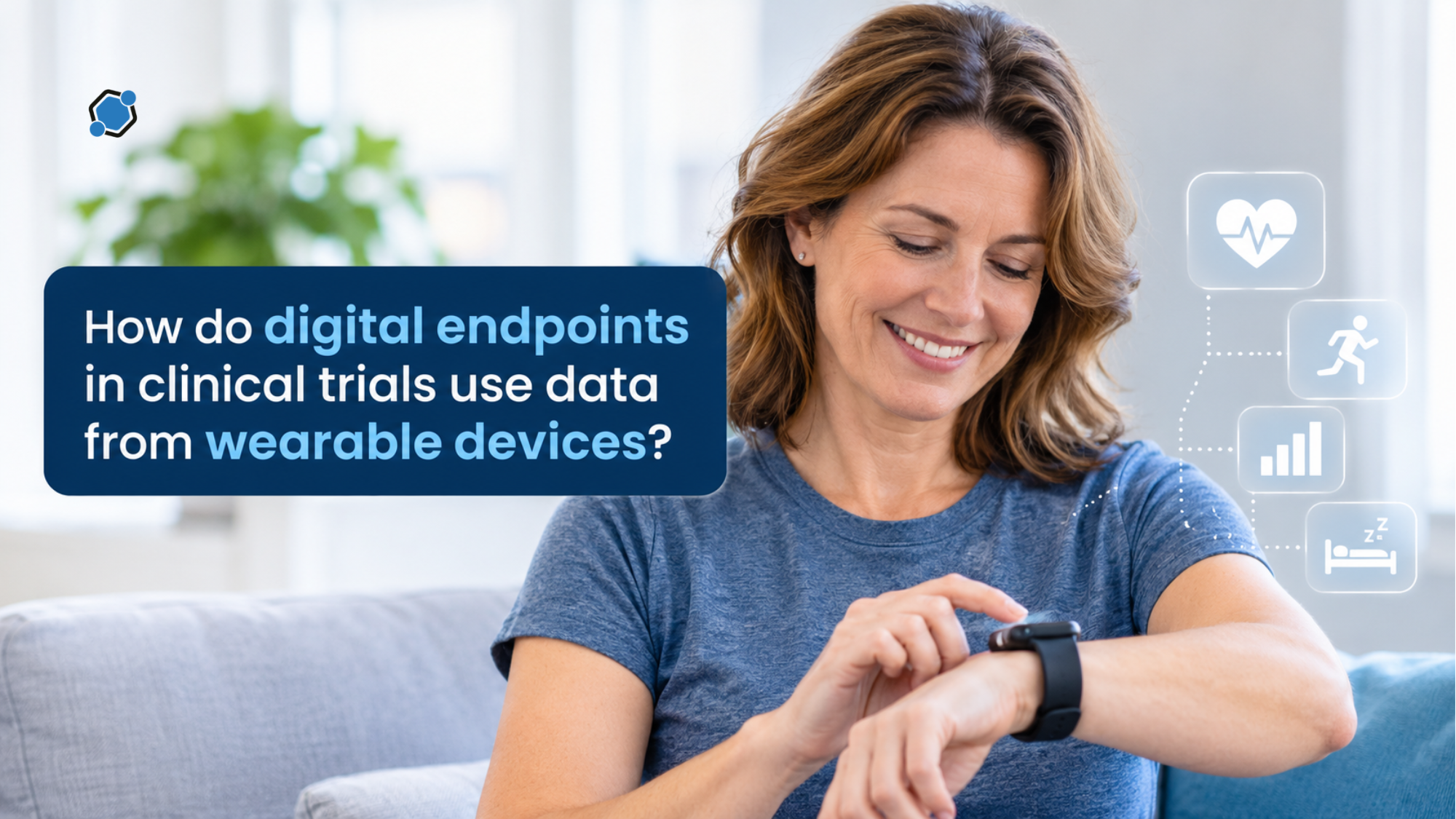
Digital endpoints in clinical trials are measurements of health that are collected by a device, such as a smartwatch, a skin patch, or a continuous glucose monitor, and then used to judge whether a study intervention is working or is safe. More studies now ask participants to wear these devices at home, which raises a practical question for anyone considering a trial: how does the data on a wrist become evidence that regulators will accept?
Raw readings are only the starting point. Before a step count or a heart rate can support a scientific conclusion, researchers must define exactly what is being measured, show that the device measures it accurately, and show that the number reflects something that matters to patients. This article explains that process and what participants should know before agreeing to wear a study device.
What is an endpoint in a clinical trial?
An endpoint is the specific measurement a clinical trial uses to answer its main question. Examples include blood pressure after 12 weeks or a score on a symptom questionnaire. Researchers choose endpoints before a study begins and record them in the protocol, the formal plan that governs how the trial runs.
Most trials name one primary endpoint, which is the outcome the study is designed and sized to answer. Secondary endpoints add supporting information, such as quality of life or daily activity. Exploratory endpoints are studied to learn and to generate new ideas rather than to prove a benefit, and many digital measures begin in this category. Choosing the right endpoint is central to how trials judge whether a new medicine works.
What makes an endpoint digital
A digital endpoint is an endpoint captured by a digital health technology. The U.S. Food and Drug Administration (FDA) describes a digital health technology as a system that uses computing platforms, connectivity, software, and/or sensors for health care and related uses. The difference between the device and the endpoint is easy to blur, so it helps to separate four layers:
- The device: a smartwatch, ankle sensor, or glucose monitor worn by the participant.
- The raw data: the signals the sensor records, such as movement or pulse.
- The measure: a number calculated from that data, such as average daily steps over two weeks.
- The endpoint: that measure written into the protocol in advance, for example the change in average daily steps from the start of the study to week 24, compared between study groups.
Only the last layer is used to draw a conclusion about the intervention being tested. A device can collect large amounts of data without any of it serving as an endpoint.
How does wearable data become clinical trial evidence?
Data from a wearable becomes evidence only after it is shown to be fit for purpose. That phrase, used throughout FDA guidance, means the tool is reliable enough for its specific job, in a specific group of people, in a specific setting. Researchers call this the context of use. A walking measure that works well in healthy adults may not work for people who shuffle or use a walker, so evidence from one group does not automatically carry over to another.
Researchers across the field commonly rely on a validation framework known as V3, first published in 2020 and extended in 2025 to add a fourth step. Together, the steps ask four plain questions:
- Verification: does the sensor capture and store raw signals correctly? This is usually tested in a laboratory.
- Analytical validation: does the software turn those signals into an accurate measurement when compared with a trusted reference, such as steps counted by a trained observer?
- Clinical validation: does the measurement reflect a real health state, or a real change in health, in the people the study will enroll?
- Usability validation: can participants, caregivers, and study staff use the device correctly in everyday conditions?
The fourth question matters because a device that is uncomfortable or confusing produces gaps in the data, and gaps weaken the evidence.
FDA issued final guidance in December 2023 on using digital health technologies to collect data remotely in clinical investigations, covering device selection, verification and validation, usability, and protection of trial records. In August 2026, FDA published a cross-center paper on measures derived from these technologies. The paper is not new guidance. It consolidates existing expectations and emphasizes starting with an aspect of health that patients care about, rather than starting with the sensor.
One more requirement applies in every well-run study. The measure, how it is calculated, how much wear time counts as a valid day, and how missing data will be handled must all be specified before the trial starts. Researchers cannot choose the most favorable version after the results are in.
Where are digital endpoints used today?
Digital endpoints already appear in research across several conditions, although their regulatory standing varies widely.
Continuous glucose monitoring in diabetes
In diabetes research, continuous glucose monitors record blood sugar levels throughout the day and night. A widely used measure called time in range reports the percentage of readings between 70 and 180 mg/dL. International consensus recommendations set a target of more than 70 percent of readings in that range for most adults with diabetes, and time in range now serves as a primary or secondary endpoint in many diabetes trials.
Walking speed in a rare muscle disease
In Duchenne muscular dystrophy, a rare inherited disease that weakens muscles over time, an ankle-worn sensor can record how fast a person walks during ordinary daily life. In 2023, the European Medicines Agency (EMA) qualified one such measure, the speed of a person's fastest everyday strides, as a primary endpoint for superiority studies (trials designed to show that one option performs better than another) in patients aged four and older who can still walk. It was the first wearable-derived measure qualified at that level by a major regulator. In the United States, a 2025 review reported that no drug had yet been approved on the basis of a primary endpoint from a sensor-based wearable.
Heart rhythm and movement disorders
Large studies have enrolled hundreds of thousands of smartwatch users to test whether wrist-based alerts can flag an irregular heart rhythm called atrial fibrillation. These studies showed that remote research can work at very large scale, and they also showed the limits of an alert: among notified participants who later wore a medical-grade heart monitor, the monitor recorded atrial fibrillation in roughly one in three. A notification is a prompt to seek care, not a diagnosis.
In Parkinson's disease, researchers are studying smartwatch measures of walking, tremor, and fine hand movement. FDA has declined to qualify certain proposals because it was unclear how a change in the digital signal related to a change in how patients function day to day. That gap between measuring something precisely and measuring something meaningful is one of the central challenges in the field, and it shapes what wearable data can and cannot tell clinicians.
What are the benefits and limitations for participants?
For participants, digital endpoints can change what a study asks of them. A clinic visit captures one moment, often on a day when a person is tired, anxious, or feeling unusually well. A wearable can record how someone moves, sleeps, or manages blood sugar across weeks of ordinary life, giving researchers a fuller picture of daily life.
Remote data collection can also reduce the number of trips to a research site, particularly in hybrid studies that combine site visits with activities at home, such as home nursing visits. These benefits depend on the design of each study, and no device guarantees a lighter schedule or any particular health outcome.
The limitations are equally real:
- Accuracy varies. Optical heart rate sensors, which shine light into the skin to detect blood flow, are most affected by motion, and readings during activity are generally less accurate than readings at rest. Research on whether skin tone affects accuracy has produced mixed results and remains an open question.
- Wear time is rarely complete. Charging, syncing problems, discomfort, and forgetfulness create gaps. If participants who feel worse wear a device less often, those gaps can bias the results.
- Access is uneven. Studies that rely on a participant's own phone or watch can exclude people who do not own a compatible device. FDA guidance recommends that sponsors provide the technology when a participant does not have it.
- Privacy needs attention. Continuous data can reveal patterns about sleep, activity, and location. Data shared only between a person and a consumer wearable company is generally not covered by HIPAA, the federal health privacy law, while data collected for a trial is governed by informed consent, ethics board oversight, and applicable privacy rules.
What should participants ask before joining a study that uses a wearable?
Participants have the right to understand what a study device will collect and how the data will be used. The informed consent process is the place to ask, and reading the consent form carefully before signing is the best preparation. Useful questions include:
- What device will I use, and will the study provide it or ask me to use my own?
- What does the device record, and does it collect data in the background or ask me to complete specific tasks?
- How many hours a day do I need to wear it, and how often must I charge or sync it?
- What happens if I forget to wear it or it stops working?
- Who can see my data, including the sponsor, the research site, and the device maker?
- Will the study team be alerted to a possible health concern, and what happens next?
A reading from a study device is not a diagnosis. Participants with a health concern during a study should contact the study team and their own clinician.
Frequently asked questions about digital endpoints
Can I use my own smartwatch in a clinical trial?
Some studies allow participants to use their own phone or watch, an approach called bring your own device. Others provide a study device so that every participant's measurements are collected the same way. The protocol decides which approach applies, and the study team will explain it during consent.
Is data from a study wearable protected?
Data collected for a trial is governed by the informed consent document, ethics board oversight, and applicable privacy laws. These protections differ from those that apply to a personal fitness app. Participants can ask how long their data will be kept and what happens to trial data after a study ends.
Does FDA accept wearable data as evidence?
FDA accepts data from digital health technologies when a sponsor shows that the tool is fit for its purpose in that study. Acceptance is decided case by case, and the evidence required rises for primary endpoints that support approval decisions.
Finding a study that fits your situation
Digital endpoints are changing how some studies measure health, but the fundamentals stay the same: a protocol, informed consent, and ethics board oversight, with a device reading counting as evidence only after it has been carefully defined and validated.
DecenTrialz is a clinical trial recruitment and pre-screening platform that helps people find studies that may match their health profile. You share some information about your health, the platform's AI matching suggests relevant studies, and a registered nurse reviews your information before a referral goes to the research site team. The research site team makes the final eligibility decision, leads informed consent, and handles enrollment.
Decisions about study devices, and about how device data is collected and used, come from each study's sponsor and research site, not from DecenTrialz. People interested in research that uses wearable devices, or any other type of study, can explore current opportunities on DecenTrialz and bring the questions above to the study team before deciding whether to take part.
Was this article helpful?

Similar Blogs
CT vs MRI for stroke: how do doctors choose the right brain scan?
When a stroke is suspected, doctors need a clear picture of the brain before they can safe...
 Mahesh Upadrista
BRCA1 and BRCA2 mutations: what they mean for breast cancer risk
BRCA1 and BRCA2 mutations are inherited gene changes that raise the risk of breast, ovaria...
Swaroop ESD
Obesity and fatty liver: how does extra weight damage the liver?
Obesity is the strongest known driver of fatty liver disease, a condition in which excess ...
Deeksha GittaStay Informed. Stay Connected.
Get updates on verified clinical trials, emerging treatments, and research breakthroughs directly in your inbox. No spam, just science that matters.
