 HIPAA Compliant
 ISO 27001 Certified
Childhood Cancer Awareness Month 2026: Warning Signs, Common Types, and Pediatric Research
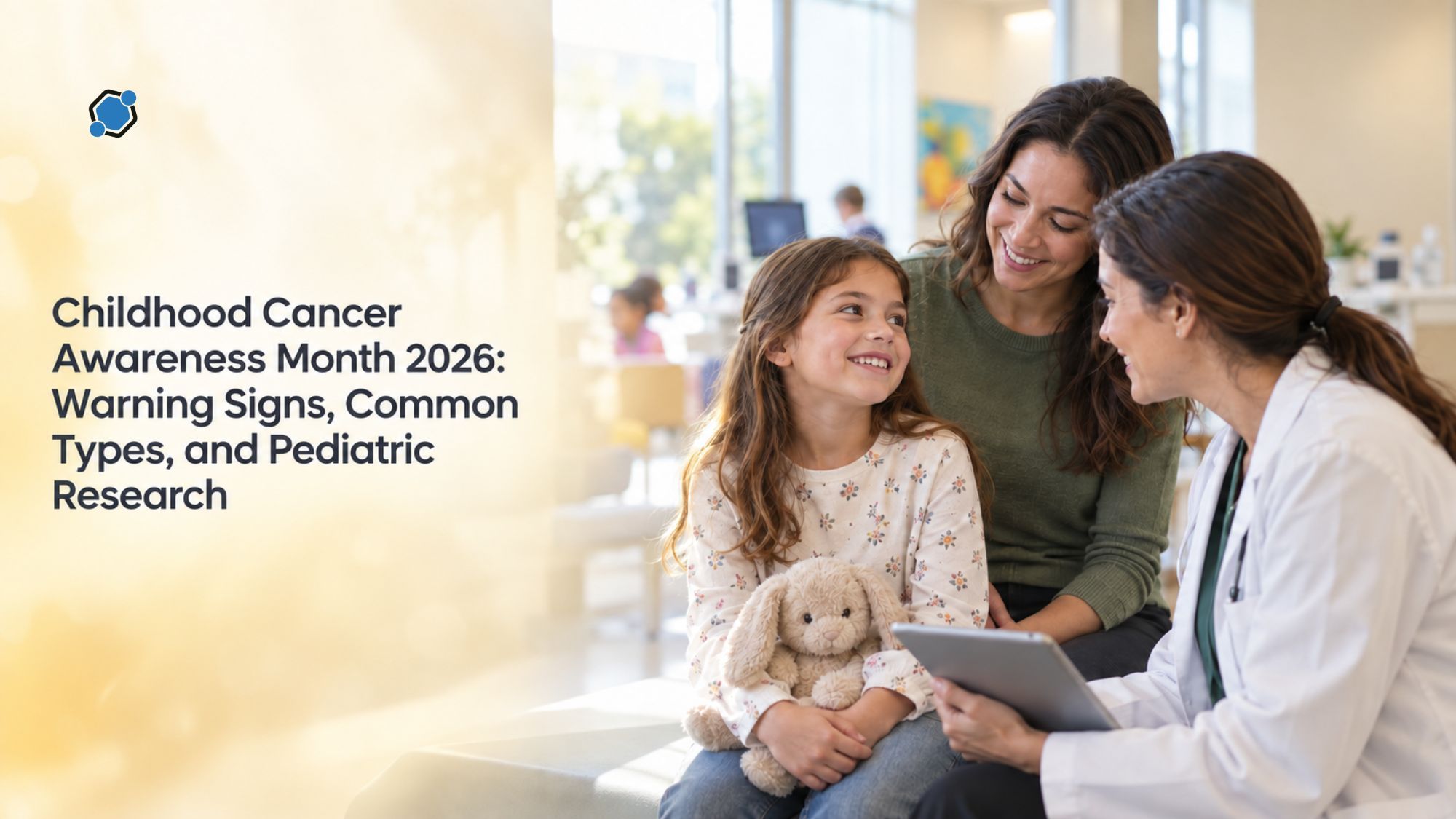
Cancer in children is a different disease from cancer in adults. It begins in different cells, it is driven by different causes, and it behaves differently once therapy starts. That distinction sits at the center of Childhood Cancer Awareness Month, observed each September in the United States, because it is why pediatric cancer requires its own research programs rather than a scaled-down version of adult oncology, the branch of medicine that studies and treats cancer.
Why September is Childhood Cancer Awareness Month
September has carried the childhood cancer designation in the United States for decades through advocacy by families and pediatric groups, and federal recognition arrived through a presidential proclamation in 2012. A congressional resolution had recognized a national childhood cancer awareness day four years earlier, in 2008. State and local proclamations are issued annually and usually name the month without assigning a subject.
The gold ribbon is the symbol of the observance. Gold was chosen because it is precious and rare, a reference to how children are valued, and unlike ribbons tied to a single diagnosis it stands for every type of childhood cancer at once. That breadth is deliberate, since more than one hundred distinct cancers occur in children and no single one accounts for most cases.
September 2026 has no single official national theme. Individual childhood cancer organizations run their own campaigns, most built around the color gold, which is why the same month can appear under several banners. Common activities include lighting public landmarks in gold, head-shaving and lemonade stand fundraisers, school and workplace gold days, and campaigns encouraging state-level proclamations.
Visibility is only part of the purpose. Pediatric cancer receives a small share of overall cancer research funding relative to the years of life at stake, and awareness campaigns are one of the few mechanisms available for pressing that imbalance into public view. The link between public attention and eventual clinical benefit is indirect but real, and it runs along the same path traced in why cancer research month matters.
What makes childhood cancer different from cancer in adults
Most adult cancers begin in epithelial tissue, the layer of cells lining the skin, organs, and glands, and they accumulate over decades as genetic damage builds up from age and exposure. Childhood cancers usually begin elsewhere, in cells that were still developing, sometimes before birth. The genetic changes behind them tend to be random events during rapid cell division rather than the result of anything a parent did or did not do.
Two consequences follow. Childhood cancer is largely not preventable, and there is no routine screening test for it in otherwise healthy children, so detection depends on recognizing symptoms rather than catching a scheduled test. A small minority of cases are linked to an inherited predisposition, meaning a genetic change passed down in a family that raises risk.
The same biology works in children's favor in one respect. Many childhood cancers grow quickly, and chemotherapy targets cells that divide rapidly, so pediatric cancers are often more responsive to it. Chemotherapy is medicine that kills or slows dividing cells throughout the body.
Because the underlying disease differs, adult protocols cannot simply be reduced in size for a smaller patient. Dosing has to account for a growing body, and study design has to weigh effects on growth, fertility, hearing, and brain development across a lifetime that may run another seventy years. That constraint shapes childhood research well beyond oncology, as the same pattern appears in pediatric arthritis research.
The most common types of childhood cancer, and the warning signs families notice
Common types
- Leukemias, cancers of the blood-forming cells that start in the bone marrow, the spongy tissue inside bones where blood cells are made. Acute lymphoblastic leukemia is the single most common childhood cancer, and acute myeloid leukemia is less common.
- Brain and central nervous system tumors, which start in the brain or spinal cord and are the most common solid tumors in children.
- Lymphomas, cancers of the lymphatic system, part of the immune system. Both Hodgkin and non-Hodgkin forms occur, and both are relatively more common in teenagers.
- Neuroblastoma, which starts in immature nerve cells, most often in the abdomen or the adrenal glands, the small hormone-producing glands on top of the kidneys. It mainly affects infants and young children.
- Wilms tumor, a kidney cancer that mainly affects young children.
- Rhabdomyosarcoma, a soft-tissue cancer that begins in cells that would otherwise have formed muscle.
- Retinoblastoma, an eye cancer of young children.
- Bone cancers, including osteosarcoma and Ewing sarcoma, which are more common in older children and teenagers.
Research increasingly organizes pediatric studies around the genetic features of a tumor rather than the organ where it started, an approach that allows children with rare diagnoses to be studied together. Several of the diagnoses above are rare enough that most people never encounter them, a problem examined further in rare bone and soft tissue cancers.
Warning signs
- Persistent paleness or unusual tiredness that does not resolve
- A fever that continues without an explanation
- Easy bruising or bleeding, or small red spots on the skin
- Unexplained weight loss
- Swollen glands that persist or continue to grow
- Headaches in the morning, particularly with vomiting
- A lump or swelling anywhere on the body
- Bone or joint pain that wakes a child at night
- Vision changes, or a white reflection in the pupil instead of the usual red in photographs
Every item on that list is caused far more often by something ordinary. Viral infections produce fevers and swollen glands, growth and sport produce joint pain, and low iron produces paleness and fatigue. What marks a symptom worth a second look is the pattern rather than the symptom itself: it persists beyond the expected course, it worsens instead of improving, or several appear together. When a child has a diagnosis and does not improve as expected, a request for re-evaluation is reasonable.
How research changed the outlook for children with cancer
Survival for children with cancer in the United States has improved dramatically over the past half-century. In the mid-1970s a minority of children diagnosed with cancer survived five years or more; today the large majority do, and for the most common childhood leukemia the shift has been steeper still. Those figures describe groups rather than individuals, and no study or therapy can promise a particular outcome for a particular child. The gains are also uneven, since certain aggressive brain tumors and some rare sarcomas have seen far less improvement than the overall picture suggests.
One factor explains much of the progress. A far higher proportion of children with cancer are treated within clinical studies than adults with cancer, coordinated through cooperative pediatric research networks that link specialized children's centers across the country. Nearly every child treated in the United States receives care at such a center, so what is learned from one child's course shapes the design of the next study. Research and care are effectively one activity in pediatric oncology rather than two separate tracks.
Structural barriers still shape what is possible. Childhood cancers are individually rare, which limits how quickly a study can enroll enough participants to produce a clear answer. Small numbers also reduce commercial incentive to develop pediatric-specific products, and specialized centers cluster in larger cities, so distance, lodging, time away from work, and care for other children fall on families rather than on the system that produced the geography. Federal law now requires that certain new targeted cancer medicines be studied in children when the biological target is relevant to a childhood cancer, addressing part of the incentive gap.
Every study also defines who can take part, using criteria such as diagnosis, subtype, age, and what a child has already received. Families often find that a study of interest is closed to them for reasons unrelated to how much they need it, a point covered in why not everyone qualifies for a study.
What happens after therapy ends
Late effects are health problems that appear months or years after therapy is complete. Depending on what a child received, they can involve the heart, hormones, growth, fertility, hearing, or learning and memory, and they include a raised risk of a second cancer. A child treated at five may need monitoring for conditions that surface only in adulthood.
Long-term follow-up care is built around a survivorship care plan, a written record of exactly what a survivor received, paired with a personalized screening schedule. That document travels with the survivor and matters most where pediatric care hands off to adult clinicians who were not involved in the original course. Survivorship carries the same weight in adult cancer care, as covered in what cancer survivorship involves.
Survivorship is itself an active research field. Long-running studies follow survivors for decades to identify which late effects follow which therapies, and that evidence feeds back into study design, where a growing objective is the same result at less long-term cost.
Families exploring study options generally start with the treating pediatric oncology team, which knows the diagnosis, the subtype, and what has already been given. Enrolling a child requires informed permission from a parent or guardian and, where the child is old enough, the child's own assent. Consent is the formal agreement given by an adult after the study has been explained in full; assent is the child's own agreement, sought in language suited to their age, and a child's refusal is meant to be respected. Before either step, pre-screening checks whether a child appears to meet a study's criteria at all, which is a separate stage from enrollment. Platforms such as DecenTrialz operate at that early stage.
Questions people ask about Childhood Cancer Awareness Month
When is Childhood Cancer Awareness Month?
The entire month of September, in the United States. A separate global observance, International Childhood Cancer Day, falls on February 15.
Is there an official theme for September 2026?
September 2026 carries no unified national theme. Different childhood cancer organizations run separate campaigns, most of them referencing the color gold, so any theme cited should be attributed to the organization using it.
Can childhood cancer be prevented?
Current evidence indicates that most childhood cancers cannot be prevented, because they arise from random genetic changes in developing cells rather than lifestyle or environmental exposure. There is also no routine screening test for childhood cancer in healthy children.
What is the most common cancer in children?
Leukemia, and specifically acute lymphoblastic leukemia, is the most common childhood cancer.
What is the difference between consent and assent in a children's study?
Consent is the binding agreement given by a parent or legal guardian after the study has been explained in full. Assent is the child's own agreement, sought in age-appropriate language, and a refusal is meant to be respected.
How communities can take part this September
Participation does not require a personal connection to a diagnosis. Sharing accurate information about warning signs shortens the distance between a symptom and an evaluation, and supporting pediatric research funding addresses the imbalance these campaigns exist to highlight. For families in active care, practical help with meals, travel, or siblings matters more than anything symbolic.
DecenTrialz is a clinical trial recruitment and pre-screening platform in the United States. It combines artificial intelligence, meaning computer systems that identify patterns in data, with pre-screening by registered nurses to connect people who may want to join a study with the research teams running those studies. Final eligibility determination, informed consent, the study walk-through, and enrollment are handled by the research site team. Families exploring options can review what is available at decentrialz.com.
Was this article helpful?

Similar Blogs
Healthy Aging Month 2026: what it is and how older adults can join clinical research
Curiosity has no age limit. That message anchors Healthy Aging Month 2026, the September o...
 Vamshi Kantoju
Thyroid Cancer Awareness Month 2026: what are the warning signs, and how do doctors find thyroid cancer?
September brings national attention to a small, butterfly-shaped gland that quietly influe...
Mahesh Upadrista
Ovarian Cancer Awareness Month: what the symptoms are and why early detection is so difficult
The teal ribbon associated with ovarian cancer first appeared in the mid-1990s, introduced...
Swaroop ESDStay Informed. Stay Connected.
Get updates on verified clinical trials, emerging treatments, and research breakthroughs directly in your inbox. No spam, just science that matters.
