 HIPAA Compliant
 ISO 27001 Certified
Thyroid Cancer Awareness Month 2026: what are the warning signs, and how do doctors find thyroid cancer?
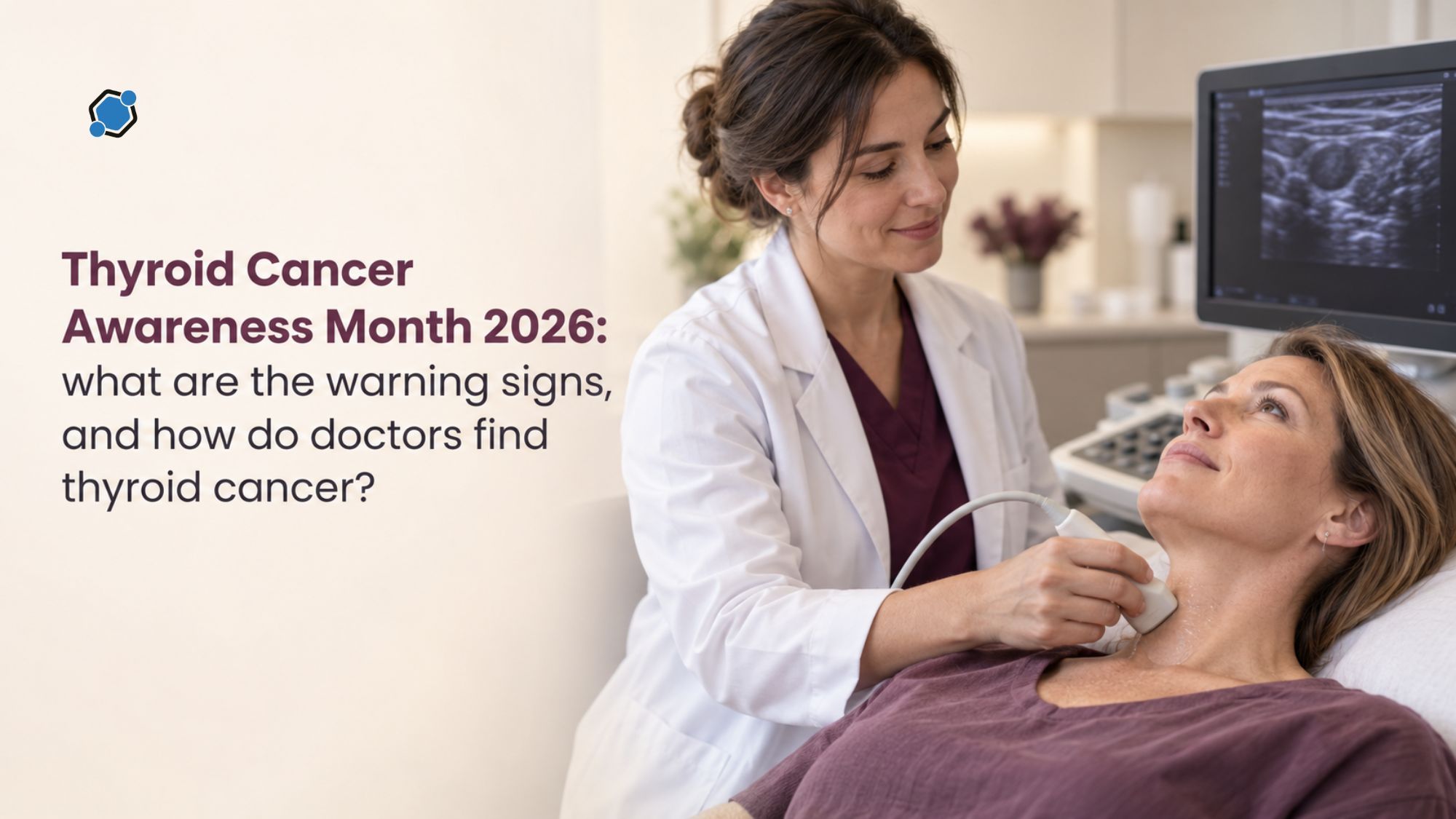
September brings national attention to a small, butterfly-shaped gland that quietly influences energy, mood, weight, and heart rate. Thyroid Cancer Awareness Month, observed across the United States throughout September, encourages adults to understand how thyroid cancer begins, what it can feel like, and why prompt attention to changes in the neck can matter. This guide explains the essentials in plain language for readers who want reliable information without medical training.
How the thyroid works and how thyroid cancer develops
The thyroid is a butterfly-shaped gland at the base of the front of the neck, just below the voice box. It produces hormones that regulate metabolism, which is the process the body uses to turn food into energy. Those hormones also help control heart rate, body temperature, and calcium levels in the blood. When cells in the thyroid begin to grow and divide in an uncontrolled way, the result can be thyroid cancer.
Thyroid Cancer Awareness Month was launched in 2000 by ThyCa: Thyroid Cancer Survivors' Association as a single awareness week, and it expanded to the full month of September in 2003. It is now observed in dozens of countries, and its long-running message encourages people to notice neck changes early and ask a clinician for a neck check. This September observance is separate from the general thyroid health day marked internationally in the spring. Awareness campaigns like this one work hand in hand with research, and readers curious about why cancer research matters can see how progress builds year after year.
Which signs and risk factors deserve attention
Thyroid cancer often produces few symptoms in its early stages, and many cases are discovered by chance during imaging done for another reason. When signs do appear, the most common is a lump or fullness in the front of the neck, which is usually painless. Other possible signs include swelling of the lymph nodes, which are small immune system glands in the neck, along with hoarseness or other voice changes, a feeling of pressure, and difficulty swallowing or breathing as a growth enlarges. Most lumps in the thyroid, called nodules, turn out to be benign, meaning noncancerous, yet any persistent change deserves a professional evaluation. Because the thyroid sits in a region that specialists also study more broadly, readers may find it useful to review head and neck cancer signs for related context.
Several factors can raise a person's likelihood of developing thyroid cancer. According to the American Cancer Society and the American Thyroid Association, exposure to radiation, particularly during childhood, is the most established risk factor. A family history of thyroid cancer, certain inherited genetic syndromes, and being female are also associated with higher risk, since the disease is diagnosed notably more often in women than in men. Having a risk factor does not mean a person will develop the disease, and many people who are diagnosed have no identifiable risk factor at all.
How thyroid cancer is diagnosed and staged
Evaluation usually begins with a medical history and a physical exam of the neck. If a nodule warrants further study, an ultrasound, which is an imaging test that uses sound waves, is typically the first step. Depending on how the nodule looks, a clinician may recommend a fine needle aspiration biopsy, a procedure that uses a thin needle to remove a small sample of cells for examination under a microscope. Blood tests can assess how the thyroid is functioning, and a specialized blood marker is used when a particular type of thyroid cancer is suspected. Some samples also undergo molecular testing, which examines genetic features of the cells to clarify risk.
Thyroid cancer is grouped into several types, as described by the National Cancer Institute and the American Thyroid Association. Papillary thyroid cancer is the most common and is typically slow growing. Follicular thyroid cancer is the next most common. Medullary thyroid cancer arises from a different type of cell and can run in families. Anaplastic thyroid cancer is uncommon and grows quickly. Papillary and follicular cancers are described as differentiated, meaning the cells still resemble normal thyroid tissue, and they are generally very treatable. Staging, the process of describing how far a cancer has spread, guides care, and thyroid cancer is unusual because a patient's age is part of how the differentiated types are staged. Understanding how a cancer is staged can help patients follow conversations with their care team.
Standard treatment options today
Care for thyroid cancer depends on the type, stage, and individual circumstances. Surgery is the most common approach, and it may involve removing part or all of the thyroid gland, a procedure called a thyroidectomy. Some patients then receive radioactive iodine, a therapy that thyroid cells absorb so that radiation can destroy remaining cancer cells while sparing most other tissue. Because thyroid hormones are essential, people who have the gland removed take daily thyroid hormone replacement, a medication that restores what the body can no longer produce.
For cancers that are more advanced or that stop responding to radioactive iodine, physicians may turn to targeted therapy, which uses drugs designed to block specific molecular signals that help cancer grow, or to immunotherapy, which helps the immune system recognize and attack cancer cells. External radiation is used in select situations. For very low-risk, small papillary cancers, some patients and specialists now choose active surveillance, a monitored watch-and-wait approach that uses periodic ultrasounds instead of immediate surgery. This shift reflects growing recognition that thyroid cancer diagnoses rose sharply in recent decades, in part because sensitive imaging detects small, slow-growing tumors that might never cause harm.
Thyroid cancer research and clinical trials today
Research continues to refine how thyroid cancer is understood and managed. A clinical trial is a carefully regulated research study that tests whether a new medical approach is safe and works as intended, and government-maintained trial registries list studies that are actively enrolling. Many current studies focus on targeted therapies aimed at specific genetic changes found in thyroid tumors. Others investigate approaches that attempt to restore a tumor's ability to absorb radioactive iodine, immune-based strategies including checkpoint inhibitors, which are a class of immunotherapy that releases natural brakes on the immune system, and newer radiopharmaceuticals. Some studies also formally evaluate active surveillance so that future guidance rests on stronger evidence.
Participation in a study is different from receiving standard care. In a trial, a person may receive a study intervention, which is the approach being tested, rather than an established therapy, and study procedures are defined in advance by a written plan. Learning how a study is designed, including who knows which approach a participant receives, can help people ask informed questions before deciding whether research participation is right for them.
How DecenTrialz supports people exploring thyroid cancer studies
For many years, the clinical research system has made studies difficult to find and difficult to understand, especially for people without a medical background. DecenTrialz is a United States based platform that helps patients and volunteers explore clinical research in plain language. The experience is designed to be straightforward. A person shares some information about their health and interests, an AI-assisted matching system highlights studies that may be a fit, and a registered nurse conducts a pre-screening conversation to review the basics. When there is a potential match, DecenTrialz refers the person to the research site team, who provide a full walk-through and answer questions so the individual can make their own decisions. Having a nurse involved early can make the process feel more human, much like understanding what a specialist nurse does in other care settings.
DecenTrialz does not provide medical care, diagnose conditions, or conduct the studies. Anyone curious about thyroid cancer research can start by exploring available studies and speaking with a care team at their own pace.
Frequently asked questions about thyroid cancer
When is Thyroid Cancer Awareness Month?
Thyroid Cancer Awareness Month is observed throughout September in the United States, with a focus on early detection and neck checks.
What is usually the first sign of thyroid cancer?
A painless lump or fullness in the front of the neck is the most common sign, although many cases are found incidentally during imaging performed for another reason.
Is thyroid cancer usually serious?
Many thyroid cancers, especially the differentiated types, are highly treatable and have favorable outcomes, though aggressive types exist and every case is individual. Outcomes can never be guaranteed.
How do doctors confirm thyroid cancer?
Diagnosis typically involves a neck exam, an ultrasound, and a fine needle aspiration biopsy, sometimes supported by blood tests and molecular testing.
Who is at higher risk?
Radiation exposure in childhood, a family history of thyroid cancer, certain inherited syndromes, and being female are associated with higher risk.
Can thyroid cancer be monitored instead of treated right away?
For some small, low-risk papillary cancers, active surveillance with regular ultrasounds is an accepted option that a specialist can discuss.
How can someone find a thyroid cancer clinical trial?
Government trial registries list enrolling studies, and platforms such as DecenTrialz can help match interested individuals and arrange a nurse-led pre-screening.
Taking the next step this September
Thyroid Cancer Awareness Month is a reminder that small changes in the neck are worth noticing and that reliable information supports better conversations with clinicians. Whether a reader is newly curious, supporting a loved one, or considering research participation, understanding the basics is a meaningful first step. Awareness, early attention, and ongoing research each play a part in improving the outlook for people affected by thyroid cancer.
Was this article helpful?

Similar Blogs

Healthy Aging Month 2026: what it is and how older adults can join clinical research
Curiosity has no age limit. That message anchors Healthy Aging Month 2026, the September o...
 Vamshi Kantoju
Ovarian Cancer Awareness Month: what the symptoms are and why early detection is so difficult
The teal ribbon associated with ovarian cancer first appeared in the mid-1990s, introduced...
Swaroop ESD
Childhood Cancer Awareness Month 2026: Warning Signs, Common Types, and Pediatric Research
Cancer in children is a different disease from cancer in adults. It begins in different ce...
ParamrajStay Informed. Stay Connected.
Get updates on verified clinical trials, emerging treatments, and research breakthroughs directly in your inbox. No spam, just science that matters.
