 HIPAA Compliant
 ISO 27001 Certified
Clinical Trial Matching for Rare Disease: DecenTrialz vs Advocacy Group Tools
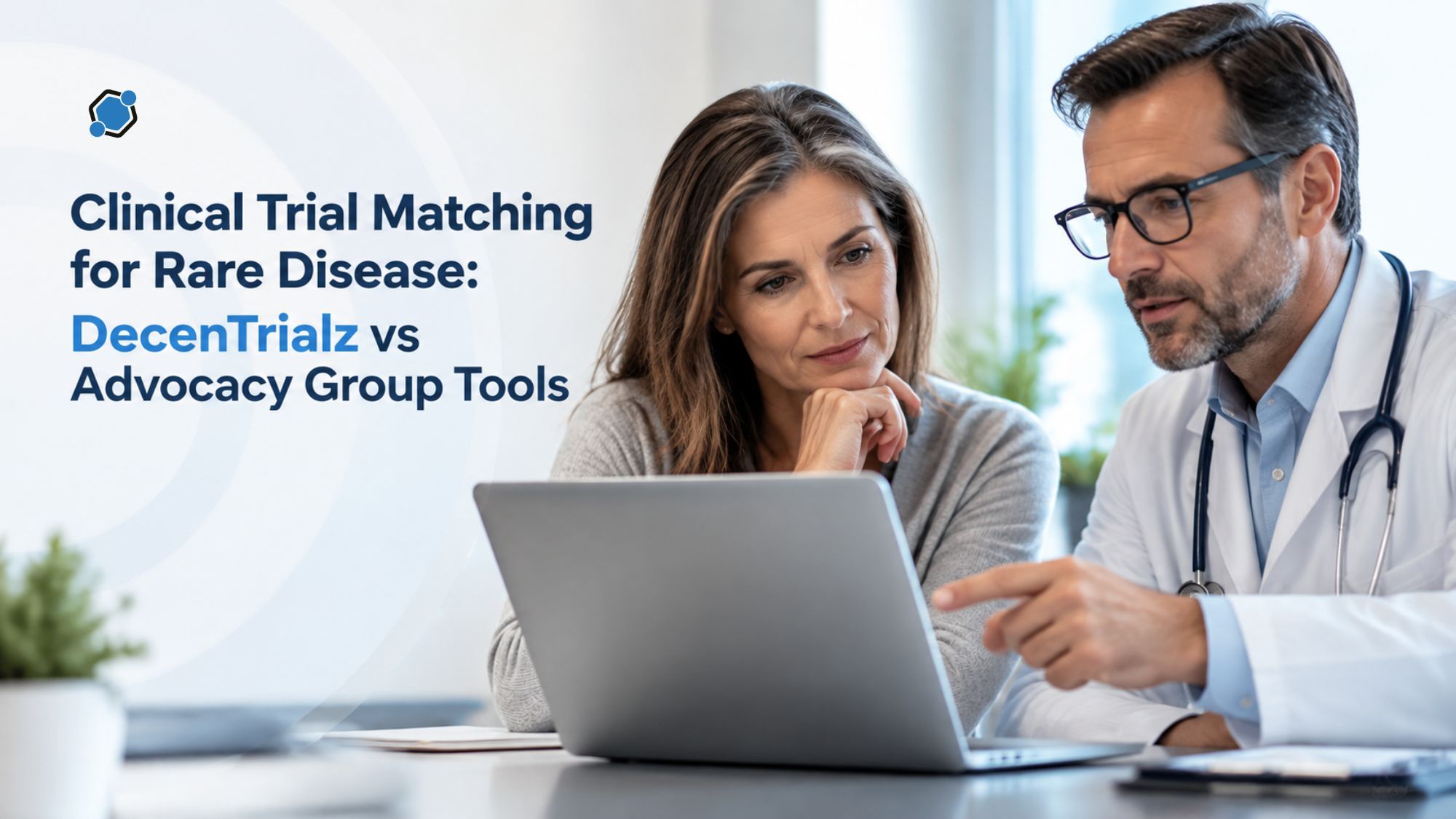
Clinical trial matching is one of the hardest problems in rare disease care. Small patient populations, narrow eligibility criteria, and geographically scattered research sites make finding and qualifying for a study genuinely difficult. Families in the United States most often turn to one of two categories of tool: a patient advocacy group search tool, or a clinical trial matching platform such as DecenTrialz. On the surface, both look like ways to connect a person with a study. In practice, they are built for different jobs, and they perform differently on the tasks that matter most. This comparison walks through what each type of tool does, where each one is stronger, and what that means for a family choosing between them.
What rare disease advocacy groups offer through their search tools
A rare disease advocacy group is a nonprofit organization that supports people affected by a specific disease or a group of related conditions. Its search tool is usually one feature inside a broader mission of education, community support, and awareness. Common features include a curated list of studies for the disease, a disease-specific search portal drawing on public data, a patient registry where members enter their information and are notified about new studies, and one-on-one guidance from a patient navigator.
The core job of these tools is to inform and orient a specific community. They speak the disease’s language, connect families with peers who have lived through the same journey, and surface studies that matter to that community. For a broader look at how these organizations connect people to research, see how patient advocacy groups guide their community to clinical trials.
What clinical trial matching with DecenTrialz is built to do
DecenTrialz is a clinical trial matching and pre-screening platform. Its core job is to match individual people to individual studies and move qualified candidates into a structured referral with a specific research site. The system continuously pulls trial information from public registries and structured feeds, evaluates a person’s shared health information against detailed eligibility criteria, and then hands the match to a registered nurse (RN) for review before anything reaches a research team.
The nurse review is central. It filters out weak matches, adds clinical judgment, and gives the person a chance to talk through the study with a qualified professional before a referral goes out. When the fit is strong, DecenTrialz sends a documented, pre-qualified referral to the research site. Final eligibility, informed consent, the study walk-through, and enrollment are handled by the research site team. For a step-by-step view of the workflow, see how to search, read, and apply for clinical trials on DecenTrialz.
Where patient advocacy group search tools fall short for matching
Advocacy tools were built for a community, not for individual clinical trial matching. Three limits show up repeatedly. First, most curated lists draw from ClinicalTrials.gov, the federal registry maintained by the National Library of Medicine, and inherit its keyword-based search and lay-usability weaknesses. Second, listings can lag reality, showing trials that have already closed or missing ones that just opened, because manual updates cannot keep pace with a live registry.
Third, and most important for rare disease families, the tools rarely evaluate whether a specific person is likely to qualify for a specific study. Rare disease eligibility often depends on a combination of laboratory values, imaging results, genetic subtypes, biomarkers (measurable biological signals, such as a protein level in the blood), and prior treatments. A listing page cannot check any of that. Patient registries in the advocacy space are also often siloed by organization, so a family may never learn about a study running under a different foundation or a related subtype. Some of these gaps can be softened when a family also participates in a natural history study for the disease, which builds the data that supports future trial design.
Where DecenTrialz clinical trial matching outperforms
A dedicated clinical trial matching service is built to answer the matching question directly, and that is where DecenTrialz pulls ahead on the mechanics of finding and qualifying for a rare disease study. Four differences stand out. Data is continuously refreshed rather than periodically curated, so listings do not go stale. Matching is structured against detailed criteria rather than surfaced through keyword search, which is decisive for rare disease trials with narrow inclusion rules. A registered nurse reviews the AI-generated match before a referral goes anywhere, which adds human clinical judgment and protects the person from being sent to a poor-fit study. When the match is strong, the platform delivers a documented, pre-qualified referral to a research site rather than leaving the family to cold-contact the site themselves.
The strength of this model is supported by peer-reviewed evidence. A randomized clinical trial published in JAMA in 2025 found that AI-assisted pre-screening nearly doubled enrollment compared with manual review, without a loss of accuracy across race, gender, and ethnicity subgroups. Public policy direction is aligned; the FDA’s 2024 final guidance on decentralized clinical trials specifically points to potential benefits for rare disease populations, where local visits and remote check-ins can reduce travel burden. For historical context on how the rare disease research ecosystem itself came to exist, see the 1983 law that changed rare disease research.
Side by side: which tool wins on which dimension
Each category is stronger on different dimensions. The honest read for a rare disease family:
- Disease-specific expertise and community trust: rare disease advocacy groups are stronger. They are built by and for a specific community.
- Patient education and long-term navigation: advocacy group search tools are stronger. They provide support before, during, and after a study.
- Data currency: DecenTrialz is stronger. Continuous automated refresh outperforms manual curation.
- Individual eligibility triage: DecenTrialz is stronger. Structured clinical trial matching against detailed criteria is what the platform is built for.
- Human clinical review before referral: DecenTrialz is stronger through RN-led pre-screening. Most advocacy tools do not offer this step.
- Structured referral handoff to a research site: DecenTrialz is stronger. Advocacy tools generally point the family to a listing rather than a documented handoff.
- Cross-condition and cross-organization visibility: DecenTrialz is stronger. Advocacy registries tend to be siloed by disease and organization.
- Cost to the participant: both should be free. A fee to a rare disease family is a red flag from either category.
- Data privacy standards: comparable when both operate under U.S. health data rules. Families should ask each tool the same questions about storage, sharing, and consent.
The practical read is that rare disease advocacy groups are the right home for trust, community, and education, and DecenTrialz is the right tool for actually matching to and being referred into a specific study. For a broader picture of how research itself is reshaping outcomes in this space, see how clinical trials are transforming rare disease treatment.
How DecenTrialz clinical trial matching fits a rare disease family’s search
For a rare disease family, DecenTrialz is the layer that does the individual clinical trial matching and site referral that most advocacy tools do not attempt. A family can stay with the community, education, and long-term support of an advocacy group, and separately use DecenTrialz to identify, pre-screen for, and be referred into specific studies.
Using the platform is straightforward. A person shares information about their diagnosis and health, an AI-assisted matching engine narrows the list of potentially relevant studies, and a registered nurse reviews the match and speaks with the person before a referral goes out. When the fit is strong, DecenTrialz sends a structured referral to a research site, and the site team then handles final eligibility, informed consent, the study walk-through, and enrollment. To explore the platform, visit decentrialz.com.
Common questions about clinical trial matching for rare disease
How do I join a clinical trial for a rare disease?
The most common paths are through a rare disease advocacy group that supports the specific condition, through a treating specialist, through the federal registry ClinicalTrials.gov, or through a clinical trial matching platform such as DecenTrialz. Many families use more than one path.
Is DecenTrialz a replacement for a rare disease advocacy group?
No. Rare disease advocacy groups provide disease-specific community, education, and long-term support. DecenTrialz provides structured clinical trial matching, nurse pre-screening, and a documented referral to a research site. The two are complementary and address different needs.
What is RN-led pre-screening?
A registered nurse reviews the AI-generated match, checks the person’s information, and speaks with the person before any referral goes to a research team.
Where do these tools get their trial information?
Most search tools, including advocacy portals and clinical trial matching platforms, draw on ClinicalTrials.gov, the federal registry maintained by the National Library of Medicine. The difference is how each tool processes and updates that data.
Who decides if a person actually qualifies for the trial?
The research site team running the study. DecenTrialz pre-screens only; final eligibility determination, informed consent, and enrollment are handled by the site.
Does a clinical trial matching service cost money for participants?
Legitimate clinical trial matching services do not charge participants. The same standard applies to rare disease advocacy group search tools.
Choosing the right clinical trial matching tool for a rare disease search
For a rare disease family, the choice between a patient advocacy group search tool and DecenTrialz is not either-or, but the two tools do very different jobs. Advocacy groups are the trusted home for community, education, and long-term navigation. DecenTrialz is the structured clinical trial matching and referral layer that most advocacy tools do not attempt to build. When the goal is to be actively matched to a specific study and referred into a specific research site, DecenTrialz is built for that job. To see the platform in action, visit decentrialz.com.
Was this article helpful?

Similar Blogs
HER2 positive and HER2 negative breast cancer explained: testing, treatment, and what HER2 low means
A breast cancer pathology report contains a great deal of information, and HER2 status is ...
 Swaroop ESD
Metabolic syndrome symptoms and diagnosis: what the five warning numbers mean
Metabolic syndrome is a cluster of five measurable risk factors that, when they appear tog...
Vamshi Kantoju
What is a hypertensive crisis? Blood pressure warning signs and when to call 911
A hypertensive crisis is a sudden, severe rise in blood pressure to 180/120 millimeters of...
Deeksha GittaStay Informed. Stay Connected.
Get updates on verified clinical trials, emerging treatments, and research breakthroughs directly in your inbox. No spam, just science that matters.
