 HIPAA Compliant
 ISO 27001 Certified
Mobile phlebotomy in clinical trials: how home blood draws work
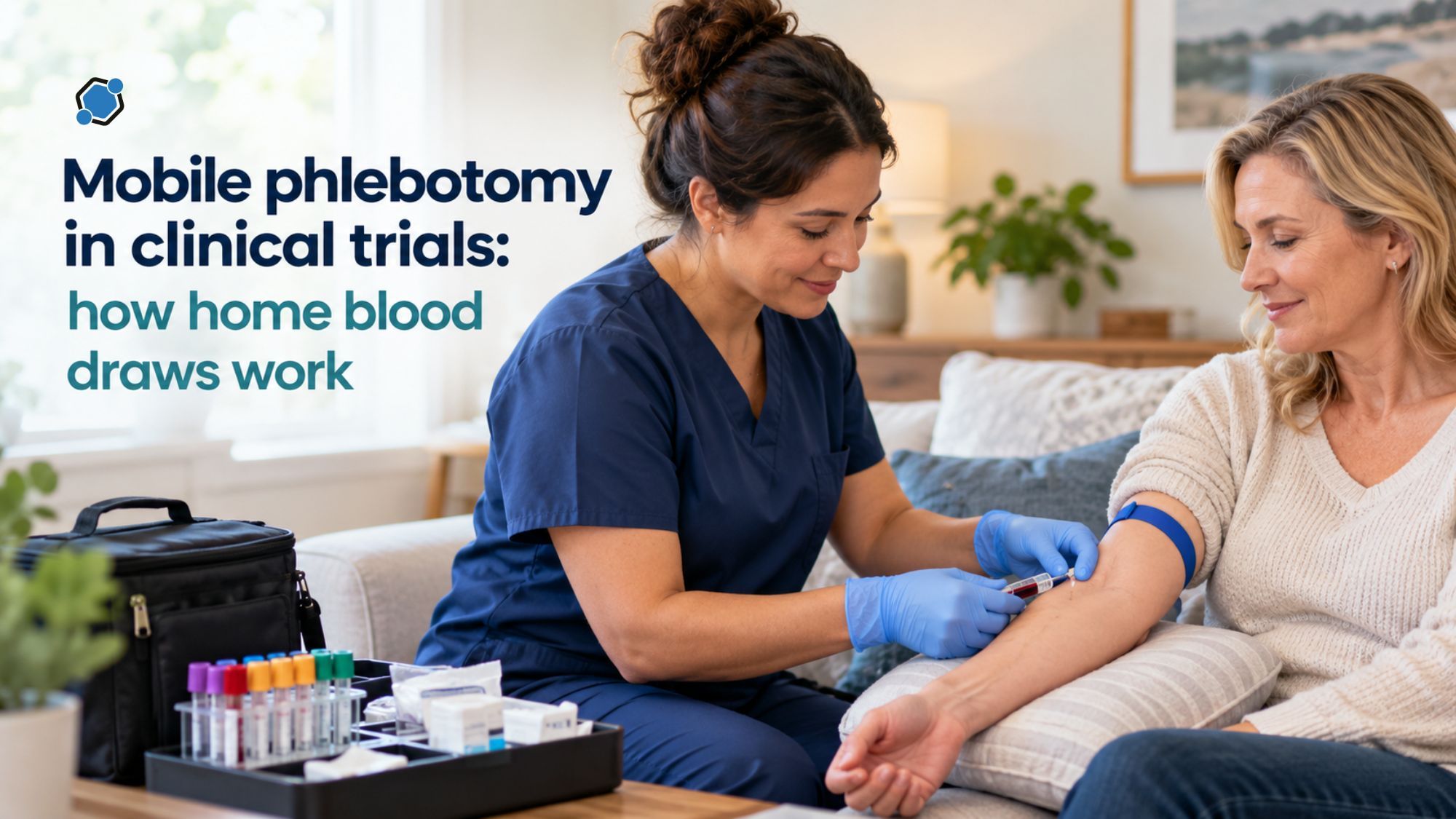
Blood tests are one of the most common procedures in a clinical trial. They tell the study team how the body is responding to an investigational treatment and how a drug is being processed over time. For many participants, getting to a research site for every blood draw is one of the hardest parts of taking part. Travel, time off work, parking, and the physical effort of a clinic visit all add up.
Mobile phlebotomy changes that part of the trial experience. A trained professional travels to the participant's home or another agreed location, collects the blood sample on schedule, and arranges for it to reach the laboratory under the conditions the protocol requires. The study doctor at the research site continues to oversee care and review results.
The U.S. Food and Drug Administration (FDA) recognizes this approach in its 2024 final guidance on clinical trials with decentralized elements. Home visits are one of several ways study activities can take place outside a traditional site, and the same regulatory requirements apply to them as to any in-clinic activity. This article explains what mobile phlebotomy is in a trial setting, how a home blood draw usually works, what rights participants keep, and where the limits are. It is not medical advice. Anyone considering a clinical trial should speak with the research team conducting the study. For a broader view of how modern trials blend in-person and remote activities, see this overview of hybrid clinical trial visits.
What mobile phlebotomy is and why trials use it
Phlebotomy is the medical term for drawing blood, usually from a vein in the arm. A phlebotomist is the professional trained to perform this procedure. In routine healthcare, a phlebotomist is often based at a hospital, a clinic, or a laboratory draw station. In mobile phlebotomy, the phlebotomist travels to the participant instead of the other way around.
In a clinical trial, a blood draw is not just a lab test. It is a protocol-specified research procedure. That means the exact timing of the draw, the type and number of tubes collected, how the sample is handled, and which laboratory analyzes it are all set in advance by the study protocol. The results become research data that the principal investigator, the physician legally responsible for the trial at that site, reviews on an ongoing basis.
Mobile phlebotomy is one component of decentralized or hybrid clinical trials. In a hybrid trial, some visits take place at the research site and some take place closer to home. A 2025 analysis of more than 1,000 trials with decentralized features, published in npj Digital Medicine, found the great majority used a hybrid model rather than operating fully remotely. In practice, mobile phlebotomy supplements the research site rather than replacing it.
The main reason trials offer this option is participant burden. Travel to the clinic is consistently reported as the single most disruptive part of taking part in a trial. In a 2023 global survey of more than 4,500 trial participants conducted by the Center for Information and Study on Clinical Research Participation (CISCRP), 56 percent of respondents who found participation disruptive named travel to the study clinic as a top cause. Almost one in four said that having a nurse or doctor visit their home for some study visits would have made participation less disruptive.
Home blood draws reduce three kinds of burden. They remove the travel itself. They shorten the time commitment, since there is no waiting room. They also lower the load on participants managing a serious condition and on caregivers who would otherwise arrange transportation.
The benefit is often largest for older adults, people in rural areas, people with mobility limitations, caregivers of young children, and participants with demanding work schedules. By bringing part of the visit to the participant, trials can reach a broader and more representative group of people. Related at-home logistics, such as study medication arriving by courier, support the same model; see this companion explainer on direct-to-patient shipping of trial medication.
What a home blood draw visit usually looks like
Mobile phlebotomy visits are scheduled in advance within the window defined by the study protocol. Participants are told whether any preparation is needed, such as fasting for a set number of hours or drinking water before the draw. If the sample needs to be taken at a specific time in relation to a dose of study medication, the schedule is confirmed with the research site.
On the day of the visit, the phlebotomist arrives at the agreed location, confirms the participant's identity and study identification, and reviews what will happen. The participant has already given written informed consent to join the trial. The phlebotomist does not consent anyone into the study; that remains the responsibility of the research site and the investigator. The visit is a chance to confirm the participant is comfortable going ahead with that specific draw.
The draw itself follows the same technique used in any clinical lab: hand hygiene, gloves, an antiseptic wipe, a tourniquet, a single-use sterile needle, and immediate safe disposal of sharps. The needle portion typically takes only a few minutes. Blood is collected into labeled tubes that match the protocol's requirements.
After the draw, the phlebotomist labels and packages the sample according to the protocol. Some tubes need to be processed quickly, for example by being kept at a specific temperature. Samples are then shipped to the central laboratory or the research site using a courier trained to handle biological specimens. A chain-of-custody record tracks the sample from the home to the laboratory.
A full visit, including setup, identity checks, the draw itself, and packaging, often lasts around thirty to forty-five minutes, depending on the number of samples and any additional measurements required by the protocol. Participants who want to understand how this fits with earlier steps may find this walkthrough of a first clinical trial screening visit useful for context.
Who performs the draw, and under what rules
Mobile phlebotomy in a trial is usually delivered by a credentialed phlebotomist, a registered nurse, or another qualified healthcare professional. In the United States, four states, California, Louisiana, Nevada, and Washington, require phlebotomists to hold a specific state credential. In the other states, national certification is voluntary but widely expected by trial vendors.
For trial-specific tasks, additional training applies. The FDA guidance makes clear that any activity unique to a research study must be performed by trial personnel trained on that protocol. Good Clinical Practice, the international standard for clinical research known as ICH E6, is the usual baseline. The updated version, ICH E6(R3), was adopted in January 2025 and explicitly addresses decentralized settings.
The principal investigator at the research site remains legally responsible for the participant's safety and for the integrity of the data, even when individual visits take place at home. The investigator reviews lab results, follows up on anything that looks abnormal, and keeps the overall picture of each participant's trial journey. Mobile phlebotomy adds a route for collecting one specific piece of data; it does not shift medical responsibility away from the site.
Participant rights, costs, and privacy
Everything the participant agreed to in the written informed consent still applies during a home visit. Participation remains voluntary. A participant can decline any individual procedure, ask to reschedule, or withdraw from the trial at any time, without losing any care they would otherwise receive. Federal regulations require the consent form to describe which activities will take place at home, which professionals may be involved, and any additional costs the participant may face.
In most trials, study-related procedures are paid for by the sponsor, including the phlebotomist's visit, supplies, and sample shipping. Participants are entitled to a clear answer from the research site about what, if anything, they will be asked to pay. Reading the consent document carefully is the best way to confirm these details; this plain-language guide on how to read an informed consent form walks through what to look for before signing.
Privacy during the visit matters too. The FDA guidance notes that investigators should take steps to protect participant privacy during in-home activities, including offering alternative locations when a home setting is not suitable. On the data side, the Health Insurance Portability and Accountability Act (HIPAA) governs how protected health information is used and shared. Electronic systems that capture trial data must meet the FDA's standards for electronic records, known as 21 CFR Part 11.
What mobile phlebotomy cannot replace
Not every visit in a trial can be done at home. Some procedures require equipment, imaging, or specialized clinicians that only the research site can provide. Others require the clinical judgment of the investigator in person, especially around dosing decisions, first administrations of an investigational drug, or complex physical examinations.
Certain blood tests also require immediate processing or specialized handling that only a central laboratory can provide quickly enough. Weather, geography, and courier logistics all set practical limits on how far from a laboratory a home draw can take place. Trials that use mobile phlebotomy build these limits into the protocol in advance, with clear backup options such as a visit to the research site or a local laboratory.
This is one reason home nursing and mobile phlebotomy are presented as part of a hybrid approach rather than a replacement for the research site. The research site stays at the center of the trial. For a view of what other at-home activities look like in practice, see this participant-facing explainer on home nursing visits in clinical trials.
Frequently asked questions
Is a home blood draw as safe as one done in a clinic?
The procedure itself is the same. A credentialed professional uses sterile, single-use equipment and follows the same clinical standards for venipuncture that apply in any laboratory setting. Minor side effects such as slight bruising at the needle site are the most common issue, and are typically short-lived.
Can a participant choose a clinic visit instead of a home visit?
In many trials, yes. The protocol defines which visits can be flexible and which must take place at the site. Participants are encouraged to raise this with the research team. Voluntary participation is a core principle, and no one is required to accept a home visit as a condition of taking part.
What happens if the phlebotomist cannot find a vein?
Phlebotomists are trained to try alternate sites and to recognize when further attempts are not appropriate. In those situations, the visit is usually rescheduled, or the draw is moved to the research site or a local laboratory. Protocols build in these fallback options.
Who sees the blood test results?
Results go to the research site and, where applicable, to the central laboratory and the trial sponsor through secure electronic systems. The principal investigator reviews them. Participants' identifying information is protected under HIPAA and the terms of their consent form.
Does participating in a home visit mean never going to the research site?
Usually not. Most trials that use mobile phlebotomy are hybrid, meaning some visits remain on-site, especially screening, first doses, and complex assessments. Mobile phlebotomy supplements the schedule rather than replacing it.
Where this fits in modern clinical research
Mobile phlebotomy is a practical response to a long-standing problem: travel burden discourages people from joining and completing clinical trials, and that burden falls hardest on groups whose participation matters most for generalizable results. Home blood draws are not a universal fix, and the evidence on their effect on retention is still mixed. What is clear is that they give participants a real option, backed by the same regulatory standards that apply across the trial.
DecenTrialz operates earlier in the trial journey, combining AI-powered participant matching with registered-nurse pre-screening before a referral is passed to the research site. Final eligibility, informed consent, study walk-through, and enrollment remain the responsibility of the authorized research site and study team. People exploring whether a specific trial is right for them can share some information through DecenTrialz and have a nurse review their situation before the research site reaches out.
Was this article helpful?

Similar Blogs

Men's Breast Cancer Awareness Week 2026: signs, risks, and the research gap
Every person is born with a small amount of breast tissue, and men are no exception. That ...
 Swaroop ESD
Obesity and Sleep Apnea: How Weight Affects Breathing During Sleep
Excess body weight is the strongest modifiable risk factor for obstructive sleep apnea, a ...
Paramraj
Primary vs secondary hypertension: what is the difference and why it matters
Nearly half of American adults live with high blood pressure, yet most cannot say whether ...
 Anish Teepireddy
Stay Informed. Stay Connected.
Get updates on verified clinical trials, emerging treatments, and research breakthroughs directly in your inbox. No spam, just science that matters.
