 HIPAA Compliant
 ISO 27001 Certified
Obesity and Sleep Apnea: How Weight Affects Breathing During Sleep
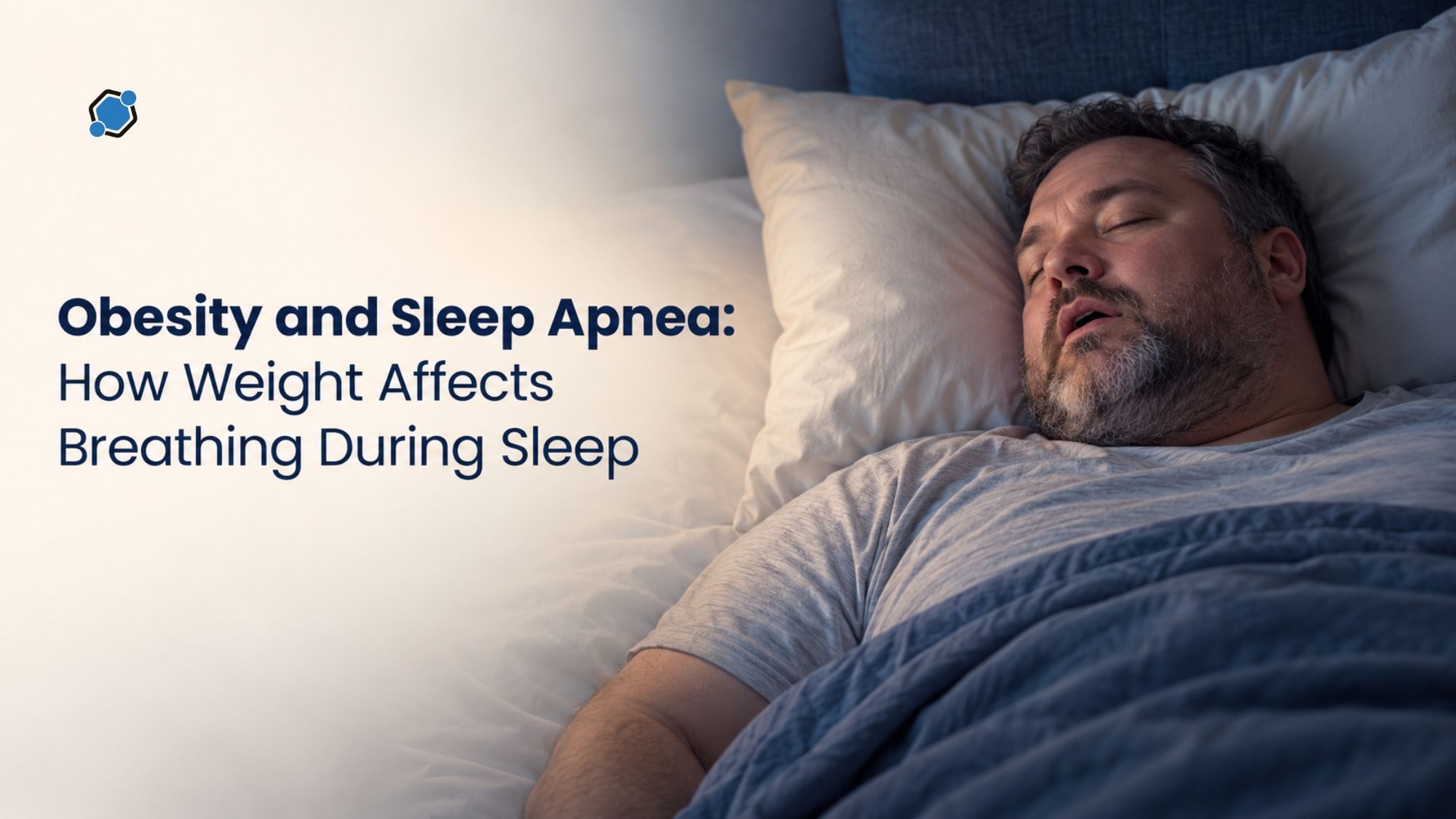
Excess body weight is the strongest modifiable risk factor for obstructive sleep apnea, a condition in which breathing repeatedly pauses during sleep. The relationship runs in both directions. Carrying extra weight makes the airway more likely to collapse at night, and disrupted sleep in turn makes weight harder to control through hormonal and metabolic changes. This article explains why that cycle develops, what warning signs point to a possible sleep problem, and how modern research, from behavior-change programs to a recently approved medication, is giving people more ways to interrupt it.
Why extra weight makes the airway collapse at night
The upper airway is a soft tube held open by muscles in the throat and tongue. During wakefulness, the brain keeps those muscles active. During sleep, muscle tone naturally relaxes. When the airway is already narrow, that relaxation can be enough to close it.
Obesity narrows the airway in two main ways. First, fat is deposited directly in the tissues around the throat, including the base of the tongue and the side walls of the pharynx. Research supported by the National Institutes of Health, using magnetic resonance imaging, found that losing tongue fat was the single most important factor in improved sleep apnea after weight loss. Second, abdominal fat pushes upward on the diaphragm, which lowers lung volume. Full lungs act like a gentle anchor on the windpipe, keeping the throat taut. When lung volume drops, that anchoring effect weakens and the throat becomes easier to collapse, especially when a person is lying on the back.
Body mass index, often used as a quick measure of body size, does not capture all of this. Two people with the same BMI can carry fat in very different places, and jaw size, neck circumference, and age also influence airway behavior. For a longer discussion of why body mass index alone can mislead, measurement limits are worth understanding before drawing conclusions from a single number.
The two-way cycle between sleep apnea and weight gain
Obstructive sleep apnea is not only a consequence of obesity. It also contributes to weight gain. Repeated breathing pauses fragment sleep, even when the person has no memory of waking. Short, fragmented sleep is linked to lower levels of leptin, the hormone that signals fullness, and higher levels of ghrelin, the hormone that signals hunger. People in this state often report stronger cravings for calorie-dense foods.
Sleep apnea also triggers brief drops in blood oxygen many times a night. These drops activate the sympathetic nervous system and promote inflammation in fat tissue, which can push the body toward insulin resistance. Insulin resistance is a step on the path to prediabetes and type 2 diabetes, and people with sleep apnea have higher rates of both. A review of the early signs of type 2 diabetes can be useful for anyone who already carries extra weight and notices changes in energy, thirst, or urination.
Fatigue from poor sleep also reduces physical activity, which further supports weight gain. The result is a reinforcing loop: weight gain worsens sleep apnea, poor sleep encourages more weight gain, and metabolic health declines quietly in the background.
Warning signs and when to seek evaluation
Many people with obstructive sleep apnea do not realize they have it. The most noticeable signs often appear to a bed partner or family member rather than to the person themselves. Common patterns include:
- Loud, chronic snoring interrupted by silences
- Witnessed pauses in breathing, followed by gasping or choking
- Daytime sleepiness, including falling asleep while reading, watching television, or driving
- Morning headaches or a dry mouth on waking
- Difficulty concentrating or memory lapses
- Blood pressure that is hard to control with medication
- Frequent nighttime urination
High blood pressure is one of the most important clues, because sleep apnea and hypertension are closely linked. Readers can review the silent warning signs of high blood pressure for a fuller picture of symptoms that often go unrecognized.
Evaluation usually begins with a conversation with a primary care clinician, who may refer the person to a sleep specialist. Diagnosis is confirmed by a sleep study, either in a sleep laboratory using full polysomnography or at home using a simplified device that records breathing, oxygen levels, and heart rate. Results are reported as an apnea-hypopnea index, or AHI, which counts breathing events per hour. In adults, an AHI below 5 is considered normal, 5 to under 15 is mild, 15 to under 30 is moderate, and 30 or more is severe.
Treatment options for people with obesity and sleep apnea
Therapy aims to keep the airway open during sleep and, where possible, address the underlying weight-related drivers of the problem. The combination of these two goals produces better long-term results than either approach alone.
Continuous positive airway pressure, or CPAP, remains the most widely used therapy. A mask delivers a steady stream of pressurized air that holds the airway open. CPAP relieves breathing events and daytime sleepiness, but it does not cause weight loss on its own, and leading professional societies now recommend pairing it with structured weight management.
Weight-focused approaches range from supervised lifestyle programs that combine reduced-calorie eating with physical activity and behavioral support, to anti-obesity medications, to bariatric surgery for people who meet eligibility criteria. In December 2024, the United States Food and Drug Administration approved the first medication specifically indicated for obstructive sleep apnea in adults with obesity. That medication belongs to a class of injectable drugs known as GLP-1 receptor agonists, which affect appetite regulation and promote weight loss. Approval followed phase 3 clinical trials that showed meaningful reductions in apnea events after about one year of use.
Other options include custom oral appliances that move the lower jaw forward, positional therapy for people whose apneas occur mainly when sleeping on the back, and implanted upper-airway nerve stimulation devices for selected individuals who cannot tolerate CPAP. Weight loss does not always eliminate sleep apnea entirely, so follow-up testing after significant weight change is important. For people who are considering joining a research study, a plain-language walkthrough of what a first screening visit looks like can take some of the mystery out of the process.
Where clinical research and DecenTrialz fit in
The first medication approval for obstructive sleep apnea came directly out of clinical trials, and research in this area is now moving quickly. Investigators are studying new drug targets, next-generation airway stimulation devices, longer-term outcomes of combined weight-loss and sleep therapy, and whether treating sleep apnea more effectively can reduce heart attacks and strokes over time. Participation in these studies is what makes future options possible.
DecenTrialz is a platform that helps adults in the United States connect with clinical research studies they may be eligible to join. Interested individuals share information about their health and goals, the platform uses AI-assisted matching to identify studies that may fit, and a registered nurse conducts a pre-screening conversation to review the match in more detail. DecenTrialz does not determine final eligibility, obtain informed consent, or enroll participants. Those steps are handled by the research site team that runs the study.
For readers who want to see how trial search tools compare, understanding what different resources actually do can make a search feel less overwhelming.
Frequently asked questions about obesity and sleep apnea
Does losing weight cure sleep apnea?
Weight loss can substantially reduce the severity of obstructive sleep apnea, and some people reach remission, particularly after large reductions in body weight. However, sleep apnea can persist even after major weight loss, so repeat testing is usually recommended before stopping any therapy.
Can a thin person still have sleep apnea?
Yes. Jaw and airway anatomy, nasal obstruction, menopausal status, aging, and family history can all contribute. Sleep apnea in people without obesity is less common but still important to diagnose.
Is a home sleep test as accurate as a laboratory study?
Home sleep apnea tests are appropriate for many adults with a high likelihood of moderate-to-severe disease. They are less sensitive than in-laboratory polysomnography and may underestimate severity. A negative home test in someone with clear symptoms should usually be followed by an in-lab study.
Does CPAP help a person lose weight?
CPAP improves sleep quality and daytime energy, but research has not shown that it produces weight loss by itself. Weight management is a separate intervention that works alongside CPAP.
How does sleep apnea affect long-term health?
Untreated sleep apnea is associated with higher risks of high blood pressure, atrial fibrillation, heart attack, stroke, type 2 diabetes, and traffic accidents from drowsy driving.
Looking at sleep and weight together
Obesity and obstructive sleep apnea are tightly interwoven, and the connection also points to a practical opportunity. Steps that improve one problem usually improve the other, and the range of effective options has grown with recent research. Anyone who recognizes the warning signs described above is well positioned to begin a conversation with a clinician, pursue testing, and consider the full set of options that modern sleep and metabolic medicine now provides.
Was this article helpful?

Similar Blogs

Primary vs secondary hypertension: what is the difference and why it matters
Nearly half of American adults live with high blood pressure, yet most cannot say whether ...
 Anish Teepireddy
Type 1 diabetes vs type 2 diabetes: how do the causes, symptoms, and treatments compare?
Diabetes is often described as a single disease with two flavors, but type 1 and type 2 ar...
 Paramraj
World Arthritis Day 2026: Early Signs, Types, and Why Timing Matters
World Arthritis Day is observed on October 12 every year, and in 2026 it falls on a Monday...
Mahesh UpadristaStay Informed. Stay Connected.
Get updates on verified clinical trials, emerging treatments, and research breakthroughs directly in your inbox. No spam, just science that matters.
